

25 dollars an hour is $52,000 per year before taxes, based on a 40 hour week worked 52 weeks a year. After federal income tax and payroll taxes, a single filer taking the standard deduction keeps about $43,962 in 2026, or roughly $3,663 per month, before any state income tax.
Hourly to yearly salary calculator
How much a year is 25 dollars an hour?
The math is simple and worth seeing once. A standard full time job in the United States is 40 hours per week for 52 weeks, which is 2,080 working hours per year.

So 25 dollars an hour is $52,000 a year before taxes. That figure assumes you are paid for all 52 weeks, which is the case for most salaried and full time hourly jobs with paid time off. If you take two weeks unpaid, your year drops to 2,000 hours and $50,000.
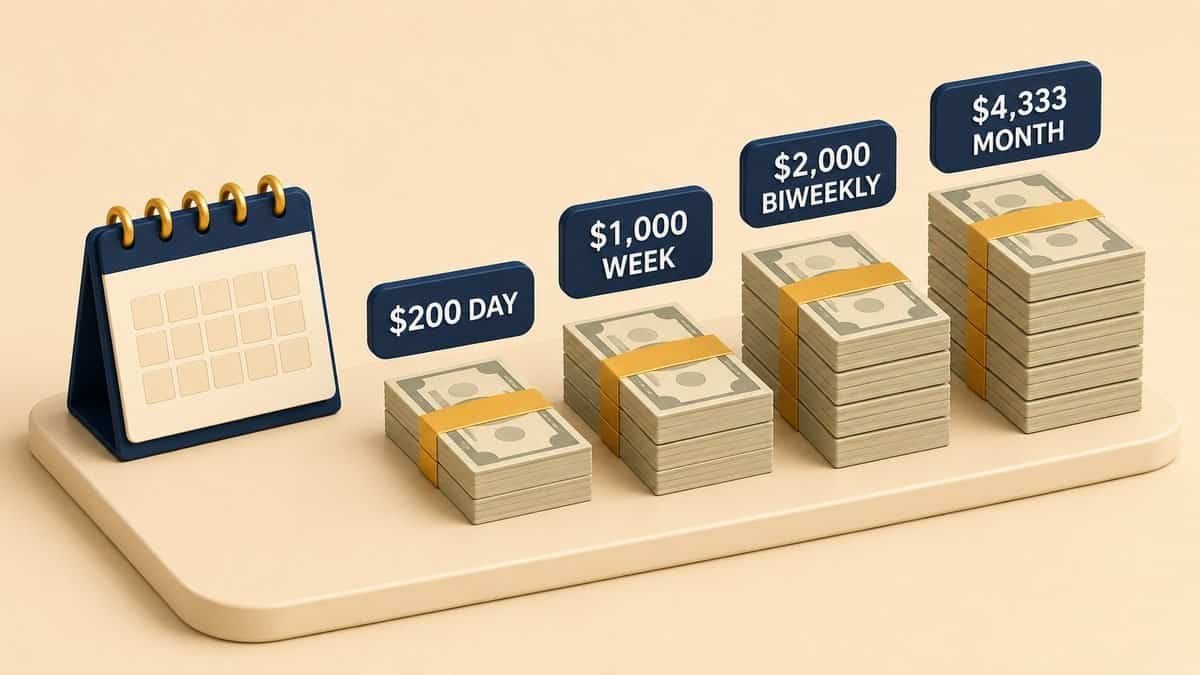
Here is the same wage translated into every pay period employers commonly use, before taxes:
| Pay period | Before taxes | After taxes (2026 estimate) |
|---|---|---|
| Yearly | $52,000 | $43,962 |
| Monthly | $4,333 | $3,663 |
| Biweekly | $2,000 | $1,691 |
| Weekly | $1,000 | $845 |
| Daily (8 hours) | $200 | $169 |
The after tax column is an estimate for a single filer taking the standard deduction, with no state income tax. The full federal math is worked out below, line by line.
25 dollars an hour after taxes in 2026
Gross pay is not what lands in your bank account. Three federal deductions come out of nearly every paycheck: federal income tax, Social Security tax, and Medicare tax. Here is the exact 2026 math for a single filer earning 25 dollars an hour full time, using the figures the IRS published in Revenue Procedure 2025-32 (October 2025).
Step 1: Federal income tax
The 2026 standard deduction for a single filer is $16,100. That comes off the top:
That taxable income falls across the first two 2026 federal brackets:
| 2026 bracket (single) | Rate | Tax on this slice |
|---|---|---|
| $0 to $12,400 | 10% | $1,240 |
| $12,400 to $35,900 | 12% | $2,820 |
| Total federal income tax | $4,060 | |
Step 2: Social Security and Medicare
Payroll taxes apply to the full $52,000 because it sits well under the 2026 Social Security wage base. Per IRS Topic 751, the employee rates are 6.2% for Social Security and 1.45% for Medicare:
Medicare: $52,000 × 1.45% = $754
Step 3: Take home pay

That is an effective total tax rate of about 15.5%, and it works out to $3,663 per month, $1,691 per biweekly paycheck, or $845 per week. Put another way, 25 dollars an hour after taxes is worth about $21.14 per hour in your pocket, before any state income tax.
Two things move this number in practice. First, state income tax, which ranges from zero to several thousand dollars a year at this income (more on that below). Second, pre tax deductions like 401(k) contributions and health insurance premiums, which lower taxable income and therefore lower federal tax.
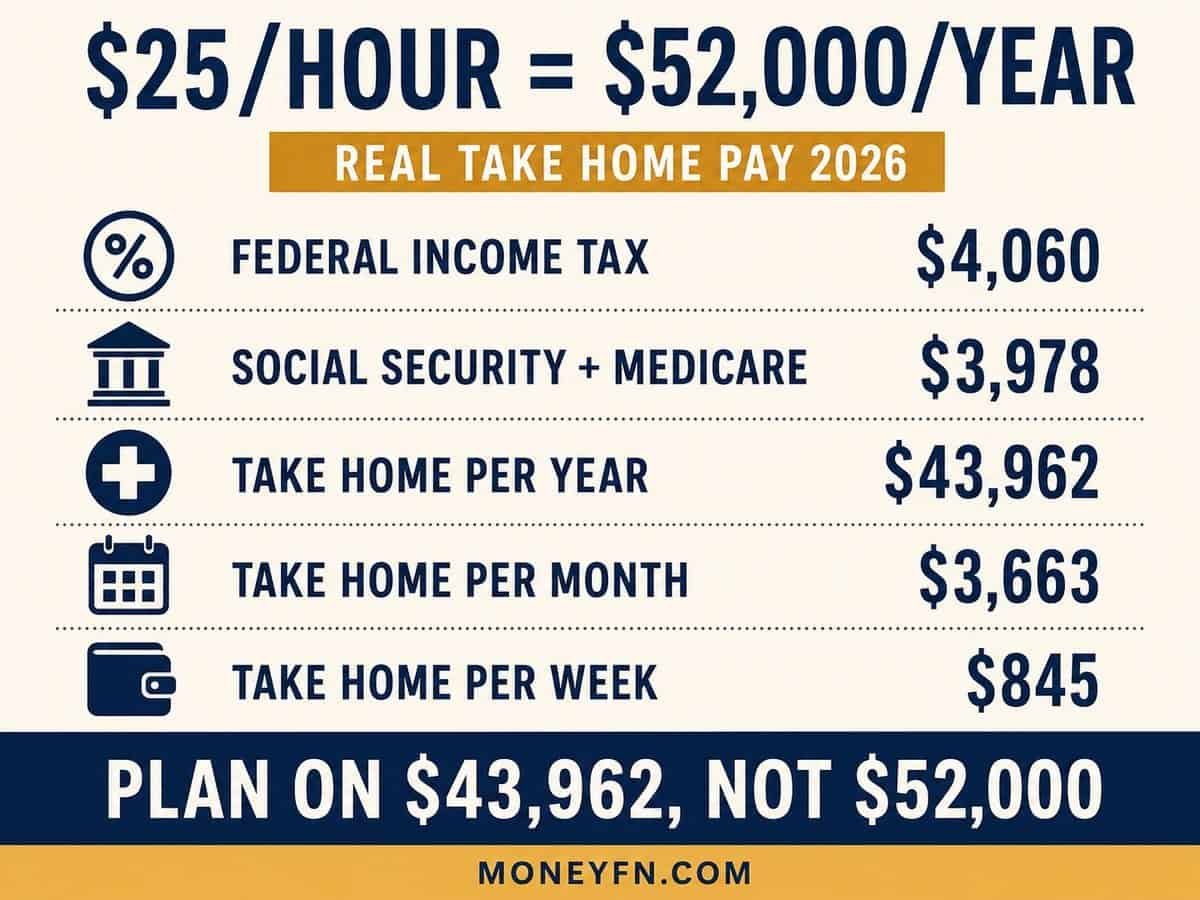
Share or cite this summary with credit to MoneyFN. The figures trace to the IRS sources listed in the methodology below.
Hourly to yearly conversion table
If your wage is near 25 dollars an hour, this table shows the annual equivalent for nearby rates at 40 hours per week, 52 weeks per year:
| Hourly rate | Yearly salary | Monthly |
|---|---|---|
| $15 | $31,200 | $2,600 |
| $17 | $35,360 | $2,947 |
| $19 | $39,520 | $3,293 |
| $20 | $41,600 | $3,467 |
| $22 | $45,760 | $3,813 |
| $23 | $47,840 | $3,987 |
| $24 | $49,920 | $4,160 |
| $25 | $52,000 | $4,333 |
| $26 | $54,080 | $4,507 |
| $28 | $58,240 | $4,853 |
| $30 | $62,400 | $5,200 |
| $32 | $66,560 | $5,547 |
| $35 | $72,800 | $6,067 |
| $40 | $83,200 | $6,933 |
Yearly salary is almost exactly hourly rate times 2,000, plus 4%. Double the hourly rate, add three zeros ($25 becomes $50,000), and the true figure is 4% higher.
Part time and overtime at 25 dollars an hour
Not everyone works 2,080 hours. Here is what 25 dollars an hour pays at common part time schedules, before taxes:
| Hours per week | Yearly | Monthly |
|---|---|---|
| 20 | $26,000 | $2,167 |
| 25 | $32,500 | $2,708 |
| 30 | $39,000 | $3,250 |
| 35 | $45,500 | $3,792 |
| 40 | $52,000 | $4,333 |
Overtime runs the other way. For non exempt workers, federal law sets overtime at 1.5 times the regular rate, so overtime hours pay $37.50. Working five overtime hours a week all year adds $9,750 before taxes, pushing the year to $61,750.
Which states take nothing from this paycheck?
The take home figure above assumes no state income tax. In 2026, nine states do not tax wage income: Alaska, Florida, Nevada, New Hampshire, South Dakota, Tennessee, Texas, Washington, and Wyoming. In those states, $43,962 is a realistic take home estimate at 25 dollars an hour.
Everywhere else, state income tax takes an additional slice that varies widely by state and filing status. We are building per state paycheck pages with 2026 state tax tables so you can see your state’s exact number.
Is 25 dollars an hour good pay?
By the national numbers, it is slightly above the middle. The Bureau of Labor Statistics Occupational Employment and Wage Statistics survey (May 2024 data) puts the median hourly wage for all US occupations at $23.80. At 25 dollars an hour you earn about 5% more than the median American worker.
Context matters more than the national median, though. $52,000 stretches very differently in Mississippi than in San Francisco, and household math changes if you are supporting dependents on one income. Two earners at this wage put a household at $104,000 before taxes, which is above the median US household income.
Jobs that commonly pay around 25 dollars an hour
The May 2024 BLS OEWS survey lists dozens of occupations with median hourly wages within a dollar of $25. A sample, with the national median for each:
| Occupation | Median hourly (May 2024) | Yearly at 40 hrs/wk |
|---|---|---|
| Tile and stone setters | $25.11 | $52,229 |
| Biological technicians | $25.00 | $52,000 |
| Solar photovoltaic installers | $24.93 | $51,854 |
| Community health workers | $24.54 | $51,043 |
| Roofers | $24.51 | $50,981 |
| Public safety telecommunicators | $24.39 | $50,731 |
| Tax preparers | $24.31 | $50,565 |
| Medical records specialists | $24.16 | $50,253 |
| Automotive technicians and repairers | $24.02 | $49,962 |
Half the workers in each occupation earn more than the median and half earn less, so experienced workers in these fields commonly clear 25 dollars an hour while entry level roles start lower.
What salary offer equals 25 dollars an hour?
Comparing an hourly job against a salaried offer is not just $52,000 versus the offer letter. Two adjustments matter.
Paid time off. The $52,000 figure assumes you are paid all 52 weeks. A salaried job with three weeks of vacation pays you the same annual amount while you work 1,960 hours, which is an effective $26.53 per hour worked. An hourly job with no paid vacation flips that math against you: three weeks unpaid at 25 dollars an hour drops the year to $49,000.
Benefits. Employer health insurance, retirement matching, and other benefits are real compensation that sits outside the wage. If a salaried offer includes a 401(k) match worth $1,500 a year and employer paid insurance premiums worth several thousand more, a $50,000 salary can beat a $52,000 hourly year with no benefits. When comparing offers, a common approach is to price each benefit at what it would cost you to buy it yourself and add that to the salary before comparing.
Never compare the offer letter number alone. A $50,000 salary with benefits can beat a $52,000 hourly year, and an hourly job with no paid vacation quietly pays for 49 weeks, not 52.
Overtime eligibility. Hourly workers are typically non exempt, meaning hours past 40 pay time and a half. Salaried exempt workers get nothing extra for a 50 hour week. If your field regularly runs overtime, the hourly side of this comparison is stronger than it looks.
What a raise or a 401(k) does to this paycheck
Two common changes to a $25 wage are worth seeing in numbers.
A one dollar raise adds $2,080 a year before taxes. At this income every extra dollar lands in the 12% federal bracket and pays 7.65% payroll tax.
A $1 raise at this income is worth about $1,671 a year in your pocket, roughly $139 a month after taxes.
A 401(k) contribution lowers your taxable income now. Contributing 6% of pay ($3,120 a year) reduces federal income tax by about $374, so the true cost of saving $3,120 is around $2,746 of take home pay. Payroll taxes still apply to 401(k) contributions, but the income tax savings alone make each saved dollar cost about 88 cents. If an employer matches any portion, the effective return on those saved dollars gets better still.
A sample monthly budget on 25 dollars an hour
A common starting framework is the 50/30/20 budget: 50% of take home pay to needs, 30% to wants, 20% to savings and debt payments beyond minimums. Applied to the estimated $3,663 monthly take home at 25 dollars an hour:
| Category | Share | Monthly amount |
|---|---|---|
| Needs (rent, groceries, utilities, insurance, minimum debt payments) | 50% | $1,832 |
| Wants (dining out, travel, subscriptions, hobbies) | 30% | $1,099 |
| Savings and extra debt payoff | 20% | $733 |

Budgeting on gross pay. $52,000 gross is $43,962 of real income in 2026; a plan built on the gross number overspends by about $8,038 a year.
The hardest line is usually needs. Keeping rent near $1,200 leaves about $630 for everything else in that category, which is workable in much of the country and tight in expensive metros. The framework is a starting point, not a rule; many people at this income run 60/20/20 or 70/20/10 in high cost areas.
Why your paycheck will not match this page exactly
The numbers above are the actual 2026 tax math. Your paycheck stub shows something slightly different: withholding, which is your employer’s running estimate of that math based on the W-4 form you filed. The two usually disagree by a little, and the difference settles up when you file your return in early 2027 as either a refund or a balance due.
Anatomy of a biweekly paycheck at 25 dollars an hour, 80 hours:
| Line | Amount | What it is |
|---|---|---|
| Gross pay | $2,000.00 | 80 hours at $25 |
| Federal withholding | ~$156 | Employer estimate of your income tax, set by your W-4 |
| Social Security | $124.00 | 6.2% of gross |
| Medicare | $29.00 | 1.45% of gross |
| State tax, benefits, 401(k) | varies | Depends on your state and elections |
| Net pay | ~$1,691 or less | What hits your account |
Three common reasons your stub differs from this table: you claimed dependents or extra withholding on your W-4, you have pre tax benefit deductions, or your state and city tax wages. None of them change the underlying annual math, only when and where the money moves.
One more timing detail: a biweekly schedule pays 26 checks a year, but two months each year contain three paydays. Budgeting on two checks a month and treating the two extra checks as savings is a common approach at any wage.
How we calculated these numbers
Every figure on this page traces to a public source, dated. Gross pay uses the standard 2,080 hour work year. Federal income tax uses the 2026 single filer standard deduction of $16,100 and the 2026 brackets from IRS Revenue Procedure 2025-32, published October 9, 2025. Payroll taxes use the employee rates from IRS Topic 751: 6.2% Social Security and 1.45% Medicare. The wage comparison uses the BLS OEWS survey, May 2024 release. Estimates assume a single filer with no dependents, taking the standard deduction, with no pre tax deductions and no state or local income tax. Your paycheck will differ if any of those assumptions do not describe you.
Learn more about how MoneyFN sources numbers on our about page, browse more money math on the blog and our growing set of salary and paycheck pages, or contact us if a number looks off.
Frequently asked questions
25 dollars an hour is how much a year after taxes?
About $43,962 in 2026 for a single filer taking the standard deduction, in a state with no income tax. That reflects $4,060 of federal income tax and $3,978 of Social Security and Medicare taxes on $52,000 of gross pay. State income tax reduces it further in most states.
How much is 25 dollars an hour biweekly?
$2,000 before taxes for 80 hours, and roughly $1,691 after federal taxes in 2026. Most US employers pay biweekly, so this is the paycheck figure most people at this wage actually see.
Is $25 an hour enough to live on?
At full time hours it is above the US median wage of $23.80 (BLS, May 2024) and supports a 50/30/20 budget in much of the country. In high cost metros, housing usually forces a different split. Location and household size matter more than the wage itself.
How much is $25 an hour if I work part time?
Multiply your weekly hours by 25, then by 52. At 20 hours per week that is $26,000 per year; at 30 hours it is $39,000, both before taxes.
What is 25 dollars an hour monthly?
$4,333 per month before taxes at 40 hours per week. After estimated 2026 federal taxes, about $3,663 per month.
What salary is $25 an hour with two weeks unpaid?
2,000 hours instead of 2,080, which is $50,000 before taxes. Unpaid time off reduces the annual figure by $1,000 per unpaid week at this wage.
How much is 25 dollars an hour with overtime?
Overtime hours pay $37.50 for non exempt workers under federal law. A steady 45 hour week works out to $61,750 a year before taxes, $9,750 more than the standard 40 hour year.
Does 25 dollars an hour change after a 401(k) contribution?
Your gross wage stays the same, but a pre tax 401(k) contribution lowers taxable income. At 6% of pay, federal income tax drops by about $374 a year, so take home pay falls by far less than the amount you save.
This content is for educational purposes only and does not constitute personalized financial advice. Tax figures are 2026 federal amounts for illustration; your actual withholding and tax depend on your filing status, deductions, and state. See our full disclaimer, and consult a qualified financial advisor or tax professional for guidance specific to your situation.
By Nathan Whitmore for MoneyFN