

17 dollars an hour is how much a year? At $17 per hour, you earn $35,360 per year before taxes if you work 40 hours a week for 52 weeks. This 2026 guide explains your annual, monthly, and weekly pay, estimated take-home income, and how taxes and work hours can change your earnings.
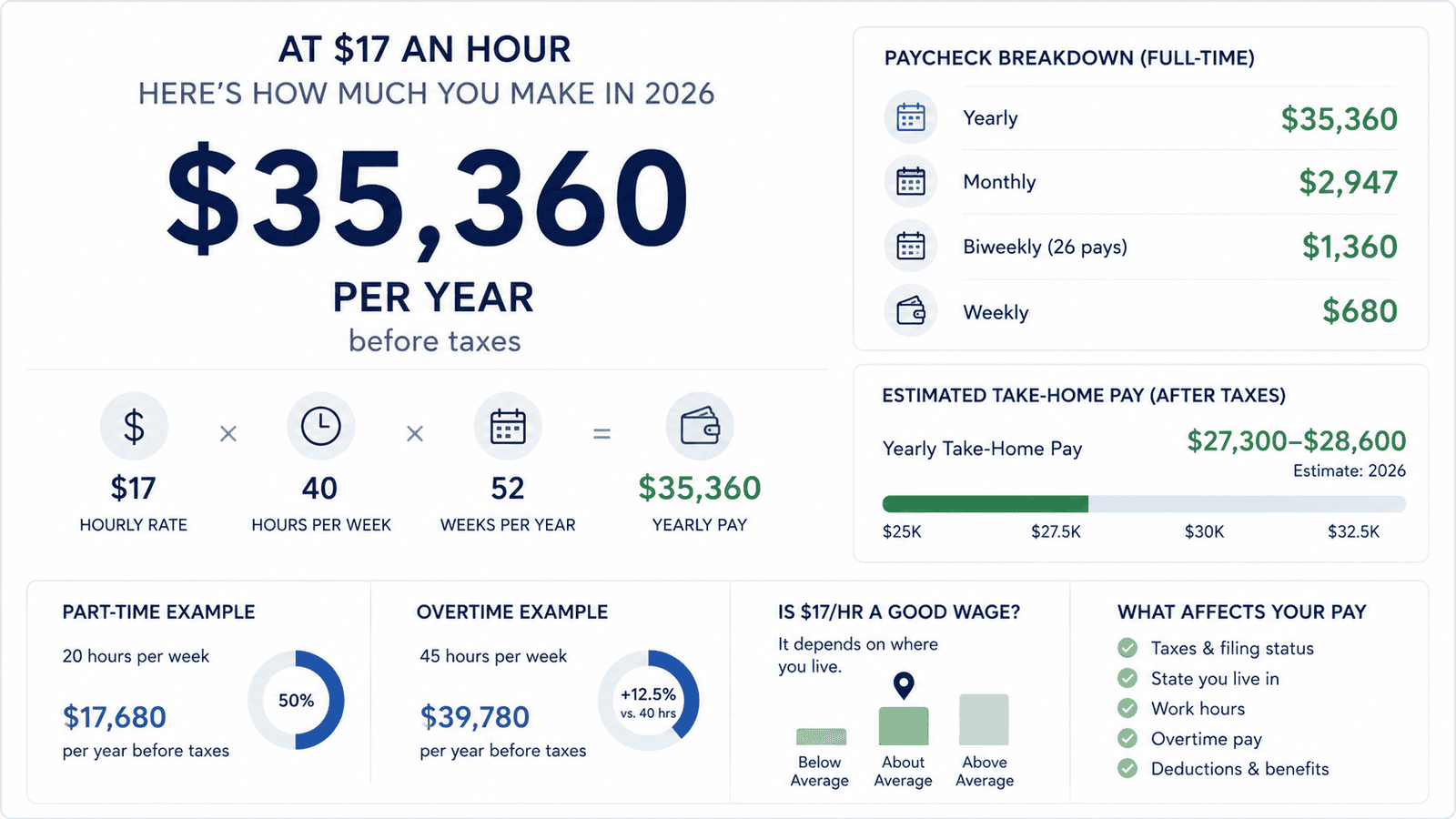
17 dollars an hour is how much a year: $17 an hour salary calculator
How to convert $17 an hour to a yearly salary
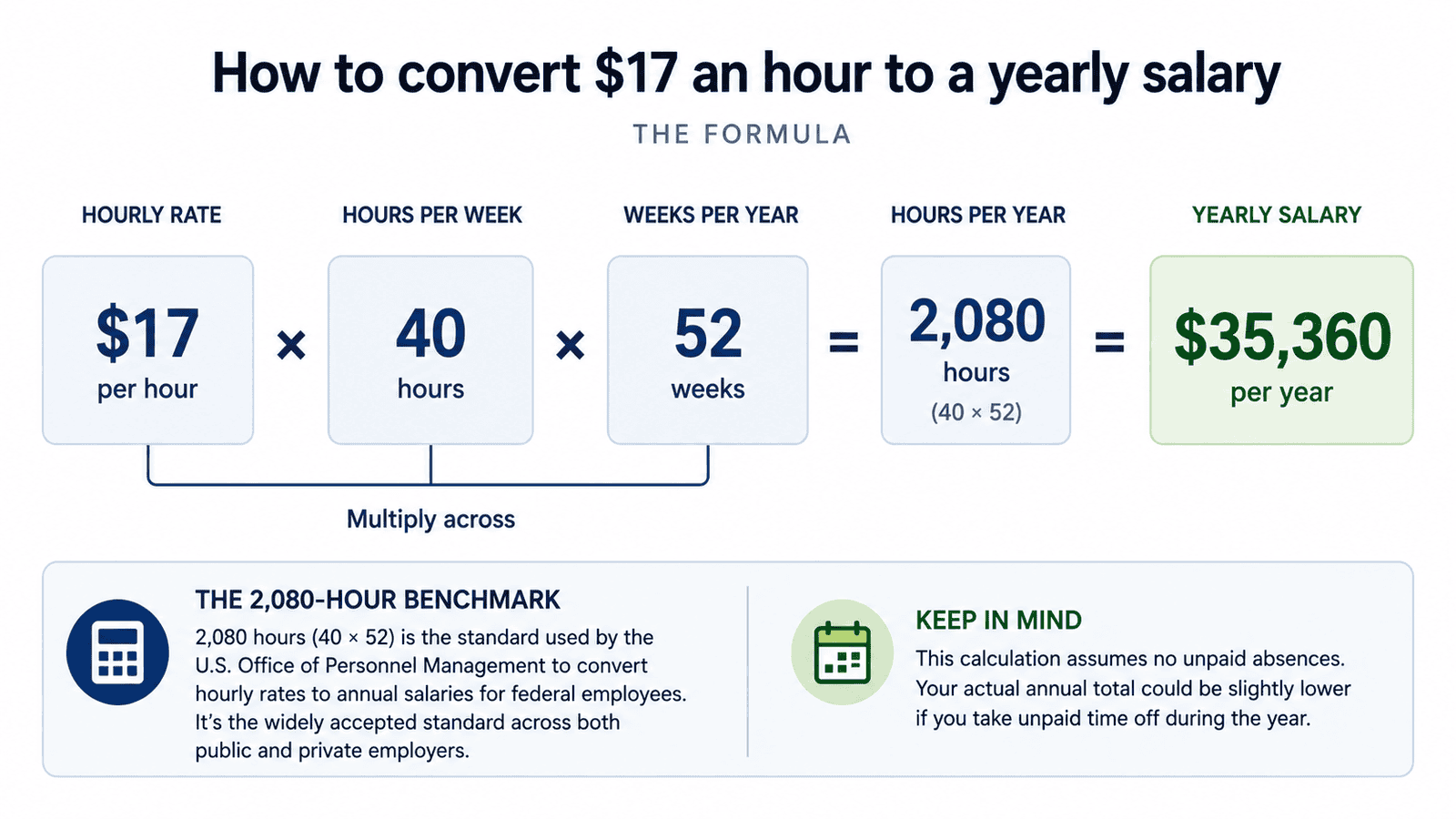
The standard formula for converting an hourly wage to an annual salary multiplies the hourly rate by the number of hours worked per week, then multiplies that result by the number of weeks in a year.
The 2,080 hour figure (40 × 52) is the benchmark the U.S. Office of Personnel Management uses to convert hourly rates to annual salaries for federal employees. It has become the widely accepted standard across public and private employers. The calculation assumes no unpaid absences, so your actual total could be slightly lower if you take unpaid time off during the year.
$17 an hour broken down by pay period
The following table converts $17 an hour into common pay period amounts, all based on a 40 hour work week before any tax withholding.
| Pay period | Gross pay (before taxes) | How it is calculated |
|---|---|---|
| Weekly | $680 | $17 × 40 hours |
| Biweekly | $1,360 | $680 × 2 |
| Semimonthly (twice a month) | $1,473.33 | $35,360 ÷ 24 |
| Monthly | $2,946.67 | $35,360 ÷ 12 |
| Yearly | $35,360 | $17 × 2,080 hours |
If your employer pays you biweekly, you will receive 26 paychecks per year. Two months each year will contain three pay dates instead of two, which can be helpful for budgeting or making extra payments toward debt. You can explore other hourly rates using the hourly to salary calculator.
What $17 an hour looks like after federal taxes in 2026
To understand what $17 an hour actually puts in your pocket, you need to account for federal income tax and FICA payroll taxes. The estimate below uses 2026 tax parameters for a single filer with no dependents who takes the standard deduction. It does not include state income tax, local tax, or any pre tax deductions such as retirement contributions or health insurance premiums.
2026 federal income tax
The IRS publishes seven marginal tax brackets for 2026 in Revenue Procedure 2025-32 (effective January 2026). The rates are 10%, 12%, 22%, 24%, 32%, 35%, and 37%. For a single filer, the 2026 standard deduction is $16,100.
Starting from $35,360 in gross wages:
- Taxable income after the standard deduction: $35,360 minus $16,100 = $19,260
- 10% on the first $12,400 of taxable income = $1,240
- 12% on the remaining $6,860 ($19,260 minus $12,400) = $823.20
- Total estimated federal income tax: $2,063.20
2026 FICA taxes (Social Security and Medicare)
FICA taxes are withheld from every paycheck regardless of filing status or deductions. The rates for 2026 are (source: IRS Topic No. 751, updated 2026):
- Social Security: 6.2% on wages up to the 2026 wage base of $184,500
- Medicare: 1.45% on all wages (no cap)
On $35,360 in annual wages:
- Social Security tax: $35,360 × 6.2% = $2,192.32
- Medicare tax: $35,360 × 1.45% = $512.72
- Total FICA: $2,705.04
Estimated take home pay
| Item | Amount |
|---|---|
| Gross annual pay | $35,360.00 |
| Federal income tax | $2,063.20 |
| Social Security tax | $2,192.32 |
| Medicare tax | $512.72 |
| Estimated annual take home (federal only) | $30,591.76 |
| Estimated monthly take home | $2,549.31 |
Single filer, 2026 standard deduction, federal taxes only. Source: IRS Rev. Proc. 2025-32, IRS Topic No. 751.
This estimate does not include state income tax. If you live in a state with an income tax, your actual take home will be lower. For a full state level breakdown, see the detailed guide on $17 an hour after taxes. If you live in a state with no income tax, such as Texas, you can also check the Texas paycheck calculator for a closer estimate.
$17 an hour working part time
Not every position offers a full 40 hour week. If you work fewer hours, your annual income drops proportionally.
| Hours per week | Weekly gross pay | Annual gross pay |
|---|---|---|
| 20 hours | $340 | $17,680 |
| 25 hours | $425 | $22,100 |
| 30 hours | $510 | $26,520 |
| 35 hours | $595 | $30,940 |
At 30 hours a week, $17 an hour produces $26,520 a year before taxes. At 35 hours a week, the annual total rises to $30,940. Working under 30 hours may also affect your eligibility for employer sponsored health insurance and other benefits, depending on company policy and the Affordable Care Act’s definition of full time employment.
How overtime changes your pay at $17 an hour
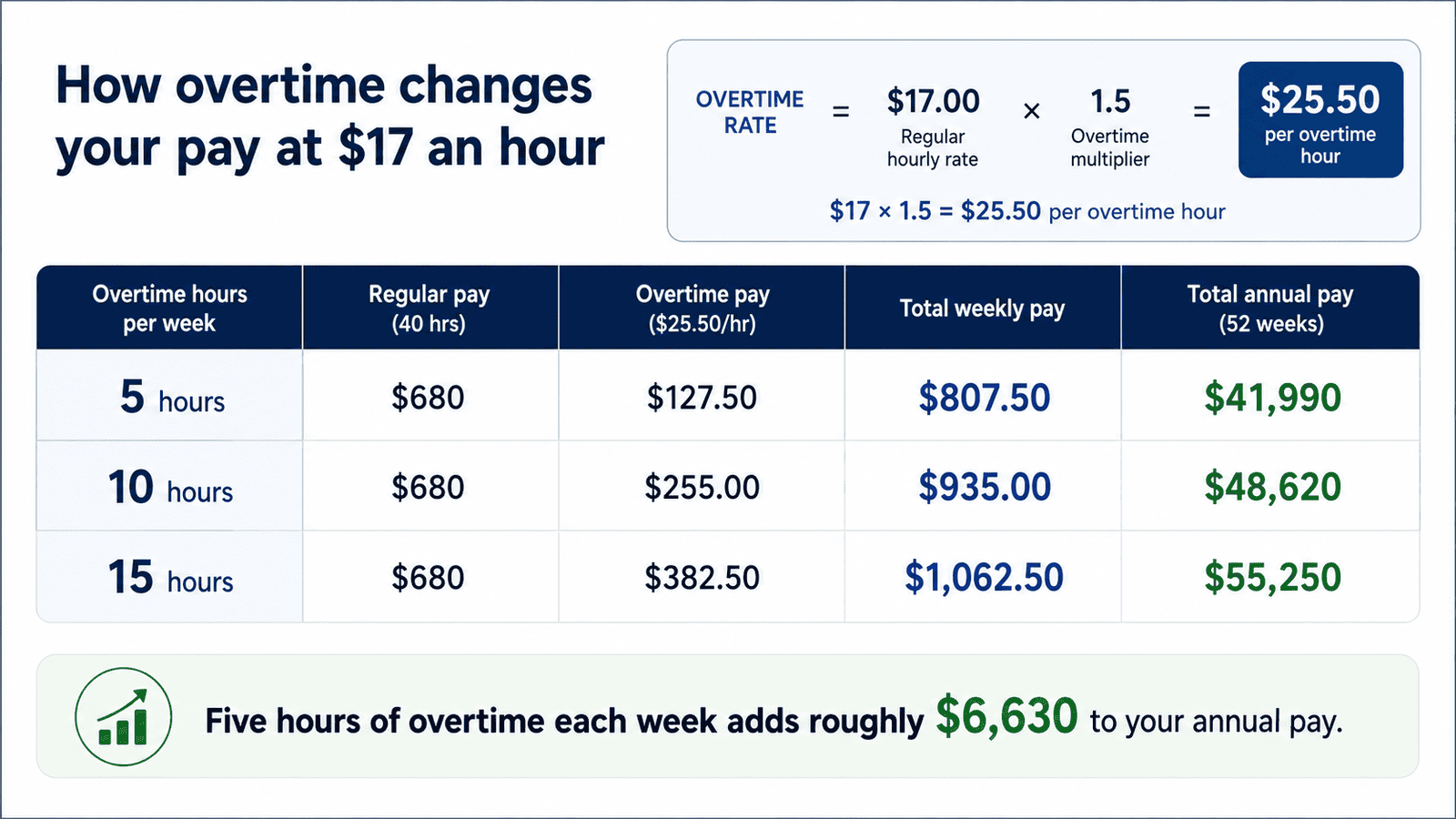
Under the Fair Labor Standards Act, most non exempt hourly employees must receive overtime pay at 1.5 times their regular rate for any hours worked beyond 40 in a single workweek. At $17 an hour, overtime pay is $25.50 per hour.
Here is how different amounts of weekly overtime affect annual income, assuming overtime is worked consistently for all 52 weeks.
| Overtime hours per week | Regular pay (40 hrs) | Overtime pay | Total weekly pay | Total annual pay |
|---|---|---|---|---|
| 5 hours | $680 | $127.50 | $807.50 | $41,990 |
| 10 hours | $680 | $255.00 | $935.00 | $48,620 |
| 15 hours | $680 | $382.50 | $1,062.50 | $55,250 |
Five hours of overtime each week adds roughly $6,630 to your annual gross income. Overtime income is taxed as ordinary income and may push a portion of your earnings into the next marginal bracket, so the after tax benefit will be somewhat smaller than these gross figures suggest.
Is $17 an hour a good wage in 2026?
Whether $17 an hour is a competitive wage depends on where you live, your household size, and your financial obligations. Two national benchmarks provide useful context.
At $17 an hour, you earn more than twice the federal minimum wage but fall below the national median hourly wage of approximately $30.83.
Federal minimum wage: The federal minimum wage has been $7.25 per hour since July 2009 (source: U.S. Department of Labor, Wage and Hour Division, as of 2026). At $17 an hour, you earn more than twice the federal floor. However, many states and cities have set their own minimum wages well above $7.25, so this comparison is most meaningful in states that still follow the federal rate.
National median earnings: According to the Bureau of Labor Statistics, the median usual weekly earnings for full time wage and salary workers were $1,233 in the first quarter of 2026 (published April 2026). Dividing by 40 hours gives an approximate median hourly wage of $30.83. At $17 an hour, your earnings fall below the national median, meaning more than half of full time workers earn more.
That does not necessarily mean $17 an hour is unlivable. Cost of living varies dramatically by region. A single person in a lower cost area of the South or Midwest may find $35,360 manageable, while the same salary in a high cost metro area would be very tight. For a look at how neighboring wage levels compare, see the breakdowns for $15 an hour, $16 an hour, $18 an hour, and $19 an hour.
Sample monthly budget on $17 an hour using the 50/30/20 rule
The 50/30/20 budget divides your after tax income into three categories: 50% for needs, 30% for wants, and 20% for savings and debt repayment. Using the estimated federal only take home of $2,549 per month calculated above, the split looks like this.
| Category | Percentage | Monthly amount | Examples |
|---|---|---|---|
| Needs | 50% | $1,275 | Rent or mortgage, utilities, groceries, insurance, minimum debt payments, transportation |
| Wants | 30% | $765 | Dining out, streaming services, hobbies, travel, non essential shopping |
| Savings and debt repayment | 20% | $510 | Emergency fund, retirement contributions, extra debt payments |
A $1,275 needs allocation means housing costs ideally stay below roughly $900 to $1,000, leaving room for groceries, basic transportation, and insurance. In many parts of the country that is achievable with a roommate or in a lower cost market, though it may be difficult as a solo renter in a major city.
If your state also collects income tax, your take home will be lower and these amounts will shrink accordingly. The $17 an hour after taxes page walks through several common state scenarios. The answer to 17 dollars an hour is how much a year changes if you work part-time, overtime, or take unpaid time off.
Frequently asked questions
How much is $17 an hour per week?
At 40 hours per week, $17 an hour is $680 before taxes. If you work fewer hours, multiply $17 by the number of hours you actually work to get your weekly gross pay.
Can you live on $17 an hour in 2026?
It depends on your location, housing costs, and whether you are supporting dependents. A single person in a low to moderate cost of living area can cover basic expenses on $35,360 a year, especially with careful budgeting. In expensive metro areas, you would likely need a second income, a roommate, or supplemental assistance. The hourly to salary calculator can help you model different scenarios.
How much is $17 an hour after taxes?
For a single filer with no dependents using the 2026 standard deduction, estimated federal taxes (income tax plus FICA) total approximately $4,768 on $35,360 of gross wages. That leaves roughly $30,592 after federal taxes, or about $2,549 per month. State and local taxes would reduce this further. See the full breakdown at $17 an hour after taxes.
How much is $17 an hour working 30 hours a week?
Working 30 hours per week at $17 an hour for 52 weeks gives you $26,520 in gross annual income. That is $8,840 less than the full time figure of $35,360.
What is the difference between $17 an hour and $18 an hour over a full year?
One additional dollar per hour at 40 hours per week for 52 weeks equals $2,080 more per year in gross pay. That means $18 an hour produces $37,440 per year compared to $35,360 at $17 an hour. You can compare both in detail at the $18 an hour page. Understanding 17 dollars an hour is how much a year makes it easier to compare hourly jobs with annual salary offers.
Methodology
All calculations in this article assume a full time schedule of 40 hours per week and 52 paid weeks per year (2,080 hours annually), which is the standard used by the U.S. Office of Personnel Management. Federal income tax estimates use 2026 brackets and the standard deduction for a single filer with no dependents, as published by the IRS in Revenue Procedure 2025-32. FICA calculations use the 2026 Social Security tax rate of 6.2% (wage base $184,500) and the Medicare tax rate of 1.45%, as confirmed by IRS Publication 926 for tax year 2026 and IRS Topic No. 751.
Median earnings data is from the Bureau of Labor Statistics, “Usual Weekly Earnings of Wage and Salary Workers,” Q1 2026 release. Federal minimum wage data is from the U.S. Department of Labor, Wage and Hour Division. No state or local taxes are included unless specifically noted. Figures are rounded to the nearest cent where applicable.
This content is for educational purposes only and does not constitute personalized financial advice. Consult a qualified financial advisor for guidance specific to your situation.
By Nathan Whitmore for MoneyFN If you're asking 17 dollars an hour is how much a year, a full-time schedule works out to $35,360 before taxes.

Nathan Whitmore is a US based personal finance writer at MoneyFN covering salary, paycheck, and tax math for American workers. He works from primary sources only: IRS revenue procedures, Bureau of Labor Statistics wage data, and Federal Reserve statistics. Every figure he publishes is dated and traceable to a public source.