

The paycheck calculator Kansas guide estimates take-home pay after federal income tax, Social Security, Medicare, and Kansas state income tax. Kansas uses two individual income tax rates of 5.2% and 5.58%, with no separate city or county payroll income tax. Under standard assumptions, a single filer earning $60,000 in 2026 may take home about $47,842 annually.

Kansas paycheck calculator
Use the MoneyFN salary after tax calculator to estimate your take home pay based on salary, filing status, pay frequency, and payroll deductions.
The examples below use 2026 tax rules and assume a single employee claiming the standard deductions, no dependents, no tax credits, no additional withholding, and no pretax deductions unless stated otherwise. Actual withholding can differ because employers use payroll withholding tables and information from Forms W-4 and K-4.
Contents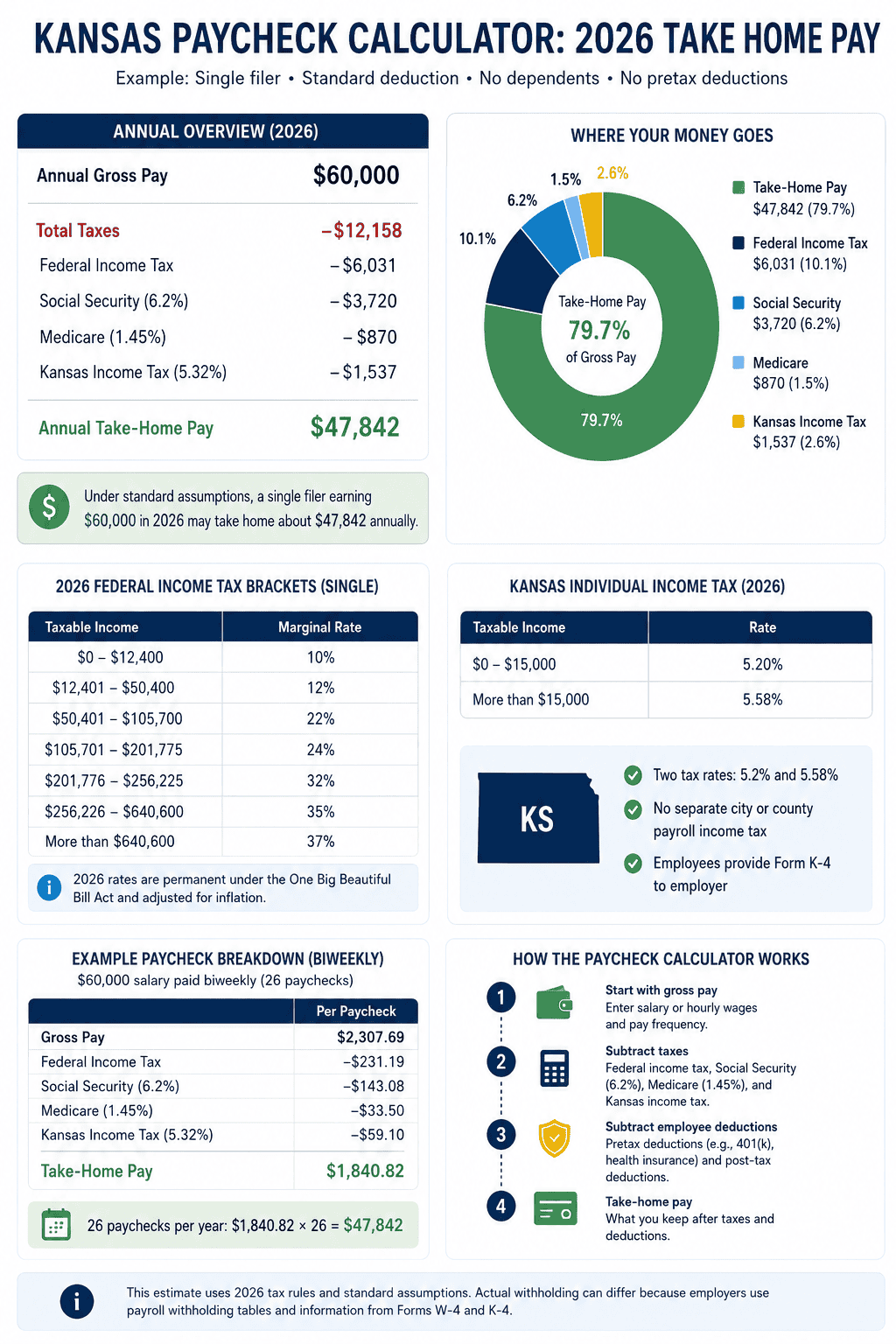
How the Kansas paycheck calculator works
A paycheck calculator Kansas estimate starts with gross pay and subtracts taxes and employee deductions.
Take home pay = gross pay − federal income tax − Social Security tax − Medicare tax − Kansas income tax − employee deductions
Information you need to enter
Gross pay
Gross pay is your earnings before taxes and deductions. For a salaried employee, divide the annual salary by the number of pay periods per year.
Annual salary ÷ number of pay periods = gross pay per paycheck
For example, a $60,000 annual salary paid biweekly produces:
$60,000 ÷ 26 = $2,307.69 gross pay per paycheck
For an hourly employee, multiply the hourly rate by hours worked. Someone earning $25 per hour and working 80 hours in a biweekly period earns $2,000 in gross biweekly pay. See the full annual conversion on the $25 an hour page.
Pay frequency
Common pay frequencies include weekly (52 paychecks per year), biweekly (26 paychecks), semimonthly (24 paychecks), and monthly (12 paychecks). Biweekly and semimonthly are not the same. A biweekly worker normally receives 26 checks per year, while a semimonthly worker receives 24.
Filing status
Federal income tax calculations use filing statuses such as single, married filing jointly, married filing separately, and head of household. Kansas employees also complete Form K-4 so their employer can calculate Kansas withholding. The Kansas Department of Revenue states that employees with Kansas source wages generally provide Form K-4 to their employer.
Pretax deductions
Certain deductions reduce the wages used to calculate income tax. Common examples include traditional 401(k) contributions, eligible health insurance premiums, health savings account contributions, and flexible spending account contributions. Traditional 401(k) contributions normally reduce federal and Kansas taxable income but generally do not reduce Social Security or Medicare wages.
Post tax deductions
Post tax deductions are taken after applicable taxes have been calculated. Examples may include Roth 401(k) contributions, union dues, wage garnishments, and some insurance premiums.
2026 federal taxes on your paycheck
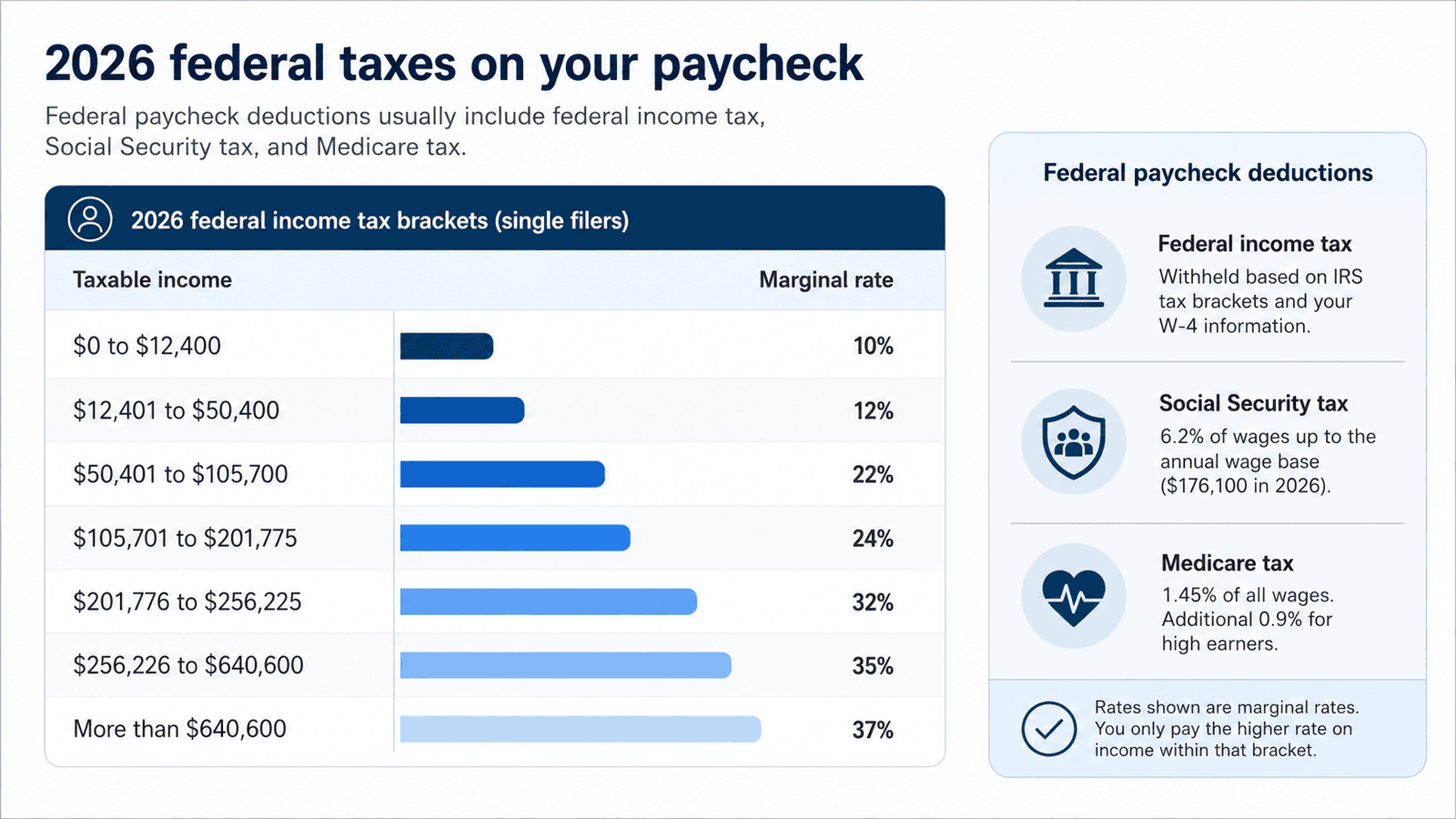
Federal paycheck deductions usually include federal income tax, Social Security tax, and Medicare tax.
Federal income tax brackets for 2026
For tax year 2026, the IRS uses seven marginal rates: 10%, 12%, 22%, 24%, 32%, 35%, and 37%. These rates were made permanent by the One Big Beautiful Bill Act signed in July 2025 and adjusted for inflation under IRS Revenue Procedure 2025-32.
The 2026 federal brackets for single filers are:
| Taxable income | Marginal rate |
|---|---|
| $0 to $12,400 | 10% |
| $12,401 to $50,400 | 12% |
| $50,401 to $105,700 | 22% |
| $105,701 to $201,775 | 24% |
| $201,776 to $256,225 | 32% |
| $256,226 to $640,600 | 35% |
| More than $640,600 | 37% |
For married couples filing jointly, the 10% bracket applies through $24,800, the 12% bracket through $100,800, and the 22% bracket through $211,400. These are tax year 2026 thresholds published by the IRS in Revenue Procedure 2025-32.
A marginal bracket does not apply to every dollar earned. Only taxable income within each bracket is taxed at that bracket’s rate.
2026 federal standard deduction
The IRS set the following standard deductions for tax year 2026:
| Filing status | 2026 standard deduction |
|---|---|
| Single | $16,100 |
| Married filing separately | $16,100 |
| Married filing jointly | $32,200 |
| Head of household | $24,150 |
These deductions apply to 2026 income reported on federal returns generally filed in 2027. For example, a single employee earning $60,000 with no other adjustments would have estimated federal taxable income of $60,000 − $16,100 = $43,900.
Social Security tax
For wages paid in 2026, the employee Social Security tax rate is 6.2%. The 2026 Social Security wage base is $184,500 (IRS, 2026). Once an employee’s Social Security wages from one employer reach that limit, the employer generally stops withholding the 6.2% employee tax for the rest of the year. The maximum employee Social Security tax on the 2026 wage base is $184,500 × 6.2% = $11,439.
Medicare tax
The employee Medicare tax rate remains 1.45% in 2026, and there is no Medicare wage base limit. An additional 0.9% Medicare tax applies after an employer pays an employee more than $200,000 during the calendar year. For the salary examples in this article, regular employee FICA is 6.2% Social Security + 1.45% Medicare = 7.65%.
Kansas state income tax explained
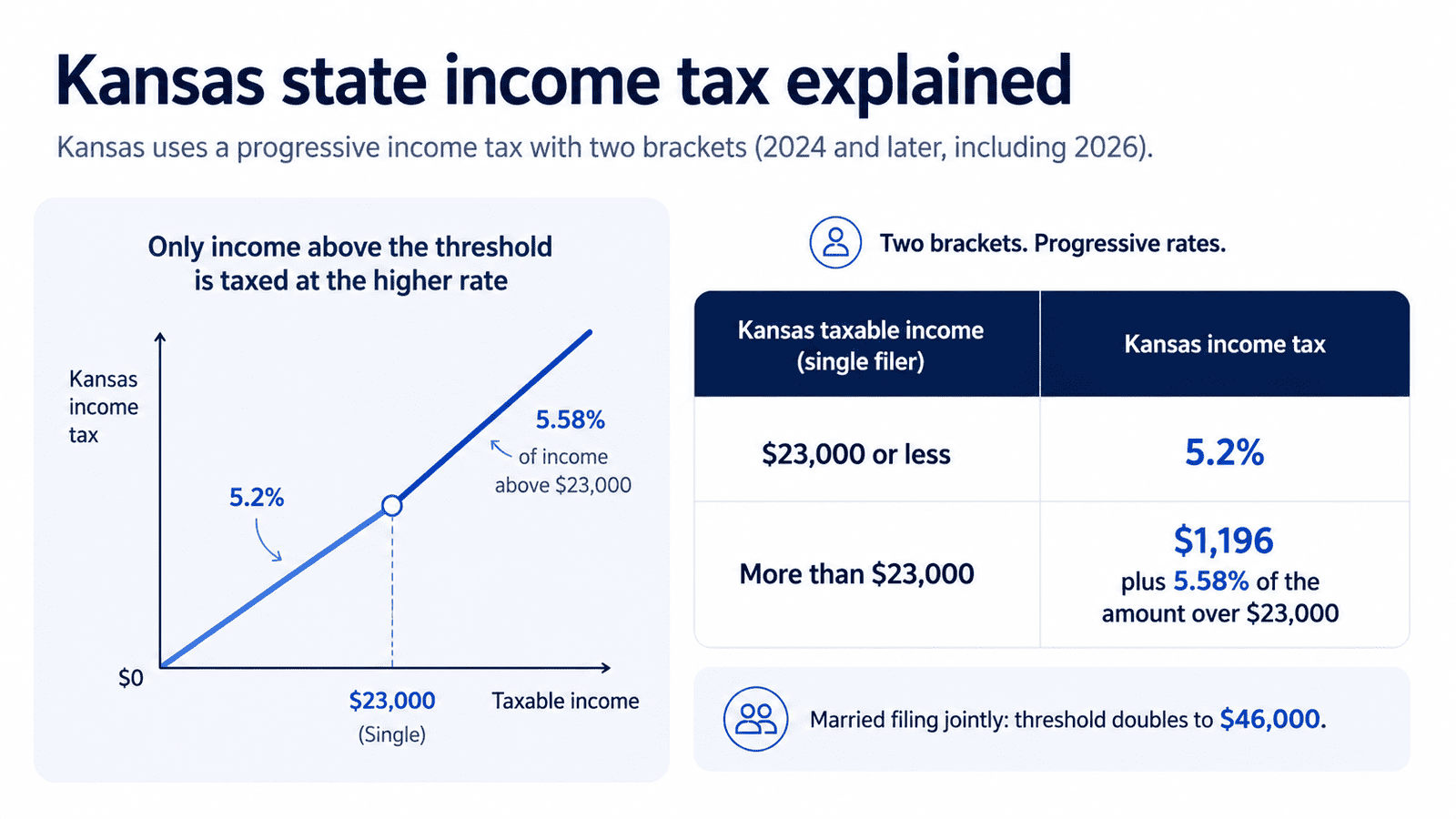
Kansas has a progressive individual income tax rather than a single flat rate. During the 2024 Special Session, Senate Bill 1 consolidated Kansas from three brackets to two and established new rates effective for tax year 2024 and all later tax years, including 2026.
The Kansas income tax rates for a single filer are:
| Kansas taxable income (single filer) | Kansas income tax |
|---|---|
| $23,000 or less | 5.2% |
| More than $23,000 | $1,196 plus 5.58% of the amount over $23,000 |
For married couples filing jointly, the bracket threshold doubles to $46,000. The Kansas Department of Revenue Notice 24-08 confirms this two bracket structure. Only Kansas taxable income above the threshold is taxed at the higher 5.58% rate.
Kansas deductions and exemptions used in these examples
For a basic single filer estimate, this article uses:
- Kansas standard deduction: $3,605
- Kansas personal exemption: $9,160
- No dependents
- No itemized deductions
- No Kansas tax credits
The Kansas Department of Revenue lists a $3,605 standard deduction for single filers and a $9,160 personal exemption for a single individual, as established by SB 1 for tax year 2024 and later.
Kansas adjusted gross income − Kansas standard deduction − Kansas personal exemption = Kansas taxable income
Kansas returns can contain additions, subtractions, credits, dependent exemptions, and other adjustments that are not included in these simplified examples.
Does Kansas have local income tax?
Standard Kansas employee withholding does not include a separate city or county individual income tax. Employees generally account for federal withholding, FICA, and Kansas state withholding only. Local sales taxes, property taxes, and business taxes are different from an individual wage income tax.
Worked examples of Kansas take home pay
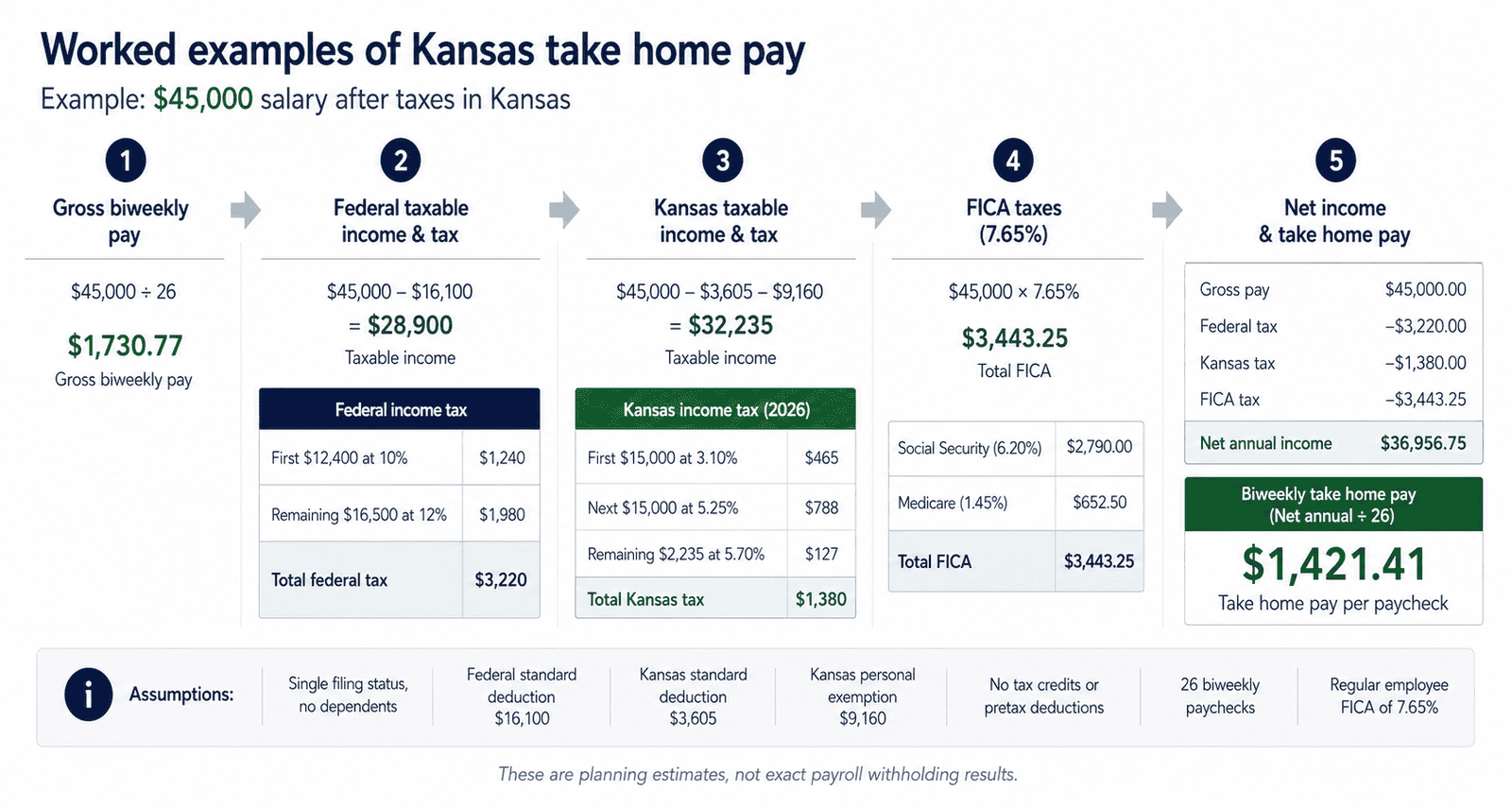
The following examples estimate annual tax liability and divide estimated net income by 26 to show biweekly take home pay. All three examples assume:
- Single filing status, no dependents
- Federal standard deduction of $16,100
- Kansas standard deduction of $3,605
- Kansas personal exemption of $9,160
- No tax credits or pretax deductions
- 26 biweekly paychecks
- Regular employee FICA of 7.65%
These are planning estimates, not exact payroll withholding results.
$45,000 salary after taxes in Kansas
Step 1: Calculate gross biweekly pay
$45,000 ÷ 26 = $1,730.77
Step 2: Calculate federal taxable income
$45,000 − $16,100 = $28,900
Federal income tax:
- First $12,400 at 10% = $1,240
- Remaining $16,500 at 12% = $1,980
Estimated federal income tax = $3,220
Step 3: Calculate FICA
Social Security: $45,000 × 6.2% = $2,790. Medicare: $45,000 × 1.45% = $652.50. Total FICA = $3,442.50.
Step 4: Calculate Kansas taxable income
$45,000 − $3,605 − $9,160 = $32,235
Kansas tax:
- First $23,000 at 5.2% = $1,196
- Remaining $9,235 at 5.58% = $515.31
Estimated Kansas income tax = $1,711.31
Step 5: Calculate take home pay
$45,000 − $3,220 − $3,442.50 − $1,711.31 = $36,626.19
| Result | Estimated amount |
|---|---|
| Annual take home pay | $36,626.19 |
| Monthly take home pay | $3,052.18 |
| Biweekly take home pay | $1,408.70 |
| Weekly take home pay | $704.35 |
| Effective tax share | 18.61% |
$60,000 salary after taxes in Kansas
Step 1: Calculate gross biweekly pay
$60,000 ÷ 26 = $2,307.69
Step 2: Calculate federal taxable income
$60,000 − $16,100 = $43,900
Federal income tax:
- First $12,400 at 10% = $1,240
- Remaining $31,500 at 12% = $3,780
Estimated federal income tax = $5,020
Step 3: Calculate FICA
Social Security: $60,000 × 6.2% = $3,720. Medicare: $60,000 × 1.45% = $870. Total FICA = $4,590.
Step 4: Calculate Kansas taxable income
$60,000 − $3,605 − $9,160 = $47,235
Kansas tax:
- First $23,000 at 5.2% = $1,196
- Remaining $24,235 at 5.58% = $1,352.31
Estimated Kansas income tax = $2,548.31
Step 5: Calculate take home pay
$60,000 − $5,020 − $4,590 − $2,548.31 = $47,841.69
| Result | Estimated amount |
|---|---|
| Annual take home pay | $47,841.69 |
| Monthly take home pay | $3,986.81 |
| Biweekly take home pay | $1,840.07 |
| Weekly take home pay | $920.03 |
| Effective tax share | 20.26% |
Under these assumptions, $60,000 a year is approximately $47,842 after federal income tax, FICA, and Kansas income tax. Employer benefits and other paycheck deductions would reduce the deposited amount further.
$85,000 salary after taxes in Kansas
Step 1: Calculate gross biweekly pay
$85,000 ÷ 26 = $3,269.23
Step 2: Calculate federal taxable income
$85,000 − $16,100 = $68,900
Federal income tax:
- First $12,400 at 10% = $1,240
- Next $38,000 at 12% = $4,560
- Remaining $18,500 at 22% = $4,070
Estimated federal income tax = $9,870
Step 3: Calculate FICA
Social Security: $85,000 × 6.2% = $5,270. Medicare: $85,000 × 1.45% = $1,232.50. Total FICA = $6,502.50.
Step 4: Calculate Kansas taxable income
$85,000 − $3,605 − $9,160 = $72,235
Kansas tax:
- First $23,000 at 5.2% = $1,196
- Remaining $49,235 at 5.58% = $2,747.31
Estimated Kansas income tax = $3,943.31
Step 5: Calculate take home pay
$85,000 − $9,870 − $6,502.50 − $3,943.31 = $64,684.19
| Result | Estimated amount |
|---|---|
| Annual take home pay | $64,684.19 |
| Monthly take home pay | $5,390.35 |
| Biweekly take home pay | $2,487.85 |
| Weekly take home pay | $1,243.93 |
| Effective tax share | 23.90% |
Kansas salary after tax comparison
| Annual salary | Gross biweekly pay | Federal income tax | FICA | Kansas income tax | Estimated biweekly take home |
|---|---|---|---|---|---|
| $45,000 | $1,730.77 | $3,220.00 | $3,442.50 | $1,711.31 | $1,408.70 |
| $60,000 | $2,307.69 | $5,020.00 | $4,590.00 | $2,548.31 | $1,840.07 |
| $85,000 | $3,269.23 | $9,870.00 | $6,502.50 | $3,943.31 | $2,487.85 |
Hourly wages in Kansas
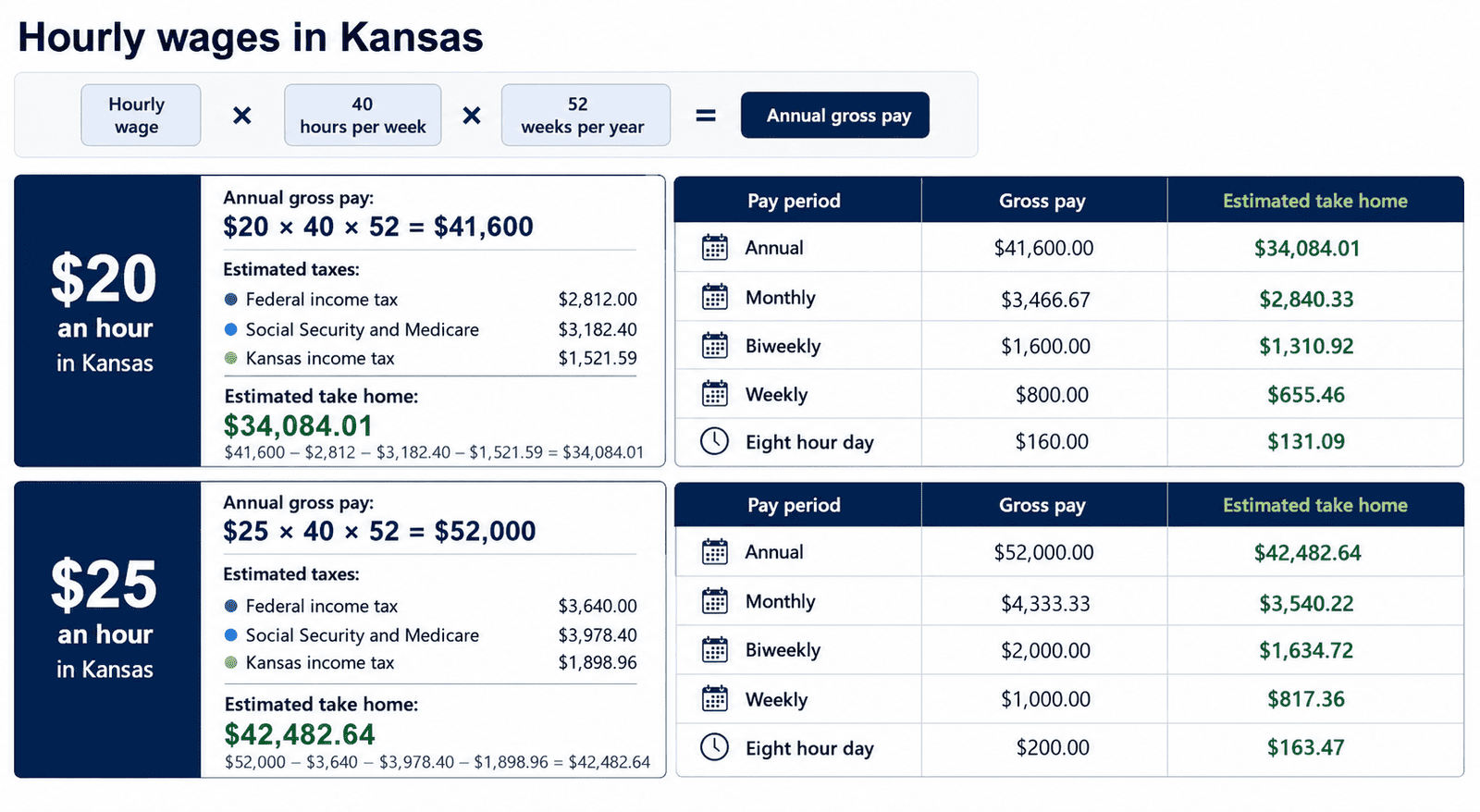
For full time hourly examples, MoneyFN uses 40 hours per week and 52 weeks per year.
Hourly wage × 40 hours × 52 weeks = annual gross pay
$20 an hour take home pay in Kansas
Annual gross pay: $20 × 40 × 52 = $41,600.
Estimated taxes:
- Federal income tax: $2,812
- Social Security and Medicare: $3,182.40
- Kansas income tax: $1,521.59
$41,600 − $2,812 − $3,182.40 − $1,521.59 = $34,084.01
| Pay period | Gross pay | Estimated take home |
|---|---|---|
| Annual | $41,600.00 | $34,084.01 |
| Monthly | $3,466.67 | $2,840.33 |
| Biweekly | $1,600.00 | $1,310.92 |
| Weekly | $800.00 | $655.46 |
| Eight hour day | $160.00 | $131.09 |
$25 an hour take home pay in Kansas
Annual gross pay: $25 × 40 × 52 = $52,000.
Estimated taxes:
- Federal income tax: $4,060
- Social Security and Medicare: $3,978
- Kansas income tax: $2,101.91
$52,000 − $4,060 − $3,978 − $2,101.91 = $41,860.09
| Pay period | Gross pay | Estimated take home |
|---|---|---|
| Annual | $52,000.00 | $41,860.09 |
| Monthly | $4,333.33 | $3,488.34 |
| Biweekly | $2,000.00 | $1,610.00 |
| Weekly | $1,000.00 | $805.00 |
| Eight hour day | $200.00 | $161.00 |
$30 an hour take home pay in Kansas
Annual gross pay: $30 × 40 × 52 = $62,400.
Estimated taxes:
- Federal income tax: $5,308
- Social Security and Medicare: $4,773.60
- Kansas income tax: $2,682.23
$62,400 − $5,308 − $4,773.60 − $2,682.23 = $49,636.17
| Pay period | Gross pay | Estimated take home |
|---|---|---|
| Annual | $62,400.00 | $49,636.17 |
| Monthly | $5,200.00 | $4,136.35 |
| Biweekly | $2,400.00 | $1,909.08 |
| Weekly | $1,200.00 | $954.54 |
| Eight hour day | $240.00 | $190.91 |
These estimates assume every scheduled hour is paid. Unpaid leave, overtime, irregular scheduling, and payroll benefits can change the result.
How bonuses are taxed in Kansas
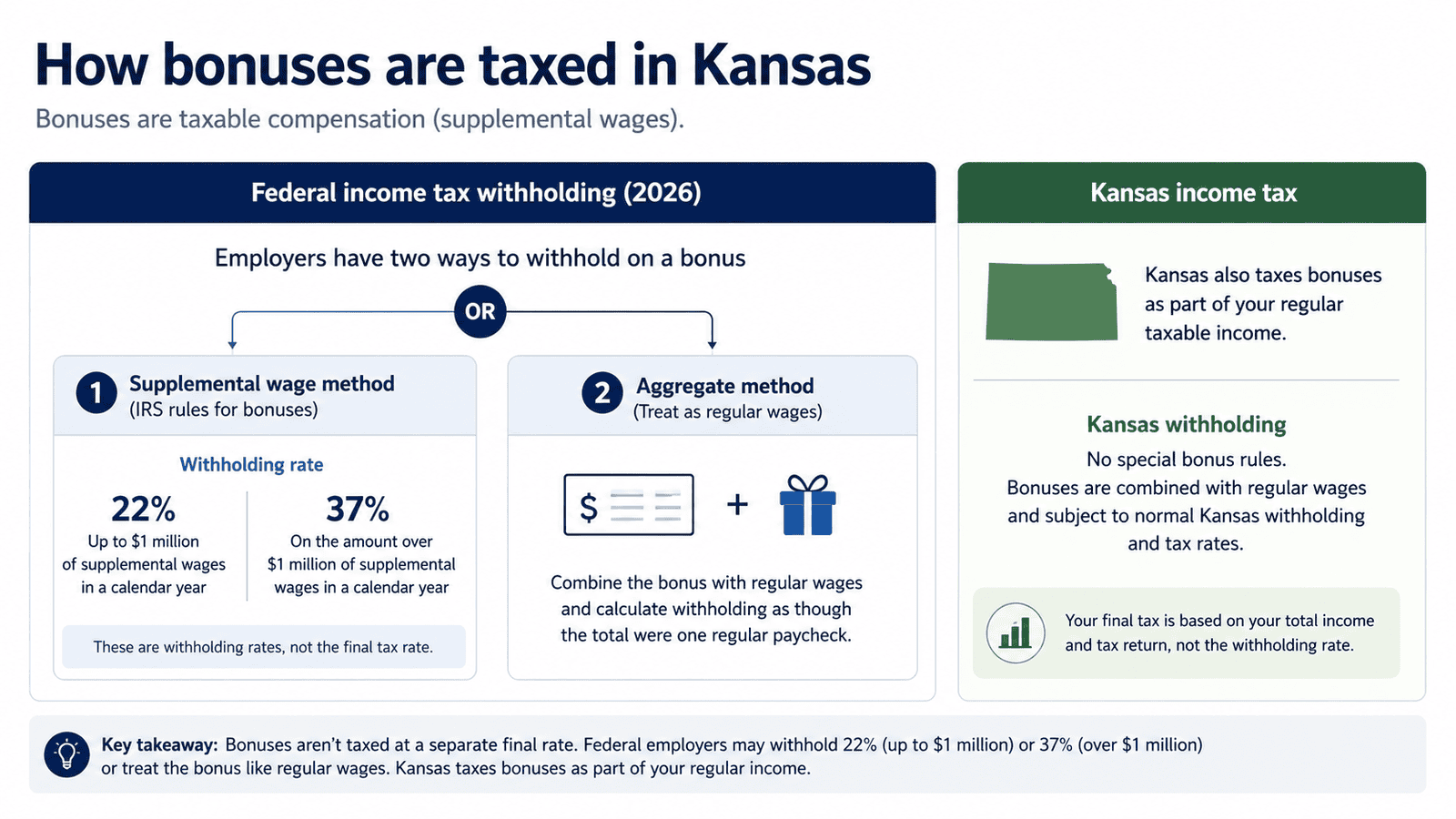
A bonus is taxable compensation. It is not subject to a separate final federal income tax rate simply because it is called a bonus, but employers may use a special withholding method when paying supplemental wages.
The IRS defines bonuses as supplemental wages. For 2026, an employer may withhold federal income tax at a flat 22% when the applicable supplemental wage rules are met. If an employee receives more than $1 million in supplemental wages during the year, the mandatory withholding rate on the excess is 37%. An employer may instead combine the bonus with regular wages and calculate withholding as though the total were one regular paycheck.
Kansas also treats bonuses, commissions, overtime, severance, and back pay as supplemental wages. The Kansas Department of Revenue requires Kansas withholding on supplemental wage payments. Kansas does not publish a universal flat bonus tax rate that determines the employee’s final state liability. The amount withheld depends on the employer’s permitted calculation method and the Kansas withholding rules.
Example of withholding on a $5,000 Kansas bonus
Suppose an employer pays a separate $5,000 bonus and uses the optional 22% federal method.
| Deduction | Calculation | Amount |
|---|---|---|
| Federal withholding | $5,000 × 22% | $1,100.00 |
| Social Security | $5,000 × 6.2% | $310.00 |
| Medicare | $5,000 × 1.45% | $72.50 |
| Kansas withholding | Varies by payroll calculation | Not fixed |
| Amount before Kansas withholding | $5,000 − $1,482.50 | $3,517.50 |
The 22% figure is withholding, not necessarily the final federal tax on the bonus. When the employee files a tax return, the bonus is combined with other taxable income and taxed under the normal marginal brackets.
Effect of 401(k) and health insurance premiums
Pretax benefits can reduce taxable income, but they do not all affect payroll taxes in the same way.
Traditional 401(k) contributions
Traditional 401(k) salary deferrals generally reduce wages subject to federal income tax. They also commonly reduce Kansas adjusted gross income because Kansas begins its calculation with federal income concepts. Traditional 401(k) contributions generally do not reduce Social Security or Medicare wages.
Example with a 5% traditional 401(k) contribution
Consider the $60,000 salary example. A 5% contribution equals $60,000 × 5% = $3,000 per year. The employee’s cash pay is reduced by $3,000, but federal and Kansas income taxes are also reduced.
Estimated federal taxable income: $60,000 − $3,000 − $16,100 = $40,900. Federal income tax: $12,400 at 10% ($1,240) plus $28,500 at 12% ($3,420) = $4,660.
Estimated Kansas taxable income: $60,000 − $3,000 − $3,605 − $9,160 = $44,235. Kansas income tax: $23,000 at 5.2% ($1,196) plus $21,235 at 5.58% ($1,184.91) = $2,380.91.
FICA remains approximately $60,000 × 7.65% = $4,590.
Estimated spendable take home = $60,000 − $3,000 − $4,660 − $4,590 − $2,380.91 = $45,369.09
| $60,000 salary scenario | No 401(k) | 5% traditional 401(k) |
|---|---|---|
| Employee contribution | $0 | $3,000.00 |
| Federal income tax | $5,020.00 | $4,660.00 |
| Kansas income tax | $2,548.31 | $2,380.91 |
| FICA | $4,590.00 | $4,590.00 |
| Spendable annual take home | $47,841.69 | $45,369.09 |
| Annual amount placed in 401(k) | $0 | $3,000.00 |
The contribution reduces spendable cash by about $2,472.60 rather than the full $3,000 because the example produces about $527.40 in combined federal and Kansas income tax savings. This does not include an employer match, investment gains or losses, plan fees, future taxes on withdrawals, or tax credits.
Health insurance premiums
Employer sponsored health insurance premiums paid through a qualifying cafeteria plan may reduce federal income tax, Kansas income tax, Social Security, and Medicare wages. For example, if an employee pays $200 per month in qualifying pretax premiums, that equals $2,400 per year. If the full $2,400 is excluded from FICA wages, the FICA savings alone would be $2,400 × 7.65% = $183.60. The income tax savings would depend on the employee’s federal and Kansas marginal rates. Not every premium is pretax; employees can review their benefits documents and pay stub to see how a particular deduction is treated.
How Kansas compares with neighboring states
Kansas shares borders with Missouri, Oklahoma, Nebraska, and Colorado. Each state has its own income tax structure, deductions, exemptions, and withholding formulas.
| State | General individual income tax structure | MoneyFN calculator |
|---|---|---|
| Kansas | Progressive, 5.2% and 5.58% brackets | Current page |
| Missouri | Progressive, top rate of 4.7% in 2026 withholding tables | Missouri paycheck calculator |
| Oklahoma | Progressive individual income tax | Oklahoma paycheck calculator |
| Nebraska | Progressive, with revised 2026 brackets | Nebraska paycheck calculator |
| Colorado | Flat individual income tax structure | Colorado paycheck calculator |
A top tax rate alone does not show which state will produce the highest take home pay. The calculation also depends on the size of each tax bracket, state deductions and exemptions, tax credits, pretax deductions, filing status, and household income. Cost of living, property taxes, and sales taxes are also separate from paycheck withholding. The paycheck calculator kansas results may differ from your pay stub because employers use specific withholding settings and benefit deductions. The paycheck calculator kansas also shows how pre-tax deductions like 401(k) contributions can affect your net pay.
Common paycheck calculator mistakes
Treating the marginal rate as the effective rate. A worker in the 22% federal bracket does not pay 22% of total gross income in federal income tax. Lower portions of taxable income are taxed at 10% and 12%.
Confusing withholding with final tax. The amount withheld from a check is a tax prepayment. Final liability is calculated on the employee’s tax return after accounting for total income, deductions, adjustments, and credits.
Using 24 paychecks for biweekly pay. Biweekly workers usually receive 26 paychecks per year. Semimonthly workers receive 24.
Assuming bonuses are only taxed at 22%. The 22% federal figure is an optional withholding method for many supplemental wage payments. It is not a separate final tax bracket for bonus income.
Forgetting pretax benefits. A calculation based only on salary and tax rates can overstate deposited pay when the actual paycheck also includes health premiums, retirement contributions, or other deductions.
Ignoring multiple jobs. Federal withholding can be too low when an employee or married couple has more than one job and the Forms W-4 do not reflect the combined income. A paycheck calculator kansas comparison can show how hourly pay converts into weekly, monthly, and annual take-home income. Before accepting a new job, try the paycheck calculator kansas to estimate how much you'll actually bring home.
Frequently asked questions
How much is taken out of my paycheck in Kansas?
A Kansas employee may have federal income tax, 6.2% Social Security tax, 1.45% Medicare tax, and Kansas income tax withheld. Benefit premiums, retirement contributions, garnishments, and other deductions may also reduce the deposited amount. For the single filer examples in this article, estimated federal, FICA, and Kansas taxes equal about 18.61% of a $45,000 salary, 20.26% of a $60,000 salary, and 23.90% of an $85,000 salary.
What is the Kansas income tax rate in 2026?
Kansas uses a progressive two bracket system. For single filers, Kansas taxable income up to $23,000 is taxed at 5.2%. Income over $23,000 is taxed at $1,196 plus 5.58% of the amount over $23,000. For married couples filing jointly, the threshold is $46,000. The Kansas Department of Revenue confirms this structure under SB 1 (2024 Special Session), effective for tax year 2024 and later.
How much is $60,000 a year after taxes in Kansas?
Under the assumptions used in this calculator, a single employee earning $60,000 has estimated annual take home pay of $47,841.69, or about $1,840.07 biweekly. This includes $5,020 in estimated federal income tax, $4,590 in FICA, and $2,548.31 in Kansas income tax. It excludes insurance, retirement contributions, credits, dependents, and other adjustments.
How are bonuses taxed in Kansas?
Bonuses are taxable as supplemental wages. Federal income tax may be withheld at a flat 22% when the applicable IRS rules are met, or the employer may combine the bonus with regular wages. Social Security and Medicare taxes generally apply. Kansas also requires withholding on supplemental wage payments. The final federal and Kansas tax depends on the employee’s total annual taxable income, not simply the amount withheld from the bonus check.
How do 401(k) contributions change take home pay in Kansas?
Traditional 401(k) contributions generally reduce federal and Kansas taxable income, which can lower income tax withholding. They normally do not reduce Social Security or Medicare tax. A Roth 401(k) contribution does not provide the same current income tax reduction because the contribution is generally made with after tax dollars.
Does Kansas have a flat income tax?
No. Kansas has a progressive income tax with two rates, 5.2% and 5.58%. For single filers, only Kansas taxable income over $23,000 enters the higher bracket.
Does Kansas have city income taxes?
Standard Kansas employee withholding does not include a separate city or county individual income tax. Other local taxes and employer deductions may still apply, but they are not a Kansas municipal wage income tax in the standard paycheck calculator.
Why is my actual paycheck different from this estimate?
Differences can result from Form W-4 entries, Form K-4 allowances, dependents, tax credits, multiple jobs, overtime, bonuses, insurance premiums, retirement contributions, garnishments, paid leave, and employer payroll rounding. Use the paycheck calculator kansas figures as planning estimates rather than exact payroll or tax advice. A paycheck calculator kansas helps compare net pay across different salaries, pay frequencies, and filing statuses.
Methodology
MoneyFN calculated the examples using an annual tax liability approach rather than reproducing an employer’s exact payroll table. The methodology was:
- Convert hourly pay to annual earnings using 40 hours per week and 52 weeks per year.
- Subtract the 2026 federal standard deduction of $16,100 for a single filer (IRS Revenue Procedure 2025-32).
- Apply the 2026 federal marginal tax brackets.
- Calculate employee Social Security at 6.2% on wages up to $184,500 and Medicare at 1.45%.
- Subtract the Kansas single standard deduction of $3,605 and personal exemption of $9,160 (Kansas Department of Revenue, KW-100).
- Apply the Kansas 5.2% and 5.58% income tax brackets with a single filer threshold of $23,000.
- Subtract estimated taxes from gross income.
- Divide annual take home pay by 26 for a biweekly estimate.
The examples exclude tax credits, dependents, itemized deductions, additional Medicare tax, employer benefits, local occupational charges, unemployment insurance paid by employers, and unusual income adjustments. Calculations are rounded to the nearest cent.
This content is for educational purposes only and does not constitute personalized financial advice. Consult a qualified financial advisor for guidance specific to your situation.
By Nathan Whitmore for MoneyFN Use the paycheck calculator kansas tool to estimate your take-home pay after federal and state tax withholdings.

Nathan Whitmore is a US based personal finance writer at MoneyFN covering salary, paycheck, and tax math for American workers. He works from primary sources only: IRS revenue procedures, Bureau of Labor Statistics wage data, and Federal Reserve statistics. Every figure he publishes is dated and traceable to a public source.