

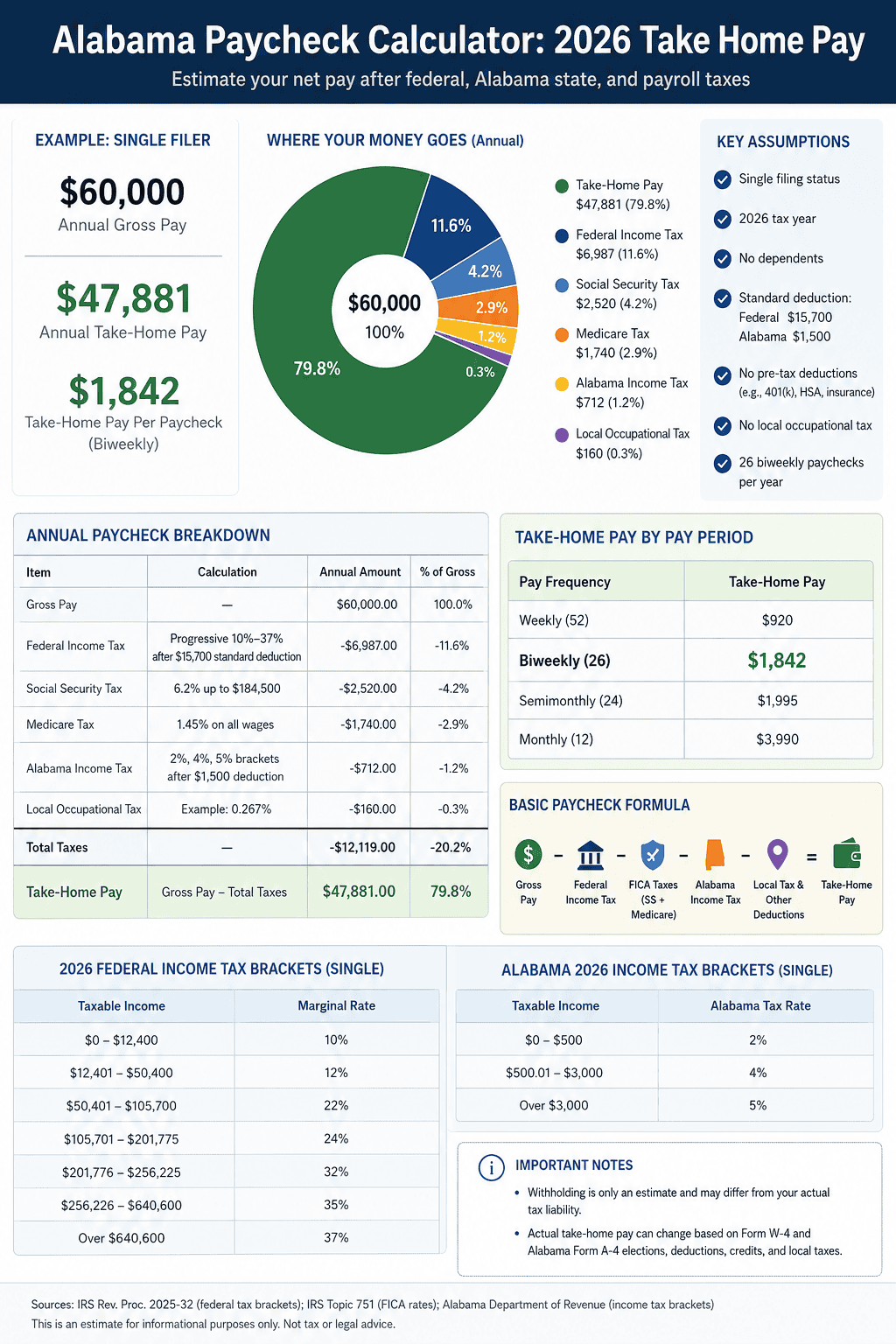
This paycheck calculator Alabama guide estimates take-home pay after federal income tax, Social Security, Medicare, and Alabama state income tax. Alabama uses progressive rates of 2%, 4%, and 5%, while some local occupational taxes may also apply. A single filer earning $60,000 could take home about $47,881 annually, or roughly $1,842 biweekly, before benefits and local taxes.

Alabama paycheck calculator
- Federal income tax: seven brackets from 10% to 37% (IRS, Rev. Proc. 2025-32)
- FICA: 6.2% Social Security (up to the $184,500 wage base) plus 1.45% Medicare (IRS Topic 751)
- Alabama state income tax: 2%, 4%, and 5% progressive brackets (Alabama Department of Revenue)
- Possible local occupational tax: varies by city or county
This estimate assumes a single filing status, no dependents, the federal and Alabama standard deductions, no pre tax deductions such as 401(k) or insurance, no local occupational tax, and 26 biweekly paychecks per year. Actual withholding may differ based on Form W-4 elections, Alabama Form A-4 elections, benefits, dependents, tax credits, and local taxes.
Use the MoneyFN salary after tax calculator to model a different salary, filing status, or pay frequency.
How the Alabama paycheck calculator works
An Alabama paycheck calculator starts with gross earnings and subtracts each tax and deduction that applies to the employee.
Information to enter
- Gross pay: the amount earned before taxes and deductions.
- Pay frequency: weekly, biweekly, semimonthly, monthly, or annually.
- Federal filing status: single, married filing jointly, married filing separately, or head of household.
- Alabama filing status: the exemption status reported on Alabama Form A-4.
- Pre tax deductions: traditional 401(k) contributions, qualifying health insurance premiums, health savings account contributions, and other eligible deductions.
- Post tax deductions: Roth retirement contributions, garnishments, union dues, or benefits that do not reduce taxable wages.
- Work location: needed when a city or county occupational tax applies.
Basic paycheck formula
Take home pay = gross pay − federal income tax − Social Security tax − Medicare tax − Alabama income tax − local tax − other payroll deductions
For an employee earning $60,000 annually and paid biweekly, gross biweekly pay is $60,000 ÷ 26 = $2,307.69. The calculator estimates each tax on an annual basis and divides the result by 26.
What the result means
The output is an estimate of federal income tax, Social Security tax, Medicare tax, Alabama income tax, local occupational tax (when applicable), pre tax deductions, post tax deductions, net annual pay, and net pay per paycheck. Payroll withholding is a prepayment of expected tax and is not always identical to the final liability shown on an employee’s federal or Alabama income tax return.
2026 federal taxes on your paycheck
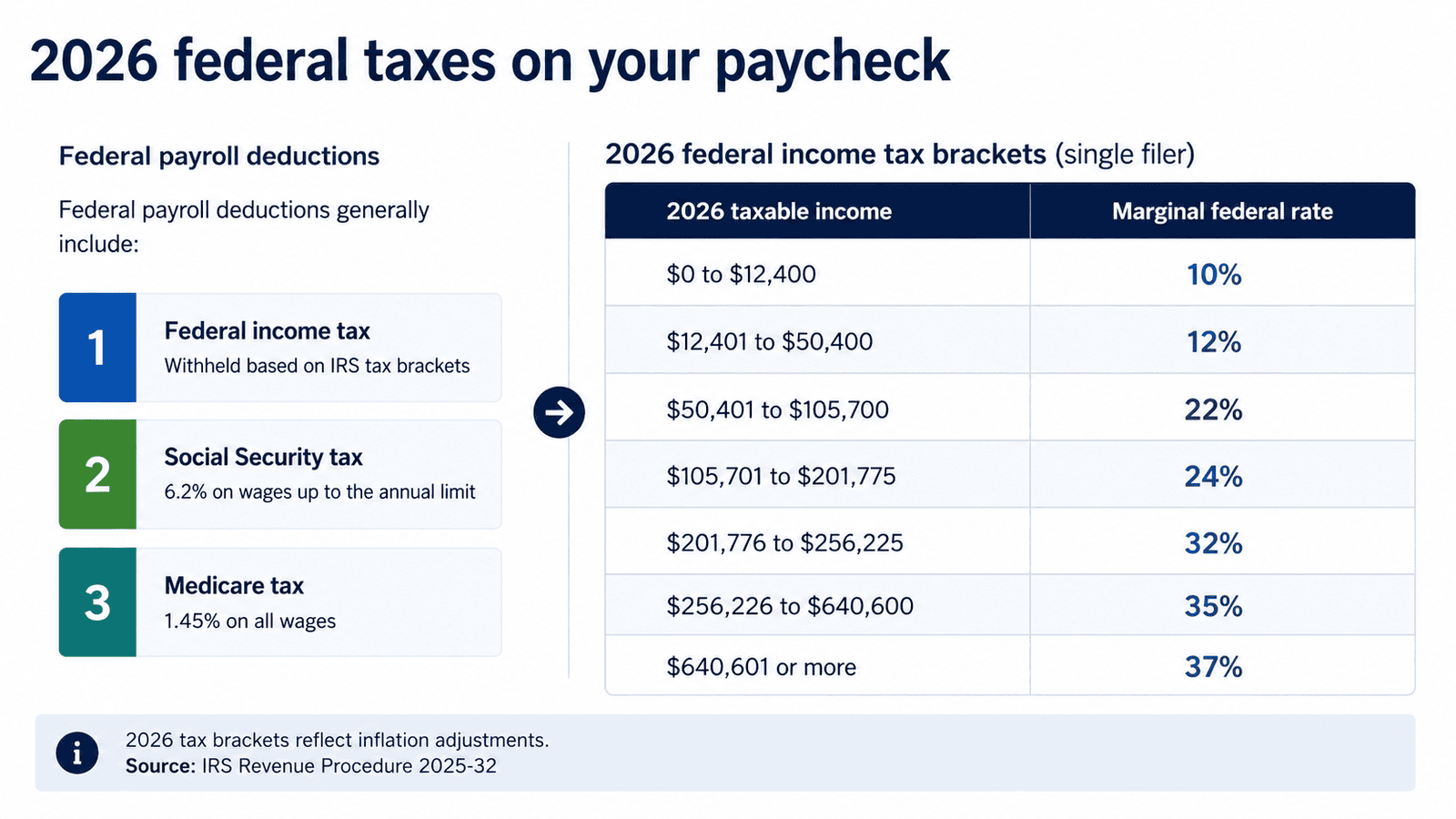
Federal payroll deductions generally include federal income tax, Social Security tax, and Medicare tax.
Federal income tax brackets for 2026
For tax year 2026, the federal income tax rates remain 10%, 12%, 22%, 24%, 32%, 35%, and 37%. The One Big Beautiful Bill Act, signed in July 2025, made the TCJA rate structure permanent and provided an additional inflation adjustment for the bottom two brackets. The following thresholds are from IRS Revenue Procedure 2025-32.
| 2026 taxable income (single filer) | Marginal federal rate |
|---|---|
| $0 to $12,400 | 10% |
| $12,401 to $50,400 | 12% |
| $50,401 to $105,700 | 22% |
| $105,701 to $201,775 | 24% |
| $201,776 to $256,225 | 32% |
| $256,226 to $640,600 | 35% |
| Over $640,600 | 37% |
For married couples filing jointly, the 10% bracket extends through $24,800, the 12% bracket through $100,800, and the 22% bracket through $211,400. A marginal rate applies only to income within that bracket, so a single filer whose taxable income falls in the 22% range does not pay 22% on every dollar earned.
Federal standard deduction for 2026
The IRS set the following standard deduction amounts for tax year 2026 (IRS, Rev. Proc. 2025-32).
| Filing status | 2026 standard deduction |
|---|---|
| Single | $16,100 |
| Married filing separately | $16,100 |
| Married filing jointly | $32,200 |
| Head of household | $24,150 |
For example, a single employee earning $60,000 with no pre tax deductions has estimated federal taxable income of:
$60,000 − $16,100 = $43,900
The estimated federal income tax would be $12,400 at 10% ($1,240) plus $31,500 at 12% ($3,780), for a total of $5,020. This estimate does not account for tax credits, itemized deductions, additional income, or special deductions.
Social Security tax in 2026
Employees generally pay 6.2% Social Security tax on wages up to the 2026 wage base of $184,500. The maximum employee Social Security tax for 2026 is therefore $11,439 (IRS Topic 751).
At $60,000 of wages:
$60,000 × 6.2% = $3,720
Medicare tax in 2026
Employees generally pay 1.45% Medicare tax on all covered wages with no regular wage ceiling (IRS Topic 751).
At $60,000:
$60,000 × 1.45% = $870
The regular employee FICA total is $3,720 + $870 = $4,590. Additional Medicare Tax may apply at higher income levels but does not affect the salary examples in this article.
Alabama state income tax explained
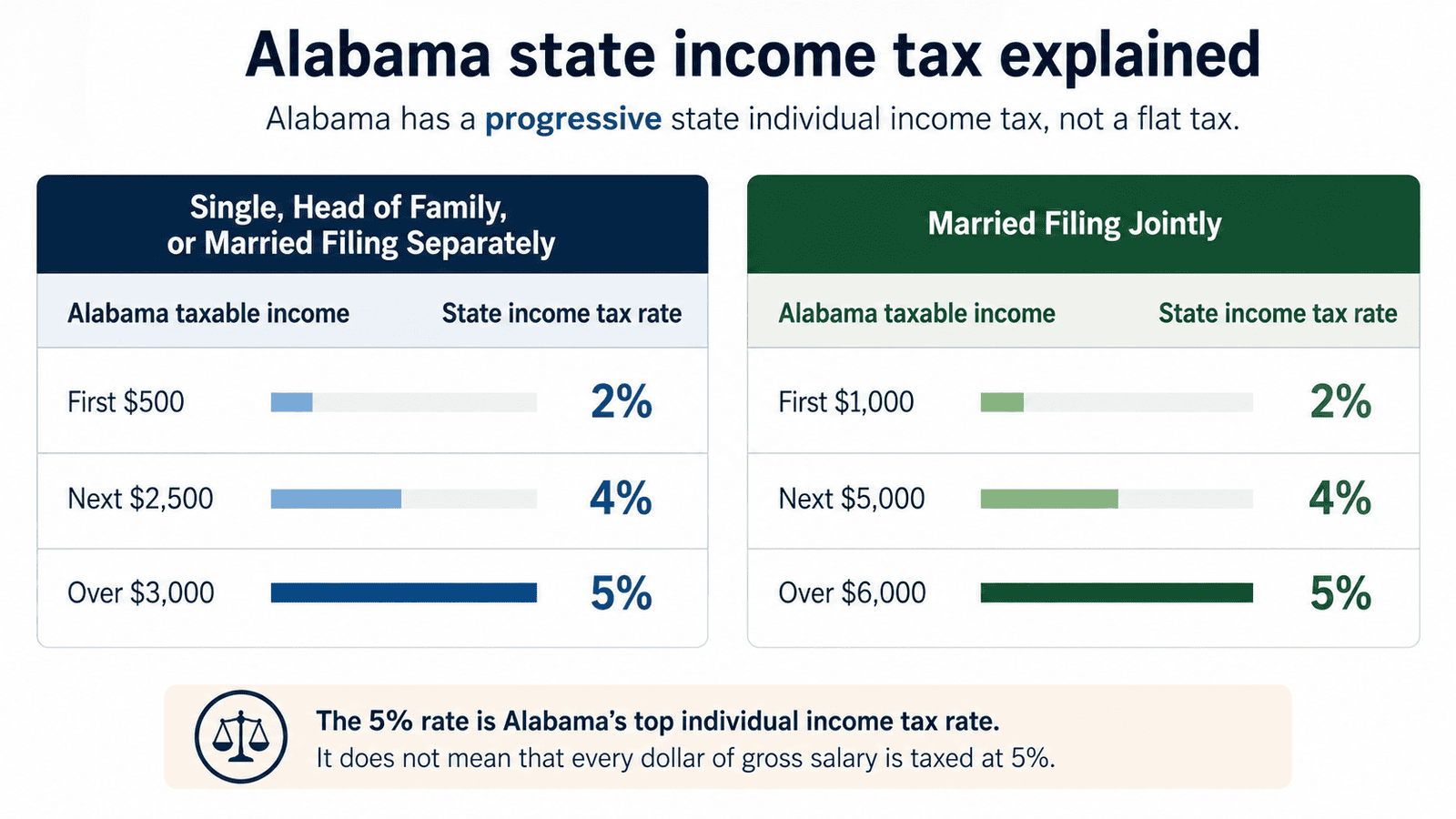
Alabama has a progressive state individual income tax, not a flat tax. The rates have been set at 2%, 4%, and 5% since 1935, with the brackets defined in the Alabama Constitution (Alabama Department of Revenue).
For single filers, heads of family, and married employees filing separately:
| Alabama taxable income | State income tax rate |
|---|---|
| First $500 | 2% |
| Next $2,500 | 4% |
| Over $3,000 | 5% |
For married couples filing jointly:
| Alabama taxable income | State income tax rate |
|---|---|
| First $1,000 | 2% |
| Next $5,000 | 4% |
| Over $6,000 | 5% |
The 5% rate is Alabama’s top individual income tax rate. It does not mean that every dollar of gross salary is taxed at 5%.
Alabama withholding deductions
The Alabama Department of Revenue’s January 2026 employer withholding instructions calculate taxable wages after several adjustments, including the Alabama standard deduction, federal income tax withholding, the Alabama personal exemption, dependent exemptions, and recognized pre tax deductions (Alabama Department of Revenue, January 2026 Withholding Booklet).
Alabama is one of only a few states that allow a deduction for federal income taxes paid when calculating state taxable income. This means the effective state tax burden is lower than it might appear from the bracket rates alone.
For a single employee earning at least $35,500, the Alabama withholding formula provides a $2,500 standard deduction and a $1,500 personal exemption.
For the examples below, estimated Alabama taxable wages are calculated as:
Alabama taxable income = gross wages − Alabama standard deduction − federal income tax − Alabama personal exemption
Do Alabama cities charge payroll taxes?
Alabama does not have a single statewide local income tax. However, some cities and counties impose an occupational tax on wages earned within their jurisdiction. These taxes are administered by the local government, not the Alabama Department of Revenue (Alabama Department of Revenue, January 2026 Withholding Booklet). Two workers with the same salary may receive different net pay when one works in a jurisdiction that imposes an occupational tax. The worked examples below exclude local occupational taxes.
Worked Alabama paycheck examples
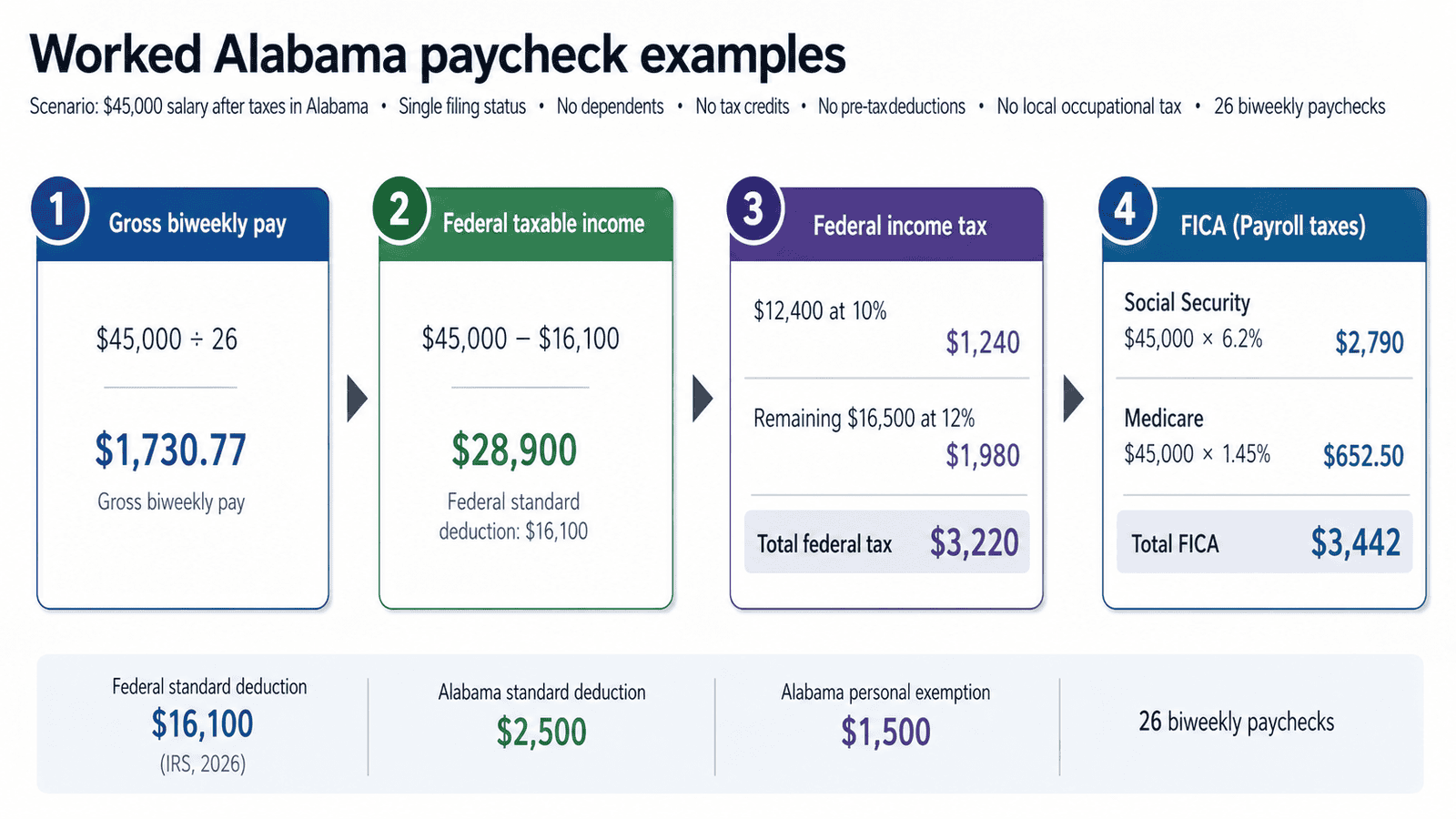
All three examples assume the following:
- Single filing status with no dependents
- No tax credits
- No pre tax deductions
- No local occupational tax
- 26 biweekly paychecks
- Federal standard deduction of $16,100 (IRS, 2026)
- Alabama standard deduction of $2,500
- Alabama personal exemption of $1,500
$45,000 salary after taxes in Alabama
Step 1: gross biweekly pay
$45,000 ÷ 26 = $1,730.77
Step 2: federal taxable income
$45,000 − $16,100 = $28,900
Step 3: federal income tax
$12,400 at 10% = $1,240. Remaining $16,500 at 12% = $1,980. Total federal tax: $3,220.
Step 4: FICA
Social Security: $45,000 × 6.2% = $2,790. Medicare: $45,000 × 1.45% = $652.50. Total FICA: $3,442.50.
Step 5: Alabama taxable income
$45,000 − $2,500 − $3,220 − $1,500 = $37,780
Step 6: Alabama income tax
$500 at 2% = $10. $2,500 at 4% = $100. $34,780 at 5% = $1,739. Total Alabama tax: $1,849.
Step 7: take home pay
$45,000 − $3,220 − $3,442.50 − $1,849 = $36,488.50
| $45,000 salary result | Amount |
|---|---|
| Annual take home pay | $36,488.50 |
| Monthly average | $3,040.71 |
| Biweekly take home pay | $1,403.40 |
| Weekly average | $701.70 |
| Effective deduction rate | 18.91% |
$60,000 salary after taxes in Alabama
Step 1: gross biweekly pay
$60,000 ÷ 26 = $2,307.69
Step 2: federal taxable income
$60,000 − $16,100 = $43,900
Step 3: federal income tax
$12,400 at 10% = $1,240. $31,500 at 12% = $3,780. Total federal tax: $5,020.
Step 4: FICA
Social Security: $60,000 × 6.2% = $3,720. Medicare: $60,000 × 1.45% = $870. Total FICA: $4,590.
Step 5: Alabama taxable income
$60,000 − $2,500 − $5,020 − $1,500 = $50,980
Step 6: Alabama income tax
$500 at 2% = $10. $2,500 at 4% = $100. $47,980 at 5% = $2,399. Total Alabama tax: $2,509.
Step 7: take home pay
$60,000 − $5,020 − $4,590 − $2,509 = $47,881
| $60,000 salary result | Amount |
|---|---|
| Annual take home pay | $47,881 |
| Monthly average | $3,990.08 |
| Biweekly take home pay | $1,841.58 |
| Weekly average | $920.79 |
| Effective deduction rate | 20.20% |
Under these assumptions, approximately $12,119 is removed for federal income tax, FICA, and Alabama income tax during the year.
$85,000 salary after taxes in Alabama
Step 1: gross biweekly pay
$85,000 ÷ 26 = $3,269.23
Step 2: federal taxable income
$85,000 − $16,100 = $68,900
Step 3: federal income tax
$12,400 at 10% = $1,240. $38,000 at 12% = $4,560. $18,500 at 22% = $4,070. Total federal tax: $9,870.
Step 4: FICA
Social Security: $85,000 × 6.2% = $5,270. Medicare: $85,000 × 1.45% = $1,232.50. Total FICA: $6,502.50.
Step 5: Alabama taxable income
$85,000 − $2,500 − $9,870 − $1,500 = $71,130
Step 6: Alabama income tax
$500 at 2% = $10. $2,500 at 4% = $100. $68,130 at 5% = $3,406.50. Total Alabama tax: $3,516.50.
Step 7: take home pay
$85,000 − $9,870 − $6,502.50 − $3,516.50 = $65,111
| $85,000 salary result | Amount |
|---|---|
| Annual take home pay | $65,111 |
| Monthly average | $5,425.92 |
| Biweekly take home pay | $2,504.27 |
| Weekly average | $1,252.13 |
| Effective deduction rate | 23.40% |
Salary comparison table
| Annual salary | Gross biweekly pay | Federal tax | FICA | Alabama tax | Estimated net biweekly pay |
|---|---|---|---|---|---|
| $45,000 | $1,730.77 | $3,220 | $3,442.50 | $1,849 | $1,403.40 |
| $60,000 | $2,307.69 | $5,020 | $4,590 | $2,509 | $1,841.58 |
| $85,000 | $3,269.23 | $9,870 | $6,502.50 | $3,516.50 | $2,504.27 |
These figures estimate annual tax liability and divide the result across 26 pay periods. An employer’s actual paycheck calculation may use payroll withholding tables and rounding rules that produce a slightly different result.
Hourly wages in Alabama
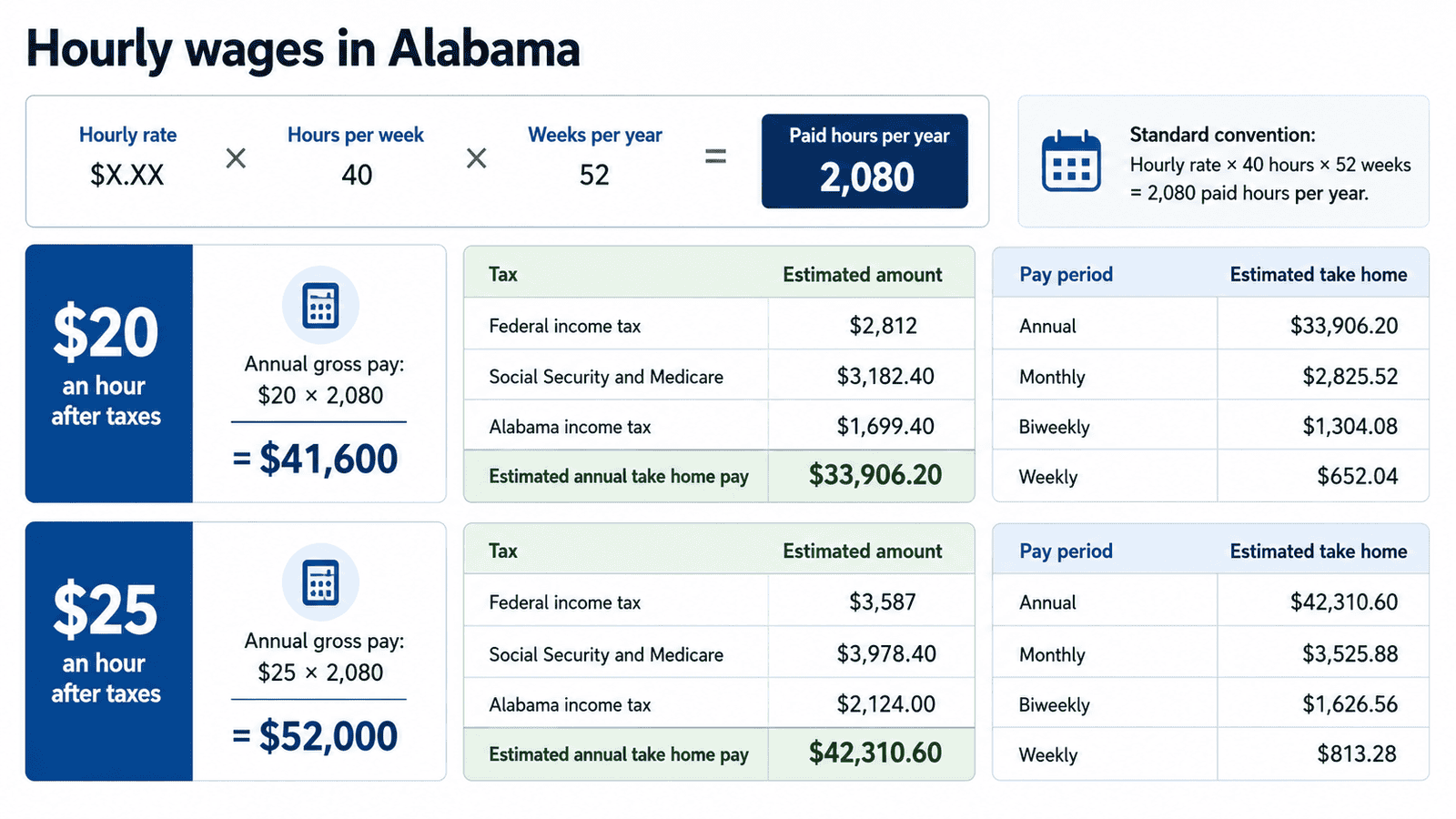
An Alabama paycheck calculator hourly estimate converts the hourly rate to annual earnings before calculating taxes. MoneyFN uses the standard convention of hourly rate × 40 hours × 52 weeks, which assumes 2,080 paid hours per year.
$20 an hour after taxes in Alabama
Annual gross pay: $20 × 2,080 = $41,600.
| Tax | Estimated amount |
|---|---|
| Federal income tax | $2,812 |
| Social Security and Medicare | $3,182.40 |
| Alabama income tax | $1,699.40 |
| Estimated annual take home pay | $33,906.20 |
| Pay period | Estimated take home |
|---|---|
| Annual | $33,906.20 |
| Monthly | $2,825.52 |
| Biweekly | $1,304.08 |
| Weekly | $652.04 |
$25 an hour after taxes in Alabama
Annual gross pay: $25 × 2,080 = $52,000.
| Tax | Estimated amount |
|---|---|
| Federal income tax | $4,060 |
| Social Security and Medicare | $3,978 |
| Alabama income tax | $2,157 |
| Estimated annual take home pay | $41,805 |
| Pay period | Estimated take home |
|---|---|
| Annual | $41,805 |
| Monthly | $3,483.75 |
| Biweekly | $1,607.88 |
| Weekly | $803.94 |
$30 an hour after taxes in Alabama
Annual gross pay: $30 × 2,080 = $62,400.
| Tax | Estimated amount |
|---|---|
| Federal income tax | $5,308 |
| Social Security and Medicare | $4,773.60 |
| Alabama income tax | $2,614.60 |
| Estimated annual take home pay | $49,703.80 |
| Pay period | Estimated take home |
|---|---|
| Annual | $49,703.80 |
| Monthly | $4,141.98 |
| Biweekly | $1,911.68 |
| Weekly | $955.84 |
These examples assume 40 paid hours every week. Unpaid leave, overtime, variable schedules, and local occupational taxes can change the result. For another hourly wage example, see $22 an hour is how much a year.
How bonuses are taxed in Alabama
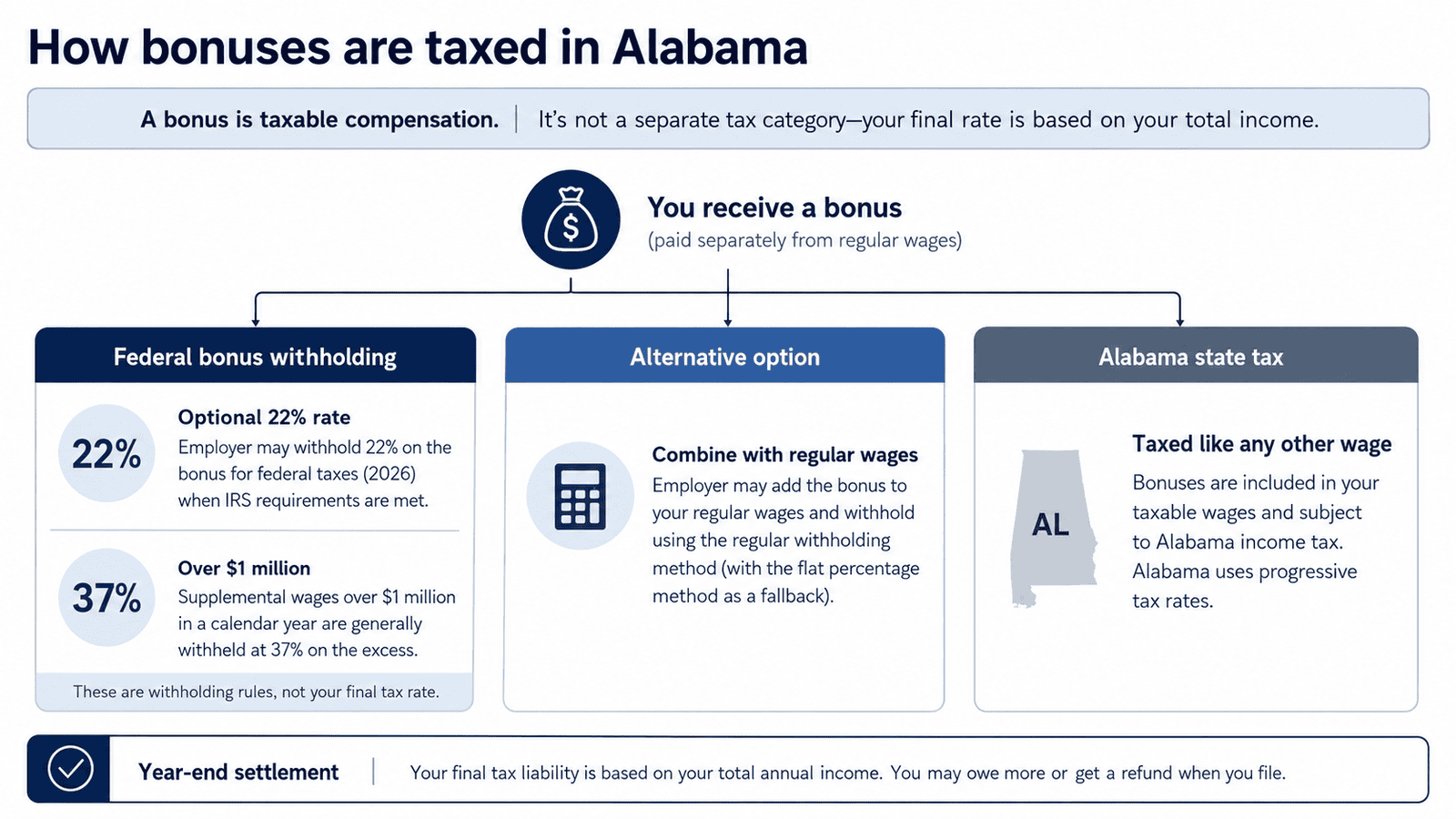
A bonus is taxable compensation. It is not a separate category of income with a permanently higher final tax rate. However, bonus withholding can look different from withholding on an ordinary paycheck.
Federal bonus withholding
For 2026, an employer that pays a bonus separately from regular wages may generally use the optional 22% federal supplemental wage withholding rate when the applicable IRS requirements are met. Supplemental wages exceeding $1 million for an employee during the calendar year are generally subject to a mandatory 37% federal withholding rate on the excess (IRS Publication 15, 2026).
Alternatively, an employer may combine the bonus with regular wages and calculate withholding using the aggregate method. That method can temporarily produce a larger withholding amount because payroll software treats the combined payment as if it represented the employee’s regular earnings level.
Alabama bonus withholding
Alabama generally treats all compensation for employee services as wages. The state’s withholding instructions apply Alabama’s regular wage withholding framework rather than publishing a separate fixed bonus tax rate (Alabama Department of Revenue, January 2026 Withholding Booklet). Because Alabama’s top individual rate is 5%, much of a bonus received by an employee already above the lower brackets will fall within the 5% state bracket.
Example of a $5,000 Alabama bonus
Assume a separate $5,000 bonus is subject to federal supplemental withholding at 22%, Social Security at 6.2%, Medicare at 1.45%, an illustrative Alabama withholding rate of 5%, and no local occupational tax.
| Bonus deduction | Amount |
|---|---|
| Federal withholding at 22% | $1,100 |
| Social Security at 6.2% | $310 |
| Medicare at 1.45% | $72.50 |
| Alabama withholding at 5% | $250 |
| Estimated net bonus | $3,267.50 |
This is a withholding illustration, not a separate calculation of final tax liability. The employee’s tax return reconciles the bonus with total annual income, deductions, and credits. A local occupational tax could reduce the net bonus further.
Effect of 401(k) and health insurance premiums
Pre tax payroll deductions can reduce income subject to federal and Alabama income tax, but the treatment depends on the type of benefit. The Alabama Department of Revenue recognizes qualifying Section 401(k), Section 403(b), and Section 125 cafeteria plan exclusions for withholding purposes (Alabama Department of Revenue, Withholding Tax FAQs).
Traditional 401(k) contributions
Traditional 401(k) contributions generally reduce federal and Alabama income taxable wages. They normally do not reduce Social Security or Medicare wages.
For 2026, the basic employee contribution limit for 401(k), 403(b), governmental 457, and federal Thrift Savings Plan accounts is $24,500. The general catch up limit for eligible participants age 50 or older is $8,000 (IRS, November 2025).
Example: 6% 401(k) contribution at $60,000
A 6% traditional 401(k) contribution equals $60,000 × 6% = $3,600 per year.
| Item | No 401(k) | 6% traditional 401(k) |
|---|---|---|
| Gross salary | $60,000 | $60,000 |
| Employee 401(k) contribution | $0 | $3,600 |
| Federal income tax | $5,020 | $4,588 |
| Alabama income tax | $2,509 | $2,350.60 |
| FICA | $4,590 | $4,590 |
| Spendable take home pay | $47,881 | $44,871.40 |
| Retirement contribution | $0 | $3,600 |
The employee’s spendable pay decreases by approximately $3,009.60 rather than the full $3,600 contribution, because the contribution produces an estimated $590.40 of combined federal and Alabama income tax savings.
Key point: On a biweekly basis, the $138.46 401(k) contribution reduces the estimated paycheck by only about $115.75 after the tax savings, bringing estimated biweekly take home pay to roughly $1,725.82. This example does not include an employer match.
Health insurance premiums
Employer sponsored health premiums paid through a qualifying Section 125 cafeteria plan may reduce federal income tax, Social Security tax, Medicare tax, and Alabama taxable wages. For example, a $250 monthly qualifying premium equals $3,000 per year. If it is excluded from federal, FICA, and Alabama taxable wages, its effect on spendable pay can be less than $3,000 because the employee also saves payroll and income taxes. Not every health related deduction receives identical treatment. Employees can review their benefits documents and pay stub tax wage boxes to see how a deduction is classified.
Roth 401(k) contributions
Roth 401(k) contributions are generally made after income taxes. They normally do not reduce current federal or Alabama taxable income, although qualified withdrawals may receive different tax treatment in retirement. A paycheck calculator Alabama comparison helps show how bonuses and regular wages affect take-home pay differently. The paycheck calculator alabama updates your estimated net pay instantly when you adjust income, filing status, or pre-tax deductions.
How Alabama compares with neighboring states
State income taxes can materially affect a paycheck, but rates alone do not determine final take home pay. Standard deductions, exemptions, tax credits, local taxes, and filing status also matter.
| State | 2026 individual wage tax structure | General paycheck effect |
|---|---|---|
| Alabama | Progressive: 2%, 4%, and 5% | State withholding plus possible local occupational tax |
| Mississippi | No tax on first $10,000 of taxable income; state rate above that threshold | State income tax withholding |
| Georgia | Flat 4.99% for tax year 2026 | State income tax withholding |
| Tennessee | No broad state individual tax on wages | Generally no state wage income tax withholding |
| Florida | No state individual income tax on wages | Generally no state wage income tax withholding |
Alabama’s progressive structure reaches 5% once taxable income exceeds $3,000 for a single filer or $6,000 for a married couple filing jointly (Alabama Department of Revenue). Georgia reduced its individual income tax rate to a flat 4.99% for tax year 2026 (Georgia Department of Revenue). Tennessee’s former Hall income tax on investment income is fully repealed (Tennessee Department of Revenue). Florida does not administer a state individual wage income tax.
Moving between states can also change housing, insurance, sales tax, property tax, commuting, and benefit costs. A state with no individual wage tax is not automatically the lowest cost location overall.
Common Alabama paycheck calculator mistakes
Treating the 5% Alabama rate as a tax on gross pay. The 5% rate applies to Alabama taxable income above the lower brackets. Deductions and exemptions reduce taxable income before the rates apply.
Forgetting local occupational taxes. Some Alabama cities and counties administer occupational taxes separately. A calculator that only includes state tax may overstate take home pay when the employee works in one of those jurisdictions.
Assuming a 401(k) avoids FICA. Traditional 401(k) contributions generally reduce income tax wages but remain subject to Social Security and Medicare taxes.
Confusing withholding with final tax. Payroll withholding estimates tax during the year. The final tax return accounts for total income, credits, deductions, and prior payments.
Using annual salary with the wrong pay frequency. Biweekly means 26 pay periods in most years. Semimonthly means 24. Dividing an annual salary by the wrong number of pay periods produces an incorrect paycheck estimate. The paycheck calculator Alabama results may be lower when local occupational taxes apply. Before accepting a new job, try the paycheck calculator alabama to estimate how much you will actually bring home.
Frequently asked questions
How much is taken out of my paycheck in Alabama?
An Alabama paycheck can include federal income tax, 6.2% Social Security tax, 1.45% Medicare tax, Alabama income tax, benefits, retirement contributions, and a local occupational tax where applicable. In the MoneyFN example, a single employee earning $60,000 has approximately $12,119, or 20.20% of gross pay, removed for federal income tax, regular FICA, and Alabama income tax. The estimated annual take home pay is $47,881 before benefits and local taxes.
What is the Alabama income tax rate in 2026?
Alabama has progressive individual income tax rates of 2%, 4%, and 5%. For a single filer, the first $500 of Alabama taxable income is taxed at 2%, the next $2,500 at 4%, and taxable income above $3,000 at 5%. Joint filers have wider lower brackets (Alabama Department of Revenue).
How much is $60,000 a year after taxes in Alabama?
A single filer earning $60,000 could take home approximately $47,881 annually, $3,990 monthly, $1,842 biweekly, or $921 weekly. This estimate assumes no dependents, no pre tax contributions, no tax credits, and no local occupational tax.
How are bonuses taxed in Alabama?
Bonuses are treated as taxable wages. Federal withholding may use the 22% supplemental wage rate when IRS requirements are met, while Alabama generally applies its regular withholding framework. Social Security, Medicare, and any applicable local occupational tax may also be withheld (IRS Publication 15, 2026).
How do 401(k) contributions change take home pay in Alabama?
A traditional 401(k) contribution generally reduces federal and Alabama taxable wages but usually does not reduce Social Security or Medicare wages. In the $60,000 example, contributing 6% ($3,600) reduces estimated spendable take home pay by about $3,009.60 because the employee receives an estimated $590.40 in federal and Alabama income tax savings.
Does Alabama have local income taxes?
Alabama does not impose one uniform local income tax across the state. Some cities or counties may impose occupational taxes on wages earned within their jurisdiction. These taxes are administered locally, not by the Alabama Department of Revenue (Alabama Department of Revenue, January 2026 Withholding Booklet).
Is Alabama income tax flat or progressive?
Alabama’s individual income tax is progressive. The state uses three rates of 2%, 4%, and 5%, with the applicable brackets depending on filing status (Alabama Department of Revenue).
Why is my actual paycheck different from the calculator?
Differences can result from Federal Form W-4 settings, Alabama Form A-4 settings, dependents and tax credits, health insurance deductions, retirement contributions, overtime or bonuses, local occupational taxes, post tax deductions, employer payroll rounding, and Additional Medicare Tax withholding at higher incomes. Use the paycheck calculator Alabama figures as a planning estimate rather than an exact payroll statement. A paycheck calculator alabama helps compare net pay across different salaries, pay frequencies, and deduction choices.
Methodology
MoneyFN calculated the examples in this article using tax rules available as of July 11, 2026. The estimates use the 2026 federal income tax brackets and standard deductions published by the IRS in Revenue Procedure 2025-32, 6.2% employee Social Security tax on wages up to $184,500, 1.45% employee Medicare tax (IRS Topic 751), Alabama’s January 2026 withholding formula, and Alabama’s 2%, 4%, and 5% individual income tax brackets (Alabama Department of Revenue).
All examples assume single filing status with no dependents, the Alabama standard deduction of $2,500 and personal exemption of $1,500 from the state withholding formula, 26 biweekly pay periods, no local occupational tax, and no tax credits or itemized deductions. Annual estimated tax is divided by the number of pay periods to produce paycheck figures. Results are rounded to the nearest cent where appropriate.
Actual payroll systems use employee withholding forms, payroll tables, benefit classifications, and employer rounding procedures. For that reason, a pay stub may differ slightly from these annualized estimates.
This content is for educational purposes only and does not constitute personalized financial advice. Consult a qualified financial advisor for guidance specific to your situation.
By Nathan Whitmore for MoneyFN Use the paycheck calculator alabama to estimate your take-home pay after federal and state tax withholdings.

Nathan Whitmore is a US based personal finance writer at MoneyFN covering salary, paycheck, and tax math for American workers. He works from primary sources only: IRS revenue procedures, Bureau of Labor Statistics wage data, and Federal Reserve statistics. Every figure he publishes is dated and traceable to a public source.