

22 dollars an hour is how much a year? At $22 per hour, you earn $45,760 per year before taxes if you work 40 hours a week for 52 weeks. Your actual take-home pay will vary based on your tax filing status, state income taxes, FICA withholding, pre-tax deductions, and the hours you work.
22 dollars an hour is how much a year: $22 an hour salary calculator
The math behind $22 an hour to a yearly salary
The standard method for converting any hourly wage to an annual salary uses 2,080 working hours per year. That number comes from multiplying 40 hours per week by 52 weeks in a year. The federal government, the Bureau of Labor Statistics, and most employers treat 2,080 hours as the baseline for a full time position.
This assumes you are paid for every week of the year, including holidays and vacation days. If your employer offers paid time off, your gross salary stays the same because you are still compensated during those weeks. If you take unpaid time off, your actual earnings for the year will be lower. You can run your own numbers with our hourly to salary calculator.
$22 an hour broken down by pay period
It helps to see your earnings across every common pay cycle. The table below shows what $22 an hour looks like before taxes on a weekly, biweekly, semimonthly, monthly, and annual basis, all assuming a 40 hour work week.
| Pay period | Gross pay | How it is calculated |
|---|---|---|
| Weekly | $880 | $22 × 40 hours |
| Biweekly | $1,760 | $880 × 2 |
| Semimonthly | $1,906.67 | $45,760 ÷ 24 |
| Monthly | $3,813.33 | $45,760 ÷ 12 |
| Annual | $45,760 | $22 × 2,080 hours |
Most employers pay on a biweekly schedule, which means you receive 26 paychecks per year. That $1,760 gross paycheck is the number you will see before any deductions are applied.
What $22 an hour looks like after taxes in 2026
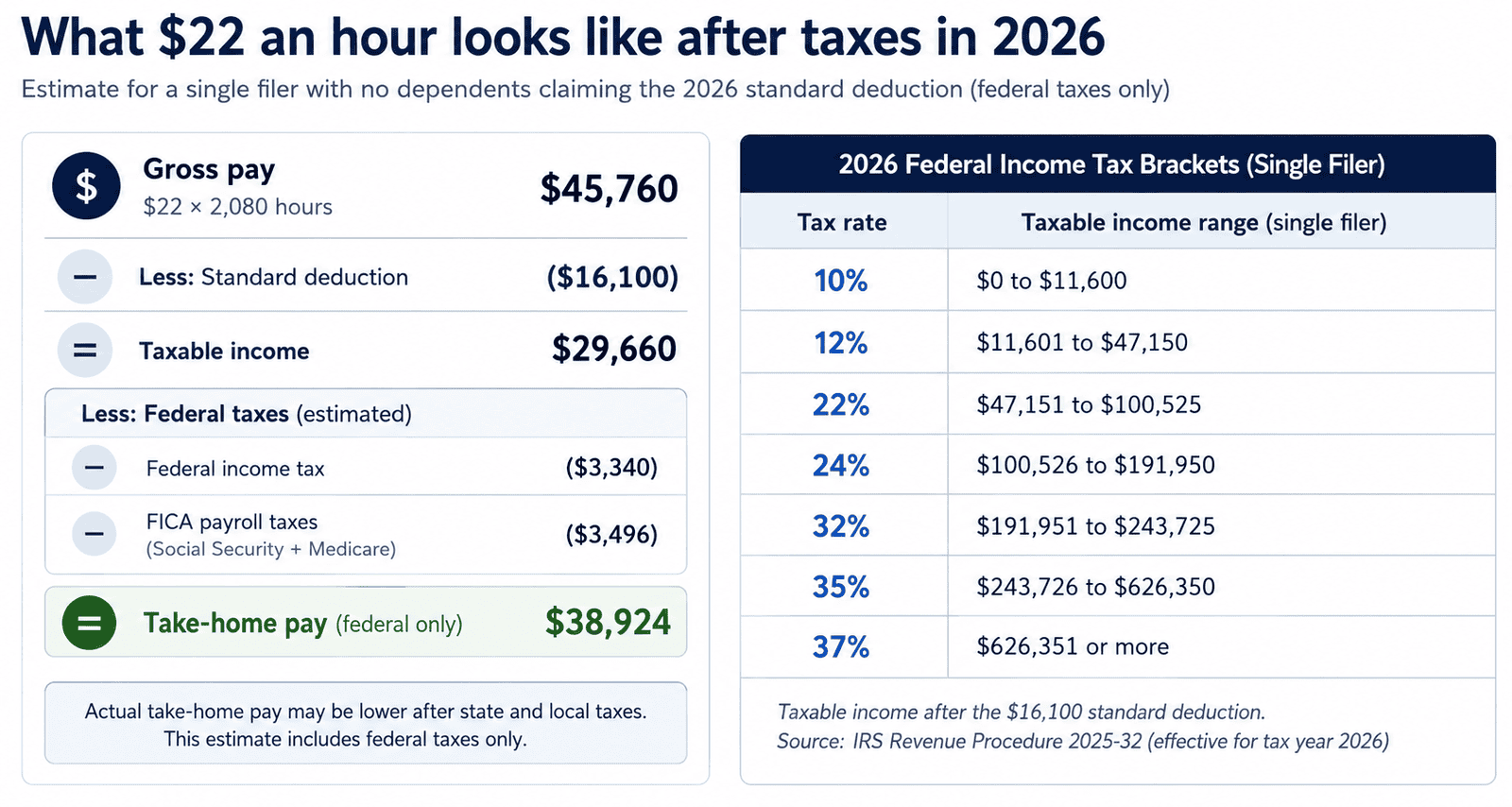
Your take home pay depends on federal income tax, FICA payroll taxes (Social Security and Medicare), and any state or local taxes. Below is an estimate of federal taxes only for a single filer with no dependents who claims the standard deduction in 2026.
2026 federal income tax estimate
The 2026 standard deduction for a single filer is $16,100 (IRS Revenue Procedure 2025‑32, effective for tax year 2026). Subtracting that from $45,760 in gross wages leaves $29,660 in taxable income.
The 2026 federal income tax brackets for single filers, as published in IRS Revenue Procedure 2025‑32, are shown below.
| Tax rate | Taxable income range (single filer) | Tax owed on $29,660 |
|---|---|---|
| 10% | $0 to $12,400 | $1,240.00 |
| 12% | $12,401 to $50,400 | $2,071.20 (on $17,260) |
Total estimated federal income tax: $3,311.20
2026 FICA taxes
FICA consists of two parts (IRS Topic No. 751, updated for 2026).
Social Security tax: 6.2% on wages up to the 2026 wage base of $184,500. On $45,760, that equals $2,837.12.
Medicare tax: 1.45% on all wages with no cap. On $45,760, that equals $663.52.
Total FICA: $3,500.64
Total estimated federal tax burden
| Tax type | Annual amount |
|---|---|
| Federal income tax | $3,311.20 |
| Social Security (6.2%) | $2,837.12 |
| Medicare (1.45%) | $663.52 |
| Total federal taxes | $6,811.84 |
After subtracting $6,811.84 in federal taxes from $45,760, a single filer earning $22 an hour would take home roughly $38,948 per year, or about $3,246 per month. This estimate does not include state income tax, local tax, or pre tax deductions like retirement contributions or health insurance premiums.
For a complete state by state breakdown, see our full guide on $22 an hour after taxes. If you live in Texas, which has no state income tax, you can also check our Texas paycheck calculator.
$22 an hour working part time
Not everyone works a full 40 hour week. If you work fewer hours, here is what your annual gross pay looks like at $22 an hour.
| Hours per week | Weekly pay | Annual pay (52 weeks) |
|---|---|---|
| 20 hours | $440 | $22,880 |
| 25 hours | $550 | $28,600 |
| 30 hours | $660 | $34,320 |
| 35 hours | $770 | $40,040 |
At 30 hours per week, your annual gross income drops to $34,320. At 35 hours per week, it comes to $40,040. The difference between 35 and 40 hours per week is $5,720 per year, which is worth considering if you are weighing schedule flexibility against total earnings.
How overtime changes your pay at $22 an hour
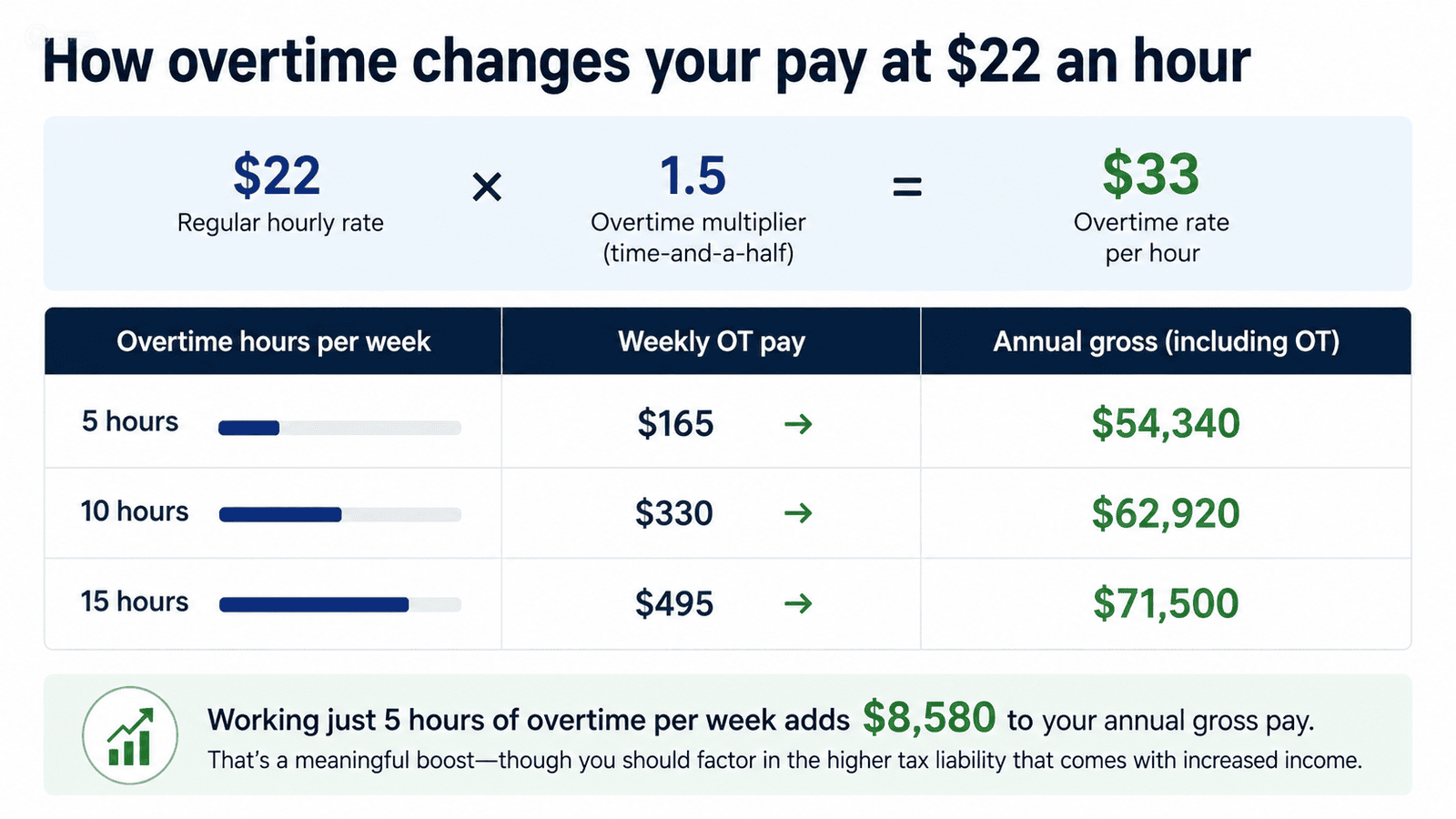
Under the Fair Labor Standards Act, non exempt employees must receive overtime pay of at least 1.5 times their regular rate for every hour worked beyond 40 in a single workweek. At $22 an hour, your overtime rate is $33 per hour.
Here is how a few common overtime scenarios affect your annual income.
| Overtime hours per week | Weekly OT pay | Annual gross (including OT) |
|---|---|---|
| 5 hours | $165 | $54,340 |
| 10 hours | $330 | $62,920 |
| 15 hours | $495 | $71,500 |
Working just five hours of overtime per week adds $8,580 to your annual gross pay. That is a meaningful boost, though you should factor in the higher tax liability that comes with increased income.
Is $22 an hour a good wage in 2026
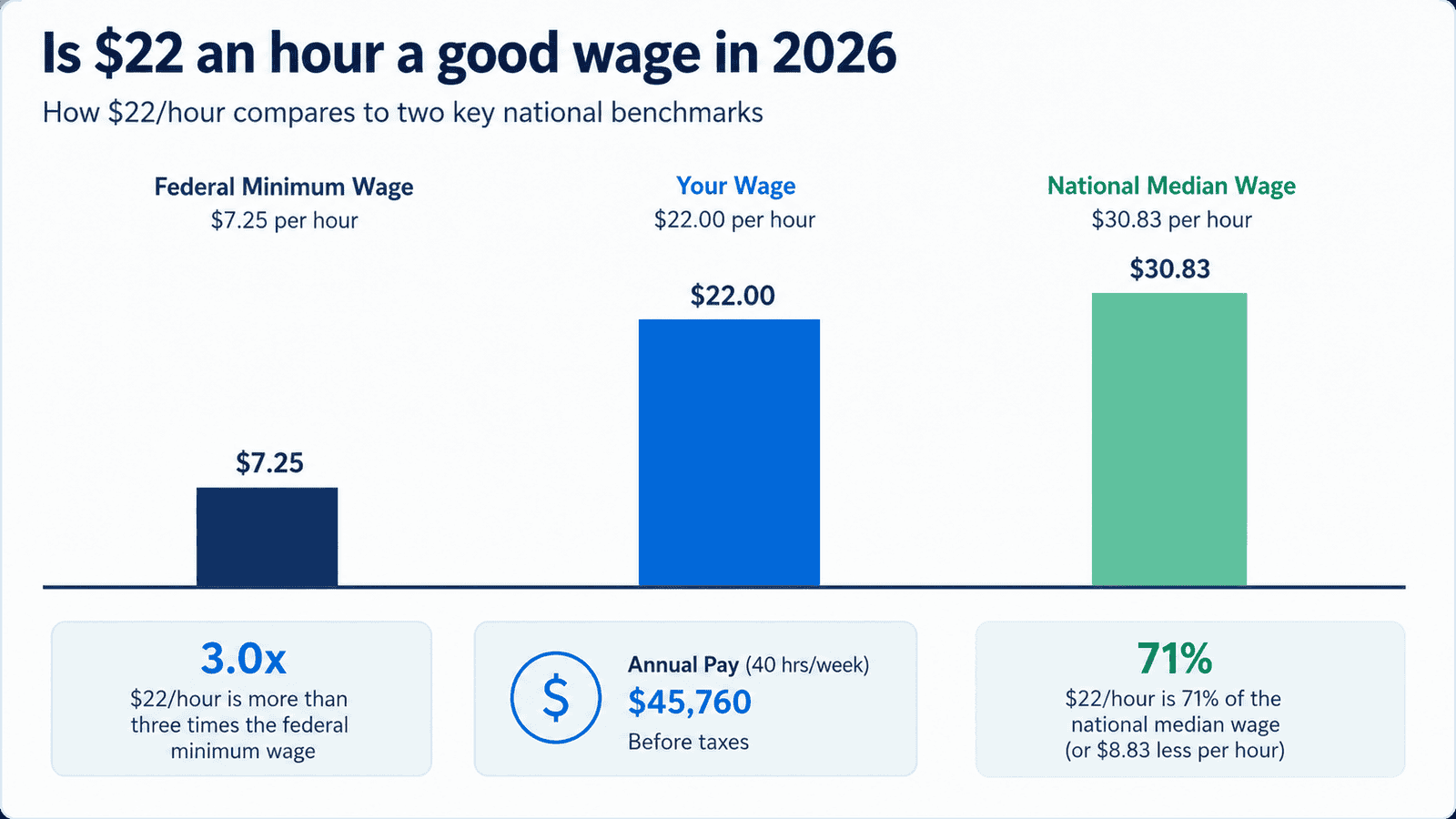
Whether $22 an hour is “good” depends on your location, household size, and financial goals. Here is how it compares to two important national benchmarks.
The federal minimum wage is $7.25 per hour and has remained unchanged since July 2009 (U.S. Department of Labor, Wage and Hour Division, updated July 1, 2026). At $22 an hour, you earn more than three times the federal minimum wage.
The Bureau of Labor Statistics reported that median usual weekly earnings for full time wage and salary workers were $1,233 in the first quarter of 2026 (BLS, Usual Weekly Earnings of Wage and Salary Workers, Q1 2026). That translates to approximately $30.83 per hour. At $22 an hour, your pay falls below the national median by about $8.83 per hour, or roughly $18,360 per year.
In practical terms, $22 an hour provides a livable income in many lower cost areas of the country, but it may feel tight in expensive metro areas like New York City, San Francisco, or Boston. A single person with modest expenses can make $22 an hour work comfortably in much of the South, Midwest, and parts of the Mountain West.
At $22 an hour you earn more than triple the federal minimum wage, but your annual salary of $45,760 falls below the national median. Cost of living in your area is the biggest factor in how far this wage stretches.
To see how nearby wage levels compare, check our guides for $19 an hour, $20 an hour, $21 an hour, and $23 an hour.
Sample monthly budget on $22 an hour
Using the estimated federal after tax monthly income of roughly $3,246 (single filer, no state income tax for simplicity), here is a sample budget using the 50/30/20 rule. This framework allocates 50% of take home pay to needs, 30% to wants, and 20% to savings and debt repayment.
| Category | Percentage | Monthly amount | Example expenses |
|---|---|---|---|
| Needs | 50% | $1,623 | Rent or mortgage, utilities, groceries, insurance, minimum debt payments, transportation |
| Wants | 30% | $974 | Dining out, entertainment, subscriptions, hobbies, nonessential shopping |
| Savings and debt repayment | 20% | $649 | Emergency fund, retirement contributions, extra debt payments |
The $1,623 allocated to needs must cover housing, which is typically the largest line item. A common guideline suggests keeping housing costs at or below 30% of gross income, which would be about $1,144 per month on a $45,760 salary. In many parts of the country, that amount can cover rent for a studio or one bedroom apartment.
The $649 going toward savings may seem modest, but it adds up to $7,788 per year. Directing even a portion of that into a 401(k) or Roth IRA early in your career can make a significant difference over time through compound growth.
Frequently asked questions
How much is $22 an hour per week?
At 40 hours per week, $22 an hour is $880 per week before taxes.
How much is $22 an hour per month?
Working full time, $22 an hour comes to approximately $3,813 per month before taxes ($45,760 divided by 12 months).
Can you live on $22 an hour?
A single person can live on $22 an hour in many parts of the United States, particularly in areas with a lower cost of living. It becomes more challenging in high cost cities or for households with multiple dependents. Budgeting carefully, minimizing high interest debt, and building an emergency fund are all important at this income level.
What is the difference between $22 an hour full time and part time?
A full time worker at $22 an hour earns $45,760 per year. A part time worker at 30 hours per week earns $34,320, and one at 20 hours per week earns $22,880. The gap between full time and 30 hours per week is $11,440 annually.
How does $22 an hour compare to the median American wage?
The BLS reported median weekly earnings of $1,233 for full time workers in Q1 2026, which works out to about $30.83 per hour. At $22 an hour, your earnings are below the national median. However, cost of living varies greatly by region, and $22 an hour goes further in some areas than the median wage does in others.
How much is $22 an hour after taxes?
For a single filer claiming the 2026 standard deduction with no state income tax, roughly $38,948 per year or about $3,246 per month after federal taxes. State taxes will reduce that amount further in most states. Visit our $22 an hour after taxes page for the full breakdown. Understanding 22 dollars an hour is how much a year makes it easier to compare job offers, estimate take-home pay, and plan your monthly budget.
Methodology
All calculations in this article use a standard full time schedule of 40 hours per week and 52 weeks per year (2,080 annual hours). Federal income tax estimates use the 2026 tax brackets and standard deduction published in IRS Revenue Procedure 2025‑32. FICA tax rates are sourced from IRS Publication 926 (2026 edition) and IRS Topic No. 751: Social Security tax at 6.2% on wages up to $184,500 and Medicare tax at 1.45% on all wages. The federal minimum wage of $7.25 per hour is sourced from the U.S. Department of Labor, Wage and Hour Division (updated July 1, 2026).
Median weekly earnings of $1,233 are sourced from the Bureau of Labor Statistics, Usual Weekly Earnings of Wage and Salary Workers, Q1 2026. All figures are gross (before tax) unless explicitly stated otherwise. No state or local taxes are included in the estimates. This article is for educational purposes only and does not account for individual circumstances such as pre tax deductions, credits, dependents, or filing status other than single.
This content is for educational purposes only and does not constitute personalized financial advice. Consult a qualified financial advisor for guidance specific to your situation.
By Nathan Whitmore for MoneyFN If you are wondering 22 dollars an hour is how much a year, this guide breaks down your annual, monthly, biweekly, and weekly earnings.

Nathan Whitmore is a US based personal finance writer at MoneyFN covering salary, paycheck, and tax math for American workers. He works from primary sources only: IRS revenue procedures, Bureau of Labor Statistics wage data, and Federal Reserve statistics. Every figure he publishes is dated and traceable to a public source.