

23 dollars an hour is how much a year? At $23 per hour, you earn $47,840 per year before taxes if you work 40 hours a week for all 52 weeks. Your actual take-home pay depends on your filing status, state taxes, pre-tax deductions, and hours worked, but a single filer with no state income tax would keep about $40,619 per year, or roughly $3,385 per month, after estimated 2026 federal taxes.
23 dollars an hour is how much a year: $23 an hour salary calculator
The math behind $23 an hour to a yearly salary
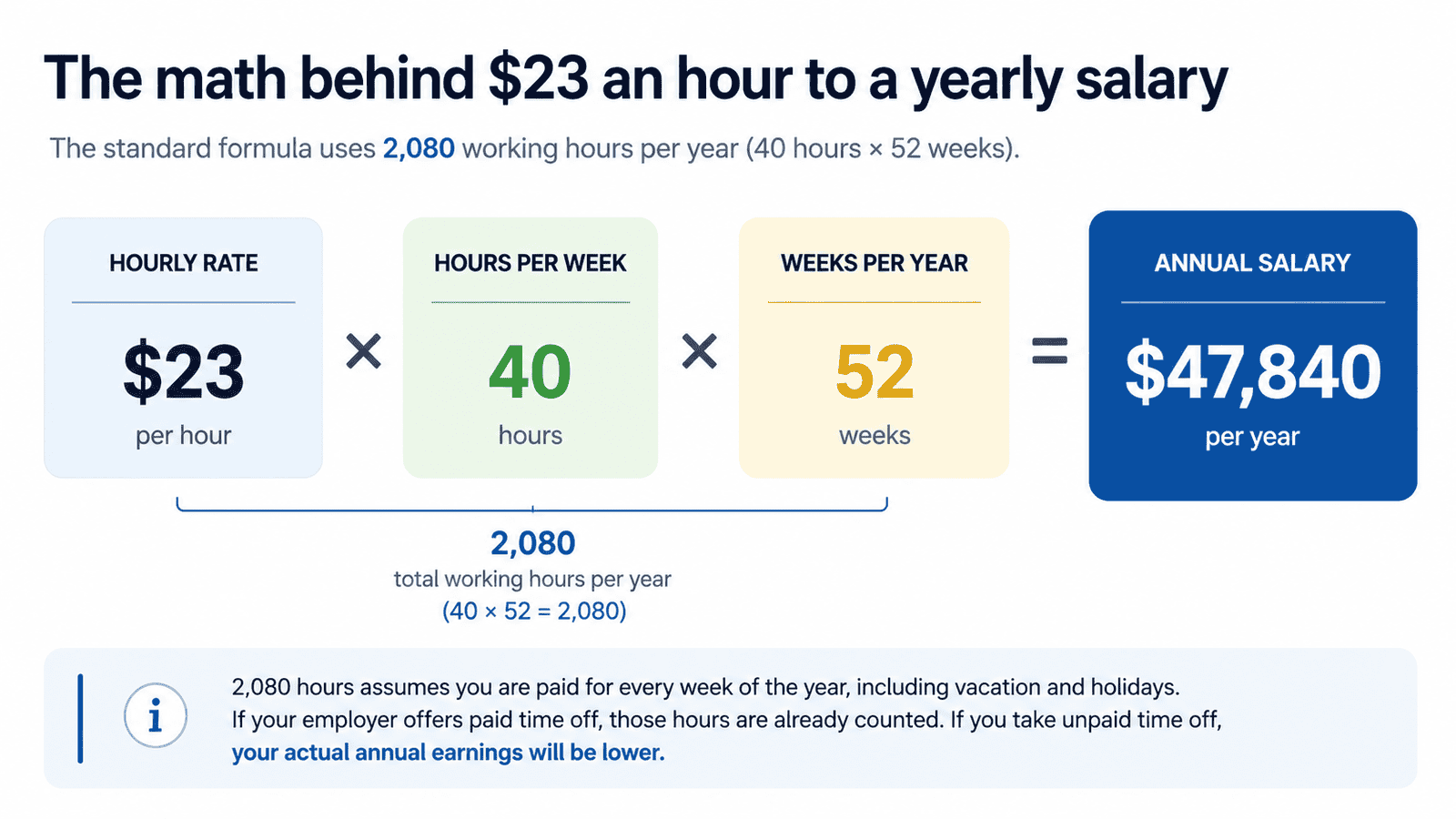
The standard formula for converting an hourly wage to an annual salary uses 2,080 working hours per year. That number comes from multiplying 40 hours per week by 52 weeks in a year. The federal government, the Bureau of Labor Statistics, and most payroll systems treat 2,080 hours as a full time work year, which is why it appears in virtually every salary conversion.
Keep in mind that 2,080 hours assumes you are paid for every week of the year, including vacation and holidays. If your employer offers paid time off, those hours are already counted. If you take unpaid time off, your actual annual earnings will be lower. You can plug different numbers into our hourly to salary calculator to see how changes in hours or rate affect the total.
$23 an hour broken down by pay period
Most people do not think about their income on an annual basis alone. The table below converts $23 an hour into each common pay period, assuming a 40 hour work week with no overtime.
| Pay period | Gross earnings | How it is calculated |
|---|---|---|
| Weekly | $920 | $23 × 40 hours |
| Biweekly | $1,840 | $920 × 2 |
| Semimonthly | $1,993 | $47,840 ÷ 24 |
| Monthly | $3,987 | $47,840 ÷ 12 |
| Annual | $47,840 | $23 × 2,080 hours |
If you are paid biweekly, you will receive 26 paychecks per year. Two months each year will contain three pay dates, which can be helpful for budgeting or making extra payments on debt.
What $23 an hour looks like after taxes in 2026
Your gross pay of $47,840 does not all land in your bank account. Federal income tax and FICA payroll taxes are withheld from every paycheck. The estimates below assume you are a single filer with no dependents, you take the standard deduction, and you have no pre tax retirement or health insurance deductions.
2026 federal income tax
For the 2026 tax year, the IRS maintains seven marginal tax brackets: 10%, 12%, 22%, 24%, 32%, 35%, and 37%. The standard deduction for a single filer in 2026 is $16,100 (IRS Revenue Procedure 2025-32, October 2025).
Starting with $47,840 in gross wages, subtracting the $16,100 standard deduction leaves $31,740 in taxable income. Because the tax system is progressive, that $31,740 is split across the first two brackets for a single filer in 2026:
| Bracket | Taxable income range | Tax owed |
|---|---|---|
| 10% | First $12,400 | $1,240 |
| 12% | $12,401 to $31,740 | $2,320.80 |
| Total | $3,560.80 |
FICA taxes (Social Security and Medicare)
FICA taxes are calculated on your gross wages, not your taxable income. The rates for 2026 are confirmed in IRS Topic No. 751 and IRS Publication 926, 2026 edition:
- Social Security: 6.2% on wages up to the 2026 wage base of $184,500. On $47,840, that equals $2,966.08.
- Medicare: 1.45% on all wages with no cap. On $47,840, that equals $693.68.
Total FICA: $3,659.76.
Estimated take home pay
Combining federal income tax of $3,560.80 with FICA of $3,659.76 gives total estimated federal taxes of $7,220.56.
That works out to roughly $3,385 per month before any state or local taxes. State income taxes vary widely. Texas, Florida, and several other states charge no state income tax, while California and New York have rates that can meaningfully reduce take home pay. For a full state level estimate, see our Texas paycheck calculator as an example of a no income tax state, or visit our detailed breakdown at $23 an hour after taxes.
$23 an hour working part time
Not everyone works a 40 hour week. If you work fewer hours, your annual income drops proportionally.
| Weekly hours | Annual gross pay | Monthly gross pay |
|---|---|---|
| 30 hours | $35,880 | $2,990 |
| 35 hours | $41,860 | $3,488 |
| 40 hours (full time) | $47,840 | $3,987 |
At 30 hours per week, $23 an hour comes to $35,880 per year. At 35 hours per week, it totals $41,860. Both figures are before taxes. Part time workers may also want to check whether their employer offers benefits such as health insurance, because losing employer sponsored coverage can offset some of the income difference between part time and full time work.
How overtime changes $23 an hour
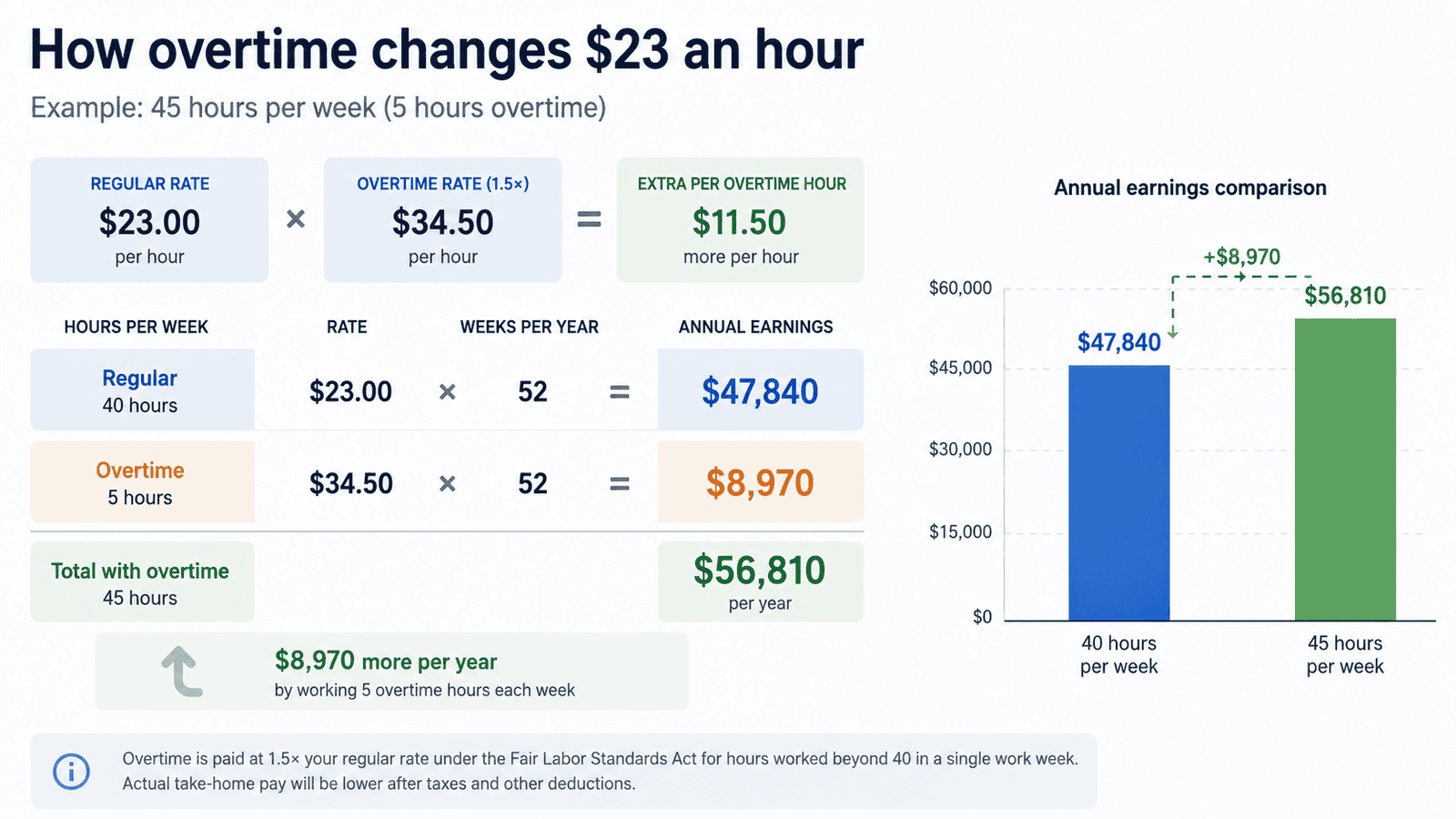
Under the Fair Labor Standards Act, most hourly employees must be paid at least 1.5 times their regular rate for every hour worked beyond 40 in a single work week. At $23 an hour, the overtime rate is $34.50 per hour.
If you consistently work 45 hours per week (5 hours of overtime), your annual earnings increase significantly:
That is roughly $8,970 more than the standard 40 hour calculation. Even a few hours of overtime each week can make a noticeable difference in annual earnings, though the additional income will also push you slightly higher in the federal tax brackets.
Is $23 an hour a good wage in 2026?
Whether $23 an hour is a “good” wage depends on where you live, your household size, and your expenses. Comparing it to national benchmarks gives useful context.
The federal minimum wage has been $7.25 per hour since July 2009 (U.S. Department of Labor, Wage and Hour Division, current as of July 2026). At $23 an hour, you earn more than three times the federal minimum wage. Many states and cities set their own higher minimum wage rates, so the gap may be smaller depending on your location.
According to the Bureau of Labor Statistics, the median usual weekly earnings for full time wage and salary workers were $1,235 in the first quarter of 2026 (BLS, Usual Weekly Earnings of Wage and Salary Workers, Q1 2026). Dividing $1,235 by 40 hours gives a median hourly wage of roughly $30.88. At $23 an hour, your earnings fall below the national median, meaning more than half of full time workers earn a higher hourly rate.
That comparison does not tell the full story. The cost of living in many parts of the Midwest and South is significantly lower than in coastal metro areas. A $23 hourly wage in a lower cost city can stretch further than $30 an hour in San Francisco or New York. In states with no income tax, such as Texas or Florida, your take home pay on $23 an hour is higher than in higher tax states at the same gross wage.
For a look at nearby wage levels, you can also explore what life looks like at $20 an hour, $21 an hour, $22 an hour, or $24 an hour.
Sample monthly budget on $23 an hour
Using the estimated monthly take home pay of $3,385 (after federal taxes only, single filer, no state tax), here is what a 50/30/20 budget might look like. This common approach allocates 50% of after tax income to needs, 30% to wants, and 20% to savings and debt repayment.
| Category | Percentage | Monthly amount |
|---|---|---|
| Needs (rent, utilities, groceries, insurance, minimum debt payments) | 50% | $1,693 |
| Wants (dining out, entertainment, subscriptions, travel) | 30% | $1,016 |
| Savings and debt repayment (emergency fund, retirement contributions, extra debt payments) | 20% | $677 |
A needs budget of $1,693 per month means you would generally want to keep rent or mortgage payments under roughly $1,100 to $1,200 to leave room for utilities, groceries, and insurance. In higher cost areas, this can be tight for a single person renting alone, which is why roommates or a dual income household make a meaningful difference at this wage level.
The 20% savings portion of $677 per month adds up to about $8,124 per year. Directing even part of that into a 401(k) or IRA would also reduce your taxable income and lower your federal tax bill in 2026. Knowing 23 dollars an hour is how much a year makes it easier to estimate your monthly budget and expected take-home pay.
Frequently asked questions
What is $23 an hour as a biweekly paycheck?
At 40 hours per week, $23 an hour produces a gross biweekly paycheck of $1,840 before taxes. After estimated federal income tax and FICA withholding, a single filer with no other deductions would take home approximately $1,561 every two weeks.
How much is $23 an hour per month after taxes?
For a single filer taking the 2026 standard deduction with no state income tax, the estimated monthly take home pay on $23 an hour is about $3,385. If you live in a state with income tax, this amount will be lower. See our full guide on $23 an hour after taxes for a detailed comparison.
Can you live on $23 an hour?
It depends on your location and lifestyle. In lower cost areas of the United States, $47,840 per year is generally enough to cover basic needs for a single person and still set aside some savings. In expensive metro areas, it can be difficult without a second income, a roommate, or other cost sharing arrangements. Building a budget using the 50/30/20 framework is a practical starting point for seeing where your money goes.
How does $23 an hour compare to the median US wage?
The BLS reported median weekly earnings of $1,235 for full time workers in Q1 2026, which works out to about $30.88 per hour. At $23 an hour, you earn roughly 74% of the national median. While that places you below the midpoint nationally, regional cost of living differences mean your purchasing power could be higher or lower depending on where you live.
Is $23 an hour enough to save for retirement?
If you follow the 50/30/20 guideline and direct 20% of your after tax income toward savings and debt repayment, you would save approximately $677 per month or $8,124 per year. Contributing to a tax advantaged account such as a 401(k) or Roth IRA can accelerate long term growth through compound interest. Starting early and contributing consistently matters more than the dollar amount at any single point in time. Understanding 23 dollars an hour is how much a year helps you compare hourly jobs with annual salary offers.
Methodology
All calculations in this article use the standard 2,080 hour work year (40 hours per week multiplied by 52 weeks). Federal income tax estimates for 2026 are based on the IRS tax brackets and standard deduction published in Revenue Procedure 2025-32. FICA rates (6.2% Social Security up to the $184,500 wage base and 1.45% Medicare on all wages) are sourced from IRS Publication 926, 2026 edition. Median wage data comes from the Bureau of Labor Statistics Usual Weekly Earnings report, Q1 2026. The federal minimum wage of $7.25 per hour is sourced from the U.S. Department of Labor, Wage and Hour Division, current as of July 2026.
All figures are gross or estimated net and do not account for state or local taxes, pre tax deductions, employer benefits, or individual tax credits.
This content is for educational purposes only and does not constitute personalized financial advice. Consult a qualified financial advisor for guidance specific to your situation.
By Nathan Whitmore for MoneyFN If you're wondering 23 dollars an hour is how much a year, the standard full-time calculation comes to $47,840 before taxes.

Nathan Whitmore is a US based personal finance writer at MoneyFN covering salary, paycheck, and tax math for American workers. He works from primary sources only: IRS revenue procedures, Bureau of Labor Statistics wage data, and Federal Reserve statistics. Every figure he publishes is dated and traceable to a public source.