

30 dollars an hour is how much a year? At 40 hours a week for 52 weeks, it equals $62,400 before taxes. That is $5,200 monthly, $2,400 biweekly, $1,200 weekly, or $240 per eight-hour workday.

Hourly to yearly salary calculator
Thirty dollars an hour converts to a solid full time salary, but gross income is only one part of the picture. Taxes, paid time off, benefits, retirement contributions, working hours, and state tax rules all affect what the job is actually worth.
This guide explains the conversion math, estimates $30 an hour after taxes, compares full time and part time schedules, and shows what a sample paycheck and monthly budget could look like in 2026.
You can also enter a different wage or work schedule in the hourly to salary calculator.
Contents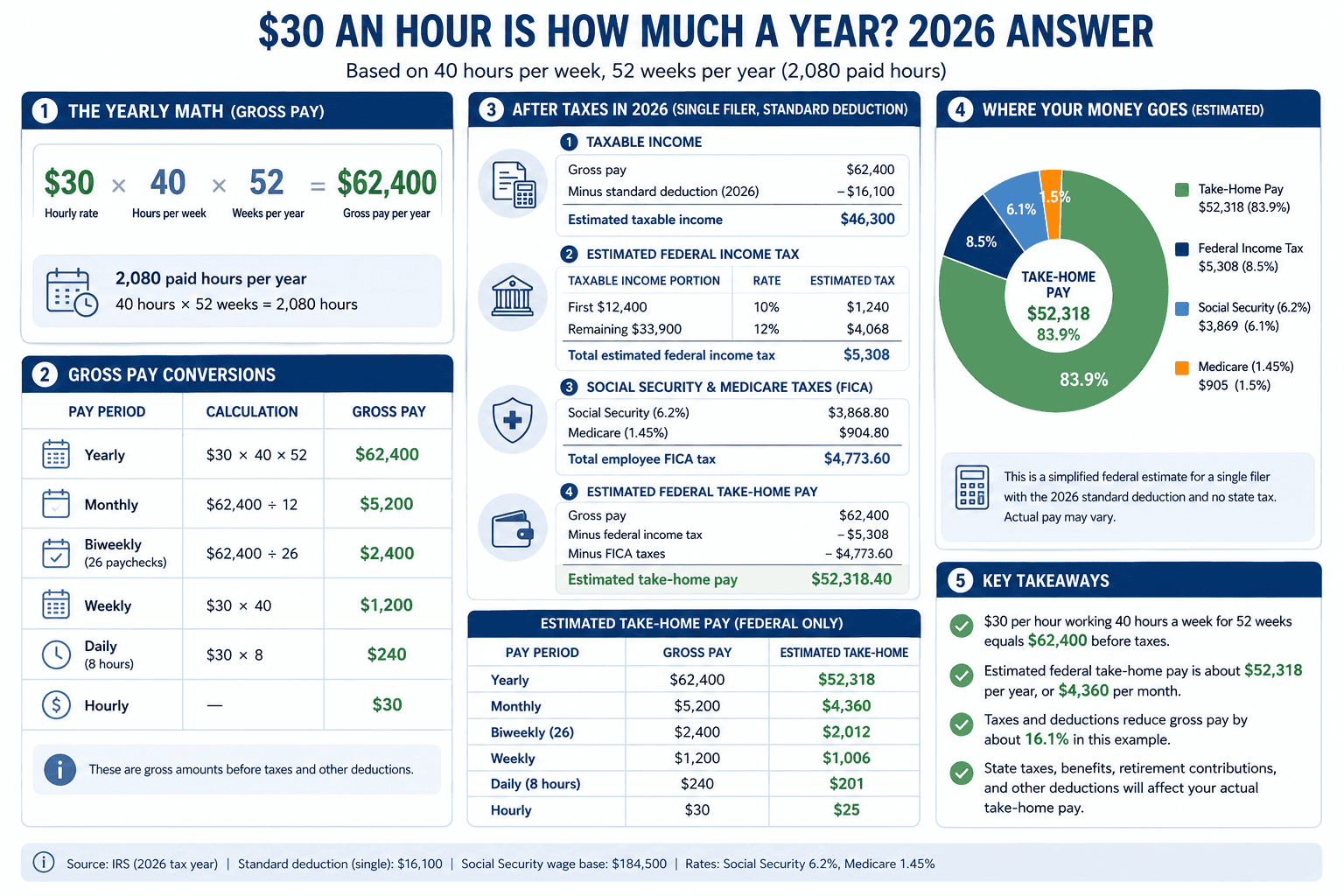
How much a year is $30 an hour?
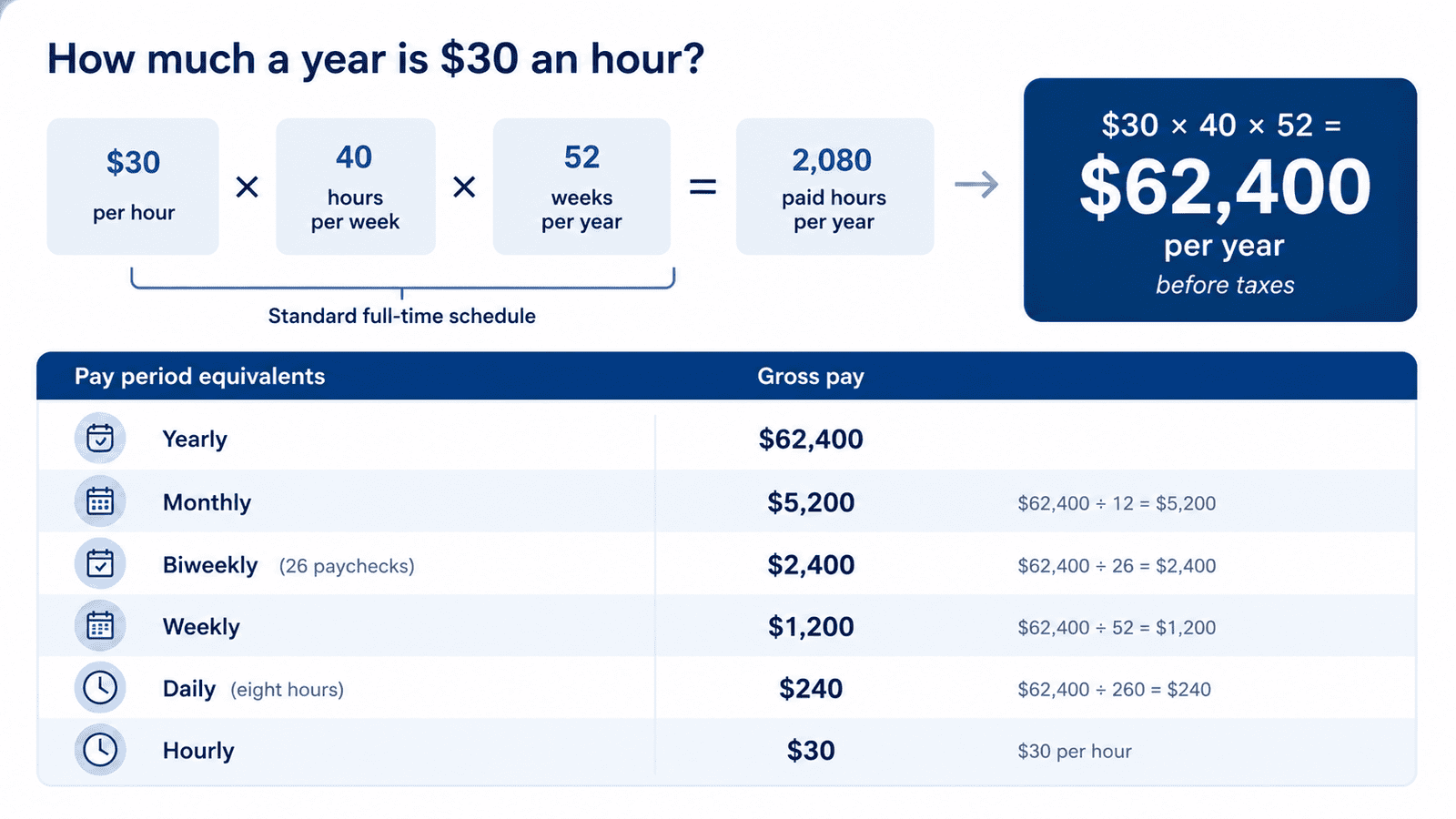
The standard calculation assumes:
- You earn $30 for each hour worked.
- You work 40 hours per week.
- You are paid for 52 weeks per year.
- Your annual schedule includes 2,080 paid hours.
Therefore, 30 dollars an hour is $62,400 a year before taxes when you receive pay for 2,080 hours.
Here are the main pay period equivalents:
| Pay period | Gross pay |
|---|---|
| Yearly | $62,400 |
| Monthly | $5,200 |
| Biweekly | $2,400 |
| Weekly | $1,200 |
| Daily (eight hours) | $240 |
| Hourly | $30 |
Monthly income is calculated by dividing annual pay by 12:
$62,400 ÷ 12 = $5,200 per month
Biweekly pay assumes 26 paychecks per year:
$62,400 ÷ 26 = $2,400 per paycheck
Weekly pay is:
Daily pay for an eight hour shift is:
These are gross figures. They do not include federal income tax, Social Security, Medicare, state taxes, insurance premiums, retirement contributions, or other payroll deductions.
$30 an hour after taxes in 2026
A rough federal take home estimate can be calculated for a single filer who takes the standard deduction, has no dependents, makes no pretax contributions, and owes no state or local income tax.
This is an educational estimate rather than a personalized tax calculation. Actual withholding depends on the employee’s Form W-4, filing status, credits, deductions, benefits, and other income.
For tax year 2026, the IRS lists a $16,100 standard deduction for single filers. The first $12,400 of taxable income falls within the 10% federal bracket, with the next portion at this income level falling within the 12% bracket.
Step 1: Calculate taxable income
Start with annual gross pay:
$62,400
Subtract the 2026 standard deduction:
$62,400 − $16,100 = $46,300 of estimated taxable income
Step 2: Estimate federal income tax
| Taxable income portion | Rate | Estimated tax |
|---|---|---|
| First $12,400 | 10% | $1,240 |
| Remaining $33,900 | 12% | $4,068 |
| Total estimated federal income tax | $5,308 |
This simplified calculation assumes no tax credits, itemized deductions, additional income, or special deductions.
Step 3: Calculate Social Security and Medicare taxes
For 2026, the employee Social Security tax rate is 6.2%, and the employee Medicare tax rate is 1.45%. The 2026 Social Security wage base is $184,500, so the full $62,400 is subject to Social Security tax.
Social Security tax:
Medicare tax:
Total employee FICA tax is:
$3,868.80 + $904.80 = $4,773.60
Step 4: Estimate federal take home pay
Subtract estimated federal income tax and FICA taxes from gross income:
$62,400 − $5,308 − $4,773.60 = $52,318.40
Under these assumptions, $30 an hour produces estimated take home pay of approximately:
| Pay period | Gross pay | Estimated federal take home |
|---|---|---|
| Yearly | $62,400 | $52,318 |
| Monthly | $5,200 | $4,360 |
| Biweekly | $2,400 | $2,012 |
| Weekly | $1,200 | $1,006 |
| Daily (eight hours) | $240 | $201 |
| Effective hourly take home | $30 | $25.15 |
The estimated combined federal income and payroll tax burden is about 16.2% of gross pay. State income tax, local tax, health insurance, retirement contributions, and other deductions can reduce the deposited amount further.
See the dedicated $30 an hour after taxes guide for a more detailed breakdown.
Hours to salary conversion table
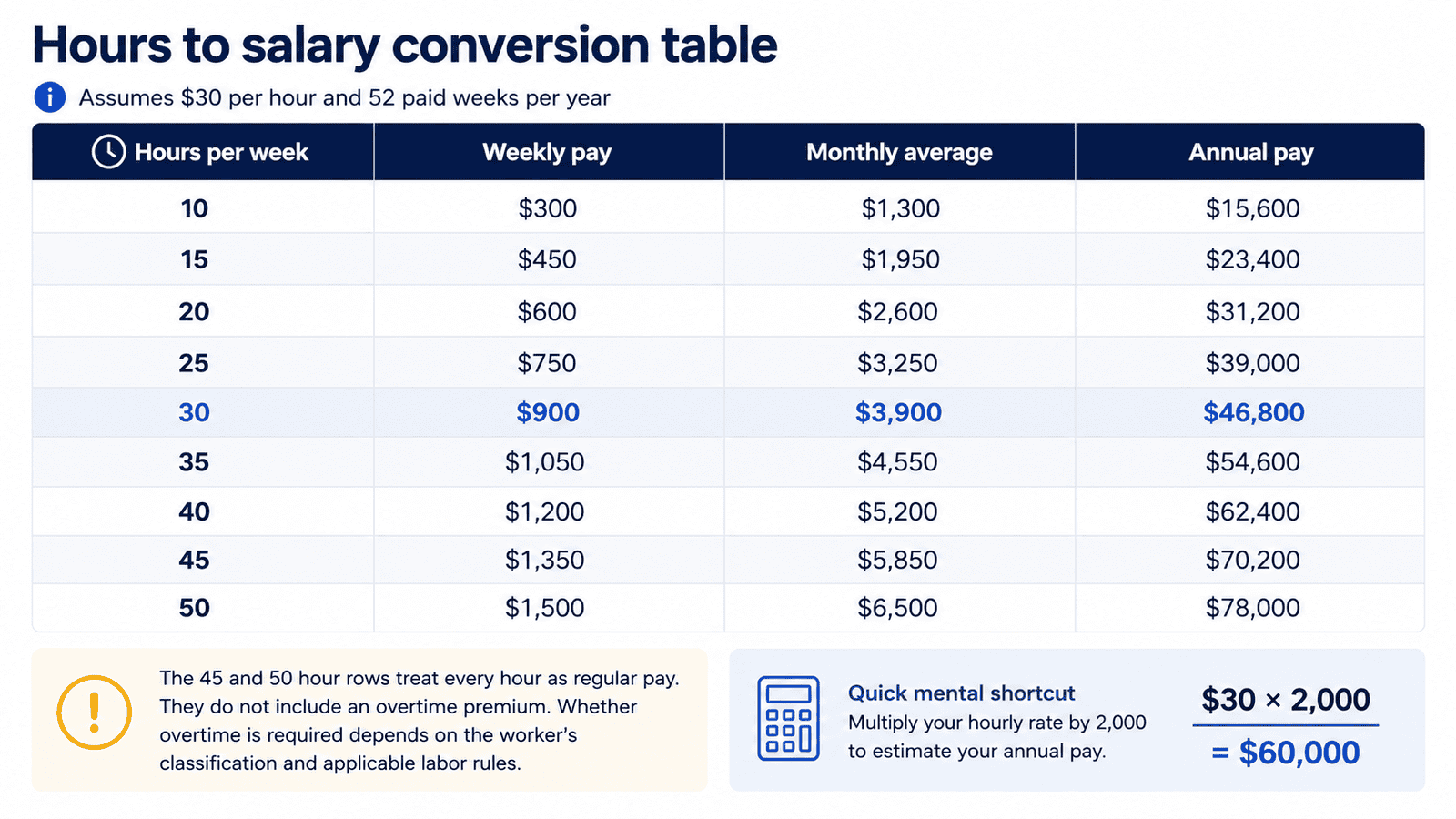
Annual income changes with both the hourly wage and the number of paid hours. The following table assumes 52 paid weeks per year:
| Hours per week | Weekly pay | Monthly average | Annual pay |
|---|---|---|---|
| 10 | $300 | $1,300 | $15,600 |
| 15 | $450 | $1,950 | $23,400 |
| 20 | $600 | $2,600 | $31,200 |
| 25 | $750 | $3,250 | $39,000 |
| 30 | $900 | $3,900 | $46,800 |
| 35 | $1,050 | $4,550 | $54,600 |
| 40 | $1,200 | $5,200 | $62,400 |
| 45 | $1,350 | $5,850 | $70,200 |
| 50 | $1,500 | $6,500 | $78,000 |
The 45 and 50 hour rows treat every hour as regular pay. They do not include an overtime premium. Whether overtime is required depends on the worker’s classification and applicable labor rules.
A quick mental shortcut is to multiply the hourly rate by 2,000. That gives $60,000. Using the full 2,080 hour convention adds another $2,400, producing the precise annual figure of $62,400.
How much is $30 an hour part time?
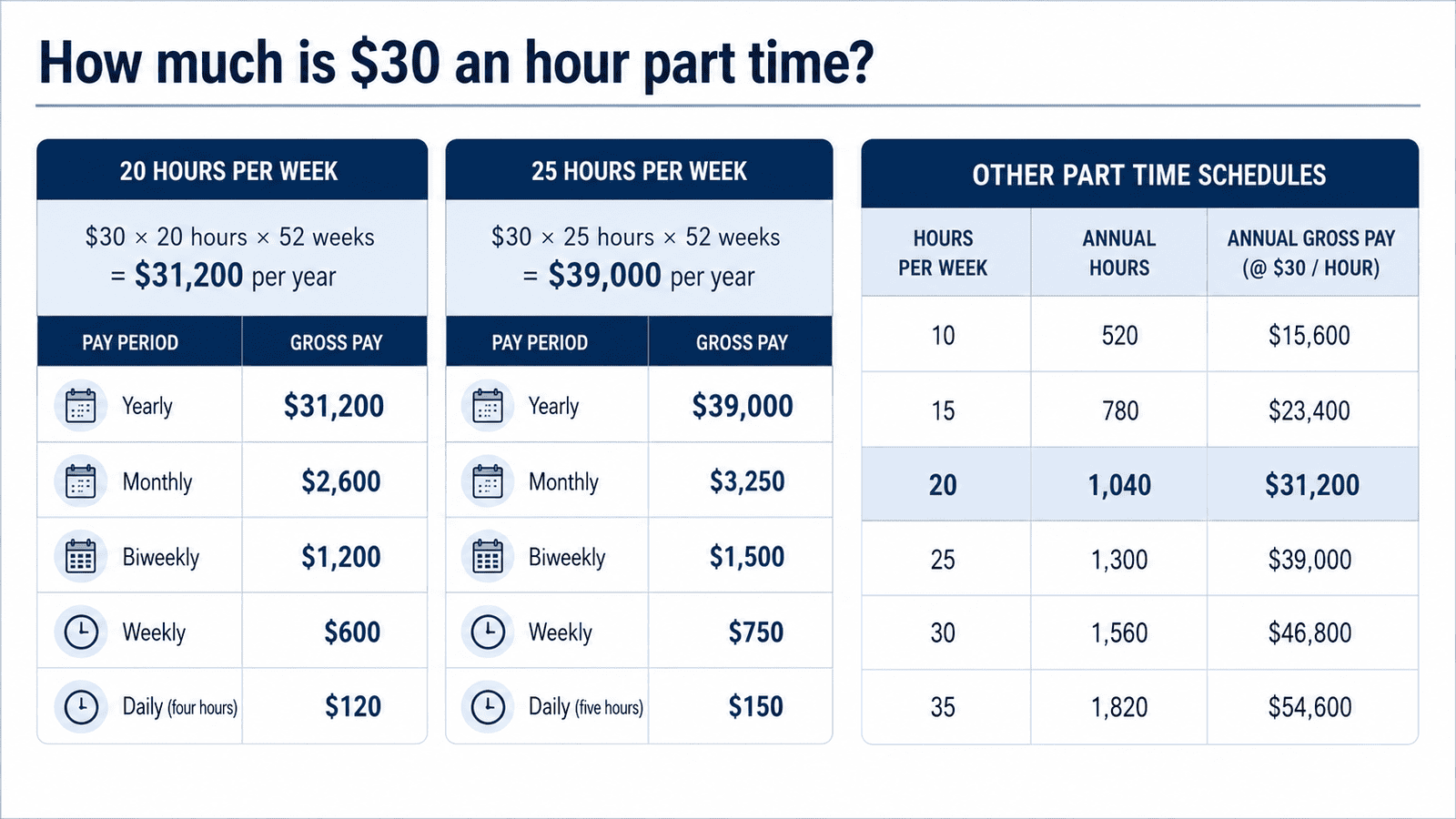
Someone working part time at $30 an hour earns less annually because the job includes fewer paid hours.
Working 20 hours per week
| Pay period | Gross pay |
|---|---|
| Yearly | $31,200 |
| Monthly | $2,600 |
| Biweekly | $1,200 |
| Weekly | $600 |
| Daily (four hours) | $120 |
Working 25 hours per week
| Pay period | Gross pay |
|---|---|
| Yearly | $39,000 |
| Monthly | $3,250 |
| Biweekly | $1,500 |
| Weekly | $750 |
| Daily (five hours) | $150 |
Other part time schedules
| Hours per week | Annual hours | Annual gross pay |
|---|---|---|
| 10 | 520 | $15,600 |
| 15 | 780 | $23,400 |
| 20 | 1,040 | $31,200 |
| 25 | 1,300 | $39,000 |
| 30 | 1,560 | $46,800 |
| 35 | 1,820 | $54,600 |
These figures assume the worker receives pay during all 52 weeks. Taking unpaid weeks off reduces annual income. For example, a person working 25 hours per week for 50 weeks would earn:
That is $1,500 less than the 52 week result.
How take home pay varies by state
The federal estimate of $52,318 does not include state or local income taxes. Take home pay can differ between states because states may:
- Charge no individual income tax on wages
- Apply a flat income tax rate
- Use graduated tax brackets
- Provide different standard deductions or exemptions
- Allow local governments to collect additional wage or income taxes
A worker in a state without individual wage income tax may come closer to the federal estimate, before insurance and workplace deductions. A worker in a state with state and local income taxes may receive less.
For example, use the Texas paycheck calculator to see how the calculation works in a state that does not impose an individual state income tax on wages.
Moving between states does not change the $62,400 gross salary when the hourly rate and schedule remain the same. It can change both take home pay and living costs.
Is $30 an hour good pay in 2026?
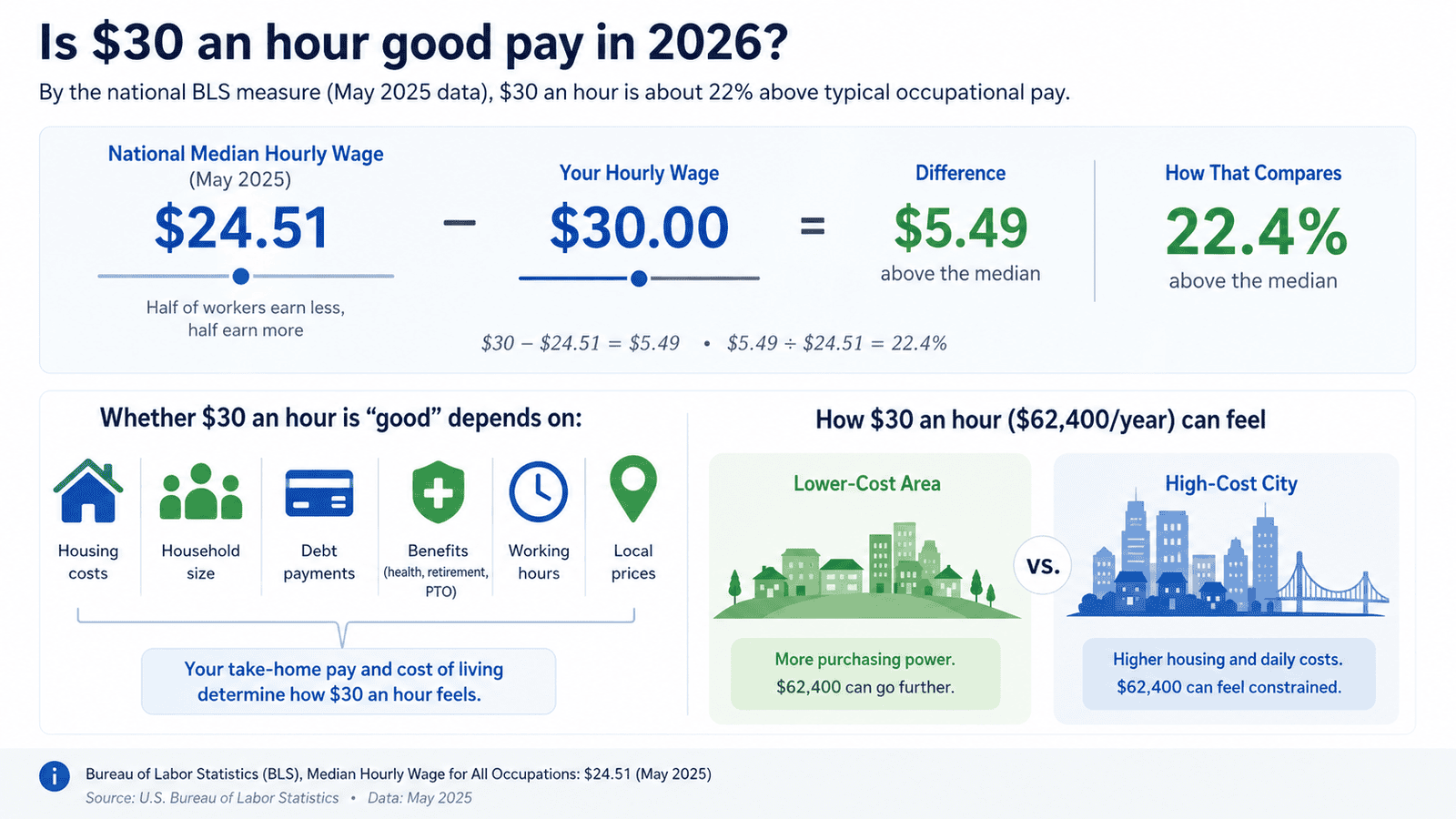
Whether $30 an hour is good pay depends on housing costs, household size, debt payments, benefits, working hours, and local prices.
The Bureau of Labor Statistics reported a median hourly wage of $24.51 for all U.S. occupations in May 2025. The median means half of workers earned less and half earned more.
At $30 an hour, the wage is:
$30 − $24.51 = $5.49 above the national median
As a percentage:
$5.49 ÷ $24.51 = about 22.4% above the median
By the national BLS measure (May 2025 data), $30 an hour is about 22% above typical occupational pay. However, $62,400 may feel comfortable in a lower cost area and constrained in a high cost city.
A single adult with moderate housing costs has a different budget from a household supporting children on one income. Benefits also affect whether the compensation is competitive. A $30 hourly job with health insurance, paid leave, retirement matching, and predictable hours can be worth more than another $30 hourly job without those benefits.
What jobs pay $30 an hour?
Jobs can pay around $30 an hour through a combination of education, licensing, technical skills, experience, location, union coverage, shift premiums, or supervisory responsibility. Occupations where workers may find pay around this level include:
| Job area | Examples |
|---|---|
| Business operations | Human resources specialists, training specialists, fundraisers |
| Property and finance | Property appraisers, claims specialists, tax professionals |
| Skilled trades | Electricians, plumbers, industrial maintenance technicians |
| Health care | Licensed practical nurses, respiratory therapy roles, diagnostic technicians |
| Transportation | Experienced heavy vehicle operators, transit workers, specialized equipment operators |
| Public services | Firefighters, correctional supervisors, experienced emergency dispatch workers |
| Technology support | Network support, user support, systems support roles |
| Management | Food service managers, lodging managers, property managers |
The BLS Occupational Employment and Wage Statistics program publishes national, state, and metropolitan wage estimates. Its May 2025 data show substantial differences by occupation and location.
A listed median is not a guaranteed starting wage. Entry level workers may earn less, while experienced workers, supervisors, licensed professionals, and employees in higher cost regions may earn more.
How to compare a $30 hourly job with a salary offer
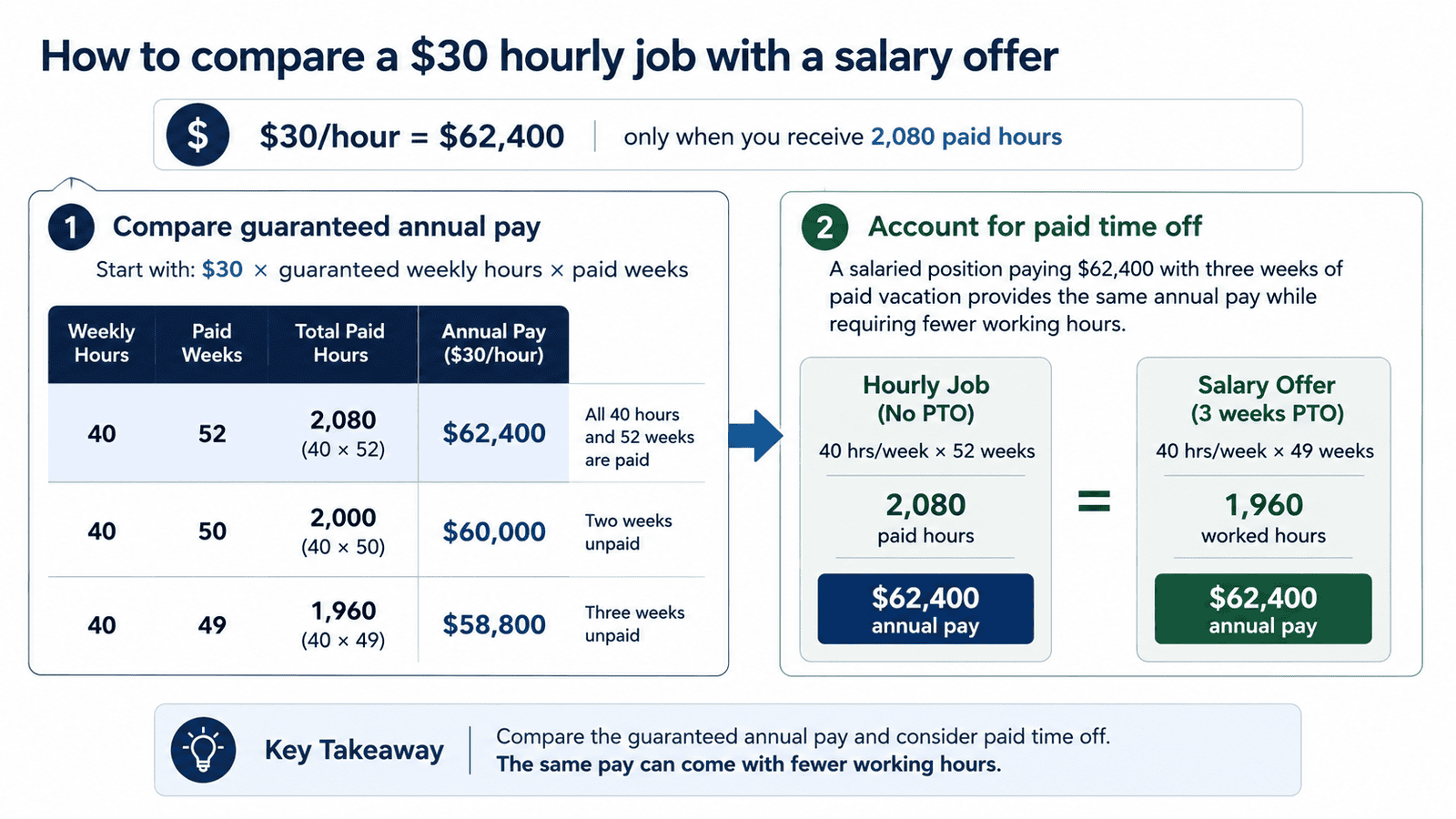
A $30 hourly wage equals $62,400 only when the employee receives 2,080 paid hours. Use the following steps when comparing it with a salaried position.
1. Compare guaranteed annual pay
Start with:
$30 × guaranteed weekly hours × paid weeks
If all 40 hours and 52 weeks are paid, the result is $62,400. If two weeks are unpaid, the calculation becomes:
Three unpaid weeks reduce annual pay to:
2. Account for paid time off
A salaried position paying $62,400 with three weeks of paid vacation provides the same annual pay while requiring fewer working hours. If the person works 49 weeks, the effective rate for hours actually worked is:
$62,400 ÷ 1,960 hours = $31.84 per hour worked
An hourly job with unpaid vacation may have a lower effective annual value.
3. Add employer benefits
Employer benefits can include health insurance contributions, dental and vision coverage, retirement matching, paid vacation and sick leave, life and disability insurance, education assistance, commuter benefits, and child care benefits.
A common comparison method is to add the estimated annual value of employer paid benefits to cash compensation:
| Offer | Cash pay | Estimated employer benefits | Estimated total compensation |
|---|---|---|---|
| Hourly role | $62,400 | $2,000 | $64,400 |
| Salary role | $60,000 | $7,000 | $67,000 |
Under these illustrative assumptions, the lower salary has greater total compensation.
4. Compare expected working hours
A $62,400 salary requiring 50 hours each week has an effective hourly rate of:
$62,400 ÷ 2,600 hours = $24 per hour
A $30 hourly job that pays for every hour may be more valuable when long workweeks are common.
5. Check job stability and schedule quality
Guaranteed hours, predictable scheduling, commute time, remote work options, and advancement opportunities can affect the practical value of an offer.
How 401(k) contributions and raises affect the numbers
Retirement contributions and wage increases change take home pay differently.
A 6% traditional 401(k) contribution
Six percent of $62,400 is:
$62,400 × 6% = $3,744 per year
That equals $312 per month, $144 per biweekly paycheck, or $72 per week.
A traditional 401(k) contribution generally reduces federal taxable income, although Social Security and Medicare taxes still apply. At a 12% marginal federal income tax rate, the estimated federal income tax reduction would be:
The approximate reduction in annual take home pay would therefore be:
$3,744 − $449 = about $3,295
This means $3,744 enters the retirement account while take home pay falls by approximately $3,295 under the simplified assumptions. The actual tax effect depends on filing status, other income, deductions, contribution type, and eligibility. Roth 401(k) contributions do not provide the same current federal income tax reduction.
A $1 per hour raise
A raise from $30 to $31 an hour adds:
At this income, a simplified estimate applies a 12% marginal federal income tax rate plus 7.65% employee FICA tax. Estimated additional take home pay is:
That is approximately $139 per month, $64 per biweekly paycheck, or $32 per week.
Compare the adjacent wage pages for more detail:
Sample monthly budget on $62,400 a year
The estimated monthly take home pay in this example is approximately $4,360, before state income tax, insurance premiums, retirement contributions, and other payroll deductions.
One possible starting framework is the 50/30/20 budget: 50% for needs, 30% for wants, and 20% for savings and additional debt payments. The Consumer Financial Protection Bureau describes this framework as one possible budgeting rule rather than a requirement for every household.
Applied to $4,360 of estimated monthly take home pay:
| Category | Percentage | Monthly amount |
|---|---|---|
| Needs | 50% | $2,180 |
| Wants | 30% | $1,308 |
| Savings and additional debt payments | 20% | $872 |
| Total | 100% | $4,360 |
A more detailed illustrative budget could look like this:
| Expense | Monthly amount |
|---|---|
| Rent or mortgage | $1,350 |
| Utilities and internet | $220 |
| Groceries | $400 |
| Transportation | $350 |
| Insurance and medical costs | $300 |
| Minimum debt payments | $200 |
| Dining and entertainment | $400 |
| Clothing and personal spending | $200 |
| Travel and subscriptions | $250 |
| Emergency savings | $350 |
| Retirement or other goals | $300 |
| Additional debt repayment | $40 |
| Total | $4,360 |
This is an example, not a recommended budget. Housing, transportation, insurance, family expenses, and state taxes vary considerably.
What a $30 an hour paycheck looks like
Paychecks usually show gross pay followed by taxes and voluntary deductions.
Sample biweekly paycheck
A biweekly employee working 80 hours earns:
80 × $30 = $2,400 gross pay
An illustrative paycheck might show:
| Paycheck line | Estimated amount |
|---|---|
| Gross pay | $2,400.00 |
| Federal income tax | $204.15 |
| Social Security tax | $148.80 |
| Medicare tax | $34.80 |
| Estimated federal take home | $2,012.25 |
The federal income tax line is the annual estimated tax divided across 26 paychecks:
$5,308 ÷ 26 = about $204.15
The payroll tax calculations are:
Actual federal withholding may differ because employers calculate withholding from Form W-4 information using IRS Publication 15-T methods.
Additional paycheck lines may include state income tax, local income tax, health insurance, dental and vision insurance, traditional or Roth 401(k) contributions, health savings account contributions, flexible spending account contributions, union dues, and life or disability insurance.
Sample weekly paycheck
For 40 hours:
| Paycheck line | Estimated amount |
|---|---|
| Gross pay | $1,200.00 |
| Federal income tax | $102.08 |
| Social Security tax | $74.40 |
| Medicare tax | $17.40 |
| Estimated federal take home | $1,006.12 |
Sample monthly pay
Monthly gross income is $5,200. Estimated federal take home averages approximately $4,360.
A person paid biweekly does not receive exactly two paychecks every calendar month. Most months contain two checks, while two months usually contain three. Annual income remains $62,400 when all 26 checks are paid. Calculating 30 dollars an hour is how much a year before taxes provides a useful starting point for budgeting.
Frequently asked questions
How much is $30 an hour per year working 40 hours a week?
Thirty dollars an hour is $62,400 per year before taxes when working 40 hours per week for 52 paid weeks.
$30 × 40 × 52 = $62,400
How much is $30 an hour per month?
Thirty dollars an hour is $5,200 per month before taxes on average.
$62,400 ÷ 12 = $5,200
What is $30 an hour in biweekly pay?
At 80 hours per biweekly pay period, gross pay is $2,400. The simplified federal take home estimate is approximately $2,012 before state taxes and workplace deductions.
$30 × 80 = $2,400
How much is $30 an hour per week?
At 40 hours, $30 an hour produces $1,200 per week before taxes.
$30 × 40 = $1,200
How much is $30 an hour per day?
An eight hour day pays $240 before taxes. A six hour day pays $180, while a ten hour day pays $300 before any overtime adjustment.
$30 × 8 = $240
How much is $30 an hour after taxes?
Using 2026 federal tax rules for a single filer taking the standard deduction, with no state income tax, credits, dependents, or pretax deductions, estimated take home pay is about $52,318 per year. That equals approximately $4,360 per month, $2,012 biweekly, $1,006 weekly, or $25.15 per hour after estimated federal taxes.
Actual take home pay depends on filing status, Form W-4 entries, state taxes, benefits, retirement contributions, and other income.
How much is $30 an hour part time?
At 20 hours per week, $30 an hour equals $31,200 per year. At 25 hours per week, it equals $39,000 per year. Both calculations assume 52 paid weeks.
Is $30 an hour good pay?
Thirty dollars an hour is above the $24.51 national median hourly wage reported by the BLS for all occupations in May 2025. It is about 22.4% higher than that median. Whether it is sufficient for a particular household depends on location, housing costs, dependents, debt, benefits, and other financial obligations.
How much is $30 an hour with two unpaid weeks?
Working 40 hours per week for 50 paid weeks produces:
$30 × 40 × 50 = $60,000 per year
Two unpaid weeks reduce gross annual income by $2,400.
How much does a $1 raise add to annual income?
At 40 hours per week and 52 weeks per year, each additional $1 per hour adds $2,080 to annual gross income. A raise from $30 to $31 per hour increases annual gross pay from $62,400 to $64,480. The answer to 30 dollars an hour is how much a year changes when unpaid time off reduces annual working hours.
Methodology
MoneyFN uses the standard salary conversion convention of 40 hours per week and 52 paid weeks per year: hourly wage × 40 × 52. Monthly income equals annual income divided by 12. Biweekly income equals annual income divided by 26. Weekly income equals the hourly rate multiplied by 40. Daily income assumes an eight hour shift.
The 2026 federal tax estimate assumes a single filer taking the $16,100 standard deduction, with no dependents, credits, itemized deductions, additional income, state income tax, or pretax payroll deductions. Federal tax brackets and the standard deduction come from IRS tax year 2026 guidance published in October 2025.
Employee payroll tax estimates use the 2026 Social Security rate of 6.2% and Medicare rate of 1.45% published by the IRS.
The national wage comparison uses the BLS Occupational Employment and Wage Statistics estimate for May 2025, released in 2026.
This content is for educational purposes only and does not constitute personalized financial advice. Consult a qualified financial advisor for guidance specific to your situation.
By Nathan Whitmore for MoneyFN

Nathan Whitmore is a US based personal finance writer at MoneyFN covering salary, paycheck, and tax math for American workers. He works from primary sources only: IRS revenue procedures, Bureau of Labor Statistics wage data, and Federal Reserve statistics. Every figure he publishes is dated and traceable to a public source.