

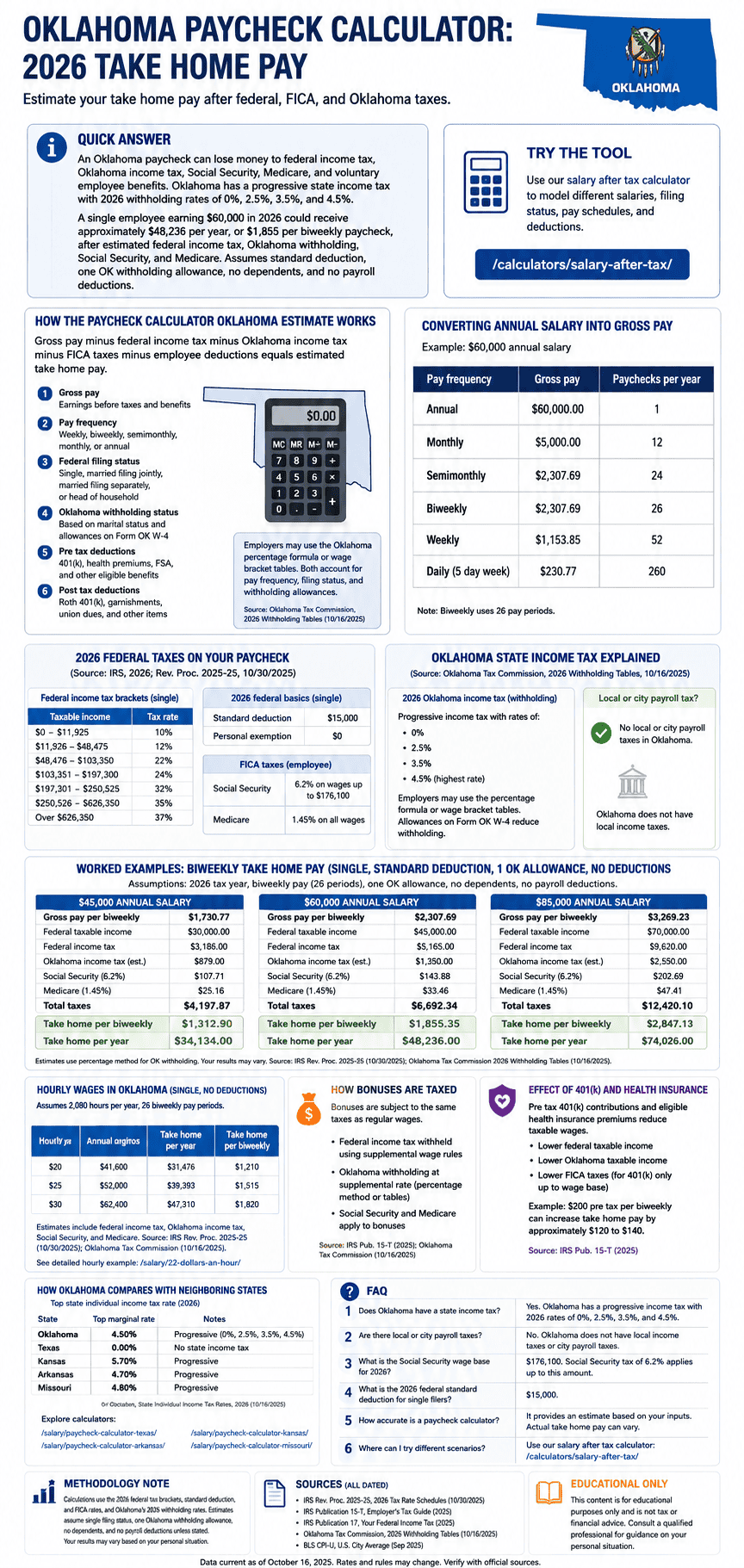
This paycheck calculator Oklahoma guide shows how federal income tax, Oklahoma income tax, Social Security, and Medicare reduce your pay. Oklahoma uses progressive 2026 rates of 0%, 2.5%, 3.5%, and 4.5%, with no local payroll income tax.

Oklahoma paycheck calculator
Use the salary after tax calculator to test a different salary, filing status, pay schedule, or deduction amount.
Contents
How the paycheck calculator works
A paycheck calculator starts with gross earnings and subtracts estimated taxes and deductions to produce an estimated net pay figure.
Gross pay − federal income tax − Oklahoma income tax − FICA taxes − employee deductions = estimated take home pay
The most important inputs are:
- Gross pay: your earnings before taxes and benefits.
- Pay frequency: weekly, biweekly, semimonthly, monthly, or annual.
- Federal filing status: single, married filing jointly, married filing separately, or head of household.
- Oklahoma withholding status: Oklahoma payroll withholding depends partly on marital status and the number of allowances entered on Form OK-W-4.
- Pre-tax deductions: traditional 401(k) contributions, eligible health premiums, flexible spending account contributions, and similar benefits.
- Post-tax deductions: Roth 401(k) contributions, garnishments, union dues, and other deductions that do not reduce taxable wages.
The Oklahoma Tax Commission permits employers to calculate withholding with either its percentage formula or wage bracket tables. Both methods account for payroll frequency, marital status, and Oklahoma withholding allowances (Oklahoma Tax Commission, 2026 withholding tables).
Converting annual salary into gross pay per check
For a $60,000 salary:
| Pay frequency | Gross pay per check |
|---|---|
| Annual | $60,000.00 |
| Monthly (12 checks) | $5,000.00 |
| Semimonthly (24 checks) | $2,500.00 |
| Biweekly (26 checks) | $2,307.69 |
| Weekly (52 checks) | $1,153.85 |
Biweekly and semimonthly are not the same. Biweekly employees usually receive 26 checks per year, while semimonthly employees usually receive 24.
2026 federal taxes on your paycheck
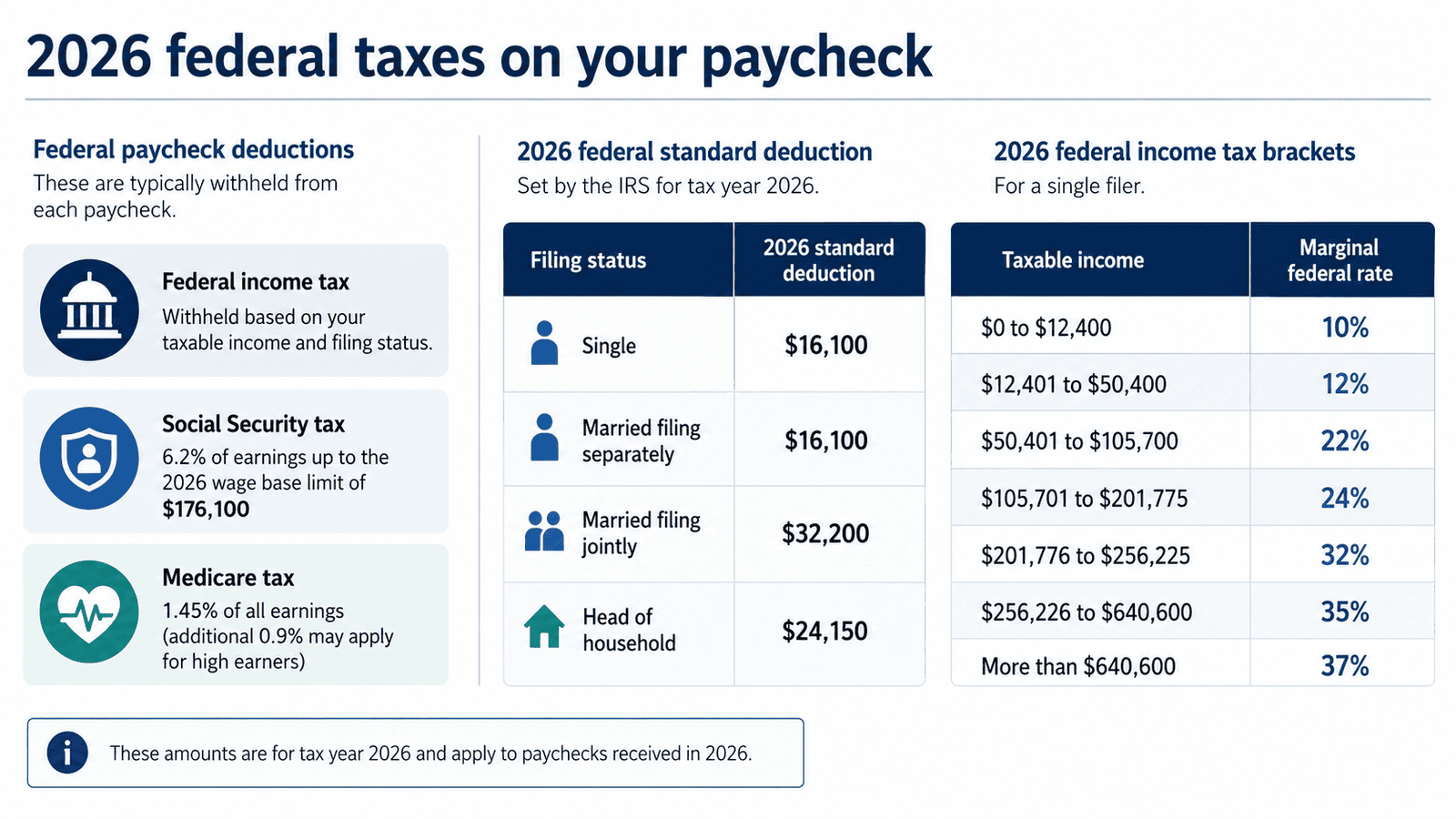
Federal paycheck deductions commonly include federal income tax, Social Security tax, and Medicare tax.
Federal income tax brackets for 2026
For tax year 2026, the IRS set the federal standard deduction at the following amounts (IRS, October 2025):
| Filing status | 2026 standard deduction |
|---|---|
| Single | $16,100 |
| Married filing separately | $16,100 |
| Married filing jointly | $32,200 |
| Head of household | $24,150 |
For a single filer, the 2026 federal income tax brackets are:
| Taxable income | Marginal federal rate |
|---|---|
| $0 to $12,400 | 10% |
| $12,401 to $50,400 | 12% |
| $50,401 to $105,700 | 22% |
| $105,701 to $201,775 | 24% |
| $201,776 to $256,225 | 32% |
| $256,226 to $640,600 | 35% |
| More than $640,600 | 37% |
These are marginal rates. Entering the 22% bracket does not cause all income to be taxed at 22%. Only taxable income within that bracket is taxed at that rate (IRS, 2026 inflation adjustments).
Payroll withholding may differ from the annual income tax shown on a return. Employers use Form W-4 information and the IRS withholding methods in Publication 15 when determining each paycheck’s federal withholding.
Social Security tax in 2026
Employees pay 6.2% in Social Security tax on covered wages up to the $184,500 wage base in 2026. The employer pays a matching amount (IRS Publication 15, 2026).
Examples at the salary levels used in this article: $45,000 of wages produces $2,790 in employee Social Security tax, $60,000 produces $3,720, and $85,000 produces $5,270. Once covered wages exceed $184,500 during 2026, the employer stops withholding the 6.2% for the remainder of that calendar year.
Medicare tax in 2026
The employee Medicare tax rate is 1.45%, with no annual wage ceiling. Employers withhold an additional 0.9% Medicare tax after an employee’s wages from that employer exceed $200,000 during the calendar year (IRS Publication 15).
6.2% Social Security + 1.45% Medicare = 7.65% total employee FICA
Oklahoma state income tax explained
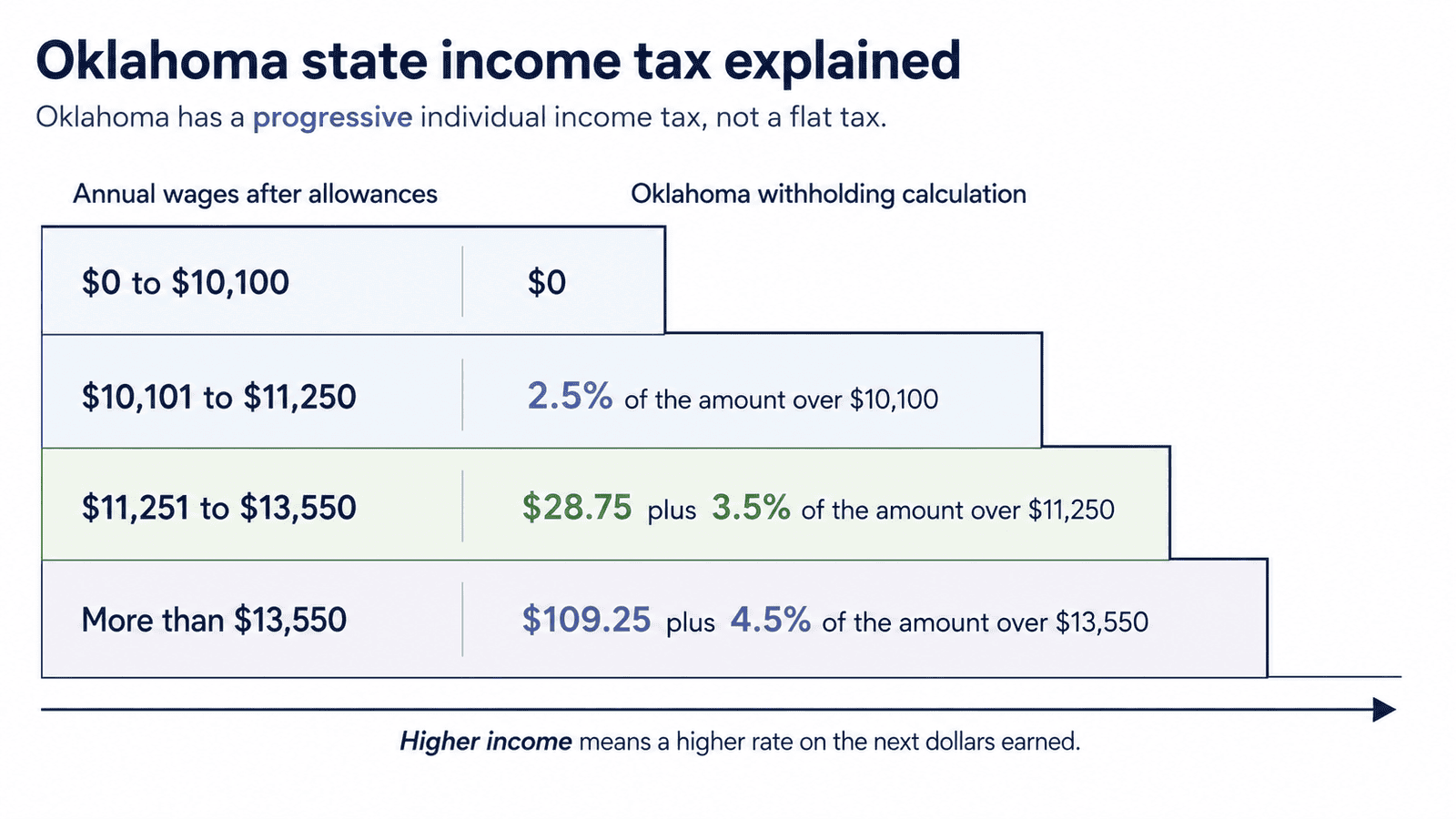
Oklahoma has a progressive individual income tax, not a flat tax.
The Oklahoma Tax Commission’s 2026 annual withholding schedule for a single person applies these levels after subtracting Oklahoma withholding allowances (Oklahoma Tax Commission, 2026 withholding tables):
| Annual wages after allowances | Oklahoma withholding calculation |
|---|---|
| $0 to $10,100 | $0 |
| $10,101 to $11,250 | 2.5% of the amount over $10,100 |
| $11,251 to $13,550 | $28.75 plus 3.5% of the amount over $11,250 |
| More than $13,550 | $109.25 plus 4.5% of the amount over $13,550 |
For married employees, the annual thresholds are higher:
| Annual wages after allowances | Oklahoma withholding calculation |
|---|---|
| $0 to $20,200 | $0 |
| $20,201 to $22,500 | 2.5% of the amount over $20,200 |
| $22,501 to $27,100 | $57.50 plus 3.5% of the amount over $22,500 |
| More than $27,100 | $218.50 plus 4.5% of the amount over $27,100 |
Oklahoma withholding allowances
Each Oklahoma withholding allowance equals $1,000 annually. Employers divide that amount by the number of payroll periods when calculating withholding for an individual check.
| Pay frequency | Allowance per check |
|---|---|
| Weekly | $19.23 |
| Biweekly | $38.46 |
| Semimonthly | $41.67 |
| Monthly | $83.33 |
| Annual | $1,000.00 |
Claiming more allowances generally reduces Oklahoma withholding. It does not necessarily reduce the final tax liability calculated on the employee’s Oklahoma tax return.
Does Oklahoma have local payroll income taxes?
No. The Oklahoma Tax Commission’s 2026 employee withholding materials provide one statewide withholding system and do not include separate city or county employee income tax tables. This calculator does not add a local Oklahoma payroll income tax (Oklahoma Tax Commission, 2026 withholding tables).
Employees can still have other paycheck deductions such as insurance premiums, retirement contributions, court ordered payments, or employer specific benefit costs.
Worked Oklahoma paycheck examples
The following examples estimate annual tax liability and divide the resulting take home pay across 26 biweekly checks. All three examples assume:
- Single filing status
- 2026 federal standard deduction of $16,100
- One Oklahoma withholding allowance of $1,000
- No dependents or tax credits
- No itemized deductions
- No 401(k), health insurance, or other employee deductions
- All wages subject to Social Security and Medicare
- No other income
Actual payroll withholding can differ because employers calculate withholding check by check using federal and Oklahoma payroll tables.
$45,000 salary in Oklahoma
Step 1: Gross biweekly pay
$45,000 ÷ 26 = $1,730.77
Step 2: Estimated federal taxable income
$45,000 gross salary minus $16,100 standard deduction = $28,900
Step 3: Estimated federal income tax
First $12,400 at 10% = $1,240
Remaining $16,500 at 12% = $1,980
Estimated federal income tax: $1,240 + $1,980 = $3,220
Step 4: Estimated Oklahoma withholding
Wages after one $1,000 allowance: $45,000 minus $1,000 = $44,000
$109.25 + 4.5% × ($44,000 minus $13,550) = $109.25 + $1,370.25 = $1,479.50
Step 5: Social Security and Medicare
$45,000 × 7.65% = $3,442.50
Step 6: Estimated take home pay
$45,000 minus $3,220 minus $1,479.50 minus $3,442.50 = $36,858
| Result | Estimated amount |
|---|---|
| Annual take home pay | $36,858.00 |
| Monthly average | $3,071.50 |
| Biweekly take home | $1,417.62 |
| Weekly average | $708.81 |
| Effective deduction rate | 18.09% |
$60,000 salary in Oklahoma
Step 1: Gross biweekly pay
$60,000 ÷ 26 = $2,307.69
Step 2: Estimated federal taxable income
$60,000 minus $16,100 = $43,900
Step 3: Estimated federal income tax
First $12,400 at 10% = $1,240
Remaining $31,500 at 12% = $3,780
Estimated federal income tax: $1,240 + $3,780 = $5,020
Step 4: Estimated Oklahoma withholding
$60,000 minus one $1,000 allowance = $59,000
$109.25 + 4.5% × ($59,000 minus $13,550) = $109.25 + $2,045.25 = $2,154.50
Step 5: Social Security and Medicare
$60,000 × 7.65% = $4,590
Step 6: Estimated take home pay
$60,000 minus $5,020 minus $2,154.50 minus $4,590 = $48,235.50
| Result | Estimated amount |
|---|---|
| Annual take home pay | $48,235.50 |
| Monthly average | $4,019.63 |
| Biweekly take home | $1,855.21 |
| Weekly average | $927.61 |
| Effective deduction rate | 19.61% |
Under these assumptions, $60,000 a year after taxes in Oklahoma is approximately $48,236, before health insurance, retirement contributions, or other benefits.
$85,000 salary in Oklahoma
Step 1: Gross biweekly pay
$85,000 ÷ 26 = $3,269.23
Step 2: Estimated federal taxable income
$85,000 minus $16,100 = $68,900
Step 3: Estimated federal income tax
First $12,400 at 10% = $1,240
Next $38,000 at 12% = $4,560
Remaining $18,500 at 22% = $4,070
Estimated federal income tax: $1,240 + $4,560 + $4,070 = $9,870
Step 4: Estimated Oklahoma withholding
$85,000 minus one $1,000 allowance = $84,000
$109.25 + 4.5% × ($84,000 minus $13,550) = $109.25 + $3,170.25 = $3,279.50
Step 5: Social Security and Medicare
$85,000 × 7.65% = $6,502.50
Step 6: Estimated take home pay
$85,000 minus $9,870 minus $3,279.50 minus $6,502.50 = $65,348
| Result | Estimated amount |
|---|---|
| Annual take home pay | $65,348.00 |
| Monthly average | $5,445.67 |
| Biweekly take home | $2,513.38 |
| Weekly average | $1,256.69 |
| Effective deduction rate | 23.12% |
Federal bracket amounts, the standard deduction, FICA rates, and Oklahoma withholding rates used in these examples come from the IRS 2026 inflation adjustments and the Oklahoma Tax Commission 2026 withholding tables.
Hourly wages in Oklahoma
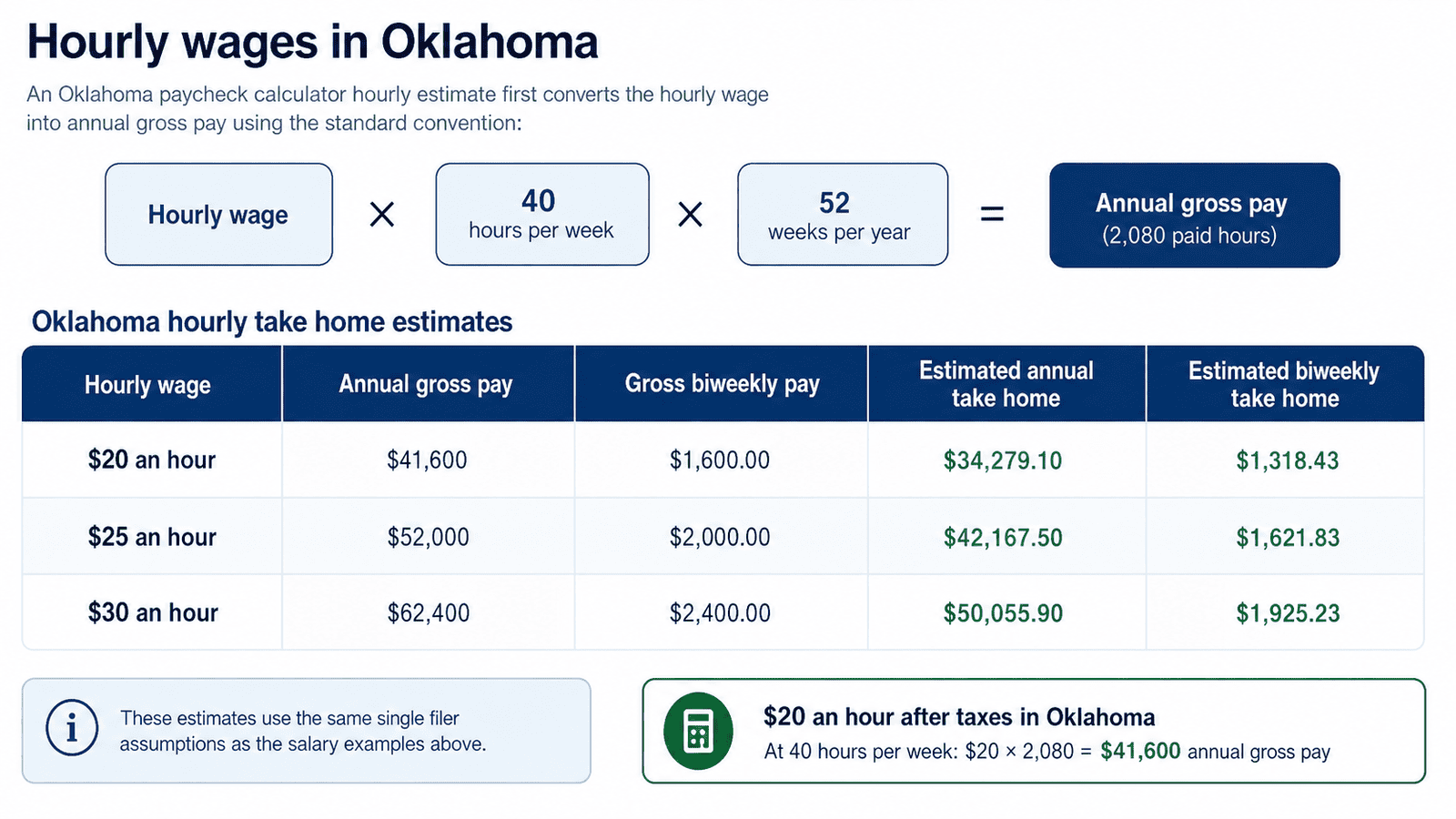
An Oklahoma paycheck calculator hourly estimate first converts the hourly wage into annual gross pay using the standard convention:
Hourly wage × 40 hours per week × 52 weeks per year = annual gross pay (2,080 paid hours)
Oklahoma hourly take home estimates
| Hourly wage | Annual gross pay | Gross biweekly pay | Estimated annual take home | Estimated biweekly take home |
|---|---|---|---|---|
| $20 an hour | $41,600 | $1,600.00 | $34,279.10 | $1,318.43 |
| $25 an hour | $52,000 | $2,000.00 | $42,167.50 | $1,621.83 |
| $30 an hour | $62,400 | $2,400.00 | $50,055.90 | $1,925.23 |
These estimates use the same single filer assumptions as the salary examples above.
$20 an hour after taxes in Oklahoma
At 40 hours per week: $20 × 2,080 = $41,600 per year
Estimated deductions: $2,812 federal income tax, $1,326.50 Oklahoma withholding, and $3,182.40 in Social Security and Medicare.
Estimated take home pay: $34,279.10 per year, or $1,318.43 biweekly.
$25 an hour after taxes in Oklahoma
At 40 hours per week: $25 × 2,080 = $52,000 per year
Estimated deductions: $4,060 federal income tax, $1,794.50 Oklahoma withholding, and $3,978 in Social Security and Medicare.
Estimated take home pay: $42,167.50 per year, or $1,621.83 biweekly.
$30 an hour after taxes in Oklahoma
At 40 hours per week: $30 × 2,080 = $62,400 per year
Estimated deductions: $5,308 federal income tax, $2,262.50 Oklahoma withholding, and $4,773.60 in Social Security and Medicare.
Estimated take home pay: $50,055.90 per year, or $1,925.23 biweekly.
For another hourly salary example, see $22 an hour is how much a year.
How bonuses are taxed in Oklahoma
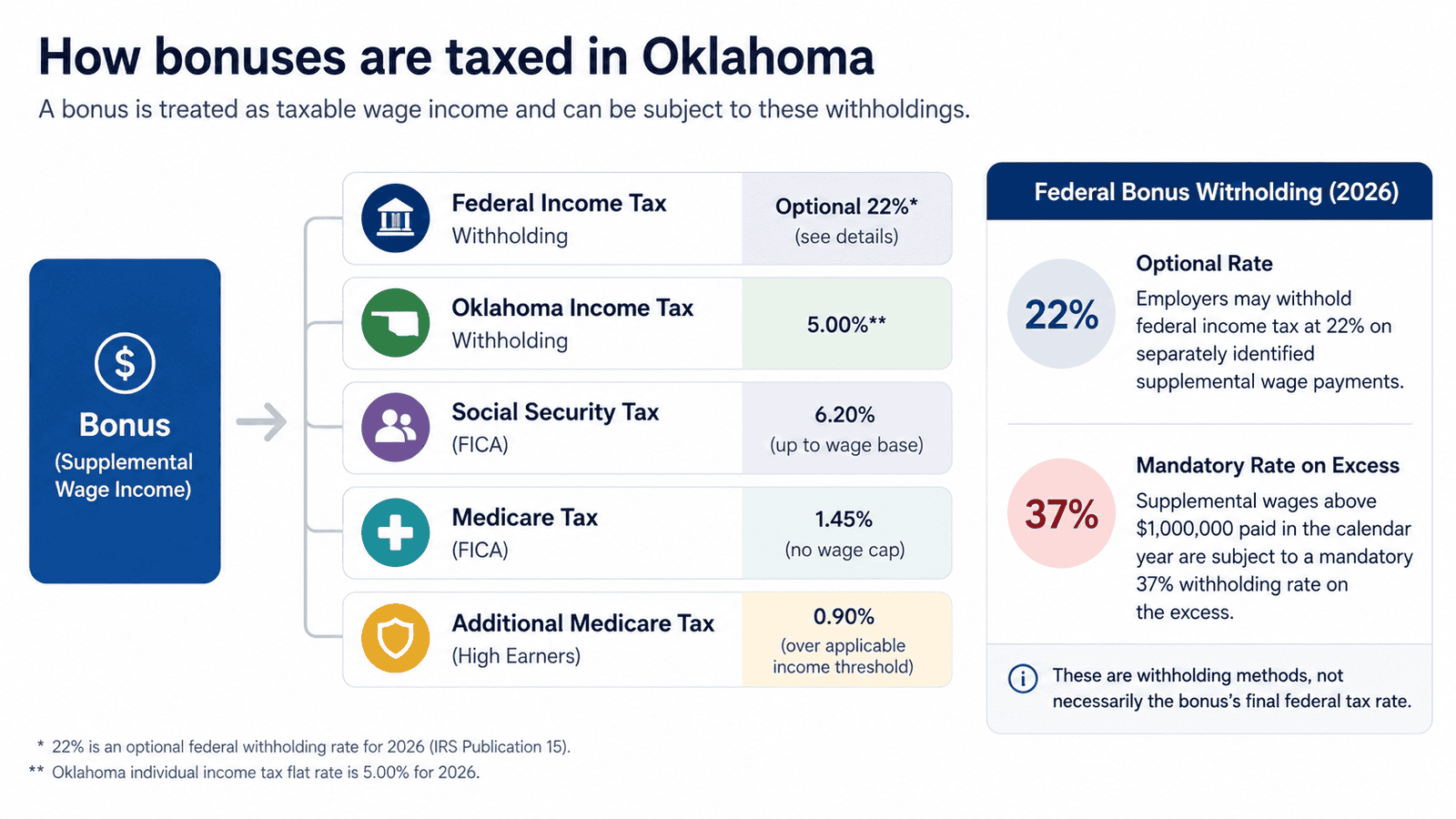
A bonus is generally taxable wage income. It can be subject to federal income tax withholding, Oklahoma income tax withholding, Social Security tax, Medicare tax, and the additional 0.9% Medicare tax when applicable.
Federal bonus withholding
For 2026, an employer that pays a separately identified supplemental wage payment may use the optional 22% federal withholding rate. Supplemental wages above $1 million paid to an employee during the calendar year are subject to a mandatory 37% withholding rate on the excess (IRS Publication 15, 2026).
The 22% rate is a withholding method, not necessarily the bonus’s final federal tax rate. Final federal tax depends on total annual taxable income, deductions, credits, and filing status. An employer may instead combine the bonus with regular wages and calculate withholding on the combined payment under the aggregate method.
Oklahoma bonus withholding
Oklahoma treats bonus payments as part of the employee’s taxable wage payments. The employer may calculate Oklahoma withholding through the percentage formula or applicable wage table. Oklahoma’s 2026 top withholding rate is 4.5%, and a bonus placed on top of regular wages will often fall within that highest withholding band (Oklahoma Tax Commission, 2026 withholding tables).
Example of a $5,000 Oklahoma bonus
Suppose a $60,000 employee receives a separately paid $5,000 bonus and the employer uses the federal flat supplemental method:
| Deduction | Illustrative amount |
|---|---|
| Federal withholding at 22% | $1,100.00 |
| Social Security at 6.2% | $310.00 |
| Medicare at 1.45% | $72.50 |
| Illustrative Oklahoma withholding at 4.5% | $225.00 |
| Estimated bonus check | $3,292.50 |
This example assumes the employee remains below the Social Security wage base and that the employer withholds Oklahoma tax at 4.5% for the payment. Actual Oklahoma withholding may differ under the employer’s payroll method.
Effect of 401(k) and health insurance premiums
Pre-tax benefits can reduce taxable wages, but different deductions affect different taxes.
Traditional 401(k) contributions
Traditional 401(k) contributions generally reduce wages subject to federal income tax. They commonly also reduce Oklahoma taxable income because Oklahoma starts its individual income tax calculation from federal income figures, subject to state adjustments.
Traditional 401(k) contributions generally do not reduce Social Security or Medicare wages. An employee usually continues to pay 7.65% in FICA taxes on the contributed amount.
The employee elective deferral limit for most 401(k), 403(b), and governmental 457 plans is $24,500 in 2026. The general catch up contribution limit for eligible participants age 50 or older is $8,000, subject to special rules for certain ages and plans (IRS, November 2025).
Example of a 5% traditional 401(k) contribution
Consider the $60,000 employee contributing 5%: $60,000 × 5% = $3,000 per year, or $115.38 per biweekly paycheck.
| Item | No 401(k) | With $3,000 traditional 401(k) |
|---|---|---|
| Gross salary | $60,000.00 | $60,000.00 |
| 401(k) contribution | $0 | $3,000.00 |
| Estimated federal income tax | $5,020.00 | $4,660.00 |
| Estimated Oklahoma withholding | $2,154.50 | $2,019.50 |
| Social Security and Medicare | $4,590.00 | $4,590.00 |
| Spendable cash after listed items | $48,235.50 | $45,730.50 |
| Amount directed to 401(k) | $0 | $3,000.00 |
The contribution reduces current spendable pay by about $2,505 rather than the full $3,000 in this simplified example because estimated federal and Oklahoma income taxes fall by about $495.
Health insurance premiums
Employer paid accident and health insurance premiums generally are not treated as wages subject to federal income tax, Social Security, Medicare, or federal unemployment tax (IRS Publication 15).
Employee health premiums deducted through a qualifying Section 125 cafeteria plan may also reduce federal income tax and FICA wages. A premium deducted outside a qualifying pre-tax arrangement might not receive the same treatment.
For example, a $250 monthly qualifying pre-tax health premium equals $3,000 per year. If the premium reduces both income tax wages and FICA wages, the employee’s paycheck falls by less than the full $250 because the deduction also reduces certain taxes. Benefit treatment depends on the specific employer plan. Employees can check their pay stub or plan documents to see whether a deduction is classified as pre-tax or post-tax.
How Oklahoma compares with neighboring states
Oklahoma’s 4.5% top payroll withholding rate places it between neighboring states that use different individual income tax systems.
| State | General paycheck treatment | MoneyFN page |
|---|---|---|
| Oklahoma | Progressive state withholding with a 4.5% top rate in 2026 | Current page |
| Texas | No individual state income tax withheld from paychecks | Texas paycheck calculator |
| Kansas | State income tax withholding applies under Kansas rules | Kansas paycheck calculator |
| Arkansas | State income tax withholding applies under 2026 Arkansas payroll tables | Arkansas paycheck calculator |
| Missouri | State income tax withholding applies, with a 4.7% top formula rate in 2026 | Missouri paycheck calculator |
State income tax is only one part of a location comparison. Housing, property taxes, sales taxes, insurance, transportation, and employer benefits can also affect household costs. The paycheck calculator Oklahoma calculation includes federal withholding, FICA taxes, and applicable state income tax. Try the paycheck calculator oklahoma to compare weekly, biweekly, semimonthly, or monthly pay estimates.
Common Oklahoma paycheck calculation mistakes
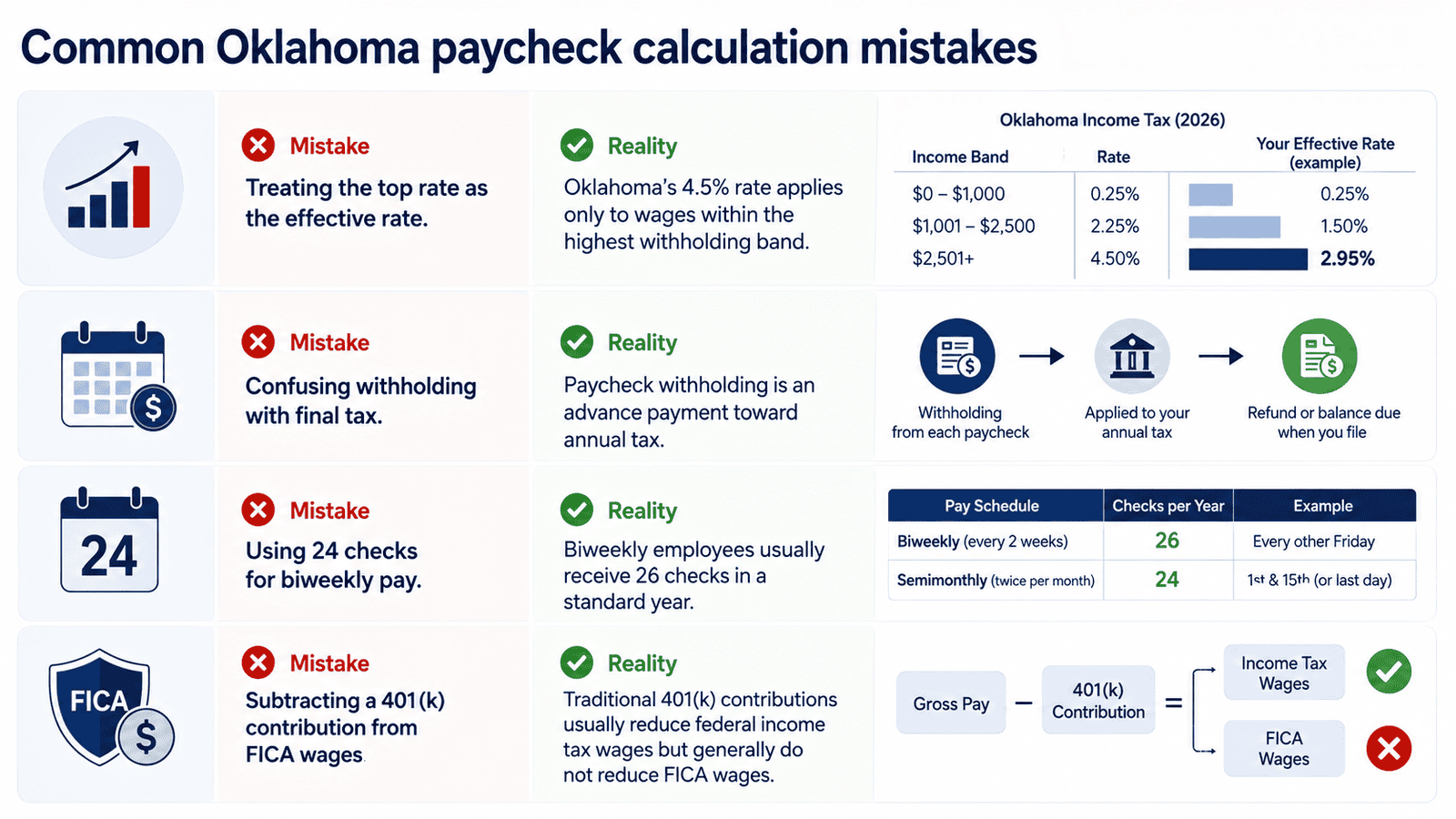
Treating the top rate as the effective rate. Oklahoma’s 4.5% rate applies only to wages within the highest withholding band. It does not mean every dollar of pay is withheld at 4.5%.
Confusing withholding with final tax. Paycheck withholding is an advance payment toward annual tax. A refund or balance due may result when the employee files federal and Oklahoma returns.
Using 24 checks for biweekly pay. Biweekly employees usually receive 26 checks in a standard year. Semimonthly employees usually receive 24.
Subtracting a 401(k) contribution from FICA wages. Traditional 401(k) contributions usually reduce federal income tax wages but generally do not reduce Social Security or Medicare wages.
Applying the 22% bonus rate as a final tax rate. The federal 22% supplemental rate is a withholding method. The employee’s final federal rate depends on total annual taxable income.
Ignoring benefit deductions. A paycheck estimate based only on taxes can be higher than the actual direct deposit if the employee pays for insurance, retirement, parking, flexible spending accounts, or other benefits. A paycheck calculator Oklahoma comparison can show how hourly and salaried earnings produce different take home amounts. The paycheck calculator oklahoma updates your estimated net pay based on your filing status and deductions.
Frequently asked questions
How much is taken out of my paycheck in Oklahoma?
A typical Oklahoma paycheck may include federal income tax, Oklahoma income tax withholding, 6.2% Social Security tax, 1.45% Medicare tax, and employee benefit deductions. The exact percentage depends on income, filing status, Oklahoma allowances, Form W-4 entries, pay frequency, and benefits. In the simplified examples above, combined federal, state, Social Security, and Medicare deductions equal about 18.09% of a $45,000 salary, 19.61% of a $60,000 salary, and 23.12% of an $85,000 salary.
What is the Oklahoma income tax rate in 2026?
Oklahoma has a progressive income tax. The official 2026 employee withholding schedules use rates of 0%, 2.5%, 3.5%, and 4.5%. The highest withholding rate is 4.5% (Oklahoma Tax Commission, 2026 withholding tables).
How much is $60,000 a year after taxes in Oklahoma?
Under the assumptions used in this article, a single filer earning $60,000 could take home approximately $48,235.50 per year, $4,019.63 per month, or $1,855.21 per biweekly paycheck. The estimate excludes dependents, tax credits, health insurance, retirement contributions, and other payroll deductions.
How are bonuses taxed in Oklahoma?
Bonuses are generally subject to federal income tax withholding, Oklahoma withholding, Social Security, and Medicare. A separately identified bonus may have federal tax withheld at 22% in 2026. Oklahoma withholding is calculated under the state’s wage withholding rules, whose highest 2026 rate is 4.5% (IRS Publication 15, 2026).
How do 401(k) contributions change take home pay in Oklahoma?
A traditional 401(k) contribution generally reduces wages subject to federal and Oklahoma income tax, but it normally does not reduce Social Security or Medicare wages. Take home cash decreases because money is deposited into the retirement account, but income tax savings offset part of that decrease.
Does Oklahoma have a flat income tax?
No. Oklahoma’s 2026 withholding schedule is progressive. It moves through 0%, 2.5%, 3.5%, and 4.5% withholding levels (Oklahoma Tax Commission, 2026 withholding tables).
Does Oklahoma have city income tax?
The Oklahoma Tax Commission’s standard employee withholding publications provide statewide tables and do not include a separate general city or county employee income tax schedule. This calculator does not add a local Oklahoma payroll income tax.
Why does my paycheck differ from this estimate?
Your actual check can differ because of Form W-4 settings, Oklahoma allowances, dependents, bonuses, overtime, pre-tax benefits, post-tax deductions, tax credits, additional withholding, and payroll rounding. Employer payroll systems also calculate withholding one pay period at a time rather than by simply dividing estimated annual tax by 26. Use the paycheck calculator Oklahoma results as a planning estimate rather than an exact payroll statement. A paycheck calculator oklahoma helps you see how state and federal taxes affect each paycheck.
Methodology
MoneyFN calculated the examples using 2026 federal tax brackets and the $16,100 single standard deduction published by the IRS (October 2025). Employee FICA was calculated at 6.2% for Social Security and 1.45% for Medicare. All salaries shown are below the 2026 Social Security wage base of $184,500.
Oklahoma withholding was estimated using the Oklahoma Tax Commission’s 2026 annual percentage formula for a single employee with one $1,000 Oklahoma allowance. Annual results were divided by 26 for biweekly estimates.
The calculations exclude tax credits, itemized deductions, dependents, additional income, special deductions, benefit costs, and adjustments that may apply on an actual return.
This content is for educational purposes only and does not constitute personalized financial advice. Consult a qualified financial advisor for guidance specific to your situation.
By Nathan Whitmore for MoneyFN Use the paycheck calculator oklahoma to estimate your take-home pay before accepting a new job.

Nathan Whitmore is a US based personal finance writer at MoneyFN covering salary, paycheck, and tax math for American workers. He works from primary sources only: IRS revenue procedures, Bureau of Labor Statistics wage data, and Federal Reserve statistics. Every figure he publishes is dated and traceable to a public source.