

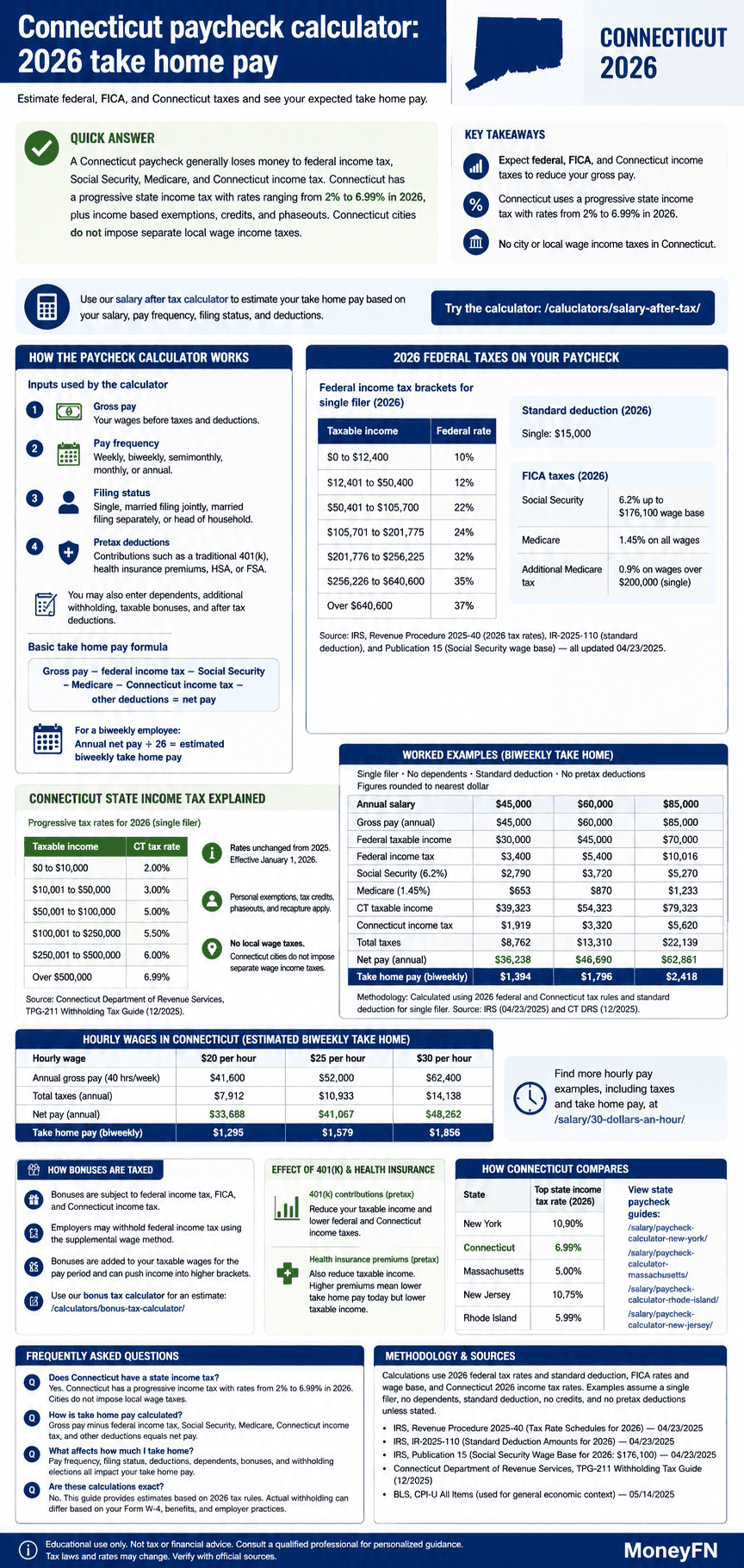
Our paycheck calculator Connecticut guide estimates take-home pay after federal income tax, Social Security, Medicare, and Connecticut state income tax. Connecticut uses seven state tax brackets from 2% to 6.99% in 2026, while cities impose no local wage tax. A single filer earning $60,000 may take home about $48,073 annually before retirement and insurance deductions.

Connecticut paycheck calculator
Use the salary after tax calculator to estimate your take home pay based on your salary, pay frequency, filing status, and deductions.
The examples below estimate taxes for a single Connecticut resident with one job, no dependents, no itemized deductions, no tax credits other than those built into Connecticut’s withholding calculation, and no pretax benefits unless stated otherwise. Actual payroll withholding can differ because of Form W 4 elections, Connecticut Form CT W4 choices, benefits, bonuses, and employer payroll practices.
ContentsHow the paycheck calculator works
A paycheck calculator Connecticut estimate starts with gross wages and subtracts taxes and payroll deductions.
Inputs used by the calculator
Enter these four main inputs:
- Gross pay: Your wages before taxes and deductions.
- Pay frequency: Weekly, biweekly, semimonthly, monthly, or annual.
- Filing status: Single, married filing jointly, married filing separately, or head of household.
- Pretax deductions: Contributions such as a traditional 401k, qualifying health insurance premiums, an HSA, or an FSA.
You may also need to enter dependents, additional withholding, taxable bonuses, and after tax deductions.
Basic take home pay formula
Gross pay − federal income tax − Social Security − Medicare − Connecticut income tax − other deductions = net pay
For a biweekly employee:
Annual net pay ÷ 26 = estimated biweekly take home pay
Connecticut uses annualized wages, filing status codes, personal exemptions, a progressive tax schedule, rate phaseouts, tax recapture, and personal tax credits to calculate state withholding. The Connecticut Department of Revenue Services states that its 2026 withholding rules became effective January 1, 2026 (CT DRS, TPG 211, revised 12/2025).
2026 federal taxes on your paycheck
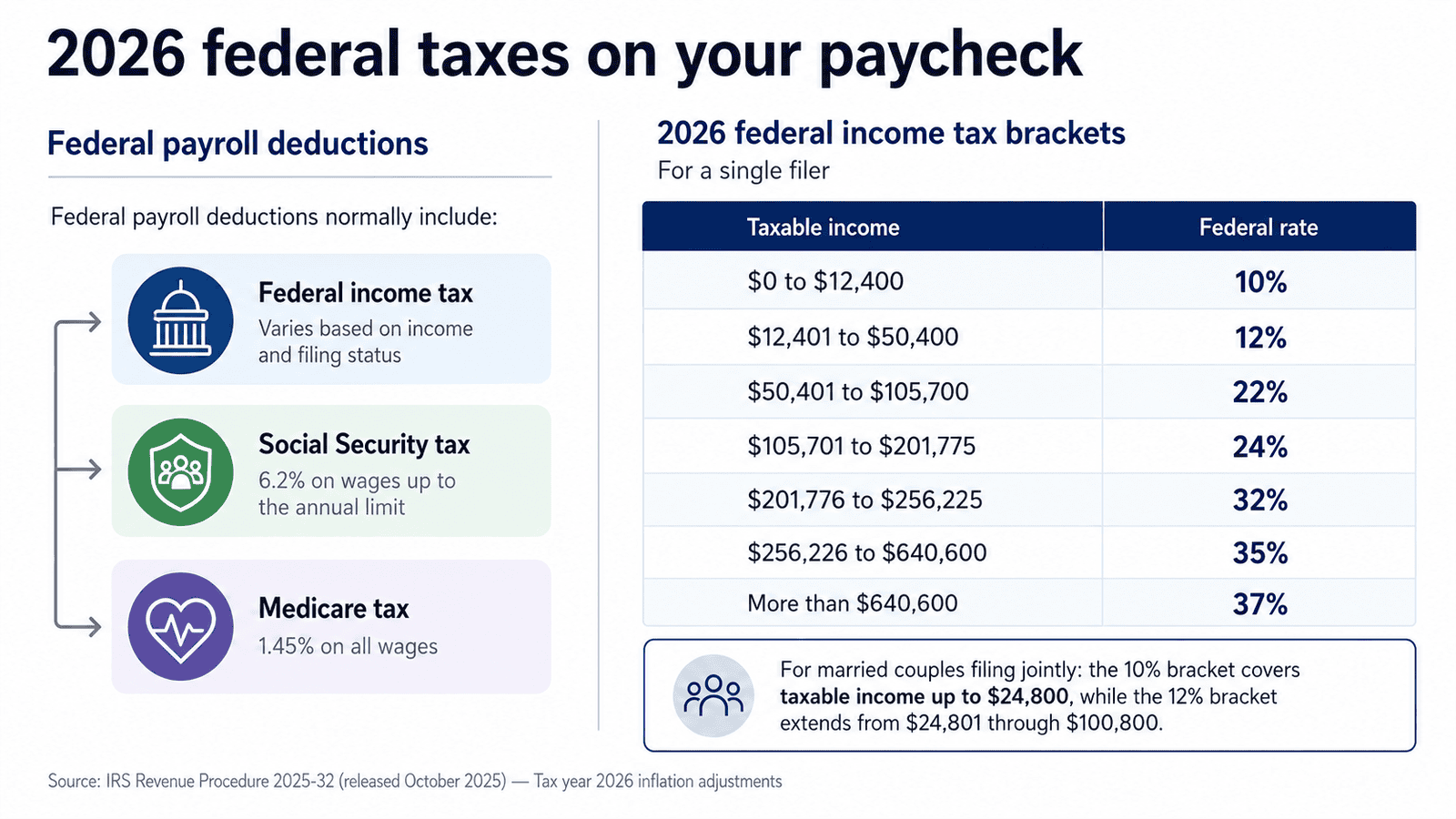
Federal payroll deductions normally include federal income tax, Social Security tax, and Medicare tax.
Federal income tax brackets for 2026
For a single filer, the 2026 federal income tax brackets are:
| Taxable income | Federal rate |
|---|---|
| $0 to $12,400 | 10% |
| $12,401 to $50,400 | 12% |
| $50,401 to $105,700 | 22% |
| $105,701 to $201,775 | 24% |
| $201,776 to $256,225 | 32% |
| $256,226 to $640,600 | 35% |
| More than $640,600 | 37% |
For married couples filing jointly, the 10% bracket covers taxable income up to $24,800, while the 12% bracket extends from $24,801 through $100,800. The IRS published these 2026 brackets in Revenue Procedure 2025-32, released October 2025 (IRS, tax year 2026 inflation adjustments).
These are marginal rates. A single filer with $60,000 of gross wages does not pay 22% on the full $60,000. Different portions of taxable income are taxed at 10% and 12% in the example used below.
2026 standard deduction
| Filing status | 2026 standard deduction |
|---|---|
| Single | $16,100 |
| Married filing separately | $16,100 |
| Married filing jointly | $32,200 |
| Head of household | $24,150 |
The standard deduction reduces taxable income rather than directly reducing tax dollar for dollar. These amounts apply to income earned during 2026 and generally reported on returns filed in 2027 (IRS, tax year 2026 inflation adjustments).
Social Security and Medicare taxes
For wages paid in 2026:
- Social Security withholding is 6.2% on wages up to $184,500.
- Medicare withholding is 1.45% on covered wages, with no wage cap.
- The combined employee FICA rate is 7.65% for wages below the Social Security limit.
- Employers begin withholding an additional 0.9% Medicare tax after an employee’s wages exceed $200,000 during the calendar year.
The IRS published the 2026 Social Security wage base and Medicare rules in Publication 15, dated December 15, 2025 (IRS Publication 15).
For a $60,000 salary, regular employee FICA is:
Social Security: $60,000 × 6.2% = $3,720
Medicare: $60,000 × 1.45% = $870
Total FICA: $4,590
Connecticut state income tax explained
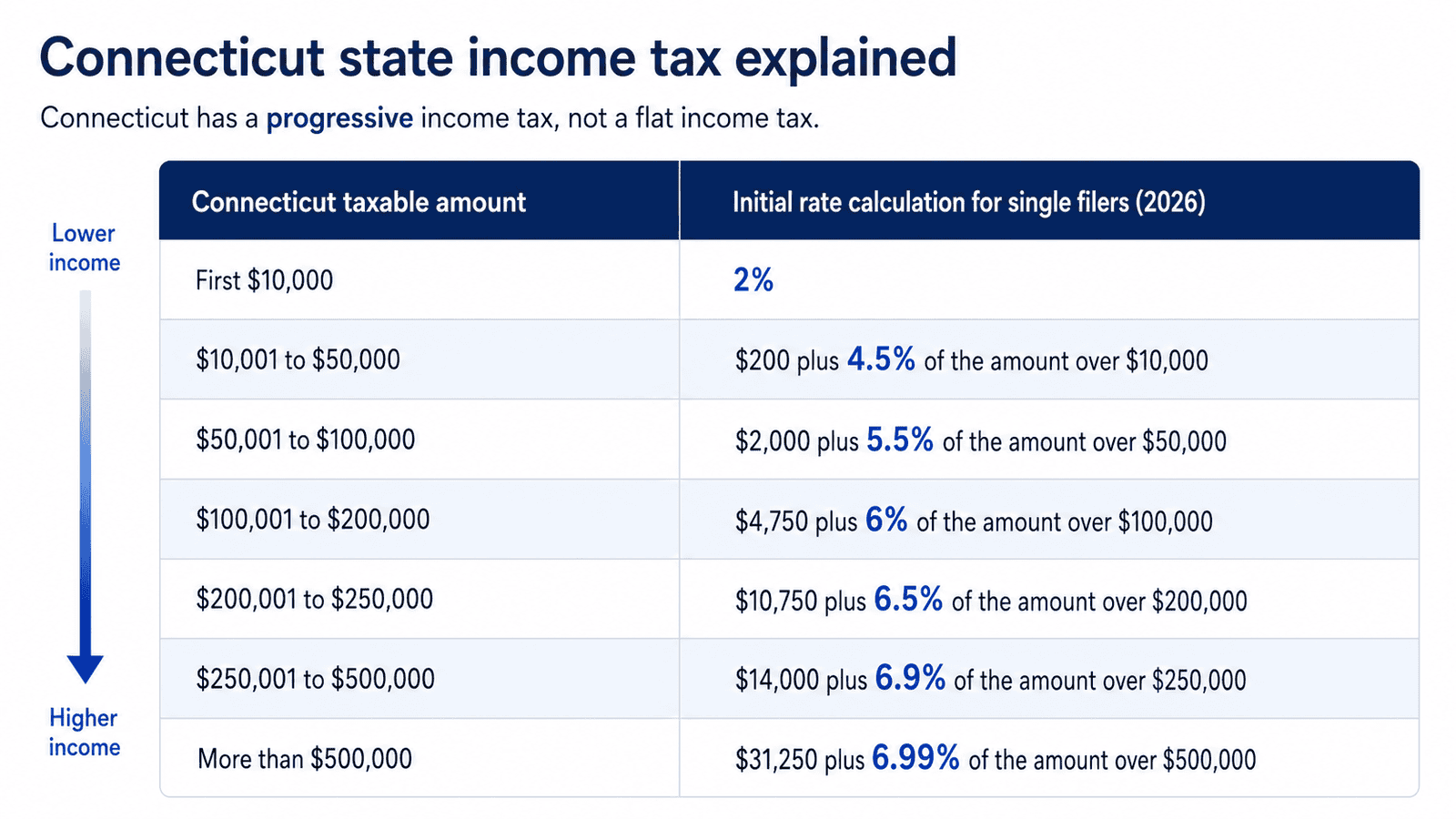
Connecticut has a progressive income tax, not a flat income tax.
For 2026, Connecticut’s initial withholding calculation uses rates of:
| Connecticut taxable amount | Initial rate calculation for single filers |
|---|---|
| First $10,000 | 2% |
| $10,001 to $50,000 | $200 plus 4.5% of the amount over $10,000 |
| $50,001 to $100,000 | $2,000 plus 5.5% of the amount over $50,000 |
| $100,001 to $200,000 | $4,750 plus 6% of the amount over $100,000 |
| $200,001 to $250,000 | $10,750 plus 6.5% of the amount over $200,000 |
| $250,001 to $500,000 | $14,000 plus 6.9% of the amount over $250,000 |
| More than $500,000 | $31,250 plus 6.99% of the amount over $500,000 |
These brackets are part of the initial calculation for Connecticut withholding codes A, D, and F. Single employees with expected annual gross income above $15,000 generally use withholding code F on the 2026 Form CT W4, unless another code better reflects their circumstances (CT DRS, TPG 211, revised 12/2025).
The final Connecticut withholding amount may differ from the initial bracket calculation because the state also applies:
- A personal exemption that declines as income rises
- A phaseout of the 2% tax rate
- Tax recapture at higher income levels
- A personal tax credit that declines as income rises
For withholding code F, the personal exemption begins at $15,000 for annualized salaries of $30,000 or less and falls as salary increases. It reaches $0 when annualized salary exceeds $44,000 (CT DRS, TPG 211).
The personal tax credit can equal as much as 75% of the calculated state tax at lower incomes. For code F, the credit gradually declines and reaches zero once annualized salary exceeds $64,500 (CT DRS, TPG 211).
Are there local payroll taxes in Connecticut?
Connecticut does not use separate city wage income tax tables. Connecticut wage withholding is administered at the state level by the Connecticut Department of Revenue Services.
This differs from nearby New York, where New York City and Yonkers can create additional location based income tax or withholding considerations. See the New York paycheck calculator for details on New York’s separate state and local withholding schedules.
Property taxes and other municipal charges are separate from paycheck income tax withholding.
Worked examples of Connecticut take home pay
The following examples assume:
- Single filing status
- Connecticut withholding code F
- One job, no dependents
- No additional Form W 4 withholding
- No pretax 401k or health deductions
- 26 biweekly pay periods
- 2026 federal standard deduction of $16,100
- Regular employee FICA of 7.65%
- No refundable or nonrefundable federal credits
These examples estimate annual tax liability and divide the result across 26 checks. Actual pay stubs may vary because payroll withholding tables can produce different per check rounding.
$45,000 salary after taxes in Connecticut
Step 1: Gross biweekly pay
$45,000 ÷ 26 = $1,730.77
Step 2: Federal taxable income
$45,000 − $16,100 standard deduction = $28,900
Step 3: Estimated federal income tax
- First $12,400 at 10% = $1,240
- Remaining $16,500 at 12% = $1,980
Estimated federal income tax = $3,220
Step 4: FICA
$45,000 × 7.65% = $3,442.50
Step 5: Connecticut income tax
At $45,000, the code F personal exemption is $0.
Initial tax:
$200 + 4.5% × ($45,000 − $10,000)
= $200 + $1,575
= $1,775
The code F personal tax credit at this income is 10%.
$1,775 × 90% = $1,597.50
Step 6: Estimated take home pay
$45,000 − $3,220 − $3,442.50 − $1,597.50 = $36,740 annually
| Pay period | Estimated take home |
|---|---|
| Annual | $36,740.00 |
| Monthly | $3,061.67 |
| Biweekly | $1,413.08 |
| Weekly | $706.54 |
| Daily (260 workdays) | $141.31 |
Estimated total tax rate: 18.4%
$60,000 salary after taxes in Connecticut
Step 1: Gross biweekly pay
$60,000 ÷ 26 = $2,307.69
Step 2: Federal taxable income
$60,000 − $16,100 = $43,900
Step 3: Estimated federal income tax
- First $12,400 at 10% = $1,240
- Remaining $31,500 at 12% = $3,780
Estimated federal income tax = $5,020
Step 4: FICA
Social Security: $60,000 × 6.2% = $3,720
Medicare: $60,000 × 1.45% = $870
Total FICA = $4,590
Step 5: Connecticut income tax
The code F personal exemption is $0.
Initial tax:
$2,000 + 5.5% × ($60,000 − $50,000)
= $2,000 + $550
= $2,550
The 2% rate phaseout add back at this salary is $25.
$2,550 + $25 = $2,575
The code F personal credit is 10%.
$2,575 × 90% = $2,317.50
Step 6: Estimated take home pay
$60,000 − $5,020 − $4,590 − $2,317.50 = $48,072.50 annually
| Pay period | Estimated take home |
|---|---|
| Annual | $48,072.50 |
| Monthly | $4,006.04 |
| Biweekly | $1,848.94 |
| Weekly | $924.47 |
| Daily (260 workdays) | $184.89 |
Estimated total tax rate: 19.9%. A single employee earning $60,000 could take home about $1,849 per biweekly paycheck before insurance, retirement contributions, and other deductions.
$85,000 salary after taxes in Connecticut
Step 1: Gross biweekly pay
$85,000 ÷ 26 = $3,269.23
Step 2: Federal taxable income
$85,000 − $16,100 = $68,900
Step 3: Estimated federal income tax
- First $12,400 at 10% = $1,240
- Next $38,000 at 12% = $4,560
- Remaining $18,500 at 22% = $4,070
Estimated federal income tax = $9,870
Step 4: FICA
$85,000 × 7.65% = $6,502.50
Step 5: Connecticut income tax
The code F exemption and personal tax credit are both $0 at this income.
Initial tax:
$2,000 + 5.5% × ($85,000 − $50,000)
= $2,000 + $1,925
= $3,925
The 2% rate phaseout add back is $150.
Estimated Connecticut tax = $4,075
Step 6: Estimated take home pay
$85,000 − $9,870 − $6,502.50 − $4,075 = $64,552.50 annually
| Pay period | Estimated take home |
|---|---|
| Annual | $64,552.50 |
| Monthly | $5,379.38 |
| Biweekly | $2,482.79 |
| Weekly | $1,241.39 |
| Daily (260 workdays) | $248.28 |
Estimated total tax rate: 24.1%
Summary of the salary examples
| Gross salary | Federal tax | FICA | Connecticut tax | Annual take home | Biweekly take home |
|---|---|---|---|---|---|
| $45,000 | $3,220.00 | $3,442.50 | $1,597.50 | $36,740.00 | $1,413.08 |
| $60,000 | $5,020.00 | $4,590.00 | $2,317.50 | $48,072.50 | $1,848.94 |
| $85,000 | $9,870.00 | $6,502.50 | $4,075.00 | $64,552.50 | $2,482.79 |
Hourly wages in Connecticut
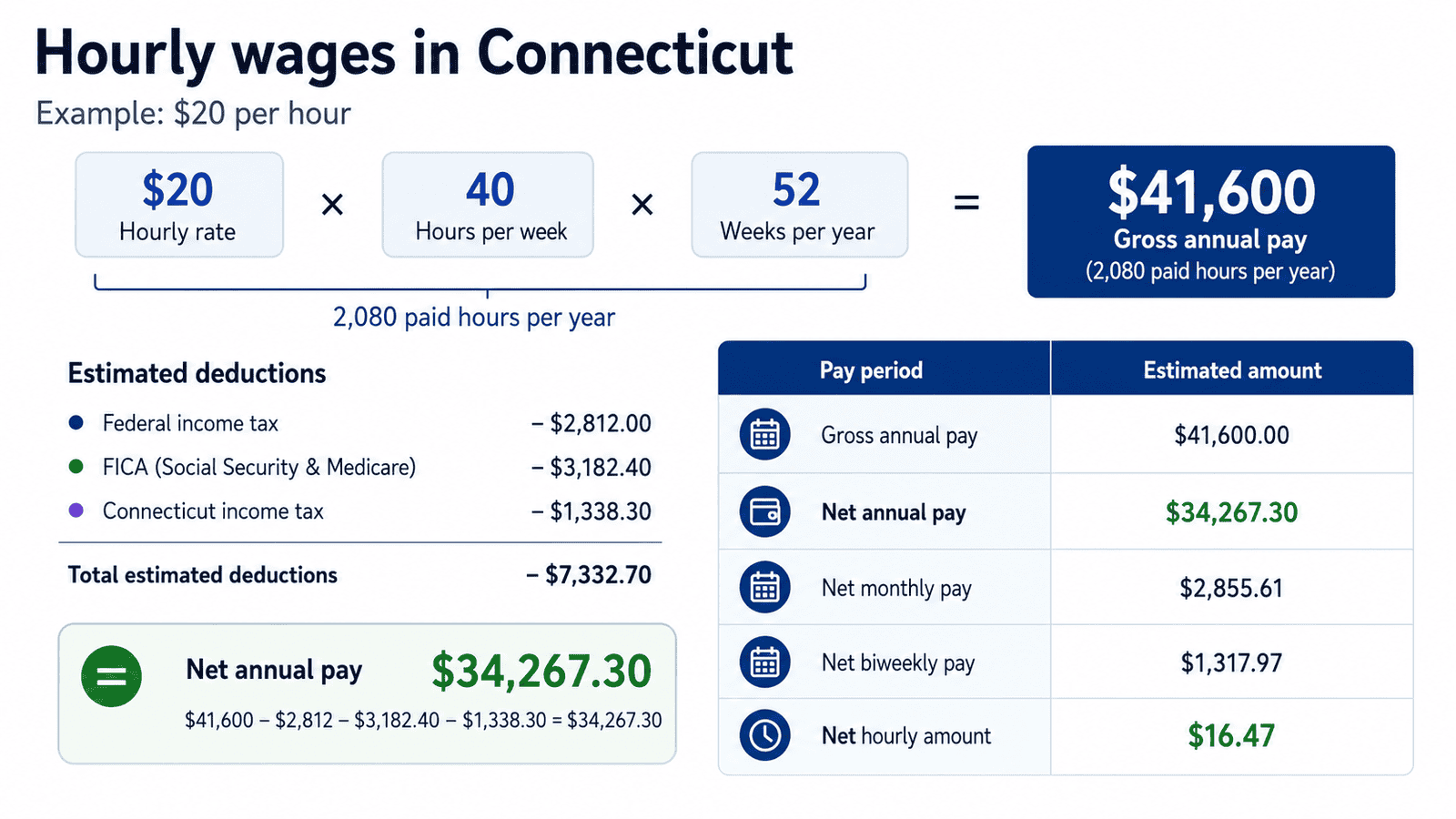
A Connecticut paycheck calculator hourly estimate first converts hourly wages to an annual salary.
Hourly rate × 40 hours × 52 weeks = annual gross pay (2,080 paid hours per year)
$20 an hour after taxes in Connecticut
$20 × 2,080 = $41,600 gross annual pay
Estimated deductions:
- Federal income tax: $2,812
- FICA: $3,182.40
- Connecticut income tax: approximately $1,338.30
$41,600 − $2,812 − $3,182.40 − $1,338.30 = $34,267.30
| Pay period | Estimated amount |
|---|---|
| Gross annual pay | $41,600.00 |
| Net annual pay | $34,267.30 |
| Net monthly pay | $2,855.61 |
| Net biweekly pay | $1,317.97 |
| Net hourly amount | $16.47 |
$25 an hour after taxes in Connecticut
$25 × 2,080 = $52,000 gross annual pay
Estimated deductions:
- Federal income tax: $4,060
- FICA: $3,978
- Connecticut income tax: approximately $1,881
Estimated take home = $42,081 annually
| Pay period | Estimated amount |
|---|---|
| Gross annual pay | $52,000.00 |
| Net annual pay | $42,081.00 |
| Net monthly pay | $3,506.75 |
| Net biweekly pay | $1,618.50 |
| Net hourly amount | $20.23 |
$30 an hour after taxes in Connecticut
$30 × 2,080 = $62,400 gross annual pay
Estimated deductions:
- Federal income tax: $5,308
- FICA: $4,773.60
- Connecticut income tax: approximately $2,595.40
Estimated take home = $49,723 annually
| Pay period | Estimated amount |
|---|---|
| Gross annual pay | $62,400.00 |
| Net annual pay | $49,723.00 |
| Net monthly pay | $4,143.58 |
| Net biweekly pay | $1,912.42 |
| Net hourly amount | $23.91 |
See the full breakdown for $30 an hour.
These figures assume every scheduled hour is paid. Unpaid leave, variable schedules, overtime, tips, and commissions change annual gross pay.
How bonuses are taxed in Connecticut
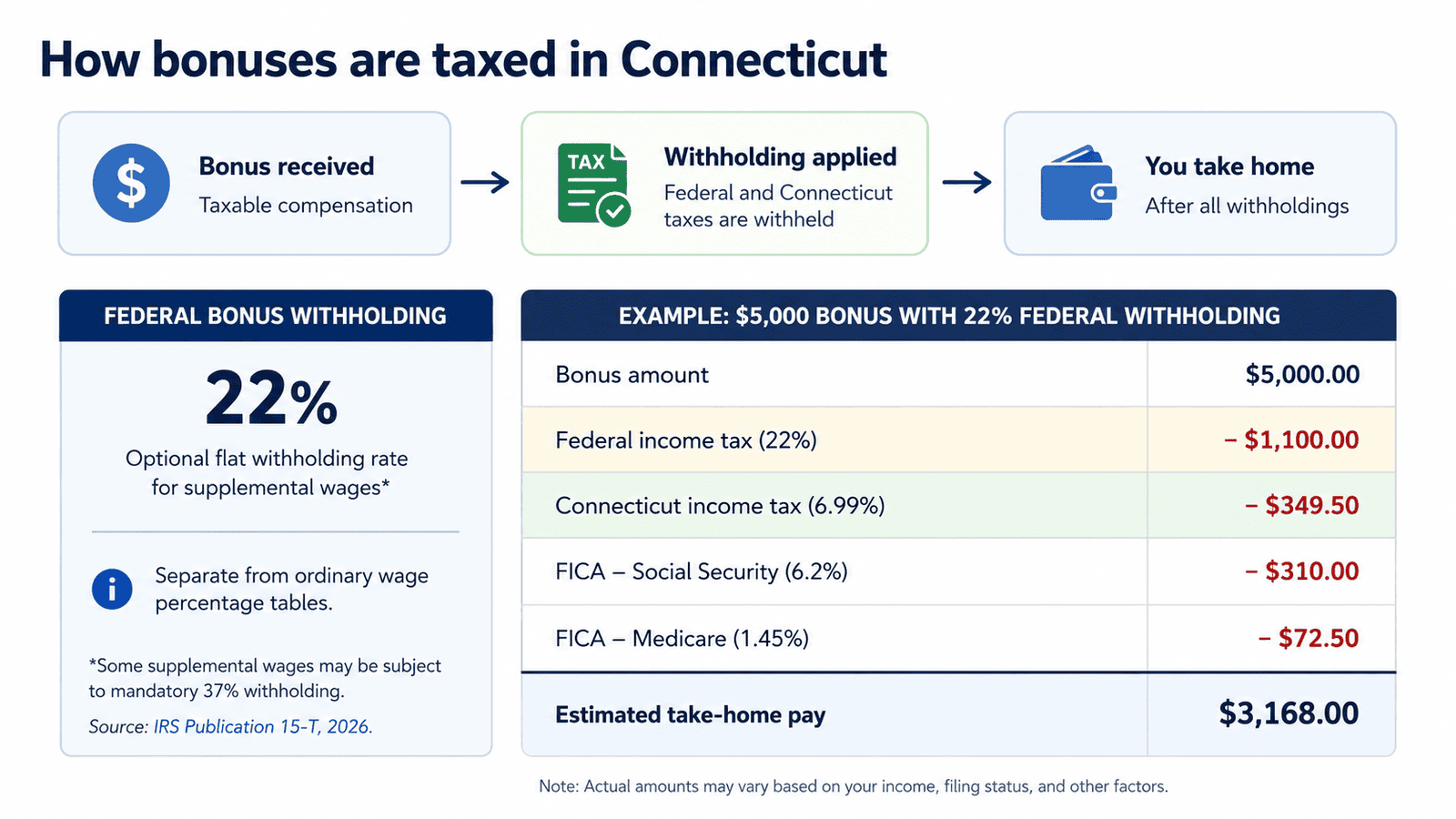
A bonus is taxable compensation. It is not subject to a separate final income tax merely because it is called a bonus. However, the withholding method can make the deduction on the bonus check look different from withholding on ordinary wages.
Federal bonus withholding
When an employer separately identifies a supplemental wage payment and uses the optional flat method, federal income tax may generally be withheld at 22%. The IRS notes that the 22% optional rate and 37% mandatory rate for certain supplemental wages are separate from the ordinary percentage tables (IRS Publication 15-T, 2026).
A $5,000 bonus using 22% federal withholding could have:
- Federal income tax withholding: $5,000 × 22% = $1,100
- Social Security: $5,000 × 6.2% = $310
- Medicare: $5,000 × 1.45% = $72.50
Federal taxes before Connecticut withholding = $1,482.50
The 22% amount is withholding, not necessarily the employee’s final federal tax rate. The bonus is included with other taxable income when the employee files a federal return.
Connecticut bonus withholding
Connecticut does not provide a single flat bonus withholding percentage.
When a bonus is paid with regular wages, the employer calculates Connecticut withholding as though the regular wages and bonus were one payment for that payroll period.
When the bonus is paid separately and tax was withheld from regular wages, the employer generally:
- Combines the regular and supplemental wages.
- Calculates Connecticut withholding on the combined amount.
- Subtracts the withholding already taken from regular wages.
- Withholds the difference from the bonus.
Connecticut applies the same combined wage method to bonuses, commissions, overtime pay, and sales awards (CT DRS, Informational Publication 2026(1)).
A bonus tax calculator Connecticut result may show a relatively high deduction on one check because the payroll system annualizes the larger payment.
Effect of 401k and health insurance premiums
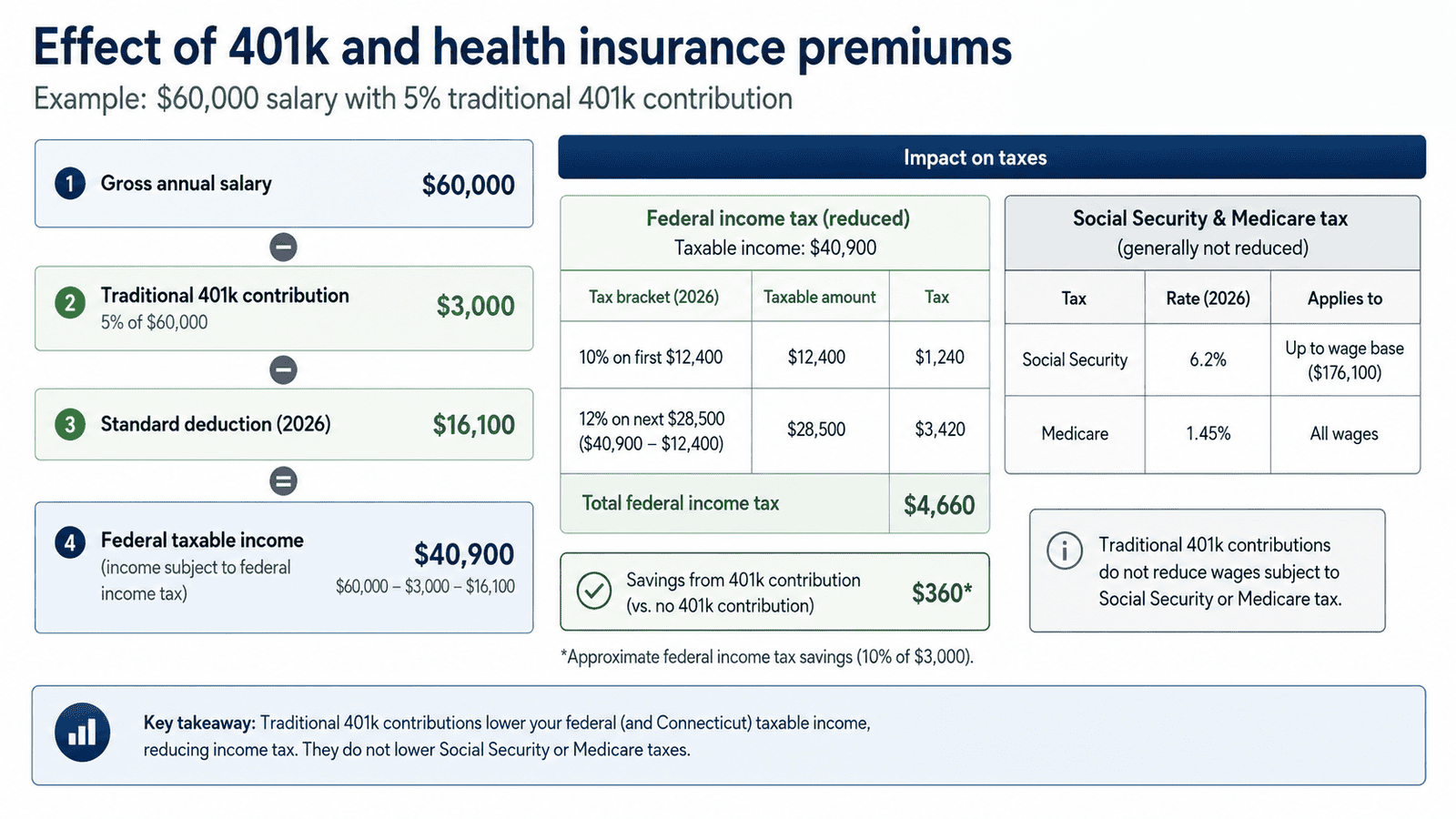
Pretax payroll deductions can reduce income subject to federal and Connecticut income tax. Their effect on Social Security and Medicare depends on the type of benefit.
Traditional 401k contributions
Traditional 401k contributions generally reduce wages subject to federal income tax. They usually do not reduce wages subject to Social Security or Medicare tax.
Consider the $60,000 example with a 5% traditional 401k contribution:
$60,000 × 5% = $3,000 annual contribution
Federal taxable income becomes:
$60,000 − $3,000 − $16,100 = $40,900
Estimated federal income tax becomes:
- $12,400 × 10% = $1,240
- $28,500 × 12% = $3,420
Total federal income tax = $4,660
Without the contribution, estimated federal tax was $5,020. The estimated federal income tax reduction is $360.
Connecticut taxable wages may also be reduced, depending on payroll treatment. Using annualized wages of $57,000 under code F:
- Initial Connecticut tax is approximately $2,385
- The phaseout add back is approximately $25
- The code F personal credit is 10%
- Estimated Connecticut withholding is approximately $2,169
That is about $148.50 less than the estimate without the 401k contribution.
FICA remains approximately $4,590 because a traditional 401k normally does not reduce Social Security or Medicare wages.
Estimated annual cash take home after the $3,000 contribution becomes:
$60,000 − $3,000 − $4,660 − $4,590 − $2,169 = $45,581
Cash take home falls by about $2,491.50, while $3,000 is directed to the retirement account. The difference reflects approximately $508.50 of estimated federal and state income tax savings.
This is an illustration, not a recommendation about how much to contribute.
Health insurance premiums
Employer sponsored health premiums paid through a qualifying cafeteria plan often reduce federal income tax, Social Security, Medicare, and state taxable wages.
Suppose an employee pays $200 per month in qualifying pretax premiums:
$200 × 12 = $2,400 annually
If the entire amount reduces FICA wages, the FICA reduction would be:
$2,400 × 7.65% = $183.60
Federal and Connecticut income tax withholding could also decline. The exact reduction depends on filing status, tax bracket, and the employer’s benefit plan.
Not every insurance deduction is pretax. Employees may want to check the earnings and tax sections of their pay stubs.
How Connecticut compares with neighboring states
Connecticut’s progressive system combines rates of 2% through 6.99% with exemptions, credits, phaseouts, and recapture provisions.
| State | General income tax structure | Local wage tax consideration |
|---|---|---|
| Connecticut | Progressive, 2% to 6.99% | No separate city wage income tax |
| New York | Progressive state tax | New York City and Yonkers rules may apply |
| Massachusetts | Generally 5% on ordinary wage income, with an additional tax at higher income levels | No standard municipal wage income tax |
| Rhode Island | Progressive, 3.75%, 4.75%, and 5.99% | No standard municipal wage income tax |
| New Jersey | Progressive gross income tax | No standard municipal wage income tax |
Rhode Island’s 2026 schedule applies 3.75% up to $82,050 of taxable income, 4.75% from $82,051 through $186,450, and 5.99% above $186,450 (Rhode Island Division of Taxation, 2026 estimated tax form).
Massachusetts’ Department of Revenue published 2026 withholding tables using a 5% withholding rate for regular wage income (Massachusetts Circular M, effective January 1, 2026).
New Jersey describes its system as a graduated income tax in which rates rise as income increases (NJ Division of Taxation, tax tables).
Compare the detailed state calculations here:
- New York paycheck calculator
- Massachusetts paycheck calculator
- Rhode Island paycheck calculator
- New Jersey paycheck calculator
A worker who lives in one state and works in another may need to consider nonresident withholding and resident tax credits. Connecticut requires withholding on Connecticut source wages paid to many nonresidents. It also has special sourcing rules for some remote workers whose home state uses a convenience of the employer test (CT DRS, withholding tax information). For bonuses, the paycheck calculator Connecticut projection should include both federal withholding and applicable state income tax. Check the paycheck calculator connecticut after changing your withholding to see how your net paycheck may change.
Common paycheck calculator mistakes
Treating a marginal rate as an effective rate. A worker in the 22% federal bracket does not pay 22% of total gross salary in federal income tax. The standard deduction and lower tax brackets apply first.
Forgetting pretax deductions. A traditional 401k, qualifying health premium, HSA, or FSA contribution can change taxable wages. Leaving these deductions out can overstate take home pay or tax.
Dividing annual salary by 24 instead of 26. Biweekly payroll has 26 checks in most years. Semimonthly payroll has 24 checks. These pay schedules are not the same.
Assuming bonus withholding equals final bonus tax. A bonus may have 22% federal withholding or be combined with regular wages. The employee’s final tax is based on total annual taxable income.
Ignoring Form CT W4 selections. Connecticut withholding depends on the code selected on Form CT W4, along with any additional or reduced withholding entered by the employee. A paycheck calculator Connecticut estimate can show how 401(k) contributions reduce taxable income while lowering current net pay. A paycheck calculator connecticut shows how pre-tax deductions can increase your take-home pay.
Frequently asked questions
How much is taken out of my paycheck in Connecticut?
The amount depends on income, filing status, deductions, and withholding elections. In the MoneyFN examples, estimated federal, FICA, and Connecticut taxes consume about 18.4% of a $45,000 salary, 19.9% of a $60,000 salary, and 24.1% of an $85,000 salary for a single filer before benefits and other deductions.
What is the Connecticut income tax rate in 2026?
Connecticut has progressive rates from 2% to 6.99% in 2026. The initial withholding calculation uses rates of 2%, 4.5%, 5.5%, 6%, 6.5%, 6.9%, and 6.99%. Exemptions, credits, phaseouts, and recapture rules affect the final amount (CT DRS, TPG 211).
How much is $60,000 a year after taxes in Connecticut?
Under the assumptions used in this article, a single filer earning $60,000 has estimated annual take home pay of $48,072.50, or about $1,848.94 biweekly. This estimate excludes health insurance, retirement contributions, dependents, and other deductions or credits.
How are bonuses taxed in Connecticut?
Bonuses are subject to federal income tax, FICA, and Connecticut income tax. Connecticut usually combines the bonus with regular wages to calculate withholding, then subtracts tax already withheld from ordinary wages when the bonus is paid separately. Connecticut does not prescribe one flat state bonus rate (CT DRS, Informational Publication 2026(1)).
How do 401k contributions change take home pay in Connecticut?
Traditional 401k contributions generally reduce federal and Connecticut income taxable wages, but usually do not reduce Social Security or Medicare wages. In the $60,000 example, a $3,000 traditional contribution reduces estimated federal and Connecticut income taxes by about $508.50 while directing $3,000 into the retirement account.
Does Connecticut have local city income taxes?
Connecticut does not impose separate city wage income tax withholding. Employees may still pay local property taxes and other municipal charges, but these are not city payroll income taxes.
Why does my actual paycheck differ from this estimate?
Differences can result from Form W 4 entries, Form CT W4 codes, tax credits, dependents, additional withholding, health benefits, retirement contributions, taxable fringe benefits, bonuses, payroll rounding, or working in more than one state. Use the paycheck calculator Connecticut results to compare hourly, biweekly, monthly, and annual take-home pay. The paycheck calculator connecticut helps compare weekly, biweekly, and monthly net pay after taxes.
Methodology
MoneyFN calculated the examples using 2026 federal tax brackets and the $16,100 standard deduction for a single filer published by the IRS in Revenue Procedure 2025-32, released October 2025. FICA uses the IRS 2026 employee rates of 6.2% for Social Security up to $184,500 and 1.45% for Medicare (IRS, tax year 2026 inflation adjustments).
Connecticut estimates use the Department of Revenue Services 2026 withholding calculation rules effective January 1, 2026. The calculations assume withholding code F, no additional withholding, and no reduced withholding. They incorporate the applicable personal exemption, initial progressive calculation, 2% rate phaseout add back, tax recapture, and personal tax credit (CT DRS, TPG 211, revised 12/2025).
Annual estimates are divided by 26 for biweekly pay, 12 for monthly pay, 52 for weekly pay, and 260 for a five day workweek. Figures are rounded to the nearest cent where appropriate.
This content is for educational purposes only and does not constitute personalized financial advice. Consult a qualified financial advisor for guidance specific to your situation.
By Nathan Whitmore for MoneyFN Use the paycheck calculator connecticut to estimate your take-home pay before accepting a new job offer.

Nathan Whitmore is a US based personal finance writer at MoneyFN covering salary, paycheck, and tax math for American workers. He works from primary sources only: IRS revenue procedures, Bureau of Labor Statistics wage data, and Federal Reserve statistics. Every figure he publishes is dated and traceable to a public source.