

New York paycheck calculator
Our paycheck calculator New York guide helps you estimate your 2026 take home pay after federal income tax, Social Security, Medicare, and New York State taxes. New York has a progressive state income tax, while New York City residents pay an additional city income tax and Yonkers residents may owe a local surcharge. A single filer earning $60,000 with the standard deduction and no pre-tax deductions can expect to take home about $47,747 per year, or roughly $1,837 every two weeks.
- State income tax: progressive, 3.9% to 10.9% (2026)
- Federal income tax: 10% to 37% across seven brackets (2026)
- Social Security: 6.2% on wages up to $184,500
- Medicare: 1.45% on all wages, plus 0.9% above $200,000
- Local taxes: NYC income tax and Yonkers surcharge may apply
Sources: IRS, Rev. Proc. 2025-32 (2026 tax year); New York State Department of Taxation and Finance (2026 withholding updates); Social Security Administration (2026 wage base).
Use the salary after tax calculator to enter your specific income, filing status, and deductions for a personalized estimate of your New York take home pay.
- How the paycheck calculator works
- 2026 federal taxes on your paycheck
- New York state income tax explained
- Worked examples
- Hourly wages in New York
- How bonuses are taxed
- Effect of 401(k) and health insurance premiums
- How New York compares with neighboring states
- Frequently asked questions
- Methodology
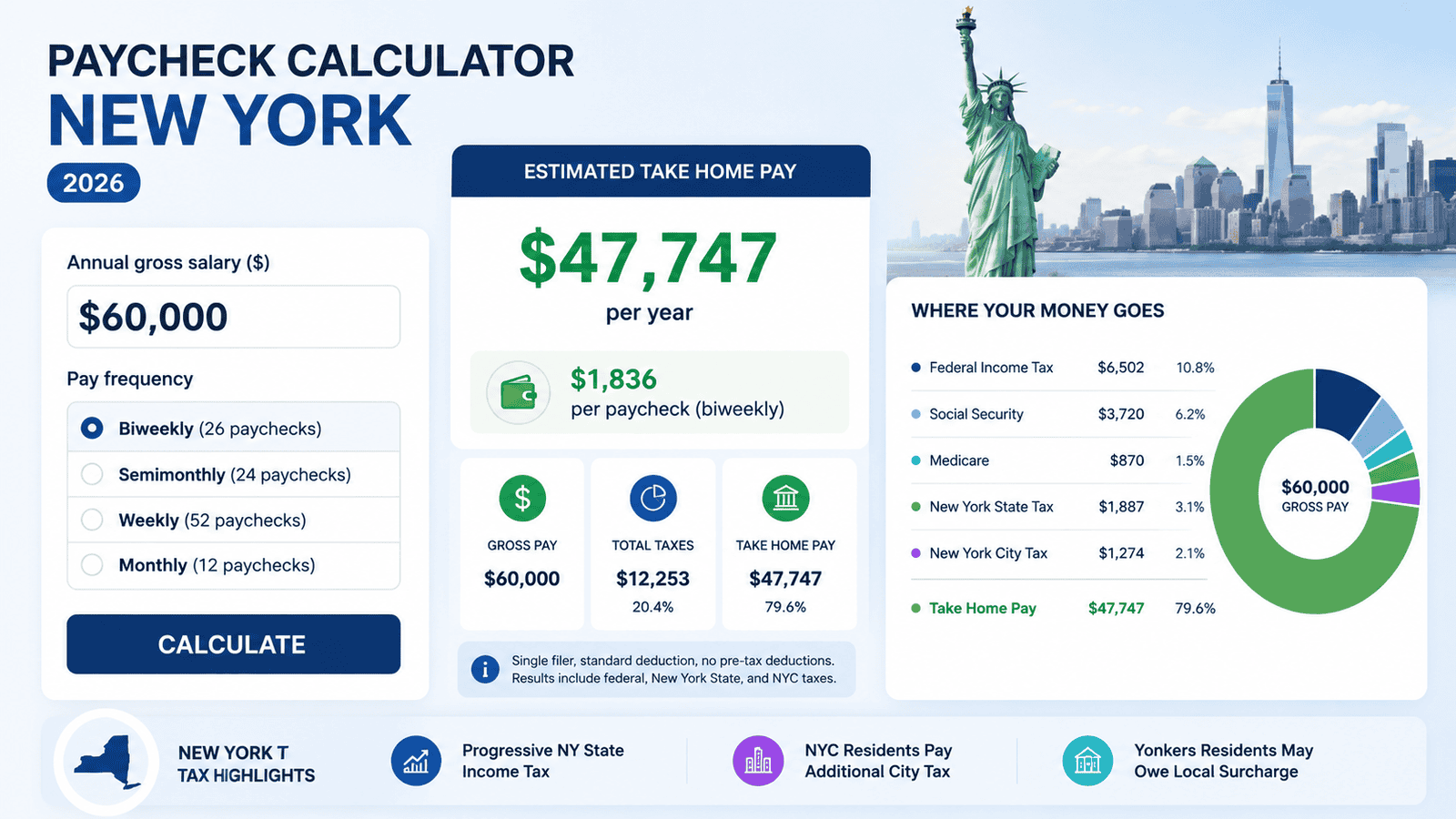
Paycheck Calculator New York: How the paycheck calculator works
A paycheck calculator New York estimates your take home pay by subtracting required payroll taxes and any voluntary pre-tax deductions from your gross wages. It helps employees see how much of each paycheck they actually keep after all withholding.
You enter the following inputs:
- Gross salary or hourly wage
- Pay frequency (weekly, biweekly, semimonthly, or monthly)
- Filing status (single, married filing jointly, head of household)
- Traditional 401(k) contributions
- Health insurance premiums deducted before taxes
- Other eligible pre-tax deductions
The calculator then estimates each layer of withholding in order: federal income tax, Social Security tax, Medicare tax, New York State income tax, and any applicable local taxes for New York City or Yonkers. The result is your estimated net take home pay per pay period.
2026 federal taxes on your paycheck
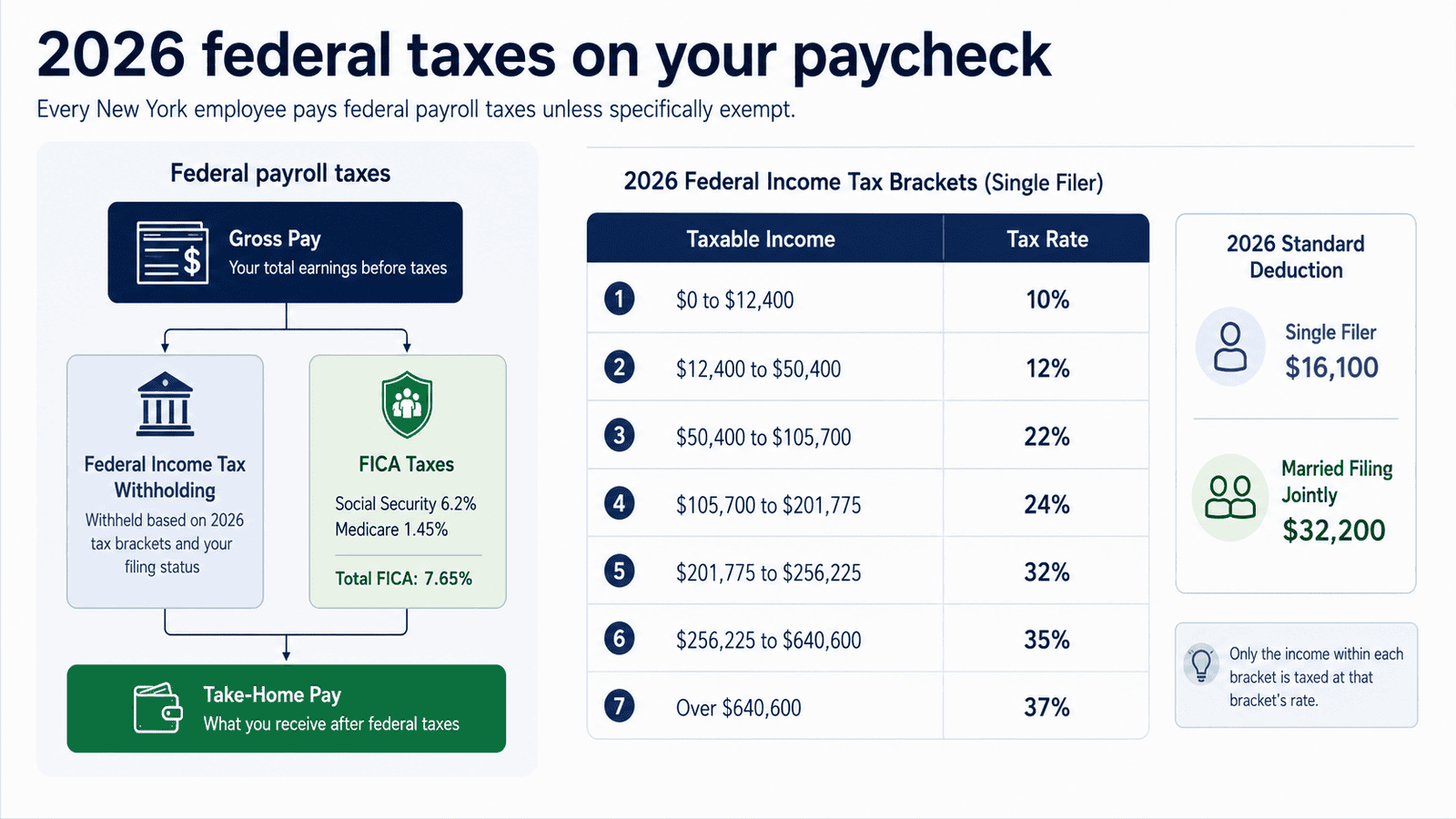
Every New York employee pays federal payroll taxes unless specifically exempt. These include federal income tax withholding and FICA contributions for Social Security and Medicare.
Federal income tax brackets
The IRS uses seven progressive tax brackets for 2026 with rates of 10%, 12%, 22%, 24%, 32%, 35%, and 37%. Only the income within each bracket is taxed at that bracket’s rate. The 2026 standard deduction for single filers is $16,100, and for married filing jointly it is $32,200. This deduction reduces your taxable income before the bracket rates are applied.
| 2026 single filer bracket | Tax rate |
|---|---|
| $0 to $12,400 | 10% |
| $12,400 to $50,400 | 12% |
| $50,400 to $105,700 | 22% |
| $105,700 to $201,775 | 24% |
| $201,775 to $256,225 | 32% |
| $256,225 to $640,600 | 35% |
| Over $640,600 | 37% |
Source: IRS, Rev. Proc. 2025-32, tax year 2026.
Social Security tax
Employees pay 6.2% on wages up to the 2026 wage base of $184,500. Any wages above this cap are not subject to Social Security tax. The maximum employee Social Security tax for 2026 is $11,439. Source: Social Security Administration, 2026.
Medicare tax
Employees pay 1.45% on all wages with no cap. An additional 0.9% Medicare surtax applies to earned income above $200,000 for single filers ($250,000 for married filing jointly). Source: IRS Topic 751, 2026.
New York state income tax explained
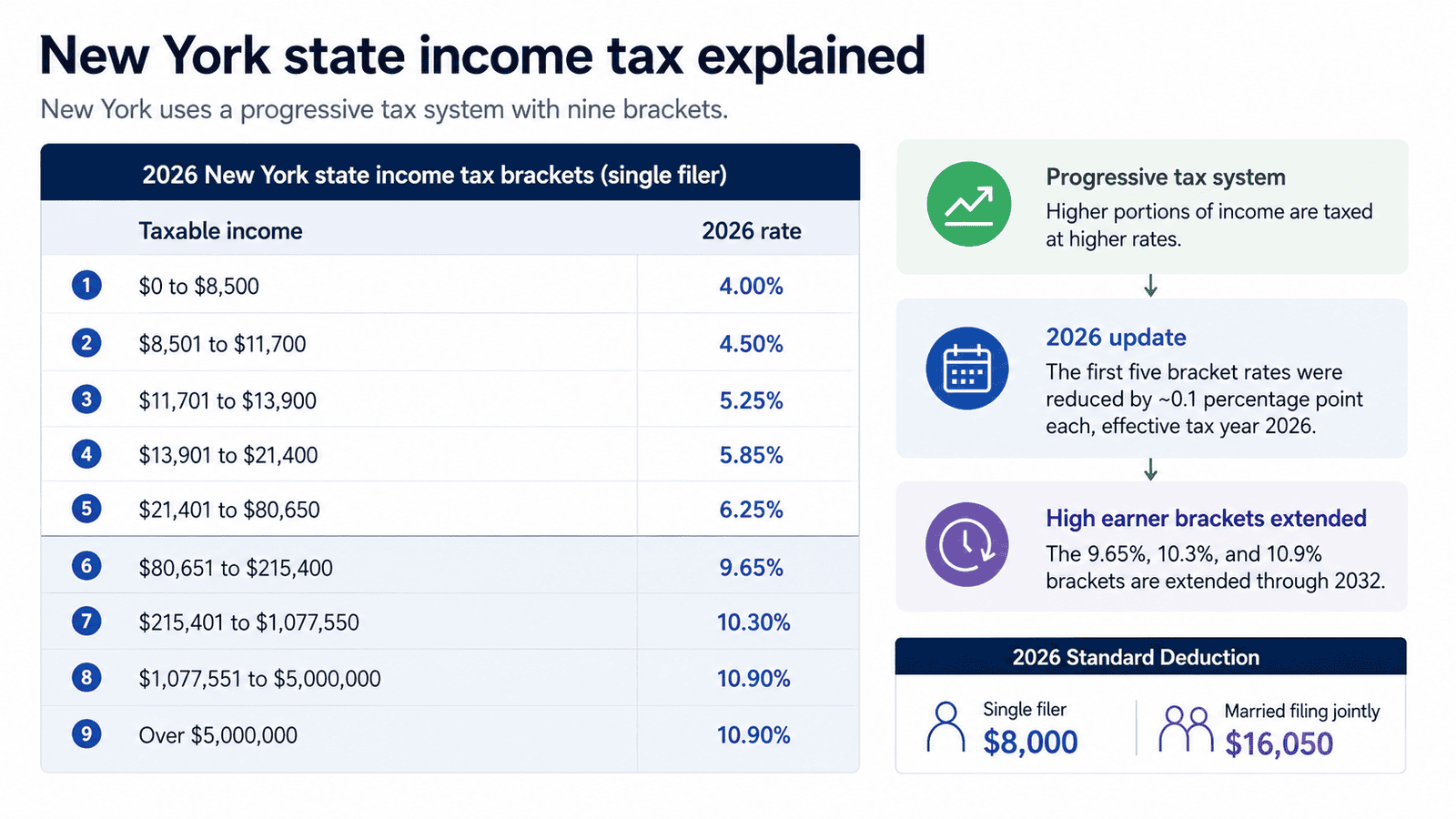
New York does have a state income tax, and it uses a progressive system with nine brackets. This means higher portions of income are taxed at higher rates, not a single flat rate applied to all earnings. Beginning with tax year 2026, New York reduced the first five bracket rates by approximately 0.1 percentage point each, as enacted under Chapter 59 of the Laws of 2025. The temporary high earner brackets (9.65%, 10.3%, and 10.9%) were extended through 2032.
The New York State standard deduction for single filers is $8,000 and for married filing jointly filers is $16,050.
2026 New York state income tax brackets (single filer)
| Taxable income | 2026 rate |
|---|---|
| $0 to $8,500 | 3.90% |
| $8,500 to $11,700 | 4.40% |
| $11,700 to $13,900 | 5.15% |
| $13,900 to $80,650 | 5.40% |
| $80,650 to $215,400 | 5.90% |
| $215,400 to $1,077,550 | 6.85% |
| $1,077,550 to $5,000,000 | 9.65% |
| $5,000,000 to $25,000,000 | 10.30% |
| Over $25,000,000 | 10.90% |
Source: New York State Department of Taxation and Finance, 2026 withholding rate changes; Form IT-2105-I (2026) rate schedules.
Local income taxes
Unlike many states, New York may also impose local income taxes in addition to the state tax.
New York City: Residents of the five boroughs pay a separate city income tax with rates ranging from 3.078% to 3.876% based on taxable income and filing status. For single filers, the top NYC rate of 3.876% applies to city taxable income above $50,000.
Yonkers: Yonkers residents pay a surcharge equal to 16.75% of their New York State income tax liability. Nonresidents who work in Yonkers pay 0.5% of wages earned in the city.
Most New York workers outside New York City and Yonkers do not owe any local payroll income tax.
Source: New York Department of Taxation and Finance, 2026 tax rate tables.
Worked examples
The following biweekly take home estimates assume a single filer taking the standard deduction with no retirement contributions, no health insurance deductions, and a location outside New York City and Yonkers. All calculations use 2026 federal and New York State tax rates. Actual payroll withholding may vary based on employer methods and individual circumstances.
Example 1: $45,000 salary
| Annual gross salary | $45,000 |
| Federal standard deduction | $16,100 |
| Federal taxable income | $28,900 |
Federal income tax: (10% x $12,400) + (12% x $16,500) = $1,240 + $1,980 = $3,220
Social Security: 6.2% x $45,000 = $2,790
Medicare: 1.45% x $45,000 = $653
| NY standard deduction | $8,000 |
| NY taxable income | $37,000 |
NY state tax: (3.9% x $8,500) + (4.4% x $3,200) + (5.15% x $2,200) + (5.4% x $23,100) = $332 + $141 + $113 + $1,247 = $1,833
| Deduction | Annual amount |
|---|---|
| Federal income tax | $3,220 |
| Social Security | $2,790 |
| Medicare | $653 |
| New York State tax | $1,833 |
| Total deductions | $8,496 |
| Estimated annual take home | $36,504 |
| Biweekly take home (26 pay periods) | $1,404 |
Example 2: $60,000 salary
| Annual gross salary | $60,000 |
| Federal standard deduction | $16,100 |
| Federal taxable income | $43,900 |
Federal income tax: (10% x $12,400) + (12% x $31,500) = $1,240 + $3,780 = $5,020
Social Security: 6.2% x $60,000 = $3,720
Medicare: 1.45% x $60,000 = $870
| NY standard deduction | $8,000 |
| NY taxable income | $52,000 |
NY state tax: (3.9% x $8,500) + (4.4% x $3,200) + (5.15% x $2,200) + (5.4% x $38,100) = $332 + $141 + $113 + $2,057 = $2,643
| Deduction | Annual amount |
|---|---|
| Federal income tax | $5,020 |
| Social Security | $3,720 |
| Medicare | $870 |
| New York State tax | $2,643 |
| Total deductions | $12,253 |
| Estimated annual take home | $47,747 |
| Biweekly take home (26 pay periods) | $1,837 |
Example 3: $85,000 salary
| Annual gross salary | $85,000 |
| Federal standard deduction | $16,100 |
| Federal taxable income | $68,900 |
Federal income tax: (10% x $12,400) + (12% x $38,000) + (22% x $18,500) = $1,240 + $4,560 + $4,070 = $9,870
Social Security: 6.2% x $85,000 = $5,270
Medicare: 1.45% x $85,000 = $1,233
| NY standard deduction | $8,000 |
| NY taxable income | $77,000 |
NY state tax: (3.9% x $8,500) + (4.4% x $3,200) + (5.15% x $2,200) + (5.4% x $63,100) = $332 + $141 + $113 + $3,407 = $3,993
| Deduction | Annual amount |
|---|---|
| Federal income tax | $9,870 |
| Social Security | $5,270 |
| Medicare | $1,233 |
| New York State tax | $3,993 |
| Total deductions | $20,366 |
| Estimated annual take home | $64,634 |
| Biweekly take home (26 pay periods) | $2,486 |
These examples are educational estimates using 2026 federal and New York State tax rules. Actual payroll withholding can differ because employers use IRS and New York withholding formulas rather than annual tax return calculations.
Hourly wages in New York
The table below shows estimated annual take home pay for common hourly rates in New York, assuming 40 hours per week, 52 weeks per year, a single filer taking the standard deduction, no pre-tax deductions, and a location outside New York City and Yonkers.
| Hourly wage | Annual gross pay | Estimated annual take home | Estimated biweekly take home |
|---|---|---|---|
| $20 | $41,600 | $33,957 | $1,306 |
| $25 | $52,000 | $41,751 | $1,606 |
| $30 | $62,400 | $49,545 | $1,906 |
For a deeper look at what $30 per hour means after taxes across all deductions, see the $30 an hour take home pay guide.
How bonuses are taxed in New York
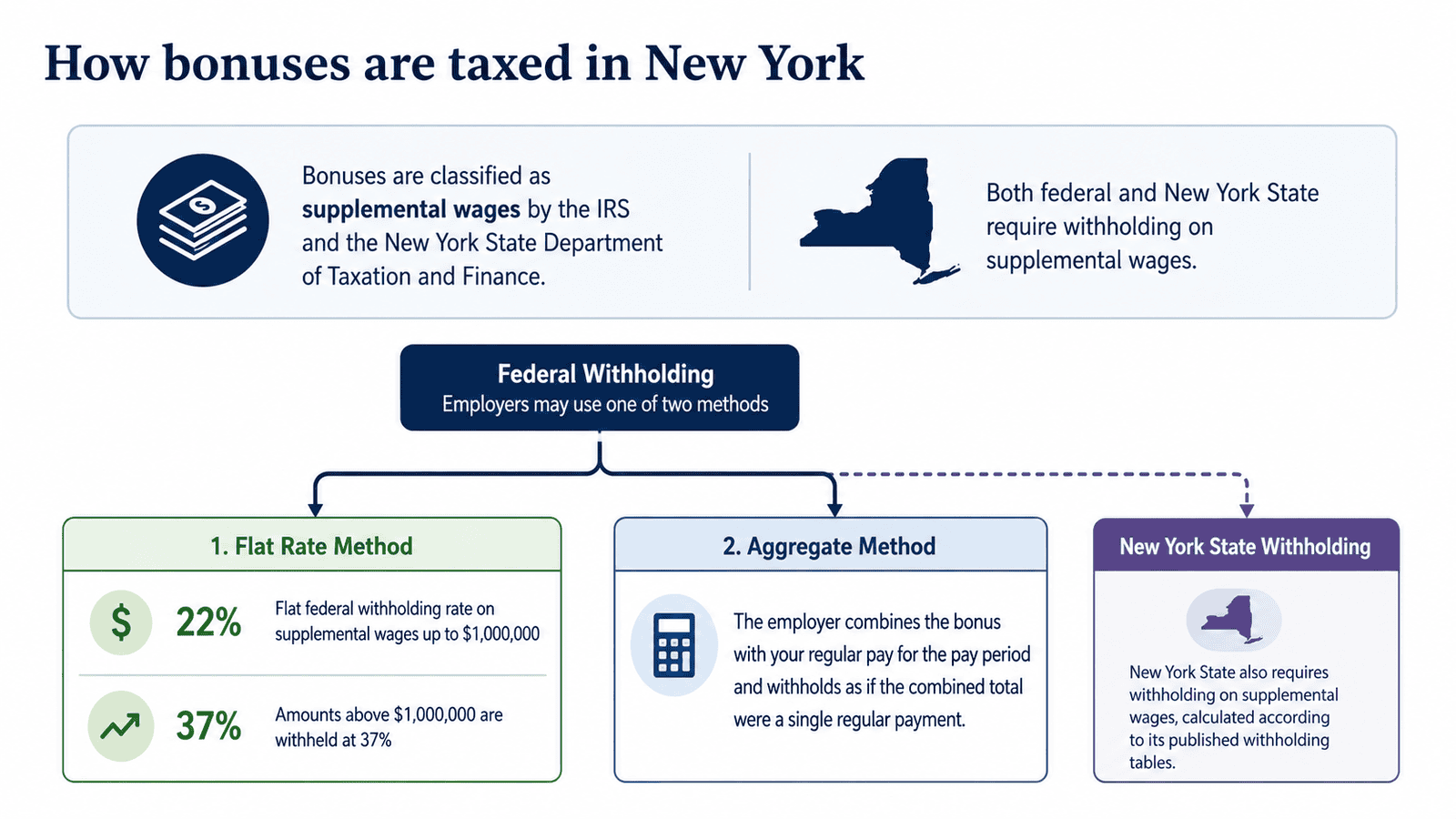
Bonuses are classified as supplemental wages by both the IRS and the New York State Department of Taxation and Finance. Employers generally withhold federal income tax on supplemental wages using one of two methods:
- Flat rate method: A flat 22% federal withholding rate applies to supplemental wages up to $1,000,000. Amounts above $1,000,000 are withheld at 37%.
- Aggregate method: The employer combines the bonus with your regular pay for the pay period and withholds as if the combined total were a single regular payment.
New York State also requires withholding on supplemental wages, calculated according to its published withholding tables. If you live in New York City or Yonkers, local withholding applies as well.
A bonus can temporarily increase your withholding because payroll systems using the aggregate method may treat the larger paycheck as if it represents your normal earnings level. Your actual tax liability is reconciled when you file your annual tax return, and any over-withholding is returned as a refund.
Source: IRS Publication 15-T, 2026; NYS Publication NYS-50-T-NYS (1/26).
Effect of 401(k) and health insurance premiums
Traditional 401(k) contributions reduce both your federal taxable wages and your New York State taxable wages. This means every dollar you contribute lowers your income tax withholding at both levels, increasing your net take home pay on each check.
However, traditional 401(k) contributions do not reduce your Social Security or Medicare wages. FICA taxes continue to apply to your full gross pay regardless of retirement contributions.
Employer-sponsored health insurance premiums deducted on a pre-tax basis (through a Section 125 cafeteria plan) work similarly, reducing federal and state taxable income while generally remaining subject to FICA.
Example: $60,000 salary with a $6,000 annual 401(k) contribution
Federal taxable income: ($60,000 − $6,000) − $16,100 standard deduction = $37,900 (down from $43,900 without the contribution)
NY taxable income: ($60,000 − $6,000) − $8,000 standard deduction = $46,000 (down from $52,000)
The lower taxable income at both levels means less income tax is withheld from each paycheck, partially offsetting the reduction in gross pay from the 401(k) contribution. Social Security and Medicare taxes continue to be calculated on the full $60,000. A paycheck calculator New York estimate can help you budget more accurately throughout the year.
How New York compares with neighboring states
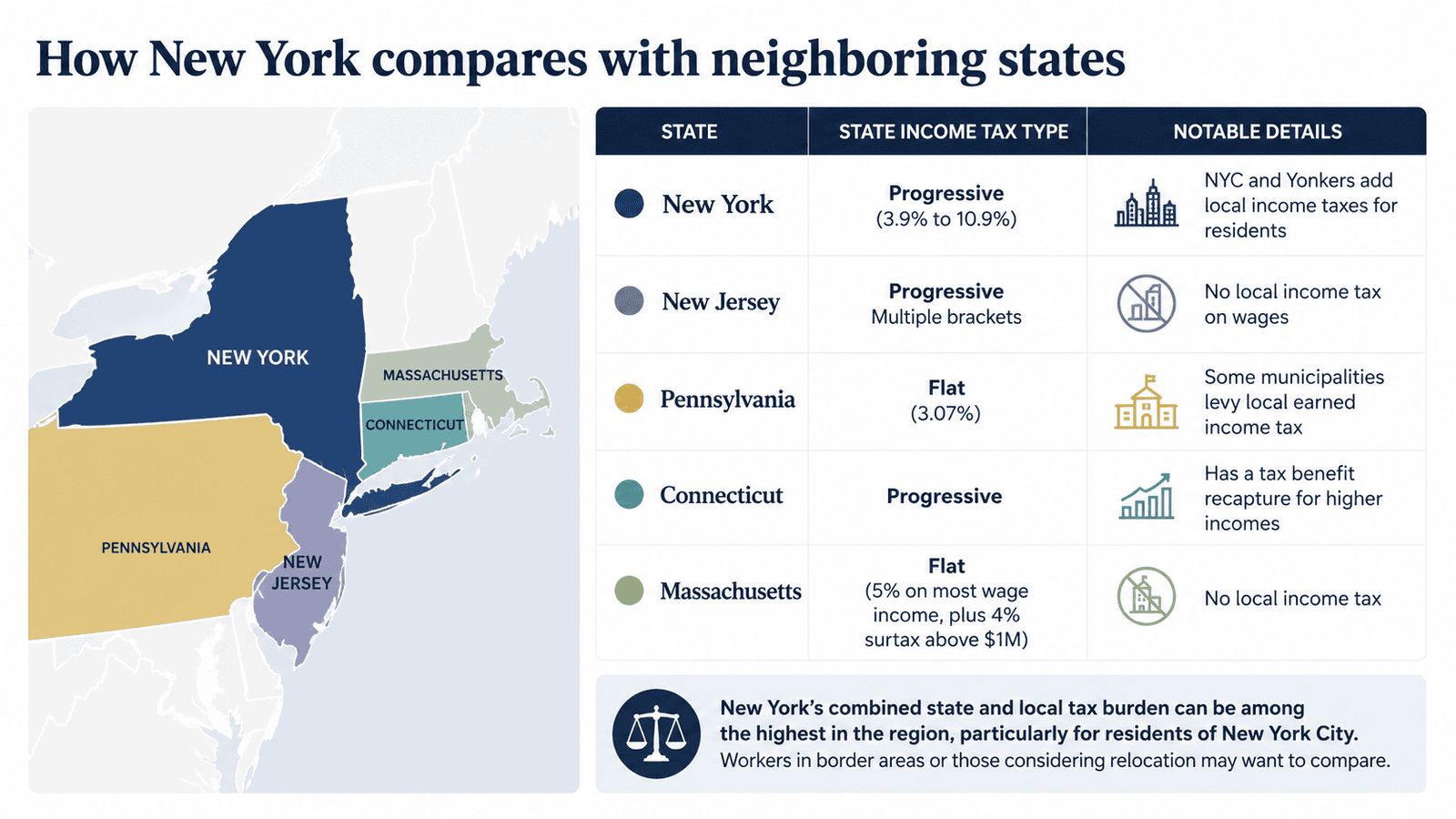
| State | State income tax type | Notable details |
|---|---|---|
| New York | Progressive (3.9% to 10.9%) | NYC and Yonkers add local income taxes for residents |
| New Jersey | Progressive | Multiple brackets, no local income tax on wages |
| Pennsylvania | Flat (3.07%) | Some municipalities levy local earned income tax |
| Connecticut | Progressive | Has a tax benefit recapture for higher incomes |
| Massachusetts | Flat (5% on most wage income, plus 4% surtax above $1M) | No local income tax |
New York’s combined state and local tax burden can be among the highest in the region, particularly for residents of New York City. Workers in border areas or those considering relocation may want to compare take home pay across these states using the salary after tax calculator. Try the paycheck calculator New York after changing your filing status or pre-tax deductions.
Frequently asked questions
How much is taken out of my paycheck in New York?
Most New York employees have deductions for federal income tax, Social Security (6.2% up to $184,500), Medicare (1.45%), and New York State income tax (3.9% to 10.9% depending on income). New York City residents also pay city income tax (3.078% to 3.876%), and Yonkers residents may owe a local surcharge. The exact amount depends on your income, filing status, and any pre-tax deductions like 401(k) contributions.
What is the New York income tax rate in 2026?
New York uses a progressive income tax with nine brackets for 2026. Rates begin at 3.90% on the first $8,500 of taxable income for single filers and rise to 10.90% for taxable income above $25,000,000. The first five brackets were reduced by approximately 0.1 percentage point starting January 1, 2026, under Chapter 59 of the Laws of 2025. Source: New York State Department of Taxation and Finance.
How much is $60,000 a year after taxes in New York?
A single filer earning $60,000 outside New York City, taking the standard deduction with no pre-tax deductions, can expect to take home approximately $47,747 per year, or about $1,837 biweekly. This accounts for roughly $5,020 in federal income tax, $3,720 in Social Security, $870 in Medicare, and $2,643 in New York State income tax. Actual results vary based on filing status, deductions, and individual circumstances.
How are bonuses taxed in New York?
Bonuses are treated as supplemental wages. For federal purposes, employers often withhold at a flat 22% rate (37% for amounts over $1,000,000) or use the aggregate method, which combines the bonus with regular pay for withholding calculations. New York State and any applicable local taxes are also withheld on bonuses. Your actual tax liability on the bonus is determined when you file your annual tax return.
How do 401(k) contributions change take home pay in New York?
Traditional 401(k) contributions reduce both federal and New York State taxable income, which lowers income tax withholding and increases your per-paycheck take home pay. However, they do not reduce Social Security or Medicare wages, so FICA taxes still apply to the full gross amount. For example, a $6,000 annual 401(k) contribution on a $60,000 salary reduces federal taxable income from $43,900 to $37,900 and NY taxable income from $52,000 to $46,000. The paycheck calculator New York accounts for federal, state, and applicable local payroll taxes.
Methodology
All estimates in this guide use the following 2026 tax year parameters:
- 2026 IRS federal income tax brackets (10% to 37%) and standard deduction ($16,100 single, $32,200 married filing jointly), per IRS Rev. Proc. 2025-32
- Social Security tax of 6.2% on wages up to $184,500, per the Social Security Administration
- Medicare tax of 1.45% on all wages, per IRS Topic 751
- 2026 New York State income tax brackets (3.9% to 10.9%) and standard deduction ($8,000 single), per the New York State Department of Taxation and Finance
Worked examples assume a single filer taking the standard deduction with no additional credits, no itemized deductions, no local taxes, and no pre-tax retirement or insurance contributions. Actual payroll withholding can differ from these annual estimates because employers use IRS and New York withholding formulas that calculate tax on a per-period basis rather than as an annual calculation. These figures are intended as educational estimates only.
This content is for educational purposes only and does not constitute personalized financial advice. Consult a qualified financial advisor for guidance specific to your situation.
By Nathan Whitmore for MoneyFN Use the paycheck calculator New York to estimate your net pay before accepting a job offer.

Nathan Whitmore is a US based personal finance writer at MoneyFN covering salary, paycheck, and tax math for American workers. He works from primary sources only: IRS revenue procedures, Bureau of Labor Statistics wage data, and Federal Reserve statistics. Every figure he publishes is dated and traceable to a public source.