

Ohio paycheck calculator
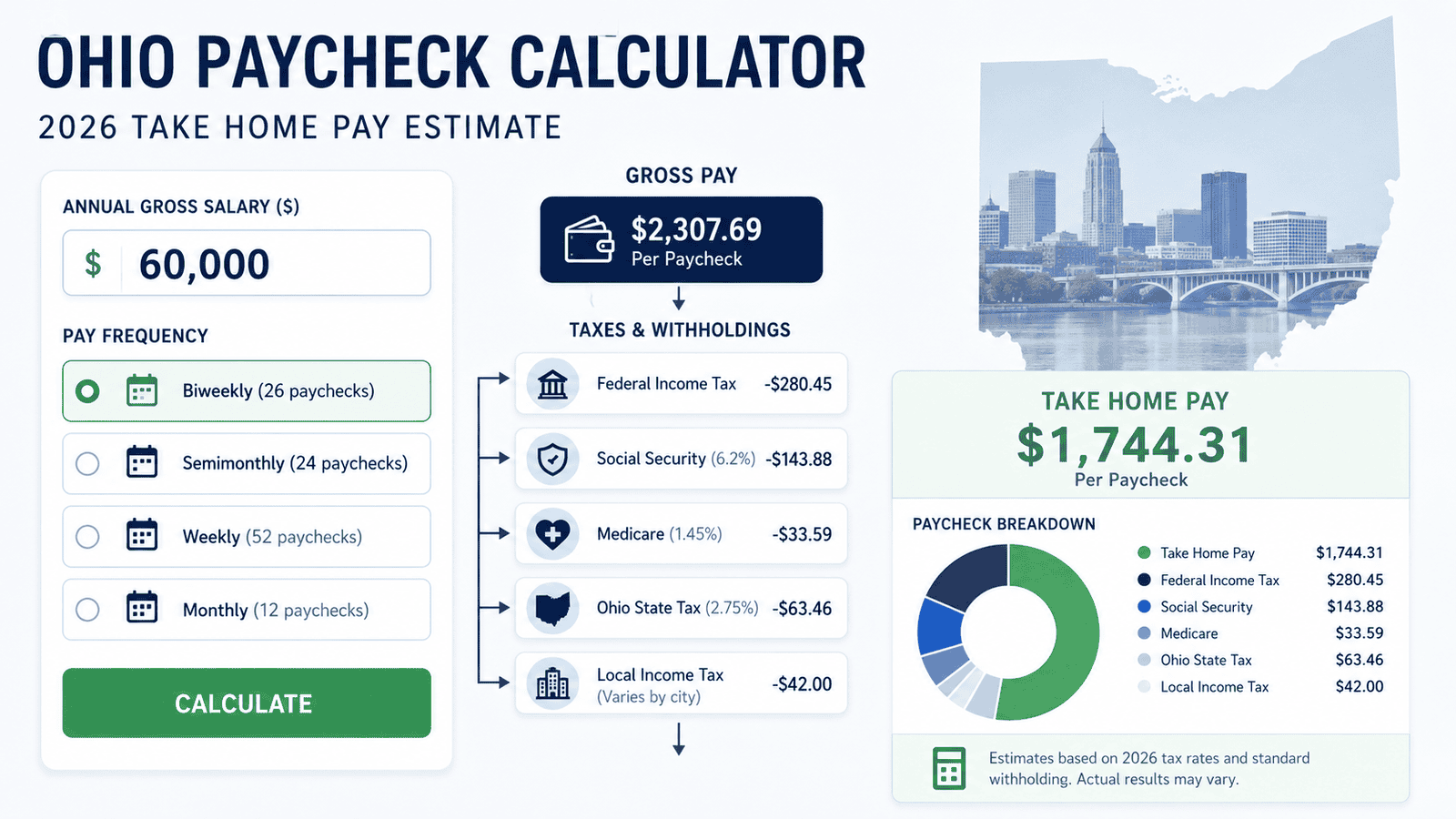
Our paycheck calculator Ohio helps you estimate your 2026 take home pay after federal, state, local, and FICA taxes. Every Ohio paycheck may include federal income tax, Social Security tax, Medicare tax, Ohio's 2.75% state income tax on qualifying nonbusiness income above $26,050, and, in many cities, a local income tax that further reduces your net pay.
Use our paycheck calculator Ohio tool below to estimate your net pay after all withholdings, or try the Salary After Tax Calculator for a full annual breakdown.
Paycheck Calculator Ohio: Contents
How the paycheck calculator works
A paycheck calculator estimates your net pay by applying current federal and state tax rules to the information you provide. You enter your gross salary or hourly wage, select a pay frequency (weekly, biweekly, semimonthly, or monthly), choose your federal filing status, and add any pre-tax deductions such as traditional 401(k) contributions, health insurance premiums, or HSA and FSA contributions. For Ohio residents, you also indicate whether a local municipal income tax applies and at what rate.
The calculator then estimates your federal income tax withholding, Social Security tax, Medicare tax, Ohio state income tax, any applicable local income tax, and your resulting net paycheck after all deductions.
2026 federal taxes on your paycheck
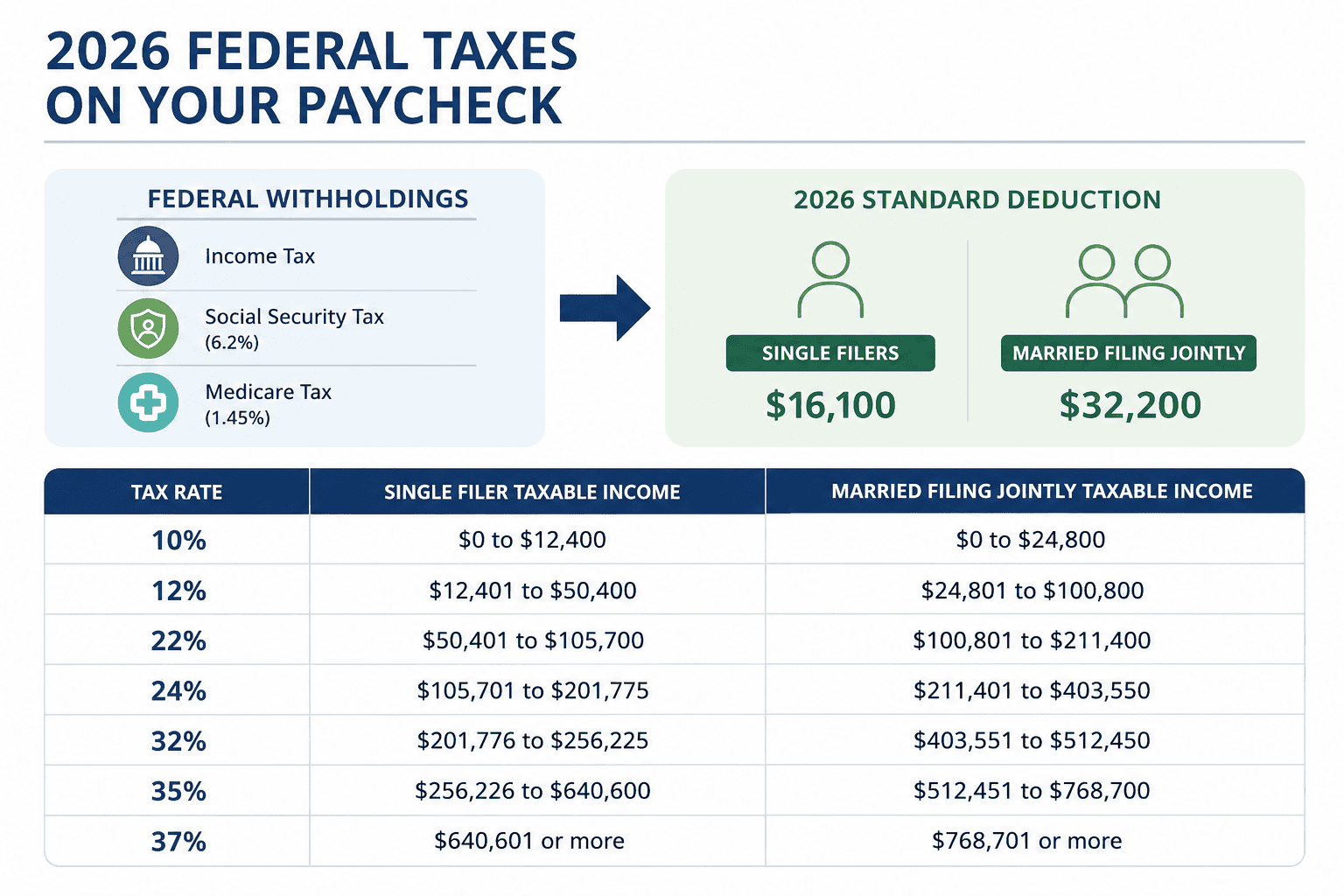
Every Ohio employee pays federal payroll taxes unless a specific exemption applies. Federal withholdings include income tax, Social Security tax, and Medicare tax.
Federal income tax brackets
The IRS updated federal income tax brackets and the standard deduction for tax year 2026 through Revenue Procedure 2025-32. The seven bracket rates remain 10%, 12%, 22%, 24%, 32%, 35%, and 37%. The 2026 standard deduction is $16,100 for single filers and $32,200 for married couples filing jointly (IRS, tax year 2026).
| Tax rate | Single filer taxable income | Married filing jointly taxable income |
|---|---|---|
| 10% | $0 to $12,400 | $0 to $24,800 |
| 12% | $12,401 to $50,400 | $24,801 to $100,800 |
| 22% | $50,401 to $105,700 | $100,801 to $211,400 |
| 24% | $105,701 to $201,775 | $211,401 to $403,550 |
| 32% | $201,776 to $256,225 | $403,551 to $512,450 |
| 35% | $256,226 to $640,600 | $512,451 to $768,700 |
| 37% | $640,601 or more | $768,701 or more |
Source: IRS, Revenue Procedure 2025-32, tax year 2026.
Social Security tax
Employees pay 6.2% of gross wages toward Social Security, up to the 2026 wage base limit of $184,500. Earnings above that threshold are not subject to Social Security tax. (IRS Topic 751; SSA, 2026.)
Medicare tax
Employees pay 1.45% on all wages with no cap. An additional 0.9% Medicare tax applies to wages above $200,000 for single filers or $250,000 for married couples filing jointly (IRS Topic 751, 2026). Combined, most employees pay 7.65% in FICA taxes before the additional Medicare threshold.
Ohio state income tax explained
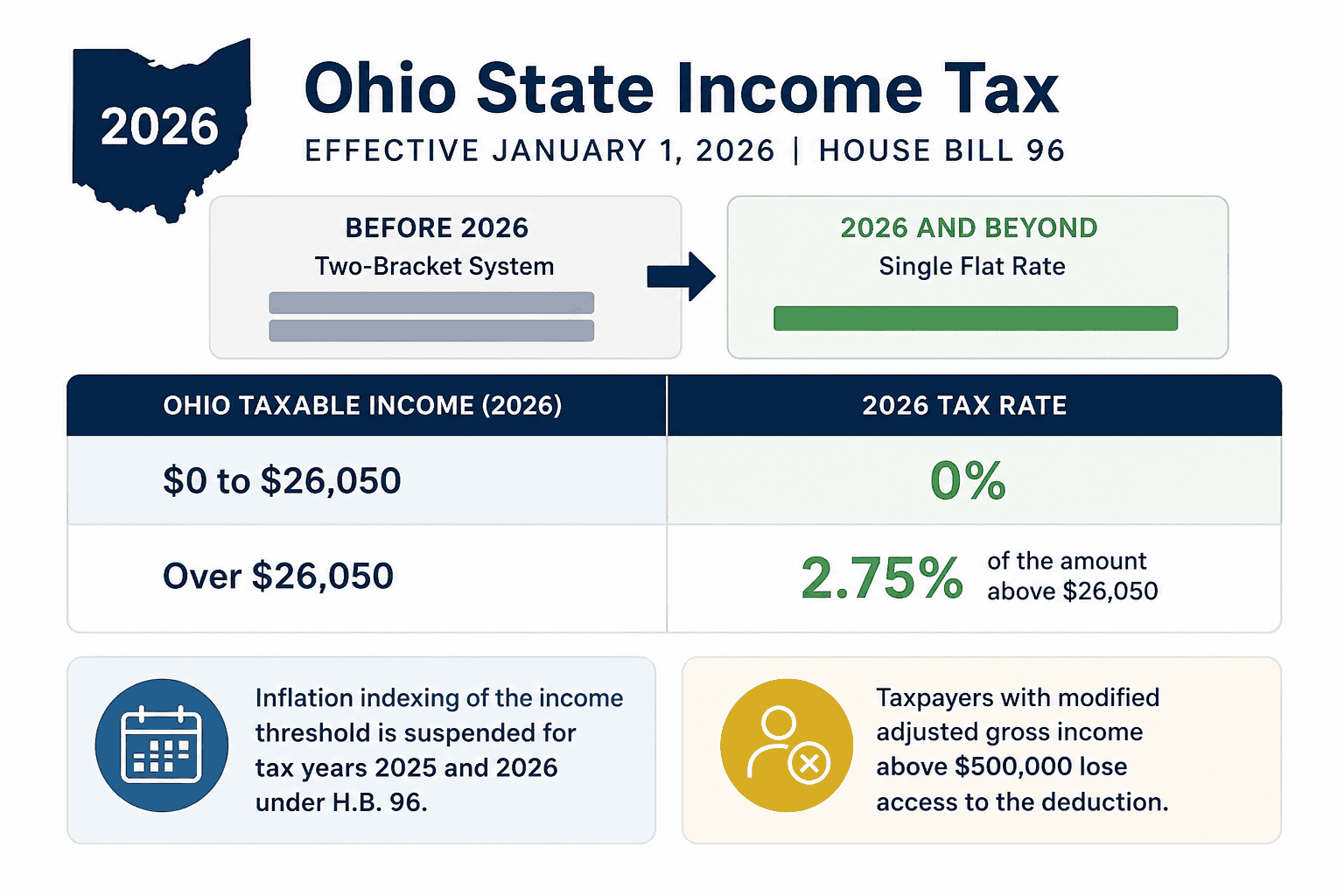
Ohio overhauled its income tax structure effective January 1, 2026, under House Bill 96. The state moved from a two bracket system to a single flat rate. For tax year 2026, Ohio taxes nonbusiness income above $26,050 at a flat rate of 2.75%. Income at or below $26,050 is not subject to Ohio individual income tax. (Ohio Department of Taxation, 2026; Ohio Revised Code Section 5747.02.)
| Ohio taxable income | 2026 tax rate |
|---|---|
| $0 to $26,050 | 0% |
| Over $26,050 | 2.75% of the amount above $26,050 |
Inflation indexing of the income threshold is suspended for tax years 2025 and 2026 under H.B. 96. Taxpayers with modified adjusted gross income above $500,000 lose access to the personal and dependent exemptions and the joint filing credit.
Local income taxes
Many Ohio municipalities impose their own income tax on wages earned or received within city limits. Major cities with local income taxes include Columbus, Cleveland, Cincinnati, Toledo, Akron, and Dayton. Rates typically fall between 1% and 3% depending on the municipality. Because local taxes can significantly reduce take home pay, employees should verify their local withholding rate with their employer or city tax office.
Worked examples
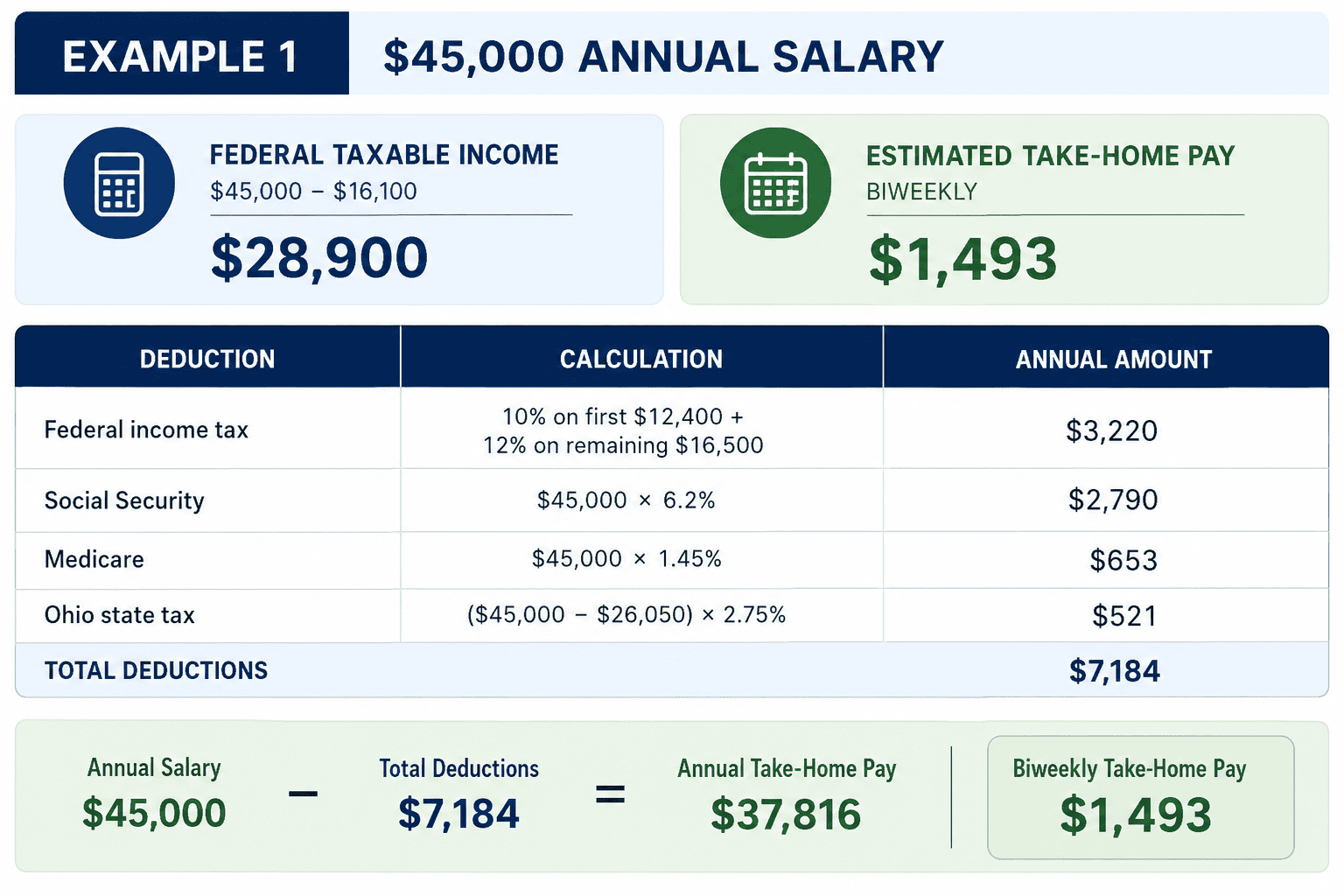
The following examples estimate biweekly take home pay for a single filer claiming the 2026 standard deduction ($16,100) with no pre-tax retirement contributions, no health insurance deductions, and no local income tax. Actual paychecks vary based on W-4 elections, additional deductions, credits, local taxes, and payroll system rounding.
Example 1: $45,000 annual salary
Federal taxable income = $45,000 − $16,100 = $28,900
| Deduction | Calculation | Annual amount |
|---|---|---|
| Federal income tax | 10% on first $12,400 + 12% on remaining $16,500 | $3,220 |
| Social Security | $45,000 × 6.2% | $2,790 |
| Medicare | $45,000 × 1.45% | $653 |
| Ohio state tax | ($45,000 − $26,050) × 2.75% | $521 |
| Total deductions | $7,184 |
Estimated annual take home = $45,000 − $7,184 = $37,816
Biweekly gross = $1,730.77 | Estimated biweekly take home ≈ $1,454
Example 2: $60,000 annual salary
Federal taxable income = $60,000 − $16,100 = $43,900
| Deduction | Calculation | Annual amount |
|---|---|---|
| Federal income tax | 10% on first $12,400 + 12% on remaining $31,500 | $5,020 |
| Social Security | $60,000 × 6.2% | $3,720 |
| Medicare | $60,000 × 1.45% | $870 |
| Ohio state tax | ($60,000 − $26,050) × 2.75% | $934 |
| Total deductions | $10,544 |
Estimated annual take home = $60,000 − $10,544 = $49,456
Biweekly gross = $2,307.69 | Estimated biweekly take home ≈ $1,902
Example 3: $85,000 annual salary
Federal taxable income = $85,000 − $16,100 = $68,900
| Deduction | Calculation | Annual amount |
|---|---|---|
| Federal income tax | 10% on $12,400 + 12% on $38,000 + 22% on $18,500 | $9,870 |
| Social Security | $85,000 × 6.2% | $5,270 |
| Medicare | $85,000 × 1.45% | $1,233 |
| Ohio state tax | ($85,000 − $26,050) × 2.75% | $1,621 |
| Total deductions | $17,994 |
Estimated annual take home = $85,000 − $17,994 = $67,006
Biweekly gross = $3,269.23 | Estimated biweekly take home ≈ $2,577
All examples use 2026 federal brackets from IRS Revenue Procedure 2025-32 and Ohio’s 2026 flat tax rate per Ohio Department of Taxation guidance. Actual withholding depends on your W-4, deductions, credits, local taxes, and payroll system.
Hourly wages in Ohio
The table below estimates annual take home pay for common hourly wages in Ohio, assuming 40 hours per week and 52 weeks per year, with the same single filer assumptions used in the salary examples above.
| Hourly wage | Annual gross pay | Estimated annual take home |
|---|---|---|
| $20 | $41,600 | About $35,200 |
| $25 | $52,000 | About $43,250 |
| $30 | $62,400 | About $51,300 |
For a detailed breakdown of what $25 per hour looks like across different tax scenarios, see our guide on $25 an hour after taxes.
How bonuses are taxed
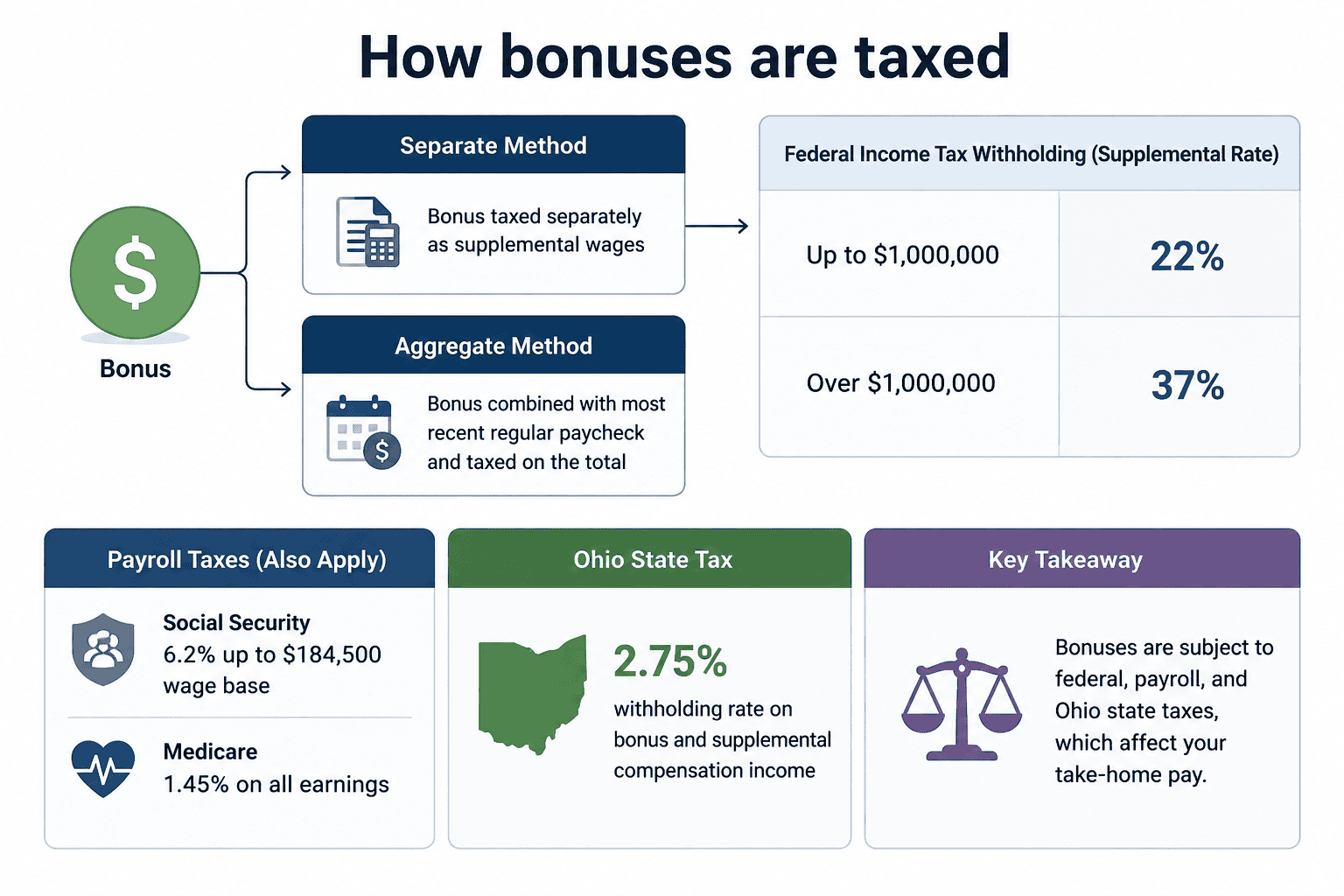
The IRS classifies bonuses as supplemental wages. When an employer pays a bonus separately from regular wages, federal income tax is typically withheld at a flat 22% rate on amounts up to $1 million, and 37% on amounts exceeding $1 million. Alternatively, employers may use the aggregate method, which combines the bonus with the most recent regular paycheck and calculates withholding on the total. (IRS Publication 15-A, 2026.)
Social Security tax (6.2% up to the $184,500 wage base) and Medicare tax (1.45%) also apply to bonus pay.
On the state side, the Ohio Department of Taxation reduced its withholding rate on bonus and supplemental compensation income to 2.75% effective January 1, 2026, matching the new flat income tax rate. If you live or work in a municipality with a local income tax, that withholding may apply to your bonus as well.
Key point: The 22% federal withholding rate is not your final tax rate on a bonus. It is an estimate. Your actual liability depends on your total income for the year. If you fall in a bracket below 22%, you may receive a refund when you file. A bonus tax calculator Ohio can help estimate the net amount you will receive.
Effect of 401(k) and health insurance premiums
Traditional 401(k) contributions reduce your federal adjusted gross income, which generally lowers your federal income tax withholding. Because Ohio begins its income tax calculation from federal adjusted gross income (subject to Ohio-specific adjustments), traditional 401(k) contributions typically reduce your Ohio taxable income as well. However, 401(k) contributions do not reduce Social Security or Medicare taxes, which are calculated on gross wages before pre-tax retirement deferrals.
Employer-sponsored health insurance premiums paid on a pre-tax basis through a Section 125 cafeteria plan also reduce federal and Ohio taxable income and typically reduce FICA wages as well.
Example: $60,000 salary with a $6,000 traditional 401(k) contribution
| Item | Without 401(k) | With $6,000 401(k) |
|---|---|---|
| Federal taxable income | $43,900 | $37,900 |
| Federal income tax | $5,020 | $4,300 |
| Ohio state tax | $934 | $769 |
| Social Security + Medicare | $4,590 | $4,590 |
| Total income tax savings | About $885 per year |
In this scenario, the $6,000 401(k) contribution reduces combined federal and Ohio income tax withholding by roughly $885 per year while Social Security and Medicare taxes remain unchanged. Your take home pay would be lower by the net amount of the contribution minus the tax savings, but you would be building retirement savings on a tax-deferred basis. The paycheck calculator Ohio can help compare hourly wages with annual salary take-home pay.
How Ohio compares with neighboring states
Ohio’s 2.75% flat rate is competitive among its neighbors, though Ohio’s widespread municipal income taxes add a layer of complexity not found in every bordering state.
| State | 2026 state income tax rate | Local wage taxes |
|---|---|---|
| Ohio | Flat 2.75% on income over $26,050 | Many municipalities (1% to 3%) |
| Pennsylvania | Flat 3.07% | Some local earned income taxes |
| Michigan | Flat 4.25% | Limited city income taxes |
| Indiana | Flat 2.95% | County income taxes |
| Kentucky | Flat 3.5% | Limited occupational taxes |
Source: Tax Foundation, 2026 state income tax rates. Try the paycheck calculator Ohio after changing your filing status or pre-tax deductions.
Frequently asked questions
How much is taken out of my paycheck in Ohio?
Most Ohio employees have federal income tax, Social Security (6.2% up to $184,500), Medicare (1.45%), and Ohio state income tax (2.75% on income over $26,050) withheld from each paycheck. If you work or live in a municipality with a local income tax, that amount is also withheld. For a single filer earning $60,000 with no pre-tax deductions and no local tax, total annual withholdings come to roughly $10,544, or about 17.6% of gross pay.
What is the Ohio income tax rate in 2026?
For tax year 2026, Ohio applies a flat 2.75% rate on nonbusiness taxable income above $26,050. Income at or below $26,050 is not subject to Ohio individual income tax. This replaced the prior two bracket structure effective January 1, 2026, under H.B. 96. (Ohio Department of Taxation, 2026.)
How much is $60,000 a year after taxes in Ohio?
A single filer earning $60,000 with no pre-tax deductions and no local income tax would take home approximately $49,456 per year, or about $1,902 per biweekly paycheck. This estimate includes federal income tax ($5,020), Social Security ($3,720), Medicare ($870), and Ohio state tax ($934). Actual results vary based on W-4 elections, additional deductions, credits, and local taxes.
How are bonuses taxed in Ohio?
Bonuses are treated as supplemental wages. Employers typically withhold federal income tax at a flat 22% rate (or use the aggregate method) and Ohio state tax at 2.75%. Social Security and Medicare taxes also apply. If your municipality levies a local income tax, that withholding may apply to bonus pay as well. The withholding rate is not your final tax rate; your actual liability is determined when you file your return.
How do 401(k) contributions change take home pay in Ohio?
Traditional 401(k) contributions reduce federal and Ohio taxable income, which lowers income tax withholding on each paycheck. However, Social Security and Medicare taxes are still calculated on your full gross pay. For example, a $6,000 annual 401(k) contribution on a $60,000 salary could save roughly $885 in combined federal and Ohio income taxes per year. The paycheck calculator Ohio accounts for federal, state, local, and payroll tax withholdings.
Methodology
This calculator and the examples in this article use the following sources and assumptions:
- IRS Revenue Procedure 2025-32: 2026 federal income tax brackets, standard deduction amounts, and withholding guidance.
- IRS Topic 751 and SSA: 2026 FICA rates (6.2% Social Security up to $184,500 wage base; 1.45% Medicare on all wages).
- Ohio Department of Taxation and Ohio Revised Code Section 5747.02: 2026 flat 2.75% income tax rate on nonbusiness income above $26,050.
- All worked examples assume a single filer claiming the standard deduction with no additional adjustments, pre-tax deductions, or local income taxes unless stated otherwise.
Examples are estimates intended for educational purposes and should not be considered exact payroll calculations. Actual withholding depends on your individual W-4 elections, pre-tax deductions, credits, local tax obligations, and employer payroll practices.
This content is for educational purposes only and does not constitute personalized financial advice. Consult a qualified financial advisor for guidance specific to your situation.
By Nathan Whitmore for MoneyFN Use the paycheck calculator Ohio to estimate your net pay before your next payday.

Nathan Whitmore is a US based personal finance writer at MoneyFN covering salary, paycheck, and tax math for American workers. He works from primary sources only: IRS revenue procedures, Bureau of Labor Statistics wage data, and Federal Reserve statistics. Every figure he publishes is dated and traceable to a public source.