

Our paycheck calculator oregon helps you estimate how much of your 2026 paycheck you keep after taxes. Oregon paychecks are reduced by federal income tax, Social Security (6.2%), Medicare (1.45%), and Oregon state income tax ranging from 4.75% to 9.9%. A single filer earning $60,000 per year in 2026 can expect to take home roughly $45,977 annually, or about $1,768 per biweekly paycheck, while most workers do not owe local income taxes.
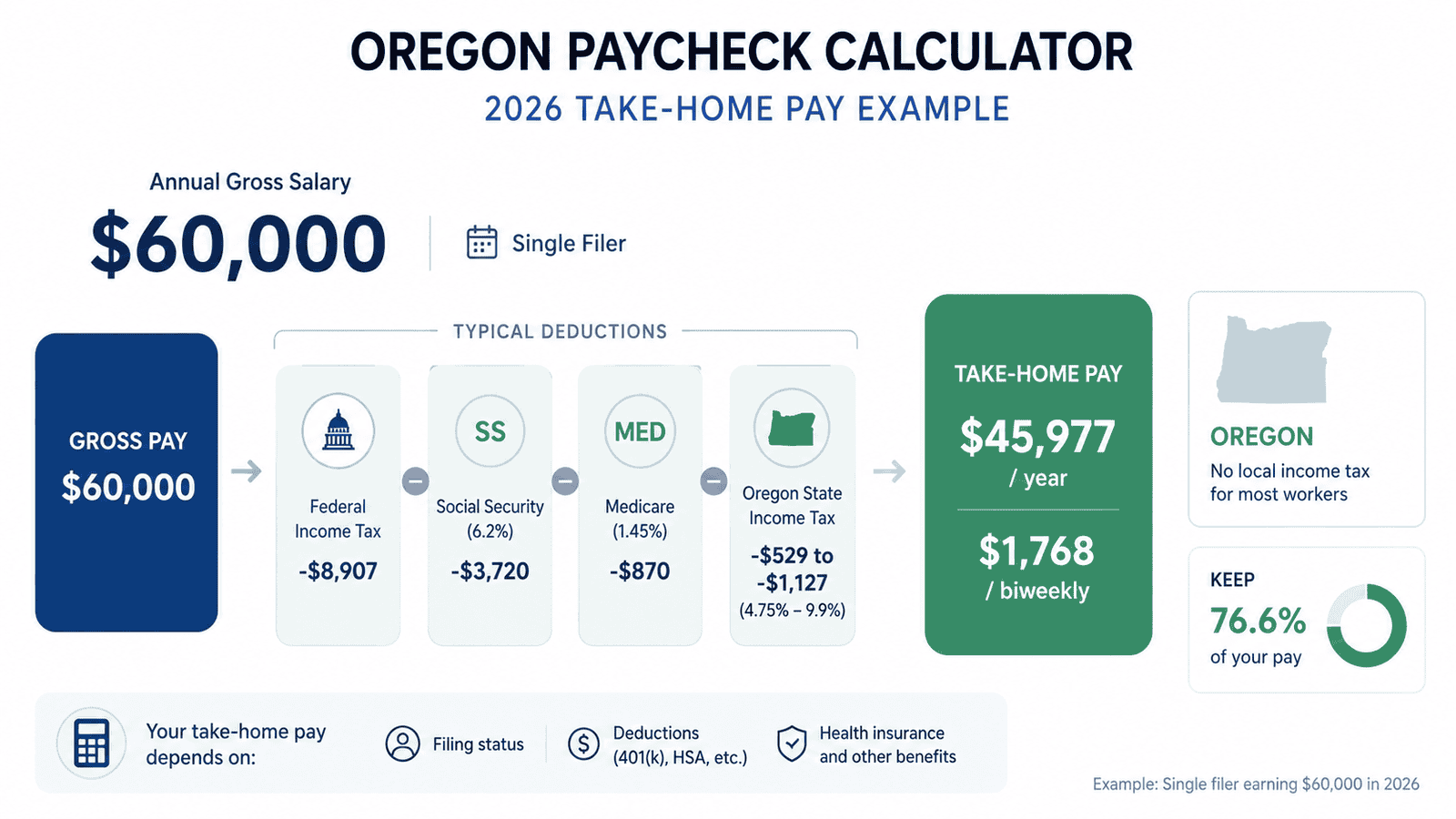
Paycheck calculator oregon: Oregon paycheck calculator
You can also use our salary after tax calculator for a more detailed personalized estimate of your Oregon take home pay.
How the paycheck calculator works
A paycheck calculator Oregon tool estimates your net pay by starting with your gross wages and subtracting all required payroll taxes plus any eligible pre-tax deductions. The calculator walks through each layer of withholding to arrive at the amount you actually deposit.
Typical inputs include:
- Gross salary or hourly wage
- Pay frequency (weekly, biweekly, semimonthly, or monthly)
- Filing status (single, married filing jointly, head of household)
- Federal and Oregon withholding selections
- Traditional 401(k) or 403(b) contributions
- Health insurance premiums paid through payroll
- Other cafeteria plan or Section 125 deductions
The calculator then estimates federal income tax withholding, Oregon state income tax withholding, Social Security tax, Medicare tax, and your net paycheck for each pay period along with annual and monthly take home pay totals.
2026 federal taxes on your paycheck
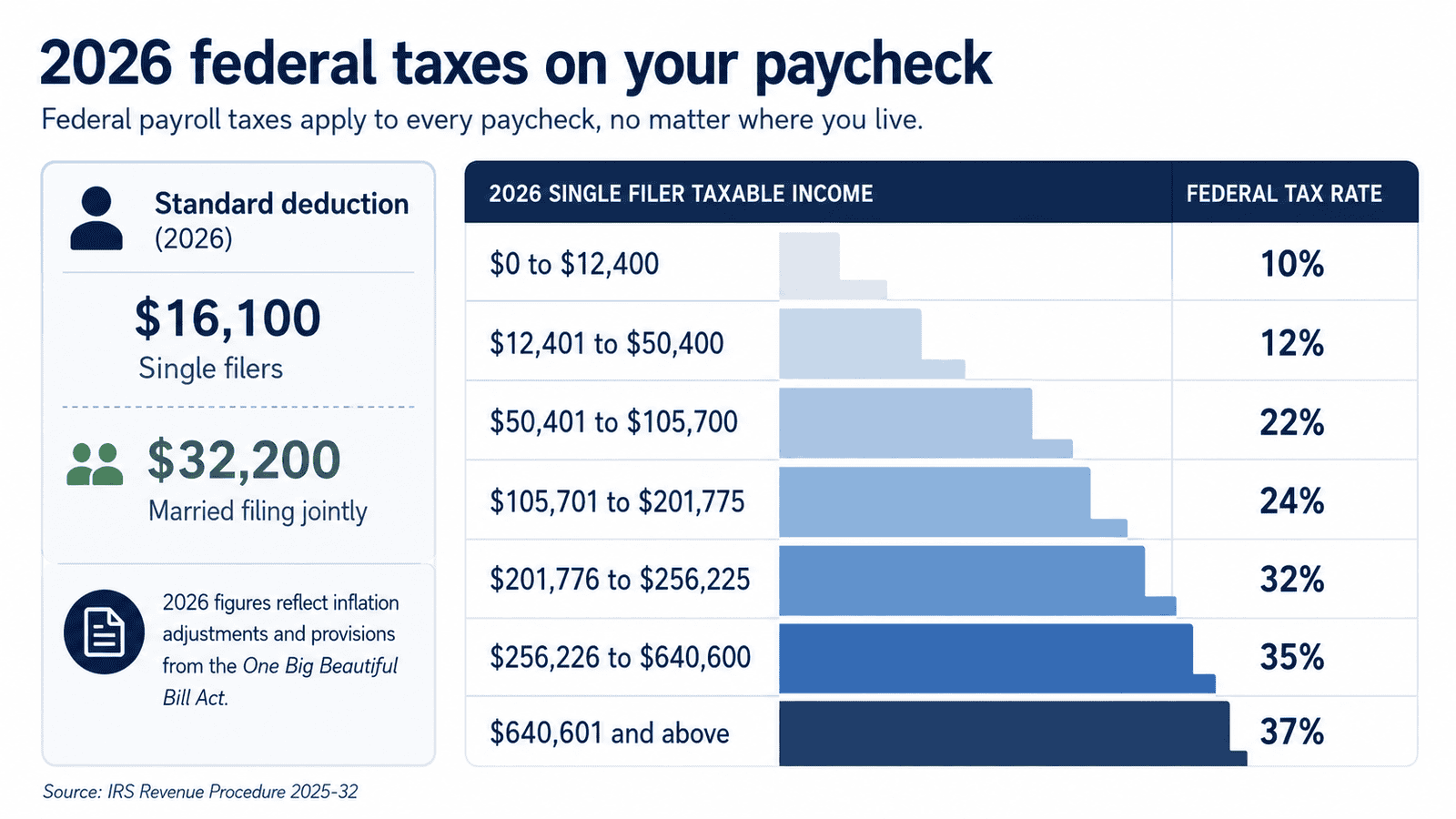
Regardless of which state you live in, federal payroll taxes apply to every paycheck. For 2026, the IRS uses seven income tax brackets with rates from 10% to 37%, along with a standard deduction of $16,100 for single filers and $32,200 for married couples filing jointly. These figures come from IRS Revenue Procedure 2025-32, which reflects inflation adjustments and provisions from the One Big Beautiful Bill Act signed in July 2025.
| 2026 single filer taxable income | Federal tax rate |
|---|---|
| $0 to $12,400 | 10% |
| $12,401 to $50,400 | 12% |
| $50,401 to $105,700 | 22% |
| $105,701 to $201,775 | 24% |
| $201,776 to $256,225 | 32% |
| $256,226 to $640,600 | 35% |
| $640,601 and above | 37% |
Source: IRS Revenue Procedure 2025-32, effective for tax year 2026.
On top of federal income tax, FICA payroll taxes are withheld from every paycheck:
| Payroll tax | Employee rate (2026) |
|---|---|
| Social Security (OASDI) | 6.2% on wages up to $184,500 |
| Medicare (HI) | 1.45% on all wages |
| Additional Medicare tax | 0.9% on wages above $200,000 |
Source: SSA 2026 COLA Fact Sheet; IRS Publication 926 (2026).
Oregon state income tax explained
Oregon has one of the higher state income taxes in the western United States, and it serves as the state’s primary revenue source because Oregon has no general sales tax. For 2026, Oregon uses a progressive income tax with four brackets. The rates and thresholds for single filers are published in the Oregon Department of Revenue Withholding Tax Formulas, Publication 150-206-436 (Rev. 12-31-25).
| Oregon taxable income (single filer) | Tax rate |
|---|---|
| $0 to $4,550 | 4.75% |
| $4,551 to $11,400 | 6.75% |
| $11,401 to $125,000 | 8.75% |
| Over $125,000 | 9.9% |
Source: Oregon DOR Publication 150-206-436 (Rev. 12-31-25), effective January 1, 2026. Oregon taxable income equals gross wages minus the Oregon standard deduction ($2,910 single) minus the federal tax subtraction (up to $8,750).
Married filing jointly brackets are approximately doubled:
- $0 to $9,100 at 4.75%
- $9,101 to $22,800 at 6.75%
- $22,801 to $250,000 at 8.75%
- Over $250,000 at 9.9%
Oregon also provides a personal exemption credit of $263 per qualifying exemption for 2026, which directly reduces your tax. This credit phases out entirely if your federal adjusted gross income exceeds $100,000 for single filers or $200,000 for joint filers.
Oregon is one of only a few states that allows a subtraction for federal income taxes paid, capped at $8,750 for single filers in 2026. This subtraction can meaningfully reduce your Oregon tax liability, especially at moderate income levels.
Are there local payroll taxes in Oregon?
Most Oregon cities do not impose a general local wage tax. However, certain local income taxes apply in the Portland metropolitan area. The Metro Supportive Housing Services tax (1% on income above $125,000 for single filers) and the Multnomah County Preschool for All tax (1.5% on income above $125,000 for single filers, with an additional 1.5% above $250,000) affect qualifying higher income households in those jurisdictions. These are not statewide payroll taxes and do not affect most Oregon workers outside the Portland area.
Worked examples: biweekly take home pay
The following examples assume a single filer taking the 2026 standard deduction with no pre-tax deductions, one personal exemption credit, regular wage income, and biweekly payroll (26 pay periods). For simplicity, these estimates do not include the Oregon federal tax subtraction, so actual take home pay may be slightly higher. Actual withholding will vary based on your W-4 and OR-W-4 selections.
$45,000 salary
Federal income tax:
- 10% on the first $12,400 = $1,240
- 12% on $12,401 to $28,900 = $1,980
- Total federal income tax: $3,220
FICA taxes:
- Social Security: $45,000 × 6.2% = $2,790
- Medicare: $45,000 × 1.45% = $653
Oregon income tax:
- 4.75% on the first $4,550 = $216
- 6.75% on $4,551 to $11,400 = $462
- 8.75% on $11,401 to $42,090 = $2,685
- Subtotal: $3,363 minus $263 exemption credit = $3,100
| Item | Annual amount |
|---|---|
| Gross pay | $45,000 |
| Federal income tax | $3,220 |
| Social Security | $2,790 |
| Medicare | $653 |
| Oregon income tax | $3,100 |
| Estimated annual take home | $35,237 |
| Estimated biweekly take home | $1,355 |
$60,000 salary
Federal income tax:
- 10% on the first $12,400 = $1,240
- 12% on $12,401 to $43,900 = $3,780
- Total federal income tax: $5,020
FICA taxes:
- Social Security: $60,000 × 6.2% = $3,720
- Medicare: $60,000 × 1.45% = $870
Oregon income tax:
- 4.75% on the first $4,550 = $216
- 6.75% on $4,551 to $11,400 = $462
- 8.75% on $11,401 to $57,090 = $3,998
- Subtotal: $4,676 minus $263 exemption credit = $4,413
| Item | Annual amount |
|---|---|
| Gross pay | $60,000 |
| Federal income tax | $5,020 |
| Social Security | $3,720 |
| Medicare | $870 |
| Oregon income tax | $4,413 |
| Estimated annual take home | $45,977 |
| Estimated biweekly take home | $1,768 |
$85,000 salary
Federal income tax:
- 10% on the first $12,400 = $1,240
- 12% on $12,401 to $50,400 = $4,560
- 22% on $50,401 to $68,900 = $4,070
- Total federal income tax: $9,870
FICA taxes:
- Social Security: $85,000 × 6.2% = $5,270
- Medicare: $85,000 × 1.45% = $1,233
Oregon income tax:
- 4.75% on the first $4,550 = $216
- 6.75% on $4,551 to $11,400 = $462
- 8.75% on $11,401 to $82,090 = $6,185
- Subtotal: $6,863 minus $263 exemption credit = $6,600
| Item | Annual amount |
|---|---|
| Gross pay | $85,000 |
| Federal income tax | $9,870 |
| Social Security | $5,270 |
| Medicare | $1,233 |
| Oregon income tax | $6,600 |
| Estimated annual take home | $62,027 |
| Estimated biweekly take home | $2,386 |
These simplified estimates do not include Oregon’s federal tax subtraction (up to $8,750 for 2026), which can further reduce Oregon tax and increase take home pay. Source: IRS Rev. Proc. 2025-32; Oregon DOR Publication 150-206-436 (Rev. 12-31-25).
Hourly wages in Oregon
The following estimates assume 40 hours per week and 52 weeks per year, with the same single filer assumptions as the salary examples above.
| Hourly wage | Annual gross pay | Estimated annual take home | Estimated biweekly take home |
|---|---|---|---|
| $20 | $41,600 | $32,803 | $1,262 |
| $25 | $52,000 | $40,249 | $1,548 |
| $30 | $62,400 | $47,695 | $1,834 |
If you earn $30 per hour, see our detailed breakdown in the $30 an hour salary guide for budgeting tips and take home calculations across all 50 states.
How bonuses are taxed in Oregon
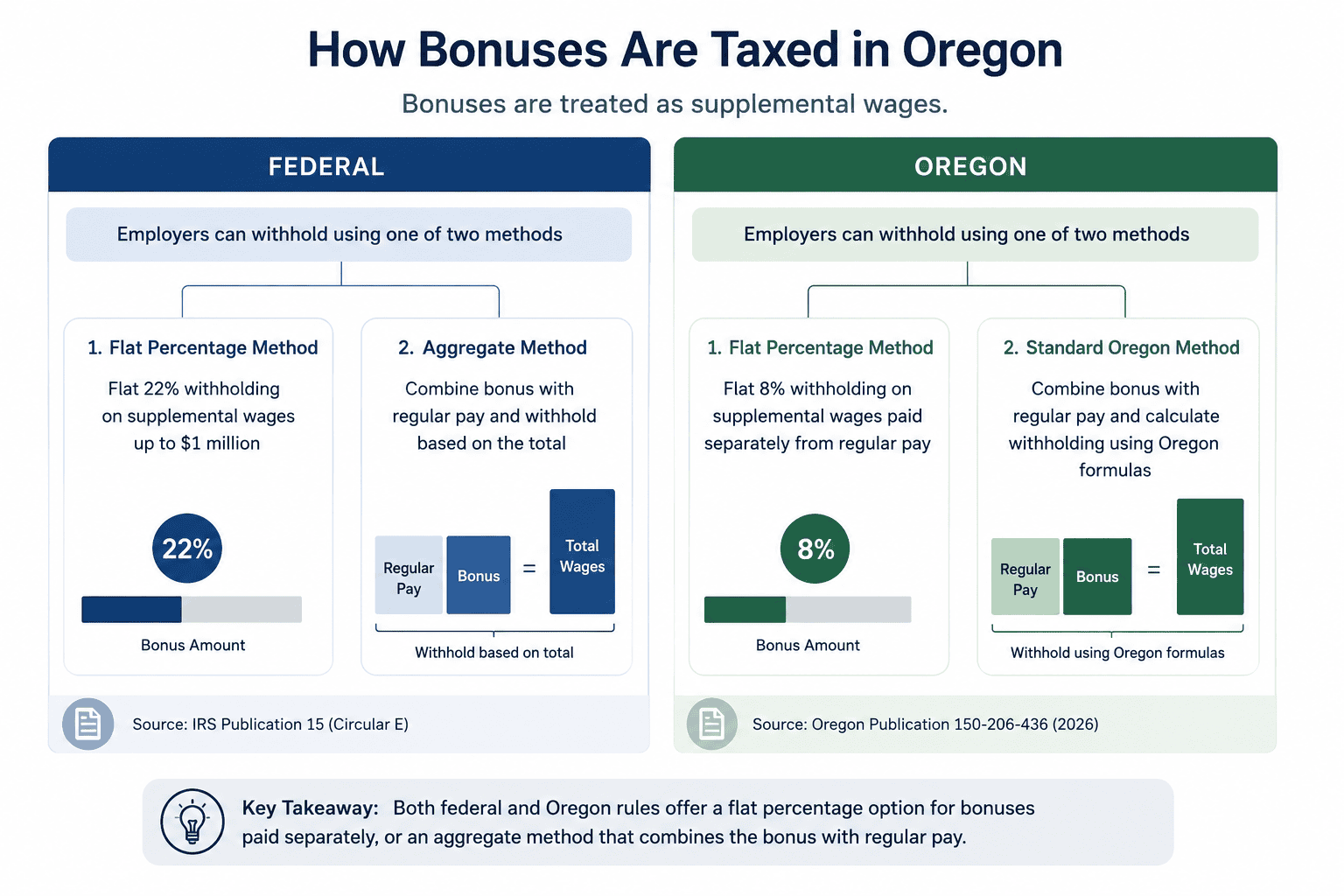
Bonuses are generally classified as supplemental wages for both federal and Oregon purposes. On the federal side, employers may withhold a flat 22% on supplemental wages up to $1 million, or they may use the aggregate method, which combines the bonus with your regular pay and withholds based on the total. These rules are outlined in IRS Publication 15 (Circular E).
For Oregon, the Department of Revenue allows employers to use a flat 8% withholding rate on supplemental wages paid separately from regular pay, according to Publication 150-206-436 (2026). Alternatively, employers may calculate withholding using the standard Oregon formulas by combining the bonus with regular wages.
The actual Oregon income tax owed on bonus income is determined when you file your annual return. Because Oregon uses progressive rates up to 9.9%, a large bonus could push some of your income into a higher bracket. A bonus tax calculator Oregon tool can help you estimate how much withholding to expect after federal, state, and FICA taxes are applied.
Effect of 401(k) and health insurance premiums
Pre-tax deductions from your paycheck can meaningfully increase your take home pay by reducing your taxable income before withholding is calculated.
Traditional 401(k) contributions reduce both federal taxable wages and Oregon taxable wages, lowering your income tax withholding on each paycheck. However, 401(k) contributions do not reduce Social Security or Medicare wages, so FICA taxes still apply to the full gross amount.
Health insurance premiums paid through a qualifying Section 125 cafeteria plan typically reduce all four payroll tax calculations: federal income tax, Oregon income tax, Social Security tax, and Medicare tax.
A single filer earning $60,000 who contributes 6% ($3,600) to a traditional 401(k) would reduce their federal and Oregon taxable income by that amount. This could save roughly $430 in federal income tax and $315 in Oregon income tax annually, though FICA taxes remain unchanged on the full $60,000. Try the paycheck calculator oregon after changing your withholding or retirement contributions to see the difference.
How Oregon compares with neighboring states
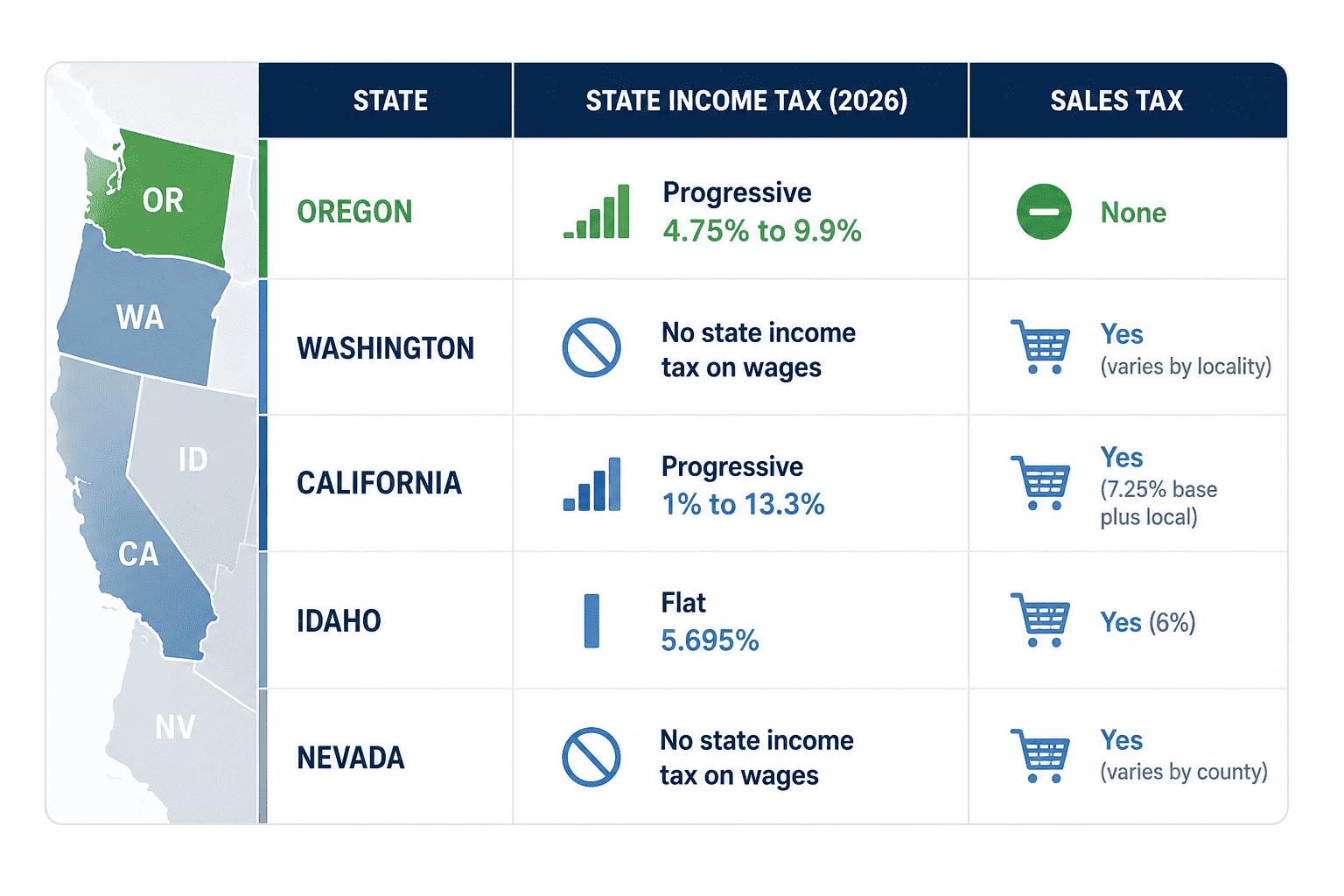
Oregon’s combination of no sales tax and a relatively high state income tax creates a distinct tax profile compared to its neighbors. The table below summarizes state income tax structures as of 2026.
| State | State income tax (2026) | Sales tax |
|---|---|---|
| Oregon | Progressive, 4.75% to 9.9% | None |
| Washington | No state income tax on wages | Yes (varies by locality) |
| California | Progressive, 1% to 13.3% | Yes (7.25% base plus local) |
| Idaho | Flat 5.695% | Yes (6%) |
| Nevada | No state income tax | Yes (varies by county) |
Read our neighboring state paycheck guides for detailed comparisons: A paycheck calculator oregon can show how pre-tax deductions affect your take-home pay.
- Washington paycheck calculator
- California paycheck calculator
- Idaho paycheck calculator
- Nevada paycheck calculator
Frequently asked questions
How much is taken out of my paycheck in Oregon?
Most Oregon paychecks are subject to federal income tax withholding, Social Security tax (6.2% up to $184,500 in 2026), Medicare tax (1.45% on all wages), and Oregon state income tax (4.75% to 9.9%). Your exact withholding depends on your gross income, filing status, number of allowances, and any pre-tax deductions you have. Use the calculator above or our salary after tax calculator to estimate your specific take home pay.
What is the Oregon income tax rate in 2026?
Oregon uses a progressive income tax with four brackets for 2026. Rates are 4.75% on the first $4,550 of taxable income (single filer), 6.75% on $4,551 to $11,400, 8.75% on $11,401 to $125,000, and 9.9% on taxable income above $125,000. For married filing jointly, the bracket thresholds are roughly doubled, with the top 9.9% rate applying above $250,000. These thresholds come from Oregon DOR Publication 150-206-436 (Rev. 12-31-25).
How much is $60,000 a year after taxes in Oregon?
A single filer earning $60,000 per year in Oregon with the 2026 standard deduction and no pre-tax deductions can expect to take home approximately $45,977 annually. This accounts for roughly $5,020 in federal income tax, $3,720 in Social Security, $870 in Medicare, and approximately $4,413 in Oregon state income tax. The actual amount could be slightly higher after applying Oregon’s federal tax subtraction.
How are bonuses taxed in Oregon?
Bonuses are taxable as supplemental wages for both federal and Oregon purposes. Federal withholding on bonuses may use a flat 22% rate or the aggregate method. Oregon employers may withhold a flat 8% on supplemental wages paid separately from regular pay, per Oregon DOR Publication 150-206-436. The final tax owed on bonus income is determined when you file your annual federal and Oregon returns.
How do 401(k) contributions change take home pay in Oregon?
Traditional 401(k) contributions reduce your federal and Oregon taxable income, which lowers income tax withholding on each paycheck. However, Social Security and Medicare taxes still apply to the full gross wage amount before the 401(k) deduction. For example, contributing $3,600 per year to a traditional 401(k) on a $60,000 salary may save roughly $745 combined in federal and Oregon income taxes annually. The paycheck calculator oregon lets hourly and salaried workers estimate net pay with the same inputs.
Methodology
All estimates in this article assume the following: single filer, standard deduction, regular W-2 wage income, no dependents, no additional tax credits, no pre-tax retirement or health insurance deductions unless otherwise stated, and 40 hour work weeks with 52 weeks per year for hourly examples.
Federal calculations are based on the 2026 tax brackets, standard deduction of $16,100, and FICA rates published in IRS Revenue Procedure 2025-32. The 2026 Social Security wage base of $184,500 is sourced from the Social Security Administration.
Oregon calculations are based on the 2026 income tax brackets (4.75% to 9.9%), Oregon standard deduction of $2,910 for single filers, and personal exemption credit of $263, as published in Oregon DOR Publication 150-206-436 (Rev. 12-31-25). The worked example tables use a simplified computation that does not include Oregon’s federal tax subtraction (capped at $8,750 for 2026). The interactive calculator above does include this subtraction. Actual paycheck withholding may differ from annual tax liability estimates due to employer payroll system settings and W-4/OR-W-4 elections.
This content is for educational purposes only and does not constitute personalized financial advice. Consult a qualified financial advisor for guidance specific to your situation.
By Nathan Whitmore for MoneyFN Use the paycheck calculator oregon to compare weekly, biweekly, or monthly take-home pay.

Nathan Whitmore is a US based personal finance writer at MoneyFN covering salary, paycheck, and tax math for American workers. He works from primary sources only: IRS revenue procedures, Bureau of Labor Statistics wage data, and Federal Reserve statistics. Every figure he publishes is dated and traceable to a public source.