

Nevada paycheck calculator
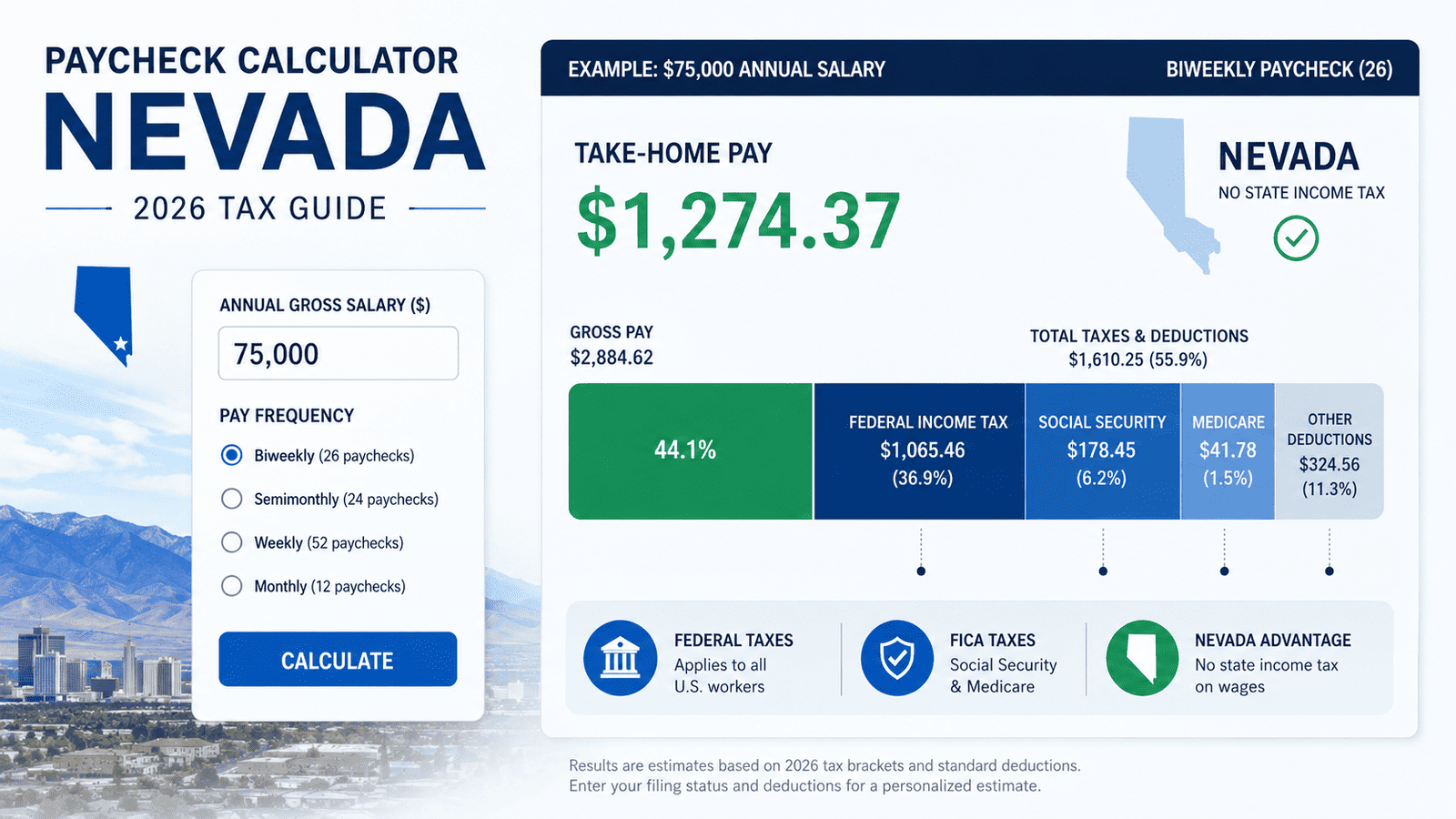
Our paycheck calculator Nevada helps estimate your 2026 take home pay after federal income tax and FICA withholding. Because Nevada has no state income tax on wages, your paycheck is generally reduced only by federal taxes, Social Security, and Medicare. Enter your pay, filing status, and deductions to get a personalized estimate.
Paycheck Calculator Nevada: Contents
How the paycheck calculator works
A paycheck calculator Nevada tool estimates your net pay by combining your gross income, tax filing details, and pre-tax deductions into one calculation. You enter a few inputs and the tool returns an estimate of your take home pay for each pay period.
Typical inputs include:
- Gross salary or hourly wage and the number of hours worked per week if paid hourly.
- Pay frequency such as weekly, biweekly, semimonthly, or monthly.
- Filing status including single, married filing jointly, or head of household.
- Pre-tax deductions such as traditional 401(k) contributions, health insurance premiums, and HSA or FSA contributions.
The calculator then subtracts federal income tax, Social Security tax, and Medicare tax from your gross pay for each period. Because Nevada has no state income tax, there is no state withholding step. The result is your estimated take home pay.
2026 federal taxes on your paycheck
Even without a state income tax, every Nevada paycheck is subject to federal taxes. These fall into two categories: federal income tax and FICA payroll taxes.
Federal income tax brackets
Federal income tax is calculated on your taxable income, which is your gross pay minus the standard deduction (or itemized deductions). The IRS uses a progressive bracket system where each portion of income is taxed at a higher rate as income rises. For tax year 2026, the standard deduction amounts are shown below (IRS Revenue Procedure 2025‑32).
| Filing status | 2026 standard deduction |
|---|---|
| Single | $16,100 |
| Married filing jointly | $32,200 |
| Head of household | $24,150 |
The 2026 federal income tax brackets for single filers are as follows (IRS, tax year 2026).
| Tax rate | Taxable income range (single) |
|---|---|
| 10% | $0 to $12,400 |
| 12% | $12,401 to $50,400 |
| 22% | $50,401 to $105,700 |
| 24% | $105,701 to $201,775 |
| 32% | $201,776 to $256,225 |
| 35% | $256,226 to $640,600 |
| 37% | $640,601 or more |
FICA payroll taxes
FICA taxes fund Social Security and Medicare. For 2026, employees pay (IRS Topic 751, 2026):
- Social Security: 6.2% on wages up to the 2026 wage base of $184,500.
- Medicare: 1.45% on all wages with no cap.
- Additional Medicare tax: 0.9% on wages above $200,000 for single filers ($250,000 for married filing jointly).
Combined, FICA takes 7.65% of most wages before the Social Security wage base is reached.
Nevada state income tax explained
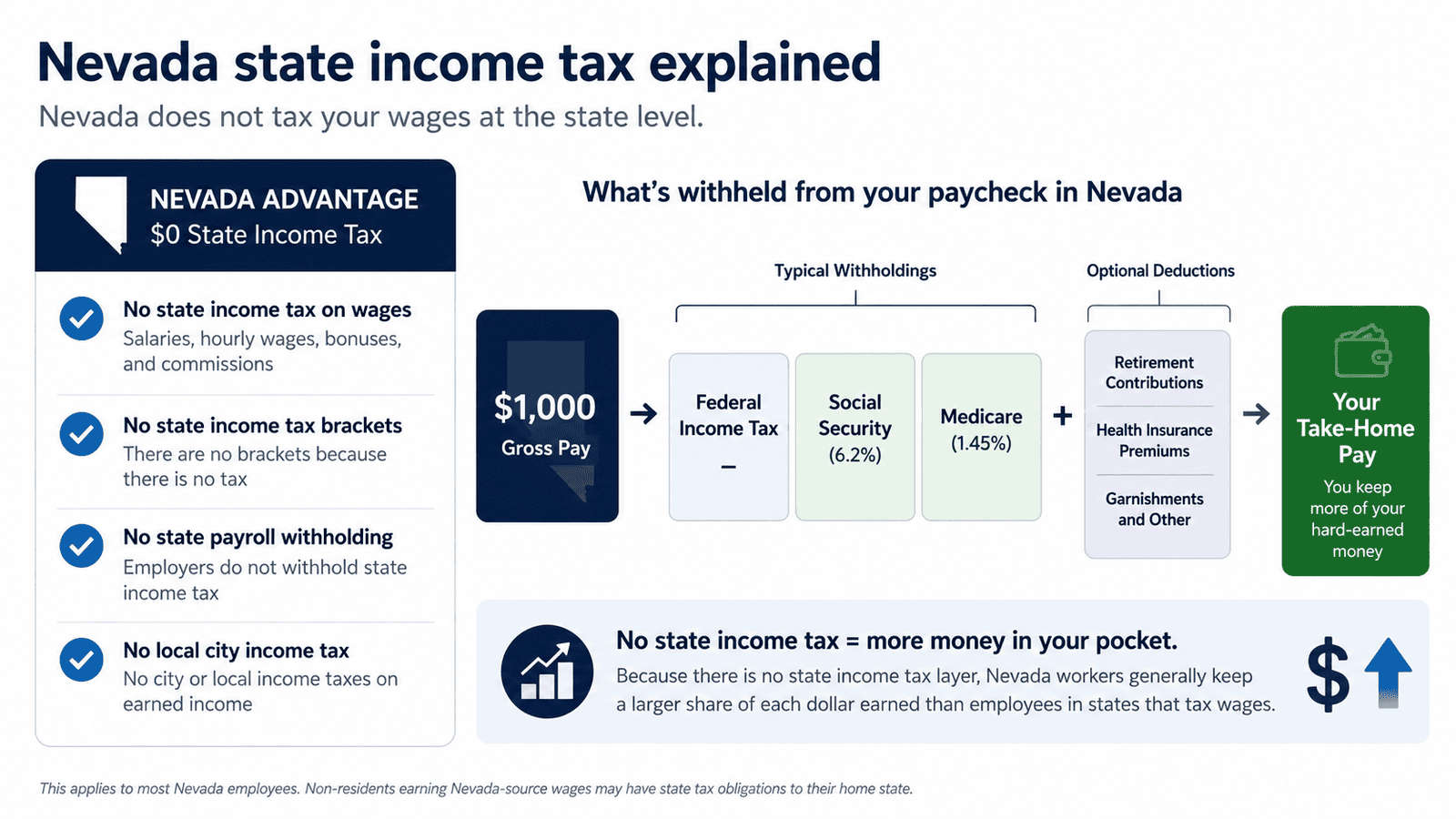
Nevada does not impose an individual state income tax on wages. There are no state income tax brackets, no state payroll withholding on wages, and no local city income taxes on earned income. This applies to salaries, hourly wages, bonuses, and commissions.
For most Nevada employees, the only taxes withheld from each paycheck are federal income tax, Social Security, and Medicare. Any additional paycheck reductions come from voluntary items such as retirement plan contributions, health insurance premiums, or garnishments.
Because there is no state income tax layer, Nevada workers generally keep a larger share of each dollar earned than employees at the same salary in states that impose an income tax. Nevada funds state services primarily through sales tax, gaming taxes, and other revenue sources rather than a personal income tax.
Worked examples: biweekly take home pay
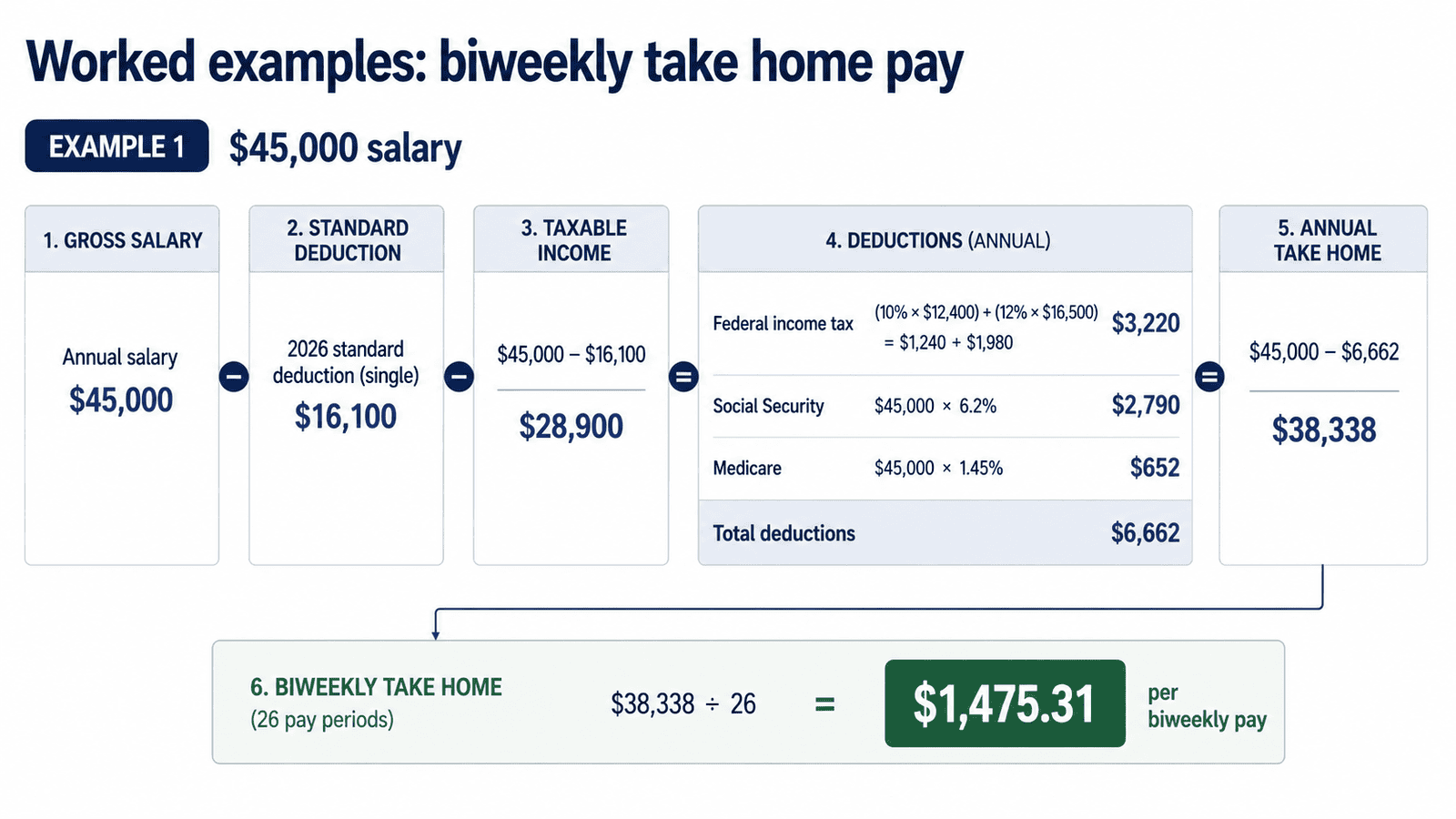
Each example below assumes a single filer using the 2026 standard deduction of $16,100, paid biweekly (26 pay periods), with no pre-tax retirement contributions or health insurance deductions. These are simplified educational estimates. Actual withholding varies based on your Form W‑4 elections and other factors.
Example 1: $45,000 salary
Taxable income = $45,000 − $16,100 = $28,900
Federal income tax = (10% × $12,400) + (12% × $16,500) = $1,240 + $1,980 = $3,220
Social Security = $45,000 × 6.2% = $2,790
Medicare = $45,000 × 1.45% = $652
Total deductions = $3,220 + $2,790 + $652 = $6,662
Annual take home = $45,000 − $6,662 = $38,338
Biweekly take home = $38,338 ÷ 26 ≈ $1,474
Example 2: $60,000 salary
Taxable income = $60,000 − $16,100 = $43,900
Federal income tax = (10% × $12,400) + (12% × $31,500) = $1,240 + $3,780 = $5,020
Social Security = $60,000 × 6.2% = $3,720
Medicare = $60,000 × 1.45% = $870
Total deductions = $5,020 + $3,720 + $870 = $9,610
Annual take home = $60,000 − $9,610 = $50,390
Biweekly take home = $50,390 ÷ 26 ≈ $1,938
Example 3: $85,000 salary
Taxable income = $85,000 − $16,100 = $68,900
Federal income tax = (10% × $12,400) + (12% × $38,000) + (22% × $18,500) = $1,240 + $4,560 + $4,070 = $9,870
Social Security = $85,000 × 6.2% = $5,270
Medicare = $85,000 × 1.45% = $1,233
Total deductions = $9,870 + $5,270 + $1,233 = $16,373
Annual take home = $85,000 − $16,373 = $68,627
Biweekly take home = $68,627 ÷ 26 ≈ $2,639
| Annual salary | Federal income tax | FICA | Annual take home | Biweekly take home |
|---|---|---|---|---|
| $45,000 | $3,220 | $3,442 | $38,338 | $1,474 |
| $60,000 | $5,020 | $4,590 | $50,390 | $1,938 |
| $85,000 | $9,870 | $6,503 | $68,627 | $2,639 |
Hourly wages in Nevada
The table below shows gross pay at common hourly rates, assuming 40 hours per week for 52 weeks (2,080 hours per year).
| Hourly wage | Annual gross | Biweekly gross | Weekly gross |
|---|---|---|---|
| $20 | $41,600 | $1,600 | $800 |
| $25 | $52,000 | $2,000 | $1,000 |
| $30 | $62,400 | $2,400 | $1,200 |
Estimated annual take home after federal income tax and FICA for a single filer using the standard deduction:
| Hourly wage | Annual gross | Estimated annual take home |
|---|---|---|
| $20 | $41,600 | $35,606 |
| $25 | $52,000 | $43,962 |
| $30 | $62,400 | $52,318 |
If you earn $25 per hour, see our detailed breakdown in the $25 an hour salary guide.
How bonuses are taxed in Nevada
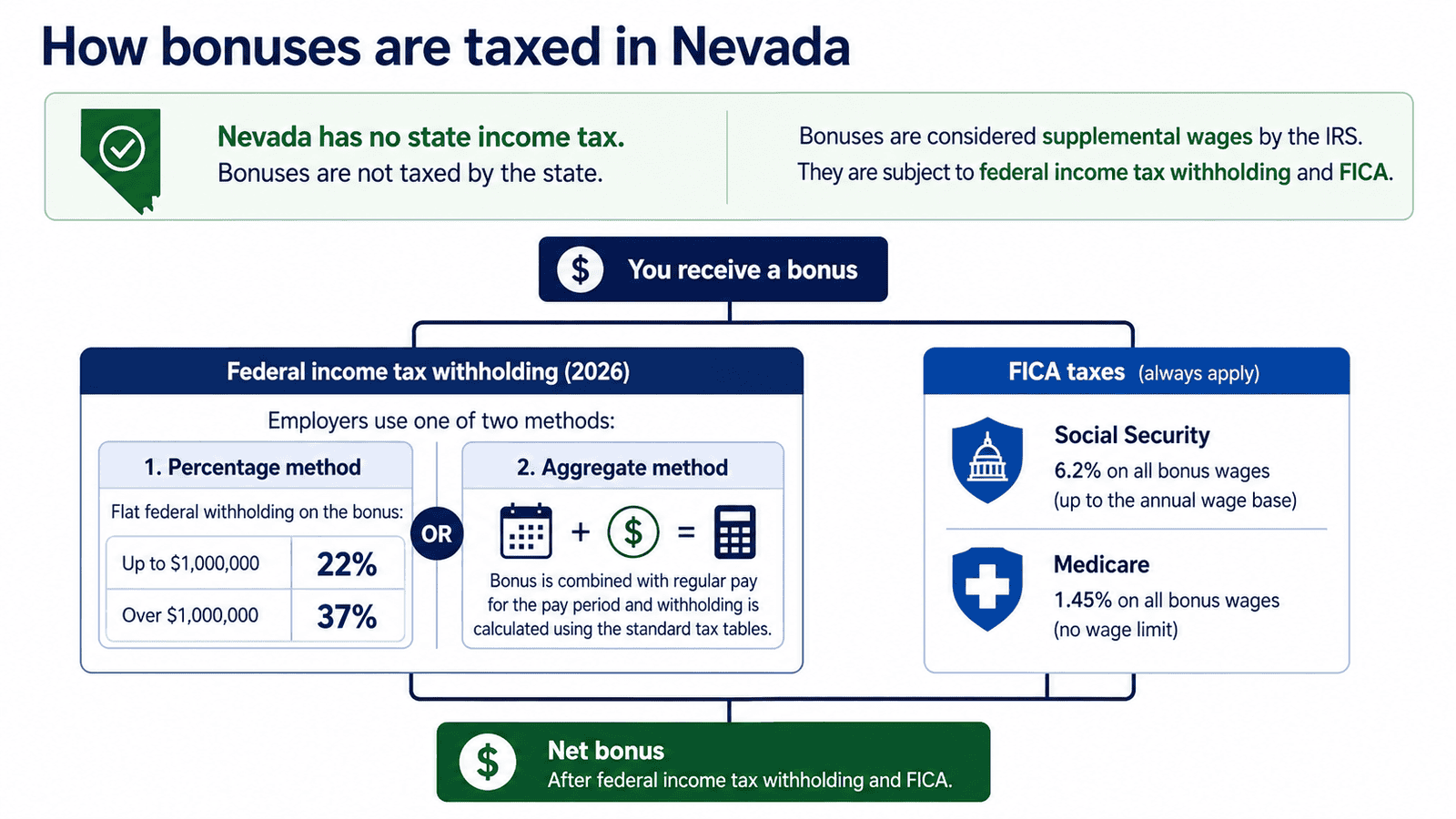
Nevada does not tax bonuses because it has no state income tax. However, bonuses are considered supplemental wages by the IRS and remain subject to federal income tax withholding and FICA.
For 2026, employers generally withhold federal income tax on bonuses using one of two methods (IRS Publication 15, 2026):
- Percentage method: A flat 22% federal income tax withholding rate on bonus payments up to $1,000,000. Amounts above $1,000,000 are withheld at 37%.
- Aggregate method: The employer combines the bonus with your regular pay for the pay period and calculates withholding on the combined total using the standard tax tables.
In addition to federal income tax withholding, bonuses are subject to 6.2% Social Security tax (up to the $184,500 wage base) and 1.45% Medicare tax.
The 22% flat withholding rate is not your final tax rate on the bonus. Your actual tax owed on bonus income depends on your total taxable income for the year. Any difference between what was withheld and what you owe is reconciled when you file your federal return.
Effect of 401(k) and health insurance premiums
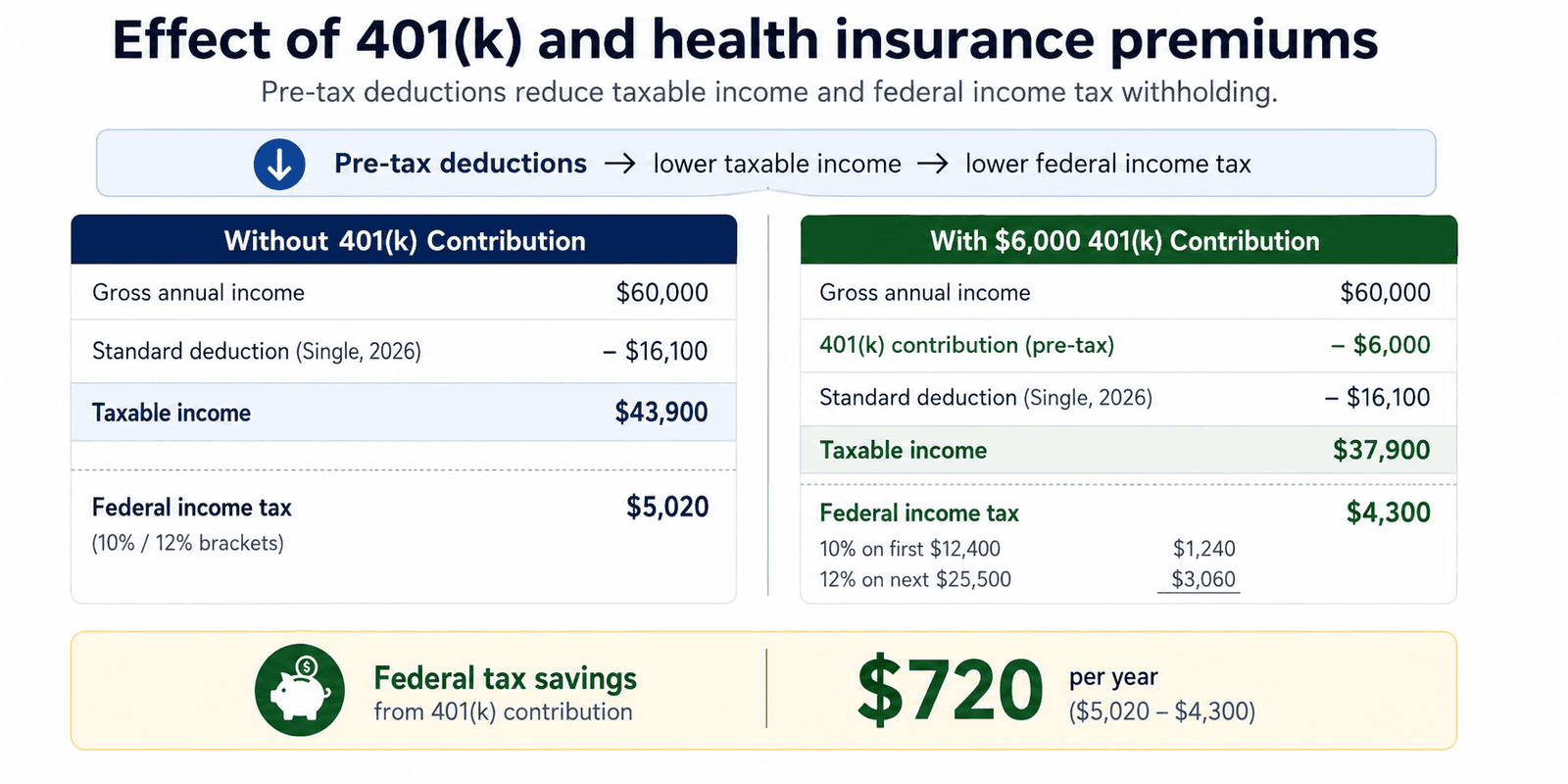
Pre-tax deductions such as traditional 401(k) contributions and employer-sponsored health insurance premiums reduce your federal taxable wages, which lowers federal income tax withholding on each paycheck.
Consider a single filer earning $60,000 who contributes $6,000 per year to a traditional 401(k):
Taxable income without 401(k) = $60,000 − $16,100 = $43,900
Federal income tax without 401(k) = $5,020
Taxable income with 401(k) = $60,000 − $6,000 − $16,100 = $37,900
Federal income tax with 401(k) = (10% × $12,400) + (12% × $25,500) = $1,240 + $3,060 = $4,300
Federal tax savings from 401(k) = $5,020 − $4,300 = $720 per year
There are a few important details to keep in mind:
- Social Security tax and Medicare tax generally still apply to traditional 401(k) contributions, so FICA does not decrease.
- Pre-tax health insurance premiums paid through a qualifying employer plan (Section 125 cafeteria plan) typically reduce wages for both federal income tax and FICA purposes.
- Roth 401(k) contributions are made after tax and do not reduce current taxable income.
Many financial planners suggest reviewing pre-tax deductions alongside paycheck estimates because these contributions can increase take home pay (through lower taxes) while simultaneously building retirement savings. The paycheck calculator Nevada shows how federal taxes and FICA affect your final paycheck.
How Nevada compares with neighboring states
Nevada is one of a small number of states with no individual income tax on wages. Each neighboring state imposes its own income tax, which means an identical salary produces lower take home pay in those states, all else being equal.
| State | State income tax on wages | Approximate top rate |
|---|---|---|
| Nevada | None | 0% |
| California | Yes (progressive) | 13.3% |
| Arizona | Yes (flat) | 2.5% |
| Utah | Yes (flat) | 4.55% |
| Oregon | Yes (progressive) | 9.9% |
Read our neighboring state paycheck guides for detailed comparisons:
- California paycheck calculator
- Arizona paycheck calculator
- Utah paycheck calculator
- Oregon paycheck calculator
Keep in mind that overall tax burden also depends on sales taxes, property taxes, and other levies. Nevada has a relatively high sales tax rate compared to some neighboring states, which partially offsets the absence of an income tax. A complete picture of tax burden requires looking beyond paycheck withholding alone. Compare different salary and hourly scenarios quickly with the paycheck calculator Nevada.
Frequently asked questions
How much is taken out of my paycheck in Nevada?
Most Nevada employees have three types of taxes withheld: federal income tax, Social Security tax (6.2% up to $184,500 in 2026), and Medicare tax (1.45% on all wages). Nevada does not withhold any state income tax on wages. The exact amount depends on your gross pay, filing status, W‑4 elections, and pre-tax deductions.
What is the Nevada income tax rate in 2026?
Nevada has no individual state income tax on wages, salaries, or other earned income. The rate is 0%. This has been the case for as long as Nevada has been a state. Only federal income tax and FICA apply to your paycheck.
How much is $60,000 a year after taxes in Nevada?
A single filer claiming the standard deduction with no additional deductions may take home approximately $50,390 per year, or about $1,938 every two weeks. That estimate includes $5,020 in federal income tax, $3,720 in Social Security tax, and $870 in Medicare tax. Actual results depend on your W‑4 elections and pre-tax deductions.
How are bonuses taxed in Nevada?
Nevada does not impose any state tax on bonuses. At the federal level, employers typically withhold 22% for income tax on bonus payments up to $1,000,000 (37% above that threshold), plus 6.2% for Social Security and 1.45% for Medicare. The 22% is a withholding rate, not necessarily your final tax rate on the bonus.
How do 401(k) contributions change take home pay in Nevada?
Traditional 401(k) contributions reduce your federal taxable income, which lowers the federal income tax withheld from each paycheck. For example, a $6,000 annual contribution on a $60,000 salary may reduce federal income tax by roughly $720 per year for a single filer in the 12% bracket. Social Security and Medicare taxes generally still apply to the full salary. The paycheck calculator Nevada updates your take home pay based on filing status and deductions.
Methodology
All calculations on this page use the following 2026 data points from the Internal Revenue Service (IRS Revenue Procedure 2025‑32):
- 2026 federal income tax rates of 10%, 12%, 22%, 24%, 32%, 35%, and 37% applied to the 2026 bracket thresholds.
- 2026 standard deduction of $16,100 for single filers, $32,200 for married filing jointly, and $24,150 for head of household.
- Social Security wage base of $184,500 at a 6.2% employee rate (IRS Topic 751).
- Medicare rate of 1.45% on all wages, with an additional 0.9% on wages above $200,000 for single filers.
Worked examples assume a single filer using the standard deduction with no additional credits, deductions, or pre-tax contributions unless noted. Actual payroll withholding may vary based on employer payroll systems, Form W‑4 elections, pre-tax benefits, and other compensation factors. Nevada’s status as a state with no individual income tax on wages is established under current Nevada law.
This content is for educational purposes only and does not constitute personalized financial advice. Consult a qualified financial advisor for guidance specific to your situation.
By Nathan Whitmore for MoneyFN Use the paycheck calculator Nevada to estimate your net pay before your next payday.

Nathan Whitmore is a US based personal finance writer at MoneyFN covering salary, paycheck, and tax math for American workers. He works from primary sources only: IRS revenue procedures, Bureau of Labor Statistics wage data, and Federal Reserve statistics. Every figure he publishes is dated and traceable to a public source.