

Our paycheck calculator washington helps you estimate your 2026 take home pay after federal income tax and FICA withholding. Washington does not tax wage income, so there is no state income tax deducted from your paycheck. A single filer earning $60,000 per year keeps about $50,390 annually after taxes, or roughly $1,938 from each biweekly paycheck.
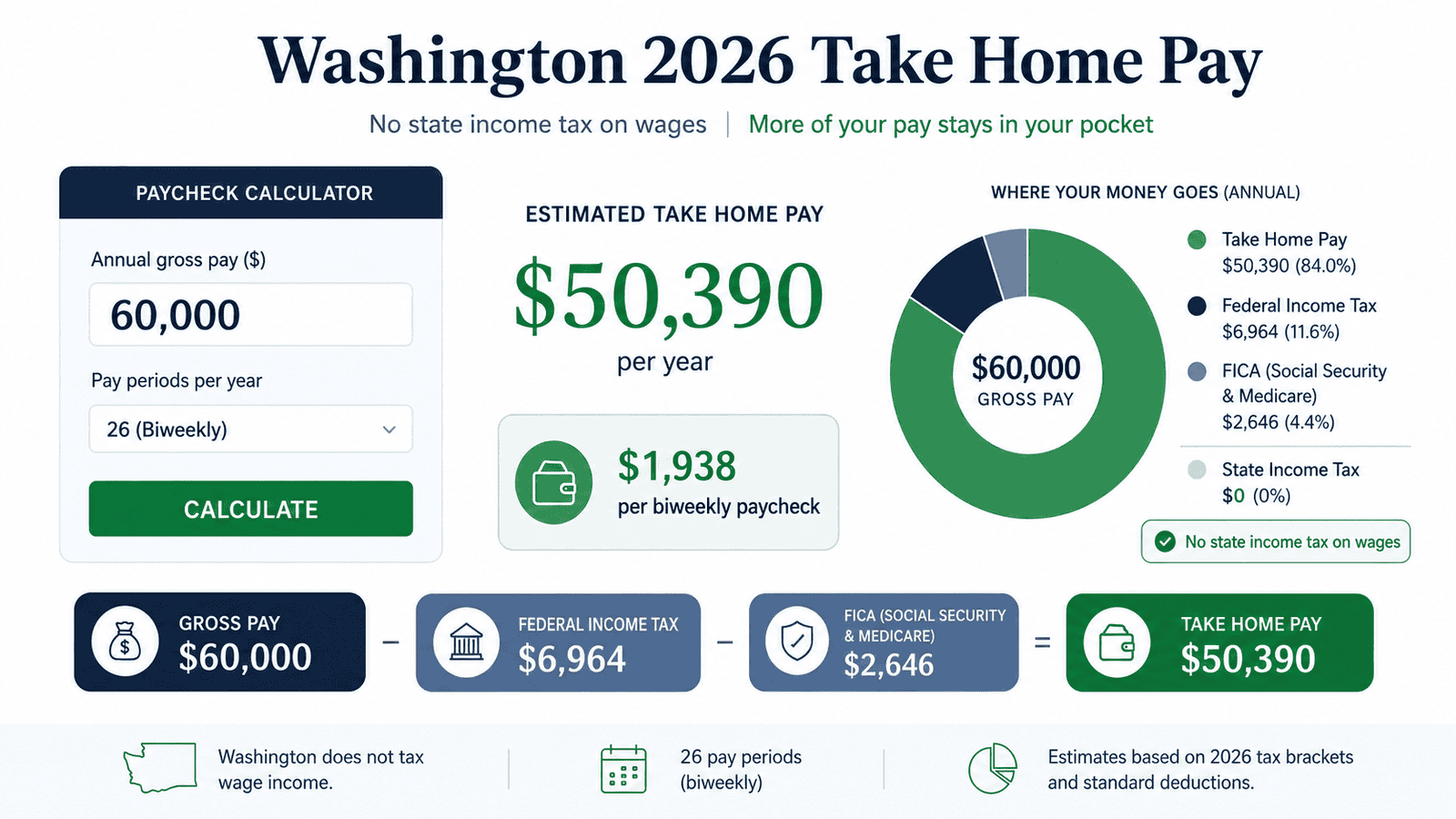
Paycheck calculator washington: Washington paycheck calculator
Use the calculator above for a quick estimate, or try our full salary after tax calculator to factor in filing status, dependents, and pre tax deductions.
How the paycheck calculator works
A paycheck calculator estimates the net amount deposited into your bank account each pay period. It starts with your gross pay and subtracts mandatory tax withholdings and any voluntary pre tax deductions. In Washington, because the state does not tax wages, the calculation is simpler than in most states. The calculator uses four key inputs to produce your result.
Gross pay is your total earnings before any deductions. You can enter this as an annual salary or as an hourly rate multiplied by your hours worked per pay period.
Pay frequency determines how your annual taxes are spread across paychecks. The most common frequencies are weekly (52 paychecks per year), biweekly (26 paychecks), semimonthly (24 paychecks), and monthly (12 paychecks). Biweekly is the most common pay schedule in the United States according to the Bureau of Labor Statistics.
Filing status affects the size of your standard deduction and where your income falls within federal tax brackets. The main options are single, married filing jointly, married filing separately, and head of household.
Pre tax deductions include contributions to a 401(k), 403(b), health savings account, or employer sponsored health insurance premiums. These amounts are subtracted from gross pay before federal income tax is calculated, which lowers your taxable income and increases your take home pay.
The calculator then applies the current year federal income tax brackets, Social Security tax, and Medicare tax to determine your total withholdings. In Washington, there is no additional state income tax line item.
2026 federal taxes on your paycheck
Every worker in the United States, including Washington residents, pays two categories of federal tax through paycheck withholding: federal income tax and FICA taxes. Here is how each one works for the 2026 tax year.
Federal income tax brackets for 2026
The federal income tax uses a progressive bracket system with seven rates. The IRS adjusts bracket thresholds each year for inflation. For 2026, the brackets were set under Revenue Procedure 2025-32 and reflect changes made permanent by the One Big Beautiful Bill Act signed in July 2025. The 2026 standard deduction is $16,100 for single filers and $32,200 for married couples filing jointly (source: IRS Revenue Procedure 2025-32).
Your taxable income equals your gross income minus the standard deduction (or itemized deductions if higher) and any pre tax adjustments. The 2026 federal income tax brackets for single filers are:
| Taxable income range | Tax rate |
|---|---|
| $0 to $12,400 | 10% |
| $12,401 to $50,400 | 12% |
| $50,401 to $105,700 | 22% |
| $105,701 to $201,775 | 24% |
| $201,776 to $256,225 | 32% |
| $256,226 to $640,600 | 35% |
| $640,601 and above | 37% |
Source: IRS Revenue Procedure 2025-32, effective for tax year 2026.
For married couples filing jointly, the bracket thresholds are roughly double the single filer amounts: the 10% bracket covers income from $0 to $24,800, the 12% bracket covers $24,801 to $100,800, and the 22% bracket covers $100,801 to $211,400.
FICA taxes: Social Security and Medicare
FICA stands for the Federal Insurance Contributions Act. These taxes fund Social Security retirement and disability benefits and the Medicare health insurance program. Every W-2 employee pays FICA regardless of filing status, and the rates are flat rather than progressive.
For 2026, the FICA rates and limits are:
| Tax | Employee rate | 2026 wage base |
|---|---|---|
| Social Security (OASDI) | 6.2% | $184,500 |
| Medicare (HI) | 1.45% | No limit |
| Additional Medicare (income over $200,000) | 0.9% | No limit |
Source: IRS Publication 926 (2026) and Social Security Administration wage base announcement, October 2025.
The combined employee FICA rate is 7.65% on earnings up to $184,500. Once your cumulative earnings for the year exceed $184,500, Social Security withholding stops and only Medicare (1.45%) continues. Your employer pays a matching 7.65%, but that amount does not appear on your pay stub because it is not deducted from your wages.
Washington state income tax explained
Washington does not impose a state income tax on wages, salaries, or other earned income. The only taxes taken from a Washington paycheck are federal income tax, Social Security tax, and Medicare tax.
Washington has never imposed a broad based income tax on wages. The Washington State Supreme Court ruled in 1933 that income is classified as property under the state constitution, and a graduated tax on property would violate the constitutional requirement for uniform taxation. That precedent has held for over 90 years (source: Washington Department of Revenue).
Because there is no state income tax, your employer does not withhold any state tax from your paycheck in Washington.
Washington does collect revenue through other channels. The state sales tax rate is 6.5%, with local additions pushing the average combined rate to approximately 9.23% statewide and as high as 10.25% in Seattle. Washington also imposes a capital gains excise tax on the sale of stocks and bonds above certain thresholds, but this does not affect regular paychecks. Property taxes fund local government and schools. None of these taxes are deducted from your paycheck.
In March 2026, Washington’s governor signed legislation imposing a 9.9% income tax on household income above $1,000,000. However, this law does not take effect until January 1, 2028, and it faces legal challenges. For the 2026 tax year, no state income tax applies to wages in Washington.
Worked examples: biweekly take home pay in Washington
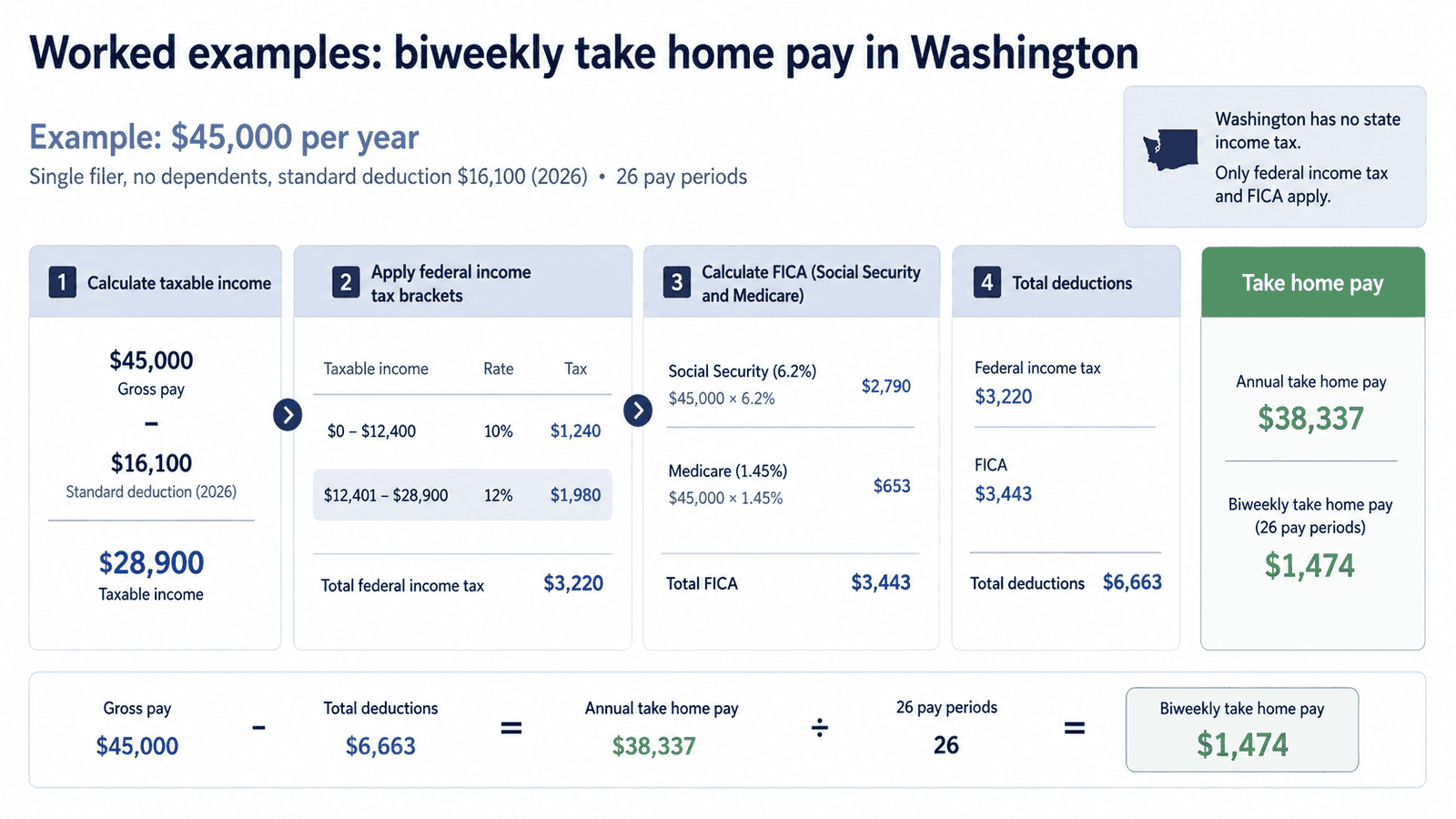
The following examples assume a single filer with no dependents, no pre tax deductions, taking the 2026 standard deduction of $16,100, and paid biweekly (26 pay periods per year). Because Washington has no state income tax, the only deductions are federal income tax and FICA.
$45,000 per year
Step 1: Calculate taxable income.
Step 2: Apply federal income tax brackets. The first $12,400 is taxed at 10%, which equals $1,240. The remaining $16,500 (from $12,401 to $28,900) is taxed at 12%, which equals $1,980.
Step 3: Calculate FICA. Social Security tax is $45,000 times 6.2%, which equals $2,790. Medicare tax is $45,000 times 1.45%, which equals $652.50.
Step 4: Determine take home pay.
That works out to approximately $1,474.52 per biweekly paycheck. The effective total tax rate is about 14.8%.
$60,000 per year
Taxable income is $60,000 minus $16,100, which equals $43,900. Federal income tax is $1,240 on the first $12,400 (at 10%) plus $3,780 on the next $31,500 (at 12%), totaling $5,020. Social Security tax is $3,720 and Medicare tax is $870, for total FICA of $4,590. Total annual deductions are $9,610.
That works out to approximately $1,938.08 per biweekly paycheck. The effective total tax rate is about 16.0%.
$85,000 per year
Taxable income is $85,000 minus $16,100, which equals $68,900. Federal income tax is calculated across three brackets: $1,240 at 10% on the first $12,400, plus $4,560 at 12% on the next $38,000 (from $12,401 to $50,400), plus $4,070 at 22% on the remaining $18,500 (from $50,401 to $68,900). Total federal income tax is $9,870. Social Security tax is $5,270 and Medicare tax is $1,232.50, for total FICA of $6,502.50.
That works out to approximately $2,639.52 per biweekly paycheck. The effective total tax rate is about 19.3%.
| Annual salary | Federal income tax | FICA | State tax | Annual take home | Biweekly take home |
|---|---|---|---|---|---|
| $45,000 | $3,220 | $3,442.50 | $0 | $38,337.50 | $1,474.52 |
| $60,000 | $5,020 | $4,590 | $0 | $50,390 | $1,938.08 |
| $85,000 | $9,870 | $6,502.50 | $0 | $68,627.50 | $2,639.52 |
Assumes single filer, 2026 standard deduction of $16,100, no pre tax deductions, 26 biweekly pay periods. Source: IRS Rev. Proc. 2025-32.
Hourly wages in Washington: what $20, $25, and $30 an hour take home
Many workers in Washington are paid hourly rather than on a salary. To convert an hourly wage to annual income, the standard assumption is 2,080 hours per year (40 hours per week for 52 weeks). The following estimates use the same assumptions as the salary examples above: single filer, no pre tax deductions, 2026 standard deduction of $16,100.
$20 per hour
Taxable income after the standard deduction is $25,500. Federal income tax is $2,812 ($1,240 at 10% plus $1,572 at 12%). FICA totals $3,182.40 ($2,579.20 Social Security plus $603.20 Medicare). Annual take home pay is approximately $35,605.60, which works out to about $17.12 per hour after taxes or roughly $1,369.45 per biweekly paycheck.
$25 per hour
Taxable income is $35,900. Federal income tax is $4,060 ($1,240 at 10% plus $2,820 at 12%). FICA totals $3,978 ($3,224 Social Security plus $754 Medicare). Annual take home pay is approximately $43,962, which works out to about $21.14 per hour after taxes or roughly $1,691 per biweekly paycheck.
$30 per hour
Taxable income is $46,300. Federal income tax is $5,308 ($1,240 at 10% plus $4,068 at 12%). FICA totals $4,773.60 ($3,868.80 Social Security plus $904.80 Medicare). Annual take home pay is approximately $52,318.40, which works out to about $25.15 per hour after taxes or roughly $2,012.25 per biweekly paycheck. For a deeper look at this wage level, see our guide on what $30 an hour looks like after taxes.
| Hourly wage | Gross annual | Total taxes | Annual take home | Effective hourly after taxes |
|---|---|---|---|---|
| $20/hr | $41,600 | $5,994.40 | $35,605.60 | $17.12 |
| $25/hr | $52,000 | $8,038 | $43,962 | $21.14 |
| $30/hr | $62,400 | $10,081.60 | $52,318.40 | $25.15 |
Assumes 2,080 hours per year (40 hours per week, 52 weeks), single filer, 2026 standard deduction. Source: IRS Rev. Proc. 2025-32.
How bonuses are taxed in Washington
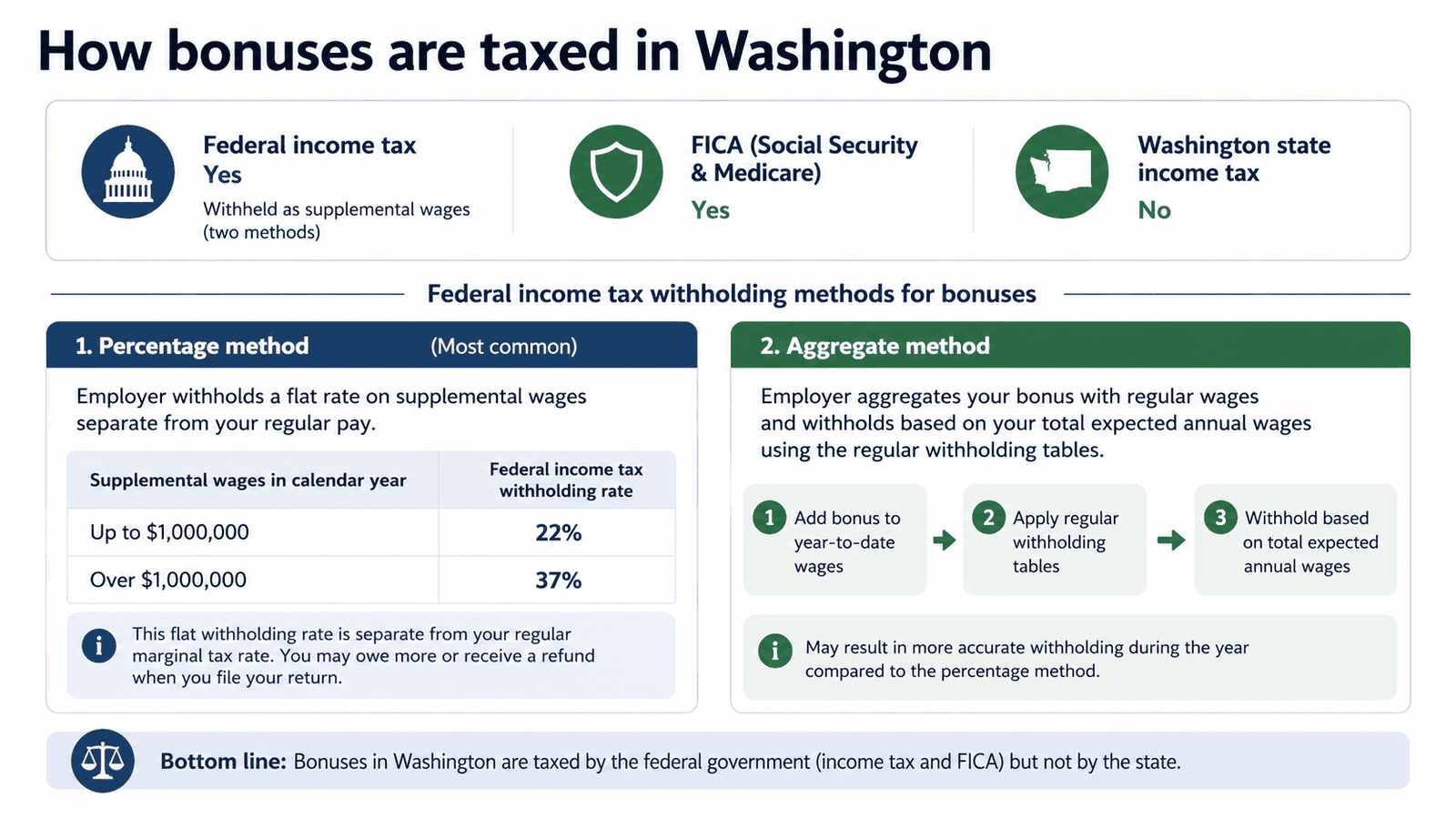
Bonuses in Washington are subject to federal income tax and FICA, but not state income tax. The IRS treats bonuses as supplemental wages and gives employers two methods for withholding federal income tax on them.
Percentage method. This is the most common approach. Your employer withholds a flat 22% for federal income tax on supplemental wages up to $1 million. For supplemental wages above $1 million in a calendar year, the withholding rate is 37%. This flat withholding rate is separate from your regular marginal tax rate. Depending on your total annual income, you may owe more or receive a refund when you file your return.
Aggregate method. This approach combines your bonus with your regular paycheck for that pay period and withholds based on the total amount as if it were a single regular payment. This can result in higher withholding in the pay period when the bonus is paid, because the combined amount may push your paycheck into a higher bracket for withholding purposes. Your actual tax liability is settled when you file your annual return.
FICA applies to bonuses the same way it applies to regular wages. Your employer withholds 6.2% for Social Security (up to the $184,500 wage base) and 1.45% for Medicare. If you have already earned more than $184,500 in the calendar year before receiving the bonus, no additional Social Security tax is withheld on the bonus amount.
For example, if you earn $60,000 per year in Washington and receive a $5,000 bonus, the federal withholding on the bonus under the percentage method would be $1,100 (22% of $5,000). FICA on the bonus would be $382.50 ($310 for Social Security plus $72.50 for Medicare). Your net bonus after all withholdings would be approximately $3,517.50. Washington takes nothing additional.
Effect of 401(k) and health insurance premiums on take home pay
Pre tax deductions like 401(k) contributions and employer sponsored health insurance premiums reduce your taxable income and therefore increase the portion of your paycheck that goes into your pocket on a net basis, even though the gross amount leaving your paycheck increases.
401(k) contributions
Traditional 401(k) contributions are deducted from your gross pay before federal income tax is calculated. They are still subject to FICA (Social Security and Medicare taxes). The 2026 employee contribution limit for a 401(k) is $23,500 for workers under 50, with a $7,500 catch up allowance for those aged 50 and older and an enhanced $11,250 catch up for ages 60 through 63 (source: IRS Notice 2024-80, inflation adjusted for 2026).
To illustrate, take a Washington worker earning $60,000 per year who contributes 6% of gross pay ($3,600) to a traditional 401(k). Taxable income drops from $43,900 to $40,300. Federal income tax falls from $5,020 to $4,588, a savings of $432. FICA remains the same at $4,590 because 401(k) contributions do not reduce FICA wages. The worker’s annual take home pay (excluding the 401(k) contribution itself) drops to $47,222, but the $3,600 is going into a retirement account rather than to taxes. The combined effect is that each $100 contributed to a 401(k) costs this worker only about $88 in reduced take home pay because of the $12 federal tax savings per $100.
In Washington, the tax savings from a 401(k) come entirely from the federal side. Workers in states with income taxes receive a state tax benefit on top of the federal benefit, so the per dollar tax advantage of a 401(k) is somewhat smaller in Washington compared to high tax states. However, the absence of state income tax means Washington workers already keep more of their paycheck overall.
Health insurance premiums
If your employer offers a health insurance plan under a Section 125 cafeteria plan, your share of the premium is usually deducted from gross pay before both federal income tax and FICA are calculated. This provides a slightly larger tax benefit than a 401(k) contribution because the premium reduces your FICA wages as well as your taxable income.
For example, a worker paying $200 per month ($2,400 per year) toward health insurance premiums on a pre tax basis would reduce their taxable income by $2,400 and also reduce their FICA wages by $2,400. On a $60,000 salary, this would save roughly $288 in federal income tax (at the 12% bracket) plus about $183.60 in FICA, for a total tax savings of about $471.60 per year. Try the paycheck calculator washington before accepting a new job offer to estimate your expected take home pay.
How Washington compares with neighboring states
Washington’s lack of a state income tax gives its workers a meaningful take home pay advantage over most neighboring states. Here is how a $60,000 salary (single filer, no pre tax deductions) compares across the region. Federal taxes are the same in every state, so the differences come entirely from state income tax.
| State | State income tax on $60,000 | Approximate annual take home | State tax page |
|---|---|---|---|
| Washington | $0 | $50,390 | This page |
| Alaska | $0 | $50,390 | Alaska paycheck calculator |
| Oregon | Approx. $3,200 to $3,800 | Approx. $46,600 to $47,200 | Oregon paycheck calculator |
| Idaho | Approx. $1,700 to $2,100 | Approx. $48,300 to $48,700 | Idaho paycheck calculator |
| California | Approx. $1,500 to $2,000 | Approx. $48,400 to $48,900 | California paycheck calculator |
Neighboring state tax amounts are approximate estimates based on 2026 rates and standard deductions for each state. Actual amounts depend on filing status, deductions, and local taxes. Oregon has no sales tax but has high income tax rates (up to 9.9%). Idaho has a flat income tax rate of 5.695%. California has a progressive system with rates up to 13.3% but lower effective rates at middle incomes. Alaska, like Washington, has no state income tax.
Washington workers who live near the Oregon border sometimes benefit from shopping in Oregon (which has no sales tax) while earning income in Washington (which has no income tax). This combination is one reason the Vancouver, Washington area remains popular with workers who commute to Portland, Oregon. Our paycheck calculator washington shows how changes to your salary affect each weekly, biweekly, or monthly paycheck.
Frequently asked questions
How much is taken out of my paycheck in Washington?
In Washington, the only mandatory deductions from your paycheck are federal income tax (which varies based on your income and filing status), Social Security tax at 6.2% of gross wages up to $184,500, and Medicare tax at 1.45% of all wages. Washington does not withhold state income tax from paychecks. For a single filer earning $60,000 per year with no pre tax deductions, total annual withholdings are approximately $9,610, leaving about $50,390 in take home pay.
What is the Washington income tax rate in 2026?
Washington’s income tax rate on wages is 0%. The state does not impose an income tax on salaries, hourly wages, tips, or other earned income. This applies for the entire 2026 tax year. Washington does have a separate capital gains excise tax on the sale of certain financial assets, but it does not apply to regular paychecks. A new income tax on household income above $1,000,000 has been signed into law but does not take effect until 2028.
How much is $60,000 a year after taxes in Washington?
A single filer earning $60,000 per year in Washington with no pre tax deductions and taking the 2026 standard deduction of $16,100 would pay approximately $5,020 in federal income tax and $4,590 in FICA taxes. That totals $9,610 in deductions, leaving approximately $50,390 in annual take home pay. On a biweekly pay schedule, that is roughly $1,938 per paycheck.
How are bonuses taxed in Washington?
Bonuses in Washington are subject to federal taxes only. Most employers use the IRS percentage method, which withholds a flat 22% for federal income tax on bonus amounts up to $1 million. FICA (6.2% Social Security and 1.45% Medicare) also applies to bonuses. There is no Washington state tax on bonuses. Your actual tax liability on the bonus is reconciled when you file your federal return, and you may receive a refund or owe additional tax depending on your total annual income.
How do 401(k) contributions change take home pay in Washington?
Traditional 401(k) contributions reduce your federal taxable income, which lowers your federal income tax. They do not reduce FICA taxes. In Washington, because there is no state income tax, the tax savings from a 401(k) come only from the federal side. For a worker in the 12% federal bracket, every $100 contributed to a 401(k) reduces federal income tax by $12, meaning the true cost to take home pay is $88 per $100 contributed. The contributed money grows tax deferred in the retirement account.
Does Washington have any payroll taxes beyond FICA?
Washington does not have a state income tax withholding, but there are a few state level payroll related programs. The Washington Paid Family and Medical Leave program requires small premium contributions from both employers and employees. The Washington Cares long term care program also involves a payroll premium. These are relatively small amounts compared to federal taxes and are separate from income tax. Check with the Washington Employment Security Department for current premium rates. The paycheck calculator washington estimates your net pay after federal taxes and FICA with no state income tax withholding.
Methodology
All calculations in this article use 2026 federal income tax brackets, standard deduction amounts, and FICA rates as published by the IRS in Revenue Procedure 2025-32. The Social Security wage base of $184,500 for 2026 was announced by the Social Security Administration in October 2025. Washington state tax information is sourced from the Washington Department of Revenue.
Worked examples assume a single filer with no dependents, no pre tax deductions, and the standard deduction unless otherwise noted. Actual take home pay may vary based on additional withholdings such as garnishments, voluntary deductions, local taxes in other jurisdictions, and W-4 elections. These examples are for educational purposes and do not account for credits like the earned income tax credit or child tax credit, which could increase take home pay for eligible filers.
This content is for educational purposes only and does not constitute personalized financial advice. Consult a qualified financial advisor for guidance specific to your situation.
By Nathan Whitmore for MoneyFN Use the paycheck calculator washington to compare take home pay across different salaries and pay frequencies.

Nathan Whitmore is a US based personal finance writer at MoneyFN covering salary, paycheck, and tax math for American workers. He works from primary sources only: IRS revenue procedures, Bureau of Labor Statistics wage data, and Federal Reserve statistics. Every figure he publishes is dated and traceable to a public source.