

Our paycheck calculator west virginia helps you estimate your 2026 take home pay after federal income tax, FICA, and West Virginia state income tax. West Virginia uses progressive state income tax rates ranging from 2.11% to 4.58% in 2026 and has no local payroll taxes. A single filer earning $60,000 per year takes home about $49,203 annually, or roughly $1,892 from each biweekly paycheck, before any voluntary deductions.
Paycheck calculator west virginia: West Virginia paycheck calculator
How the paycheck calculator works
A paycheck calculator estimates your net (take home) pay by subtracting all mandatory withholdings from your gross pay. To get an accurate result, you need to provide several key inputs.
Gross pay is your total earnings before any deductions. You can enter this as an annual salary or as an hourly wage multiplied by hours worked per pay period.
Pay frequency determines how your annual tax liability is spread across paychecks. Common frequencies include weekly (52 paychecks per year), biweekly (26 paychecks), semimonthly (24 paychecks), and monthly (12 paychecks). A biweekly paycheck will be smaller than a monthly paycheck, but you receive more of them throughout the year.
Filing status affects your federal standard deduction and tax bracket thresholds. Single filers receive a $16,100 standard deduction in 2026, while married couples filing jointly receive $32,200. Head of household filers receive $24,150 (IRS Revenue Procedure 2025-32).
Pre-tax deductions such as 401(k) contributions, health insurance premiums, HSA contributions, and FSA contributions reduce your taxable income before federal and state taxes are calculated. These deductions lower your tax bill and increase your take home pay relative to what you would receive without them.
The calculator then applies the 2026 federal income tax brackets, FICA taxes (Social Security and Medicare), and West Virginia state income tax brackets to determine the total withholding amount. Your take home pay is what remains after all of these deductions.
2026 federal taxes on your paycheck
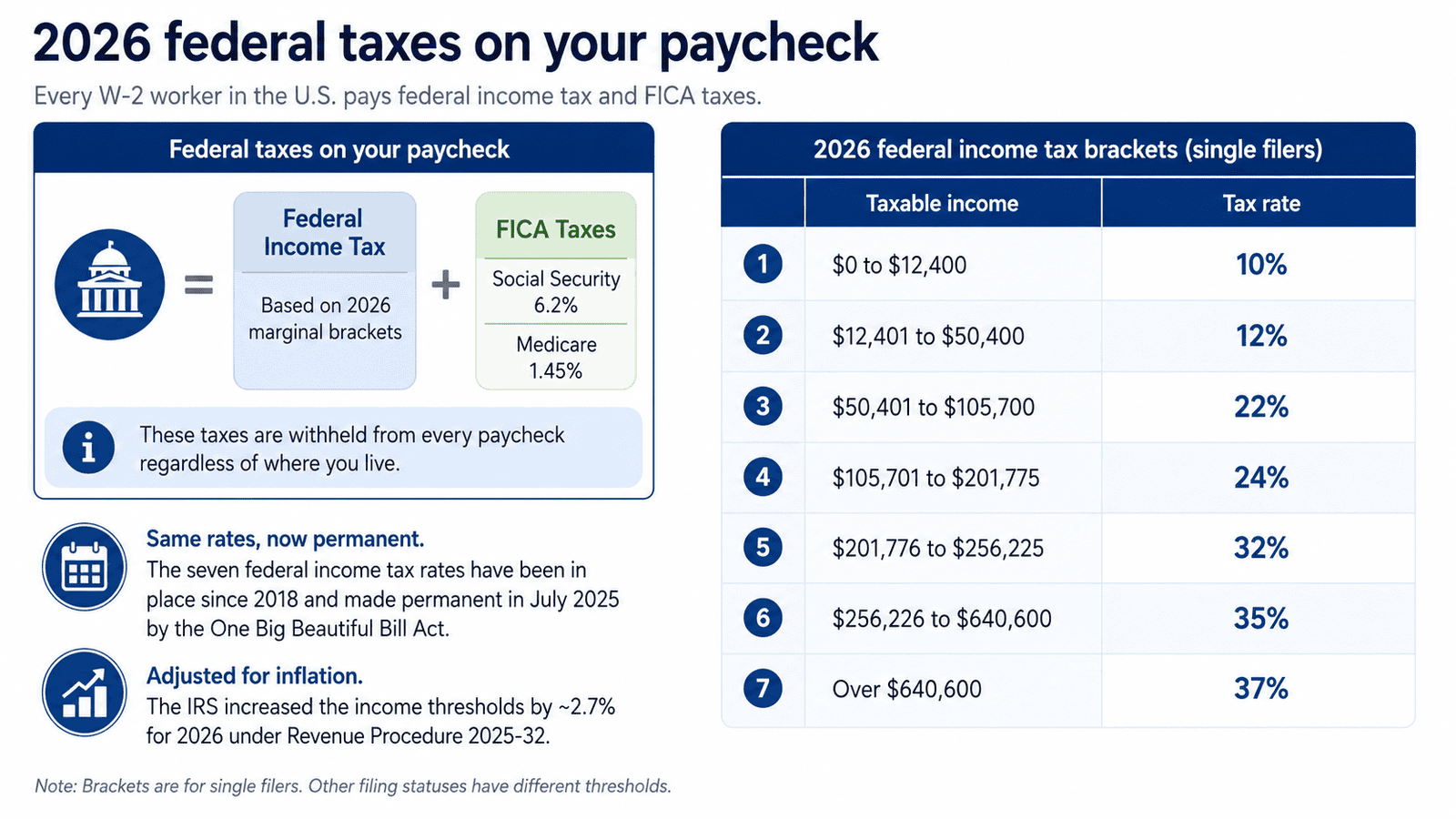
Every W-2 worker in the United States pays federal income tax and FICA taxes regardless of which state they live in. For tax year 2026, the federal income tax system uses seven marginal brackets with the same rates that have been in place since 2018, now made permanent by the One Big Beautiful Bill Act signed in July 2025. The IRS adjusted the bracket thresholds upward by approximately 2.7% for inflation under Revenue Procedure 2025-32.
2026 federal income tax brackets for single filers
| Taxable income | Tax rate |
|---|---|
| $0 to $12,400 | 10% |
| $12,401 to $50,400 | 12% |
| $50,401 to $105,700 | 22% |
| $105,701 to $201,775 | 24% |
| $201,776 to $256,225 | 32% |
| $256,226 to $640,600 | 35% |
| Over $640,600 | 37% |
Source: IRS Revenue Procedure 2025-32, applicable to tax year 2026. The 2026 standard deduction is $16,100 for single filers and $32,200 for married filing jointly.
FICA taxes in 2026
In addition to income tax, every paycheck is subject to FICA taxes that fund Social Security and Medicare. For 2026, the employee share of FICA breaks down as follows (IRS Publication 926, 2026 edition):
- Social Security tax: 6.2% on wages up to the 2026 wage base of $184,500 (Social Security Administration, October 2025)
- Medicare tax: 1.45% on all wages with no cap
- Additional Medicare tax: 0.9% on wages exceeding $200,000 for single filers ($250,000 for married filing jointly), paid by the employee only
Combined, most workers pay 7.65% of their gross wages toward FICA. Your employer pays a matching 7.65%, but that portion does not appear as a deduction on your pay stub.
West Virginia state income tax explained
West Virginia levies a progressive (graduated) state income tax with five brackets. The state has been actively cutting income tax rates in recent years. During the 2026 legislative session, Governor Morrisey signed SB 392 into law on March 31, 2026, delivering an across the board 5% rate reduction retroactive to January 1, 2026. This was codified under W. Va. Code § 11-21-4j effective June 12, 2026 (West Virginia Tax Division, tax.wv.gov).
2026 West Virginia income tax rates
| WV taxable income | Tax rate |
|---|---|
| $0 to $10,000 | 2.11% |
| $10,001 to $25,000 | $211.00 plus 2.81% of amount over $10,000 |
| $25,001 to $40,000 | $632.50 plus 3.16% of amount over $25,000 |
| $40,001 to $60,000 | $1,106.50 plus 4.22% of amount over $40,000 |
| Over $60,000 | $1,950.50 plus 4.58% of amount over $60,000 |
Source: West Virginia Tax Division, tax.wv.gov, 2026 income tax rate cut page. These rates apply to all filing statuses except married filing separately, which uses half the bracket thresholds.
A few important details about West Virginia’s income tax structure:
- The same bracket thresholds apply to single filers, joint filers, heads of household, and estates and trusts.
- West Virginia uses federal adjusted gross income (AGI) as the starting point for calculating state taxable income. Taxpayers may claim the same standard or itemized deduction used on their federal return, then subtract state personal exemptions of $2,000 per exemption.
- West Virginia does not impose any local or city income taxes. No municipality in the state levies a payroll or wage tax on workers.
- Starting in 2026, West Virginia provides a 100% reduction in state income tax on Social Security benefits for all residents regardless of income level.
- The state has a trigger mechanism that could produce additional rate cuts in future years if general revenue exceeds specified thresholds.
Worked examples: biweekly take home pay in West Virginia
The following examples calculate estimated biweekly take home pay for three salary levels. All examples assume a single filer claiming the federal standard deduction of $16,100, one West Virginia personal exemption of $2,000, no dependents, no pre-tax deductions, and 26 biweekly pay periods per year. Actual withholding may vary based on your W-4 and WV IT-104 elections and individual circumstances.
$45,000 annual salary
| Item | Annual | Per paycheck (biweekly) |
|---|---|---|
| Gross pay | $45,000.00 | $1,730.77 |
| Federal income tax | $3,220.00 | $123.85 |
| Social Security (6.2%) | $2,790.00 | $107.31 |
| Medicare (1.45%) | $652.50 | $25.10 |
| West Virginia state tax | $692.54 | $26.64 |
| Total deductions | $7,355.04 | $282.89 |
| Take home pay | $37,644.96 | $1,447.88 |
Step by step:
Federal taxable income: $45,000 minus $16,100 standard deduction equals $28,900. The first $12,400 is taxed at 10% ($1,240), and the remaining $16,500 is taxed at 12% ($1,980), for a total federal income tax of $3,220.
FICA: Social Security is 6.2% of $45,000 ($2,790). Medicare is 1.45% of $45,000 ($652.50).
WV state taxable income: $45,000 minus $16,100 standard deduction minus $2,000 personal exemption equals $26,900. The first $10,000 is taxed at 2.11% ($211.00), the next $15,000 is taxed at 2.81% ($421.50), and the remaining $1,900 is taxed at 3.16% ($60.04), for a total state tax of $692.54.
$60,000 annual salary
| Item | Annual | Per paycheck (biweekly) |
|---|---|---|
| Gross pay | $60,000.00 | $2,307.69 |
| Federal income tax | $5,020.00 | $193.08 |
| Social Security (6.2%) | $3,720.00 | $143.08 |
| Medicare (1.45%) | $870.00 | $33.46 |
| West Virginia state tax | $1,186.68 | $45.64 |
| Total deductions | $10,796.68 | $415.26 |
| Take home pay | $49,203.32 | $1,892.44 |
Step by step:
Federal taxable income: $60,000 minus $16,100 equals $43,900. Tax: 10% on $12,400 ($1,240) plus 12% on $31,500 ($3,780) equals $5,020.
FICA: $3,720 for Social Security plus $870 for Medicare.
WV state taxable income: $60,000 minus $16,100 minus $2,000 equals $41,900. Using the WV brackets: $211.00 on the first $10,000, plus $421.50 on the next $15,000, plus $474.00 on the next $15,000, plus $80.18 on the remaining $1,900 at 4.22%. Total state tax: $1,186.68.
A single filer earning $60,000 in West Virginia keeps about 82% of gross pay after all taxes, taking home roughly $1,892 per biweekly paycheck.
$85,000 annual salary
| Item | Annual | Per paycheck (biweekly) |
|---|---|---|
| Gross pay | $85,000.00 | $3,269.23 |
| Federal income tax | $9,870.00 | $379.62 |
| Social Security (6.2%) | $5,270.00 | $202.69 |
| Medicare (1.45%) | $1,232.50 | $47.40 |
| West Virginia state tax | $2,266.52 | $87.17 |
| Total deductions | $18,639.02 | $716.89 |
| Take home pay | $66,360.98 | $2,552.35 |
Step by step:
Federal taxable income: $85,000 minus $16,100 equals $68,900. Tax: 10% on $12,400 ($1,240) plus 12% on $38,000 ($4,560) plus 22% on $18,500 ($4,070) equals $9,870.
FICA: $5,270 for Social Security plus $1,232.50 for Medicare.
WV state taxable income: $85,000 minus $16,100 minus $2,000 equals $66,900. Using the brackets: $211.00 plus $421.50 plus $474.00 plus $844.00 plus 4.58% on $6,900 ($316.02). Total state tax: $2,266.52.
Hourly wages in West Virginia: what $20, $25, and $30 an hour take home
Many workers in West Virginia are paid hourly rather than on salary. To calculate annual gross pay from an hourly rate, multiply by 2,080 hours (40 hours per week for 52 weeks). The table below shows estimated take home pay at three hourly rates for a single filer with the standard deduction, one personal exemption, and no pre-tax deductions.
| Hourly rate | Annual gross | Total annual taxes | Annual take home | Biweekly take home |
|---|---|---|---|---|
| $20.00 | $41,600 | $6,585 | $35,015 | $1,347 |
| $25.00 | $52,000 | $8,952 | $43,048 | $1,656 |
| $30.00 | $62,400 | $11,370 | $51,030 | $1,963 |
At $20 per hour, a West Virginia worker takes home roughly $35,015 per year after federal tax, FICA, and state income tax. At $25 per hour, annual take home rises to about $43,048. And at $30 per hour, a worker keeps roughly $51,030 per year. These estimates assume full time hours with no overtime. For a closer look at how a specific hourly wage translates into take home pay, see $22 an hour: what that means for your paycheck.
How bonuses are taxed in West Virginia
Bonuses and other supplemental wages (commissions, overtime, severance) are subject to the same taxes as regular pay, but the withholding method is often different. At the federal level, the IRS allows employers to withhold on supplemental wages using one of two approaches.
The flat percentage method withholds federal income tax at a flat 22% on supplemental wages up to $1,000,000 in a calendar year. Any supplemental wages exceeding $1,000,000 are withheld at 37%. This is the most common method employers use for bonus checks.
The aggregate method combines your bonus with your regular pay for the pay period and withholds based on the total as if it were a single payment. This can result in higher withholding if the combined amount pushes you into a higher bracket for that paycheck, though you may receive some of that back as a refund when you file your return.
For West Virginia state tax, your bonus is also subject to withholding. Employers generally follow the state withholding tables or apply the applicable marginal rate. FICA taxes apply to bonus pay at the standard rates of 6.2% for Social Security (up to the $184,500 wage base) and 1.45% for Medicare.
As an example, if you receive a $5,000 bonus in West Virginia, the federal withholding under the flat method would be $1,100 (22%). Social Security tax would be $310 and Medicare would be $72.50. State withholding would depend on your income level but could range from roughly $106 to $229 based on the WV marginal rate that applies to your total income. On a $5,000 bonus, total withholding would likely fall between $1,588 and $1,712, leaving you with somewhere around $3,288 to $3,412 in hand.
Effect of 401(k) and health insurance premiums on take home pay
Pre-tax deductions are one of the most effective ways to reduce your tax bill. When you contribute to a traditional 401(k) or pay health insurance premiums through your employer, those amounts are subtracted from your gross pay before federal income tax and West Virginia state income tax are calculated. Most employer sponsored health premiums are also exempt from FICA taxes under a Section 125 (cafeteria) plan.
401(k) contributions
For 2026, the IRS allows employees under age 50 to contribute up to $23,500 to a traditional 401(k) plan. Workers aged 50 to 59 and 64 and older can contribute an additional $7,500 in catch up contributions, for a total of $31,000. Workers aged 60 to 63 can contribute an additional $11,250 for a total of $34,750 (IRS, November 2025).
Consider the $60,000 salary example above. Without any 401(k) contribution, the worker takes home about $49,203 after all taxes. If that worker contributes 6% of gross pay ($3,600) to a traditional 401(k), their federal taxable income drops from $43,900 to $40,300, and their WV taxable income drops from $41,900 to $38,300. The federal tax savings would be approximately $432 (at the 12% marginal rate), and the WV state tax savings would be roughly $134 (moving from the 4.22% bracket down into the 3.16% bracket on the reduced income). While the $3,600 is deducted from the paycheck, the actual reduction in take home pay is closer to $3,034 because of the approximately $566 in combined tax savings.
The contributed money grows tax deferred until withdrawal in retirement.
Health insurance premiums
Employer sponsored health insurance premiums paid through a Section 125 (cafeteria) plan reduce your taxable income for both income tax and FICA purposes. If you pay $200 per month ($4,800 per year) toward your health coverage, your federal income tax, state income tax, Social Security tax, and Medicare tax are all calculated on a lower base. For a worker in the 12% federal bracket and a mid range WV bracket, $4,800 in pre-tax health premiums may save over $1,000 in combined federal, state, and FICA taxes per year. The paycheck calculator west virginia can help you estimate the impact of pre-tax deductions on your net pay.
How West Virginia compares with neighboring states
West Virginia borders five states, each with a different income tax structure. If you live near a state line or are considering a move, understanding these differences can help you estimate the impact on your paycheck.
| State | Income tax structure | Top rate (2026) | Local income tax? |
|---|---|---|---|
| West Virginia | Progressive, 5 brackets | 4.58% | No |
| Virginia | Progressive, 4 brackets | 5.75% | No |
| Pennsylvania | Flat rate | 3.07% | Yes (local EIT up to ~3%) |
| Ohio | Flat rate | 2.75% | Yes (municipal up to ~2.5%) |
| Maryland | Progressive, 8 brackets | 5.75% | Yes (county tax up to 3.20%) |
| Kentucky | Flat rate | 3.50% | Yes (some local occupational taxes) |
West Virginia’s top rate of 4.58% is lower than Virginia’s and Maryland’s top rates. Pennsylvania has a lower flat state rate at 3.07%, but many Pennsylvania workers also pay a local earned income tax that can add 1% to 3% on top of that, which can make the total state and local burden comparable to or higher than West Virginia’s. Ohio adopted a 2.75% flat rate in 2026, though Ohio cities like Columbus, Cleveland, and Cincinnati impose municipal income taxes of up to 2.5%. Kentucky dropped to a 3.50% flat rate in 2026, though many Kentucky counties and cities levy occupational taxes.
Maryland workers face both a state income tax and a mandatory county income tax, which combined can reach nearly 9% at the top end.
West Virginia’s lack of any local income tax is a notable advantage. Workers in the state pay only one layer of income tax beyond federal, which simplifies payroll and avoids the surprise of additional local withholdings. Our paycheck calculator west virginia shows how federal, state, and FICA taxes affect every paycheck.
Frequently asked questions
How much is taken out of my paycheck in West Virginia?
Your paycheck in West Virginia is reduced by federal income tax (10% to 37% depending on your bracket), Social Security tax (6.2% up to $184,500 in wages), Medicare tax (1.45% on all wages), and West Virginia state income tax (2.11% to 4.58%). There are no local or city income taxes in West Virginia. For a single filer earning $60,000, total deductions amount to roughly $10,797 per year, or about 18% of gross pay.
What is the West Virginia income tax rate in 2026?
West Virginia uses a progressive income tax with five brackets for 2026. The rates range from 2.11% on the first $10,000 of taxable income to 4.58% on taxable income above $60,000. These rates reflect the 5% across the board cut signed into law on March 31, 2026 (SB 392), retroactive to January 1, 2026. The rates are published on the West Virginia Tax Division website at tax.wv.gov.
How much is $60,000 a year after taxes in West Virginia?
A single filer earning $60,000 per year in West Virginia with no pre-tax deductions can expect to take home approximately $49,203 after federal income tax ($5,020), Social Security tax ($3,720), Medicare tax ($870), and West Virginia state income tax ($1,187). That works out to about $1,892 per biweekly paycheck or roughly $4,100 per month.
How are bonuses taxed in West Virginia?
Bonuses are taxed as supplemental wages. At the federal level, employers typically withhold a flat 22% for income tax (37% on amounts over $1,000,000). Social Security tax (6.2%) and Medicare tax (1.45%) also apply. West Virginia state income tax is withheld according to the standard withholding tables based on your total income. A $5,000 bonus might see roughly $1,588 to $1,712 withheld in total, depending on your marginal state tax rate.
How do 401(k) contributions change take home pay in West Virginia?
Traditional 401(k) contributions reduce your taxable income for both federal and West Virginia state income tax. While the contribution itself comes out of your paycheck, you save money on taxes immediately. For example, a worker earning $60,000 who contributes 6% ($3,600) to a traditional 401(k) reduces their take home pay by approximately $3,034 rather than the full $3,600, because they save roughly $566 in combined federal and state taxes. The 2026 employee contribution limit is $23,500 (or $31,000 with catch up contributions for workers aged 50 and over).
Does West Virginia tax Social Security income?
No. Starting in 2026, West Virginia provides a 100% reduction in state income tax on Social Security benefits for all residents regardless of income level. Previously, only lower income residents qualified for the full exemption. This change makes West Virginia one of the more favorable states for retirees receiving Social Security. The paycheck calculator west virginia updates your estimated net pay as you adjust your gross income.
Methodology
All calculations in this article use the 2026 federal income tax brackets and standard deductions from IRS Revenue Procedure 2025-32. FICA rates of 6.2% for Social Security (on wages up to the $184,500 wage base announced by the Social Security Administration in October 2025) and 1.45% for Medicare are sourced from IRS Publication 926 (2026 edition). West Virginia state income tax rates reflect the 2026 rate tables published by the West Virginia Tax Division at tax.wv.gov following SB 392, signed March 31, 2026. Worked examples assume a single filer, the federal standard deduction of $16,100, one West Virginia personal exemption of $2,000, no dependents, no pre-tax deductions, and 26 biweekly pay periods.
WV state taxable income is estimated as federal adjusted gross income minus the federal standard deduction minus the $2,000 state personal exemption. Actual withholding amounts may differ based on your W-4 and WV IT-104 elections, additional income, deductions, or credits. Hourly estimates assume 2,080 hours per year (40 hours per week, 52 weeks). All figures are rounded and are intended as educational estimates only. Data sources include the Internal Revenue Service (irs.gov), the Social Security Administration (ssa.gov), the West Virginia Tax Division (tax.wv.gov), and the U.S. Bureau of Labor Statistics (bls.gov). All data points are current as of July 2026.
This content is for educational purposes only and does not constitute personalized financial advice. Consult a qualified financial advisor for guidance specific to your situation.
By Nathan Whitmore for MoneyFN Use the paycheck calculator west virginia to compare take home pay across different salary levels.

Nathan Whitmore is a US based personal finance writer at MoneyFN covering salary, paycheck, and tax math for American workers. He works from primary sources only: IRS revenue procedures, Bureau of Labor Statistics wage data, and Federal Reserve statistics. Every figure he publishes is dated and traceable to a public source.