

Our paycheck calculator Maryland helps estimate your 2026 take-home pay after federal income tax, FICA, Maryland state income tax, mandatory county income tax, and common payroll deductions. Maryland has a progressive state income tax plus required local county taxes, making paycheck calculations more complex than in many states. A single filer earning $60,000 in 2026 can expect to take home roughly $46,130 per year, or about $1,774 per biweekly paycheck, before voluntary deductions.
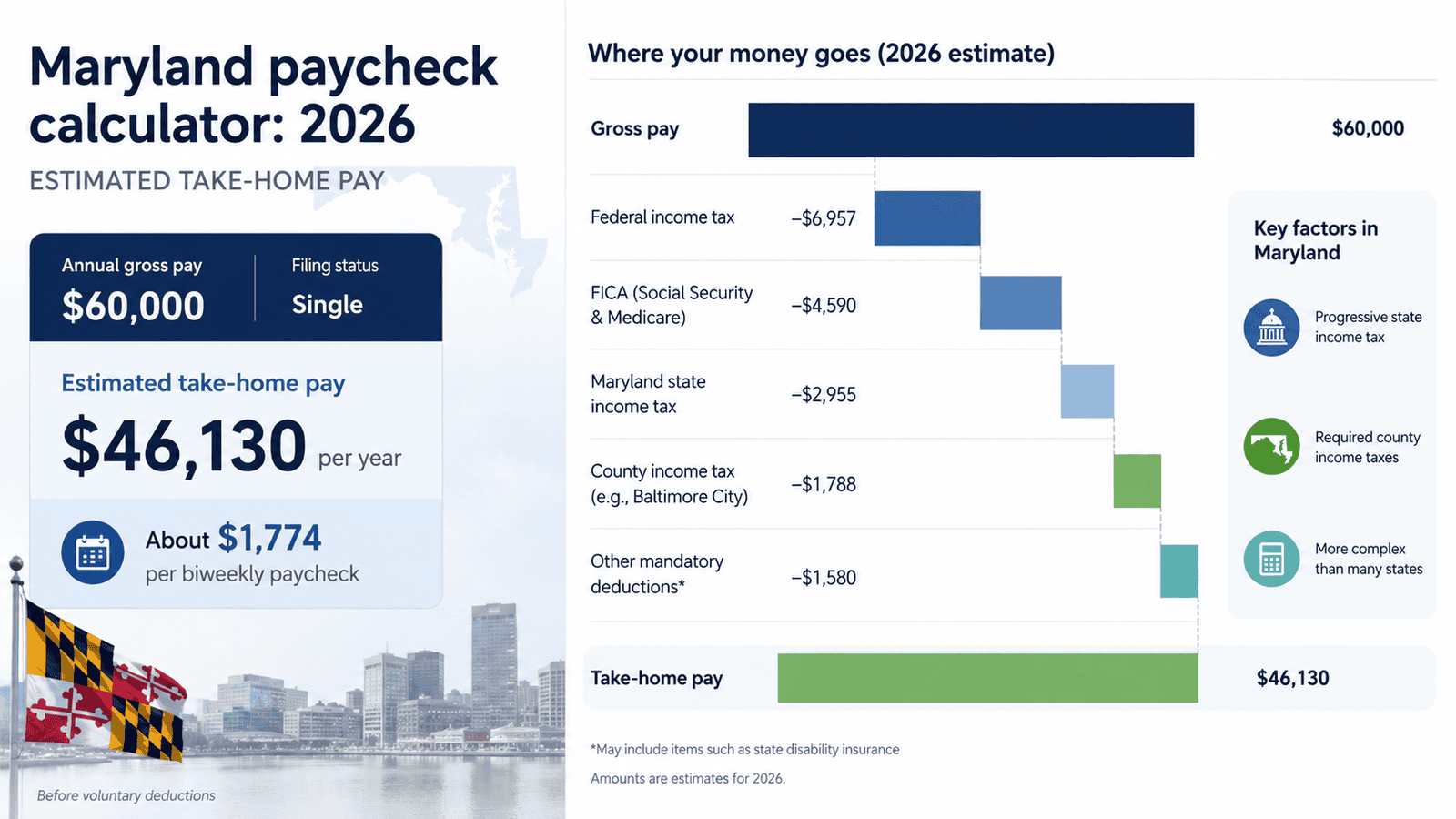
Maryland paycheck calculator
This calculator needs JavaScript. The worked examples below cover the same math.
How the paycheck calculator works
The salary after tax calculator estimates your net pay by subtracting all mandatory withholdings from your gross earnings. To produce an accurate result, it needs four inputs.
Gross pay is your total earnings before any deductions. Enter either your annual salary or your hourly rate.
Pay frequency determines how your annual taxes are divided across paychecks. Common options include weekly (52 paychecks), biweekly (26), semimonthly (24), and monthly (12).
Filing status affects your standard deduction and which tax bracket thresholds apply. Choose single, married filing jointly, married filing separately, or head of household.
Pre tax deductions include 401(k) contributions, health insurance premiums, HSA contributions, and other amounts withheld before taxes are calculated. These reduce your taxable income at both the federal and Maryland state level.
The calculator applies 2026 federal income tax brackets and the standard deduction, FICA payroll taxes, the Maryland progressive state income tax, and the county income tax for your county of residence. It then divides the result by your number of pay periods to show your estimated per paycheck take home amount.
2026 federal taxes on your paycheck
Every Maryland paycheck is subject to the same federal tax rules that apply nationwide. The 2026 federal income tax uses seven progressive brackets, unchanged by the One Big Beautiful Bill Act (OBBBA) signed in July 2025, which made the Tax Cuts and Jobs Act rate structure permanent. The IRS published the 2026 inflation adjusted thresholds in Revenue Procedure 2025-32.
2026 federal income tax brackets for single filers
| Tax rate | Taxable income range |
|---|---|
| 10% | $0 to $12,400 |
| 12% | $12,401 to $50,400 |
| 22% | $50,401 to $105,700 |
| 24% | $105,701 to $201,775 |
| 32% | $201,776 to $256,225 |
| 35% | $256,226 to $640,600 |
| 37% | $640,601 and above |
Source: IRS Revenue Procedure 2025-32, published 2025. The 22% bracket is highlighted because most Maryland workers earning between $45,000 and $85,000 will have at least some income taxed at that rate.
The 2026 standard deduction is $16,100 for single filers and $32,200 for married couples filing jointly. This amount is subtracted from gross income before the bracket schedule is applied.
FICA payroll taxes
In addition to income tax, every paycheck is subject to FICA taxes under the Federal Insurance Contributions Act. For 2026, the Social Security tax rate is 6.2% on wages up to the wage base of $184,500, as announced by the Social Security Administration. The Medicare tax rate is 1.45% on all wages with no cap. Employees earning more than $200,000 (single filers) also pay an additional 0.9% Medicare surtax on wages above that threshold. Combined, most workers pay 7.65% of gross wages in FICA taxes.
Maryland state income tax explained
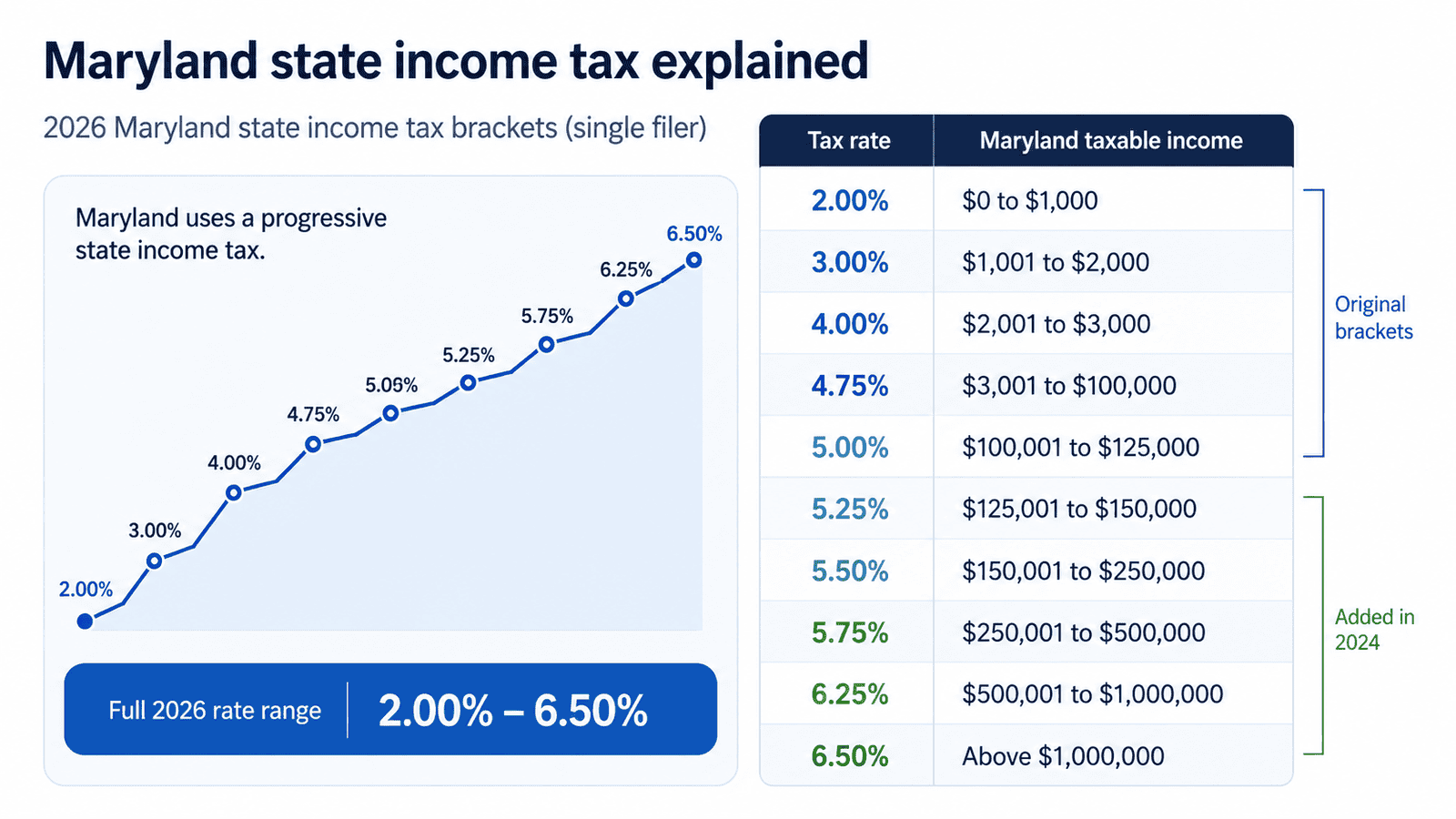
Maryland uses a progressive state income tax with rates that range from 2% on the first $1,000 of taxable income up to 5.75% on income above $250,000 for single filers. The 2024 Budget Reconciliation Act added two additional top brackets: 6.25% on income above $500,000 and 6.5% on income above $1,000,000. This means the full rate range for 2026 is 2% to 6.5%.
2026 Maryland state income tax brackets (single filer)
| Tax rate | Maryland taxable income |
|---|---|
| 2.00% | $0 to $1,000 |
| 3.00% | $1,001 to $2,000 |
| 4.00% | $2,001 to $3,000 |
| 4.75% | $3,001 to $100,000 |
| 5.00% | $100,001 to $125,000 |
| 5.25% | $125,001 to $150,000 |
| 5.50% | $150,001 to $250,000 |
| 5.75% | $250,001 to $500,000 |
| 6.25% | $500,001 to $1,000,000 |
| 6.50% | $1,000,001 and above |
Source: Maryland Comptroller, Tax Alert on rate changes, 2025. The 4.75% bracket is highlighted because most middle income earners in Maryland will have the bulk of their taxable income falling into this bracket.
Maryland’s standard deduction is calculated as 15% of your Maryland adjusted gross income, subject to a minimum of $1,800 and a maximum of $2,550 for single filers ($5,150 for married filing jointly) for 2026. The state also provides a personal exemption of $3,200 per filer, though this begins to phase out for filers with income above $100,000.
County income tax: the layer most people miss
Every Maryland county and Baltimore City imposes a local income tax on residents, applied to the same Maryland taxable income as the state tax. This is not optional. The rate depends on where you live, not where you work, and ranges from 2.25% (Worcester County) to 3.20% (Montgomery County, Prince George’s County, Howard County, and Baltimore City). The county tax is collected on the same state return, so there is no separate filing requirement. For the worked examples below, we use a county rate of 3.20%, which reflects the rate in the most populated Maryland counties surrounding Washington, D.C. and Baltimore.
Source: Maryland Comptroller, 2026 State and Local Withholding Information, February 2026.
Key point: Maryland’s combined state and county income tax rate can reach nearly 9% for high earners in major counties. Even at moderate incomes, the combined rate is typically 7% to 8%, which is higher than what neighboring Virginia or Pennsylvania residents pay in state income taxes alone.
Worked examples: biweekly take home pay
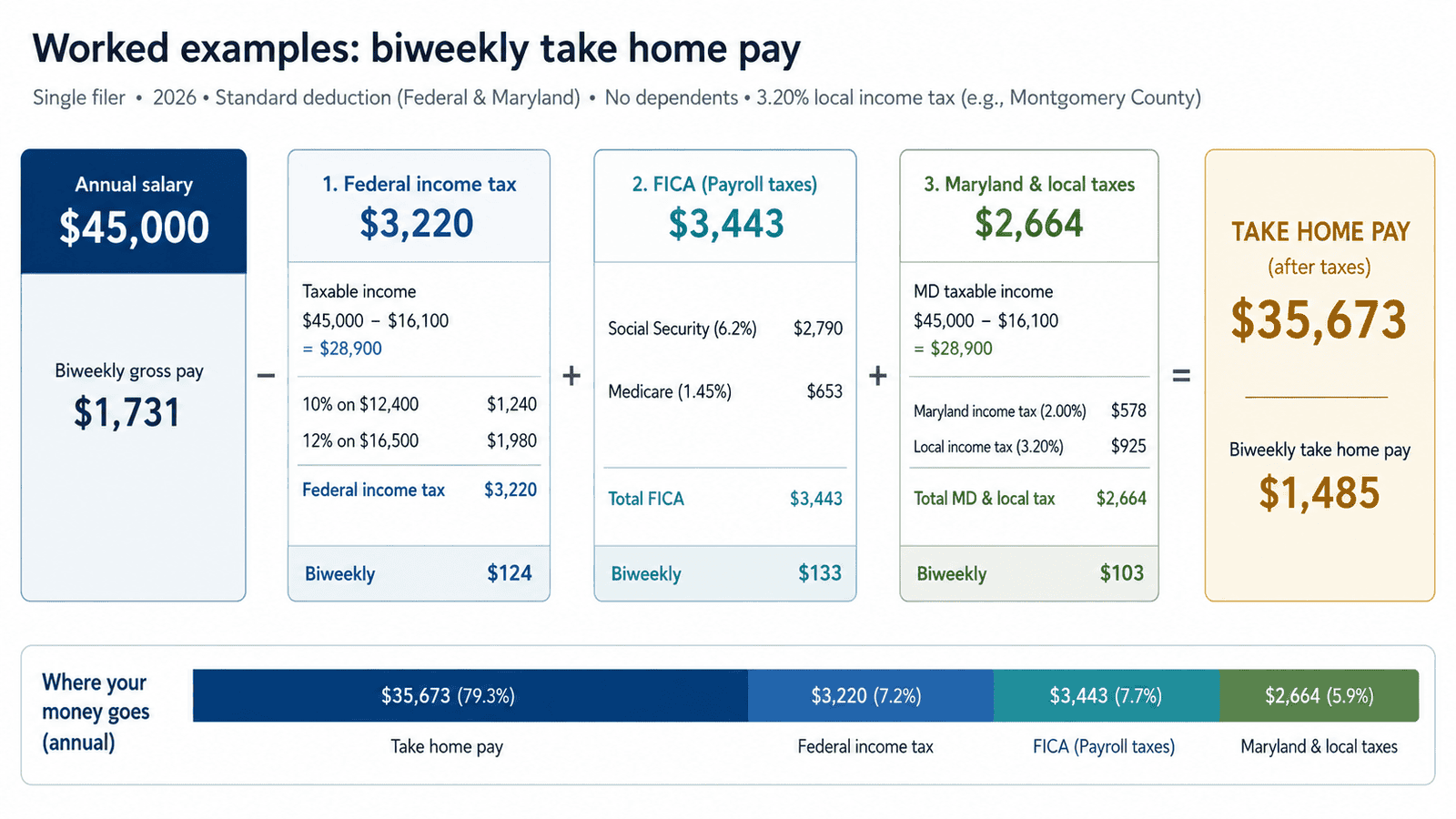
The following examples assume a single filer in 2026 who claims the standard deduction at both the federal and Maryland level, has no dependents, makes no pre tax retirement contributions, and lives in a county with a 3.20% local income tax rate (such as Montgomery County). All figures are rounded to the nearest dollar.
$45,000 salary
Federal income tax:
Taxable income = $45,000 − $16,100 standard deduction = $28,900
10% on $12,400 = $1,240
12% on $16,500 ($28,900 − $12,400) = $1,980
Federal income tax = $3,220
FICA:
Social Security: $45,000 × 6.2% = $2,790
Medicare: $45,000 × 1.45% = $653
Total FICA = $3,443
Maryland state tax:
MD taxable income = $45,000 − $2,550 − $3,200 = $39,250
2% on $1,000 = $20
3% on $1,000 = $30
4% on $1,000 = $40
4.75% on $36,250 ($39,250 − $3,000) = $1,722
Maryland state tax = $1,812
County tax:
$39,250 × 3.20% = $1,256
| Deduction | Annual amount |
|---|---|
| Federal income tax | $3,220 |
| FICA (Social Security + Medicare) | $3,443 |
| Maryland state income tax | $1,812 |
| County income tax (3.20%) | $1,256 |
| Total deductions | $9,731 |
| Annual take home pay | $35,269 |
| Biweekly take home pay | $1,357 |
$60,000 salary
Federal income tax:
Taxable income = $60,000 − $16,100 = $43,900
10% on $12,400 = $1,240
12% on $31,500 ($43,900 − $12,400) = $3,780
Federal income tax = $5,020
FICA:
Social Security: $60,000 × 6.2% = $3,720
Medicare: $60,000 × 1.45% = $870
Total FICA = $4,590
Maryland state tax:
MD taxable income = $60,000 − $2,550 − $3,200 = $54,250
2% on $1,000 = $20
3% on $1,000 = $30
4% on $1,000 = $40
4.75% on $51,250 ($54,250 − $3,000) = $2,434
Maryland state tax = $2,524
County tax:
$54,250 × 3.20% = $1,736
| Deduction | Annual amount |
|---|---|
| Federal income tax | $5,020 |
| FICA (Social Security + Medicare) | $4,590 |
| Maryland state income tax | $2,524 |
| County income tax (3.20%) | $1,736 |
| Total deductions | $13,870 |
| Annual take home pay | $46,130 |
| Biweekly take home pay | $1,774 |
$85,000 salary
Federal income tax:
Taxable income = $85,000 − $16,100 = $68,900
10% on $12,400 = $1,240
12% on $38,000 ($50,400 − $12,400) = $4,560
22% on $18,500 ($68,900 − $50,400) = $4,070
Federal income tax = $9,870
FICA:
Social Security: $85,000 × 6.2% = $5,270
Medicare: $85,000 × 1.45% = $1,233
Total FICA = $6,503
Maryland state tax:
MD taxable income = $85,000 − $2,550 − $3,200 = $79,250
2% on $1,000 = $20
3% on $1,000 = $30
4% on $1,000 = $40
4.75% on $76,250 ($79,250 − $3,000) = $3,622
Maryland state tax = $3,712
County tax:
$79,250 × 3.20% = $2,536
| Deduction | Annual amount |
|---|---|
| Federal income tax | $9,870 |
| FICA (Social Security + Medicare) | $6,503 |
| Maryland state income tax | $3,712 |
| County income tax (3.20%) | $2,536 |
| Total deductions | $22,621 |
| Annual take home pay | $62,379 |
| Biweekly take home pay | $2,399 |
Hourly wages in Maryland
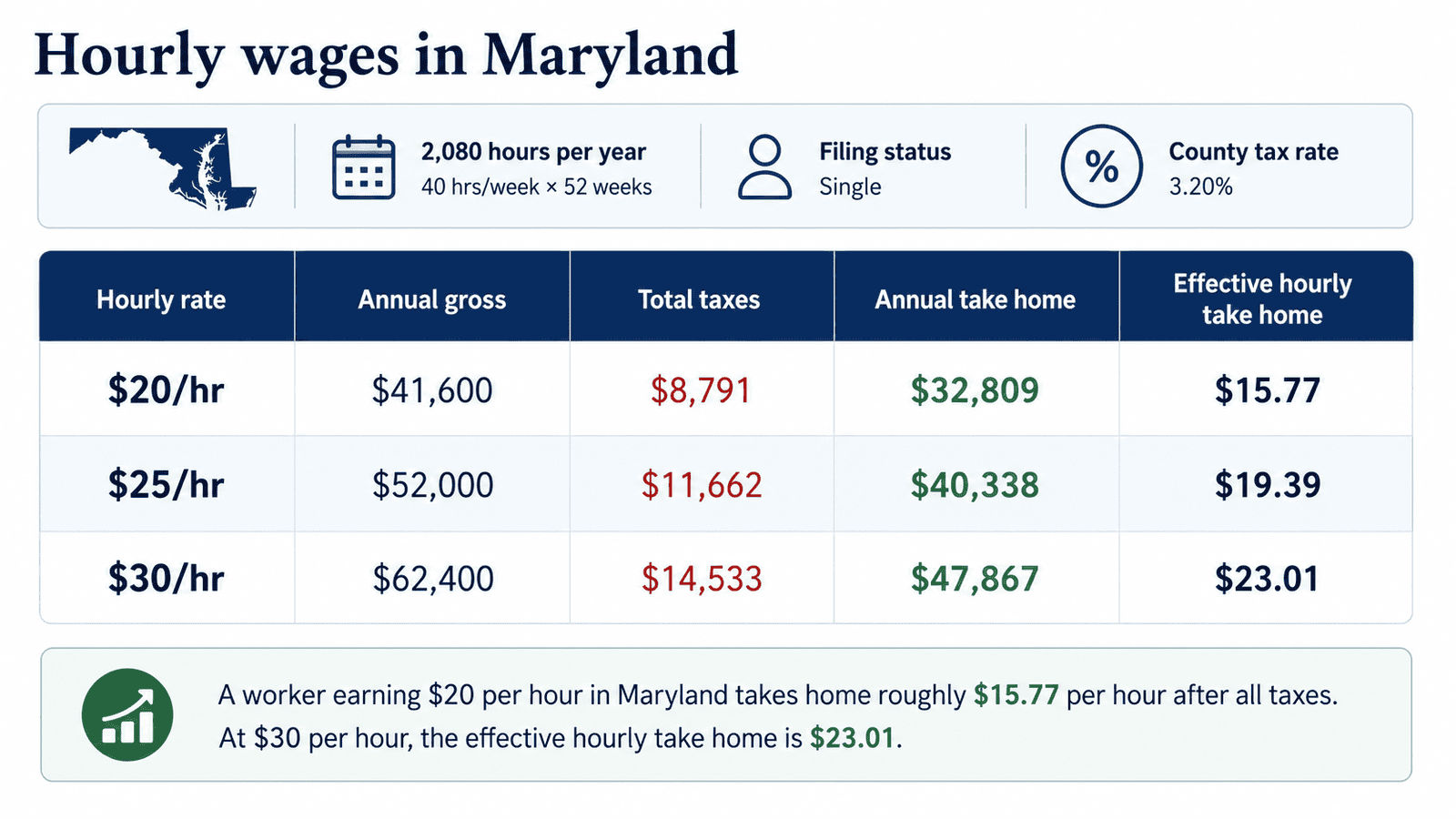
If you earn an hourly wage in Maryland, your annual gross income depends on the number of hours you work. The examples below assume a standard 2,080 hour work year (40 hours per week for 52 weeks), single filing status, and a county tax rate of 3.20%. For a deeper look at what a specific hourly rate produces after taxes, see our guide on $30 an hour take home pay.
| Hourly rate | Annual gross | Total taxes | Annual take home | Effective hourly take home |
|---|---|---|---|---|
| $20/hr | $41,600 | $8,791 | $32,809 | $15.77 |
| $25/hr | $52,000 | $11,662 | $40,338 | $19.39 |
| $30/hr | $62,400 | $14,533 | $47,867 | $23.01 |
A worker earning $20 per hour in Maryland takes home roughly $15.77 per hour after all taxes. At $30 per hour, the effective take home rate drops to about $23.01, reflecting the higher marginal federal and state brackets that apply as income rises.
How bonuses are taxed in Maryland
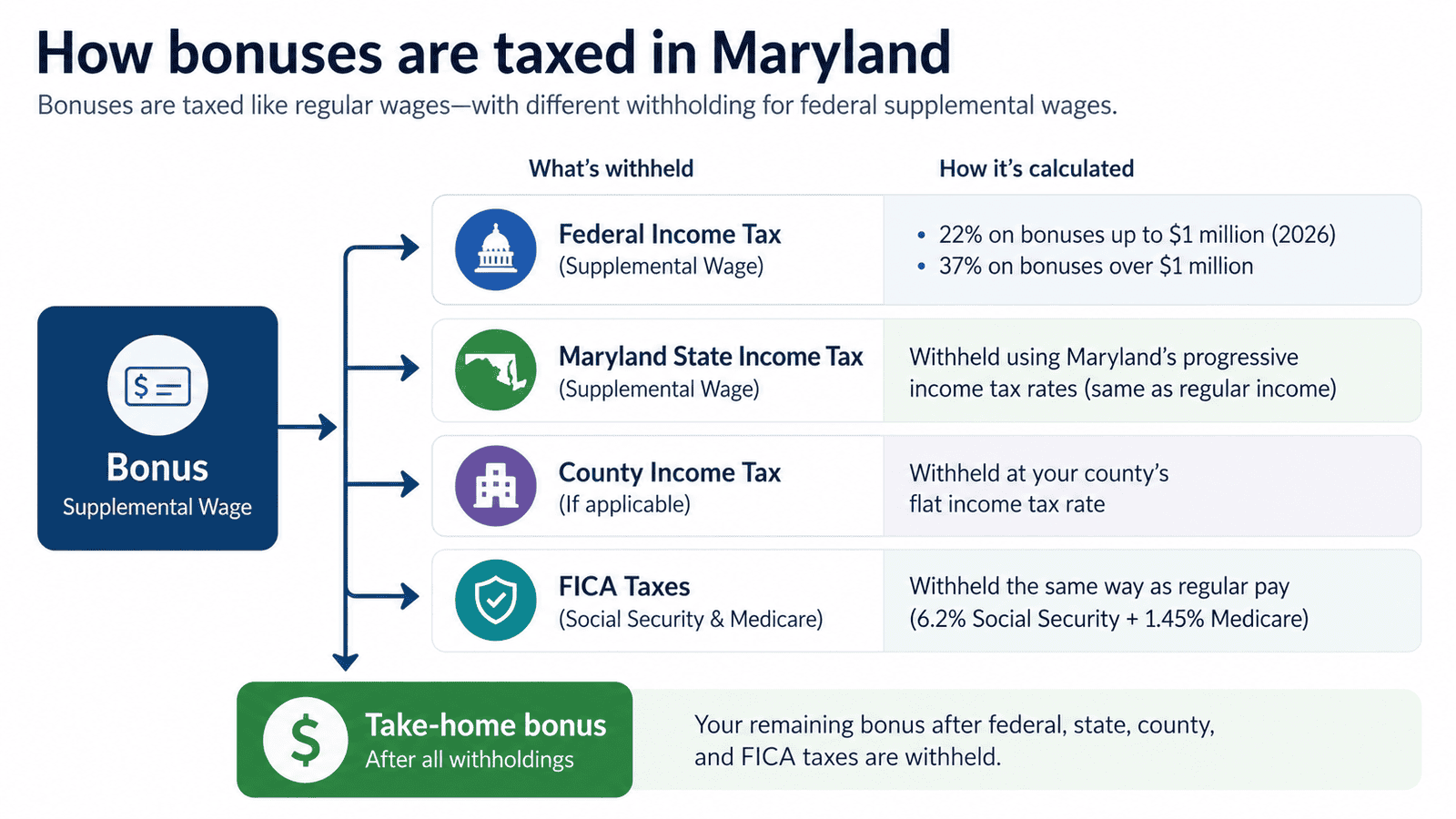
Bonuses in Maryland are subject to the same tax obligations as regular wages, but withholding is handled differently. Most employers use the IRS flat rate method, known as the supplemental wage withholding rate. For 2026, the federal supplemental withholding rate is 22% on bonuses up to $1 million. Bonuses above $1 million are withheld at 37%.
Maryland state withholding on supplemental wages generally follows the same progressive rate schedule that applies to regular income. The county income tax also applies to bonus income at your county’s flat rate. FICA taxes (Social Security and Medicare) are withheld from bonuses in the same way as regular pay, as long as your year to date earnings have not yet exceeded the $184,500 Social Security wage base.
Key point: Withholding on a bonus is not the same as your final tax liability. If your employer withholds at 22% federally but your actual marginal rate is 12%, you may receive the difference back as a refund when you file your tax return. Conversely, if your marginal rate is 24%, you may owe additional tax.
For example, a $5,000 bonus for a Maryland worker in Montgomery County might see the following withholding: $1,100 federal (22%), $383 FICA (7.65%), approximately $238 Maryland state tax (estimated at 4.75%), and $160 county tax (3.20%). That leaves roughly $3,119 of the $5,000 bonus in your pocket, before any year end adjustments on your tax return.
Effect of 401(k) and health insurance premiums
Pre tax deductions like traditional 401(k) contributions and employer sponsored health insurance premiums reduce your taxable income before federal, state, and FICA calculations. This makes them one of the most effective ways to increase your take home pay ratio.
Consider a single filer earning $60,000 who contributes 6% of salary ($3,600) to a traditional 401(k):
New federal taxable income = ($60,000 − $3,600) − $16,100 = $40,300
New federal tax = $1,240 + (12% × $27,900) = $1,240 + $3,348 = $4,588
Federal tax savings = $5,020 − $4,588 = $432
The 401(k) contribution also reduces Maryland state and county taxes. With a lower MD taxable income of $50,650 instead of $54,250, the state tax drops by about $171, and the county tax falls by about $115. Combined annual tax savings from the $3,600 contribution come to roughly $718. The contribution effectively costs $2,882 in reduced take home pay rather than the full $3,600, because of the tax savings.
Health insurance premiums paid through an employer sponsored plan under a Section 125 cafeteria plan work the same way. They reduce gross income before all taxes are calculated. A worker paying $200 per month ($2,400 per year) in pre tax health premiums would see their taxable income reduced by that amount at every level: federal, FICA, Maryland state, and county.
Common mistake: Roth 401(k) contributions do not reduce your current taxable income. They are made with after tax dollars. If your goal is to maximize current take home pay, a traditional 401(k) provides the immediate tax benefit. However, Roth contributions grow tax free and are not taxed at withdrawal in retirement. Check the paycheck calculator maryland after changing your 401(k) contribution to see updated take-home pay. Our paycheck calculator maryland examples illustrate how filing status, pre-tax contributions, and local taxes can change your take-home pay.
How Maryland compares with neighboring states
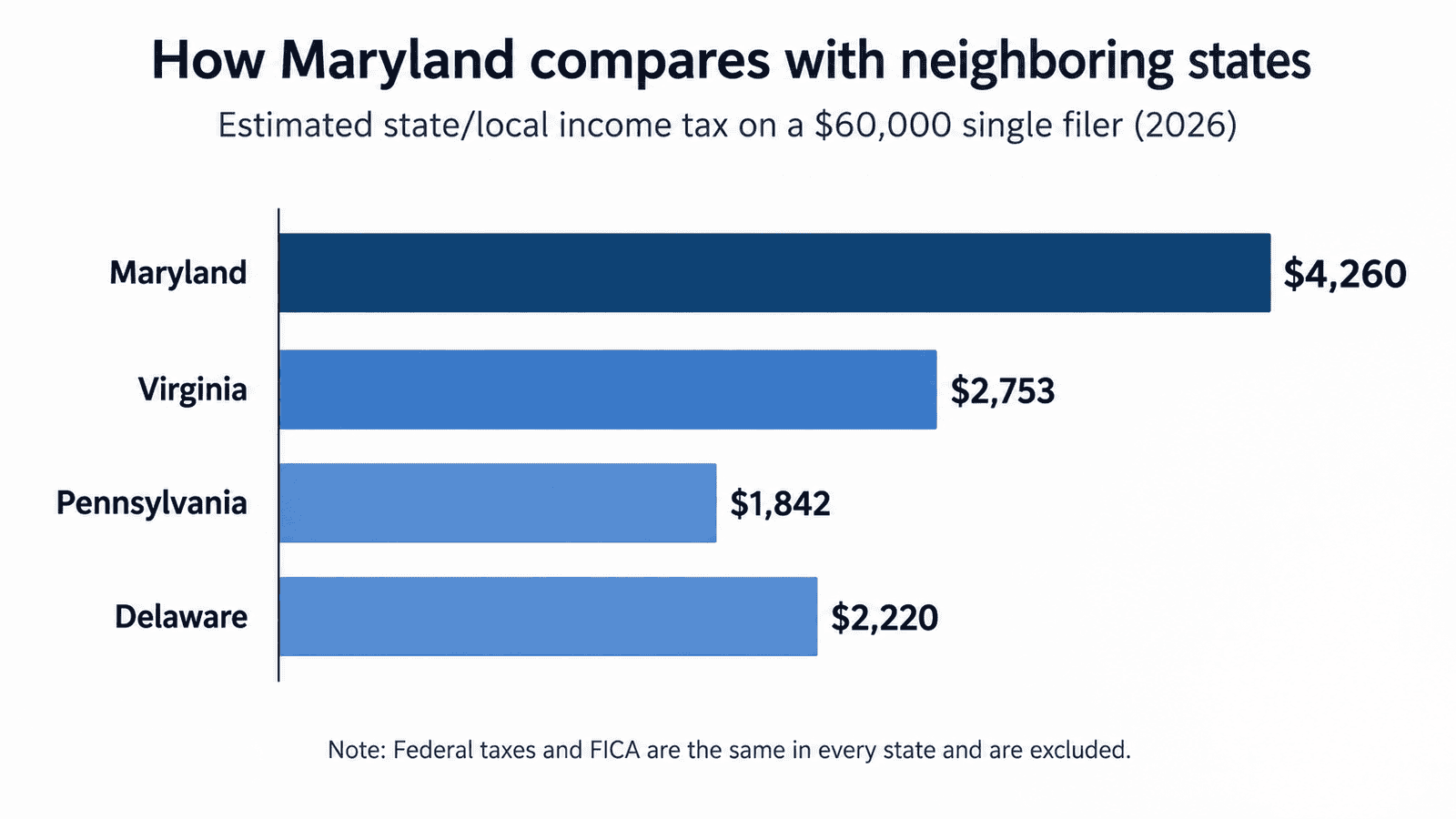
Maryland’s total tax burden is among the highest in the Mid Atlantic region, largely because of the mandatory county income tax that stacks on top of the state rate. Here is how a $60,000 single filer’s estimated state level income tax compares across Maryland and its neighbors. Federal taxes and FICA are the same in every state and are excluded from this comparison.
| State | Tax structure | Approximate state/local income tax on $60,000 |
|---|---|---|
| Maryland | Progressive (2% to 6.5%) + county tax (2.25% to 3.20%) | $4,260 |
| Virginia | Progressive (2% to 5.75%), no county income tax | $2,753 |
| Pennsylvania | Flat 3.07% + local wage taxes vary | $1,842 |
| Delaware | Progressive (2.2% to 6.6%), no sales tax, no county income tax | $2,723 |
| West Virginia | Progressive (2.36% to 5.12%), no county income tax | $2,172 |
Maryland stands out because the county income tax adds $1,200 to $1,800 in additional tax at this income level, depending on county. Pennsylvania has a lower flat rate, though residents of Philadelphia and some other municipalities face local wage taxes that can narrow the gap. Virginia and Delaware have comparable state rates but do not levy a separate county level income tax on wages. Maryland also maintains reciprocity agreements with Virginia, West Virginia, Pennsylvania, and Washington, D.C., meaning Maryland residents working in those jurisdictions pay Maryland tax on their wages rather than the other state’s tax. A paycheck calculator maryland can compare hourly wages with annual salary results. Before accepting a new job, a paycheck calculator maryland can show how deductions affect your expected paycheck.
Frequently asked questions
How much is taken out of my paycheck in Maryland?
A Maryland paycheck is reduced by federal income tax (10% to 37% depending on your bracket), FICA payroll taxes (6.2% Social Security plus 1.45% Medicare), Maryland state income tax (2% to 6.5%), and county income tax (2.25% to 3.20%). For a single filer earning $60,000, total deductions come to roughly $13,870 per year, or about 23.1% of gross pay, leaving approximately $46,130 in annual take home pay.
What is the Maryland income tax rate in 2026?
Maryland uses a progressive income tax with rates from 2% to 6.5% for tax year 2026. Most filers earning between $3,000 and $100,000 in Maryland taxable income fall into the 4.75% bracket. The top rate of 6.5% applies only to taxable income above $1,000,000. On top of the state rate, every Maryland resident also pays a county income tax between 2.25% and 3.20%. The combined state and county rate typically ranges from about 7% to nearly 9% for higher earners in major counties. Source: Maryland Comptroller Tax Alert, 2025.
How much is $60,000 a year after taxes in Maryland?
A single filer earning $60,000 in Maryland in 2026, claiming the standard deduction and living in a county with a 3.20% local tax rate, can expect to take home approximately $46,130 per year. That works out to about $1,774 per biweekly paycheck or $3,844 per month. This estimate includes federal income tax ($5,020), FICA ($4,590), Maryland state tax ($2,524), and county tax ($1,736).
How are bonuses taxed in Maryland?
Bonuses are taxed as ordinary income in Maryland. For federal withholding, most employers use the supplemental rate of 22% on bonus payments up to $1 million. Maryland state tax and the county income tax are also withheld from bonuses at rates based on your income level and county of residence. Your final tax on the bonus is reconciled when you file your annual return, and the withholding amount may differ from the actual tax owed.
How do 401(k) contributions change take home pay in Maryland?
Traditional 401(k) contributions are made with pre tax dollars, which reduces your taxable income for federal, Maryland state, and county income tax purposes. For a single filer earning $60,000 who contributes 6% ($3,600) to a traditional 401(k), the combined federal, state, and county tax savings come to roughly $718 per year. This means every $1.00 contributed effectively costs about $0.80 in reduced take home pay, because of the tax benefit. The paycheck calculator maryland accounts for federal, state, and county income taxes. A paycheck calculator maryland estimate helps you compare take-home pay across different salaries and pay frequencies.
Methodology
All calculations in this article use 2026 tax year rates and thresholds. Federal income tax brackets and the standard deduction are sourced from IRS Revenue Procedure 2025-32. The Social Security wage base of $184,500 for 2026 is published by the Social Security Administration. Maryland state income tax brackets and local tax rates are sourced from the Maryland Comptroller’s 2026 withholding guidance and the Comptroller’s published tax alert on rate changes from the 2025 legislative session.
Examples assume a single filer taking the standard deduction at both the federal and state levels, with the Maryland personal exemption of $3,200 applied in full (no phase out). County tax examples use a 3.20% rate, reflecting Montgomery, Prince George’s, Howard, and Baltimore City. No pre tax deductions, tax credits, or additional income sources are included unless specifically noted. Actual take home pay will vary based on filing status, dependents, deductions, credits, county of residence, and employer specific withholdings. Use the salary after tax calculator for a personalized estimate.
This content is for educational purposes only and does not constitute personalized financial advice. Consult a qualified financial advisor for guidance specific to your situation.
By Nathan Whitmore for MoneyFN Use the paycheck calculator maryland to estimate your net pay before each payday. Use this paycheck calculator maryland guide to estimate your net pay after federal, state, and local taxes.

Nathan Whitmore is a US based personal finance writer at MoneyFN covering salary, paycheck, and tax math for American workers. He works from primary sources only: IRS revenue procedures, Bureau of Labor Statistics wage data, and Federal Reserve statistics. Every figure he publishes is dated and traceable to a public source.