

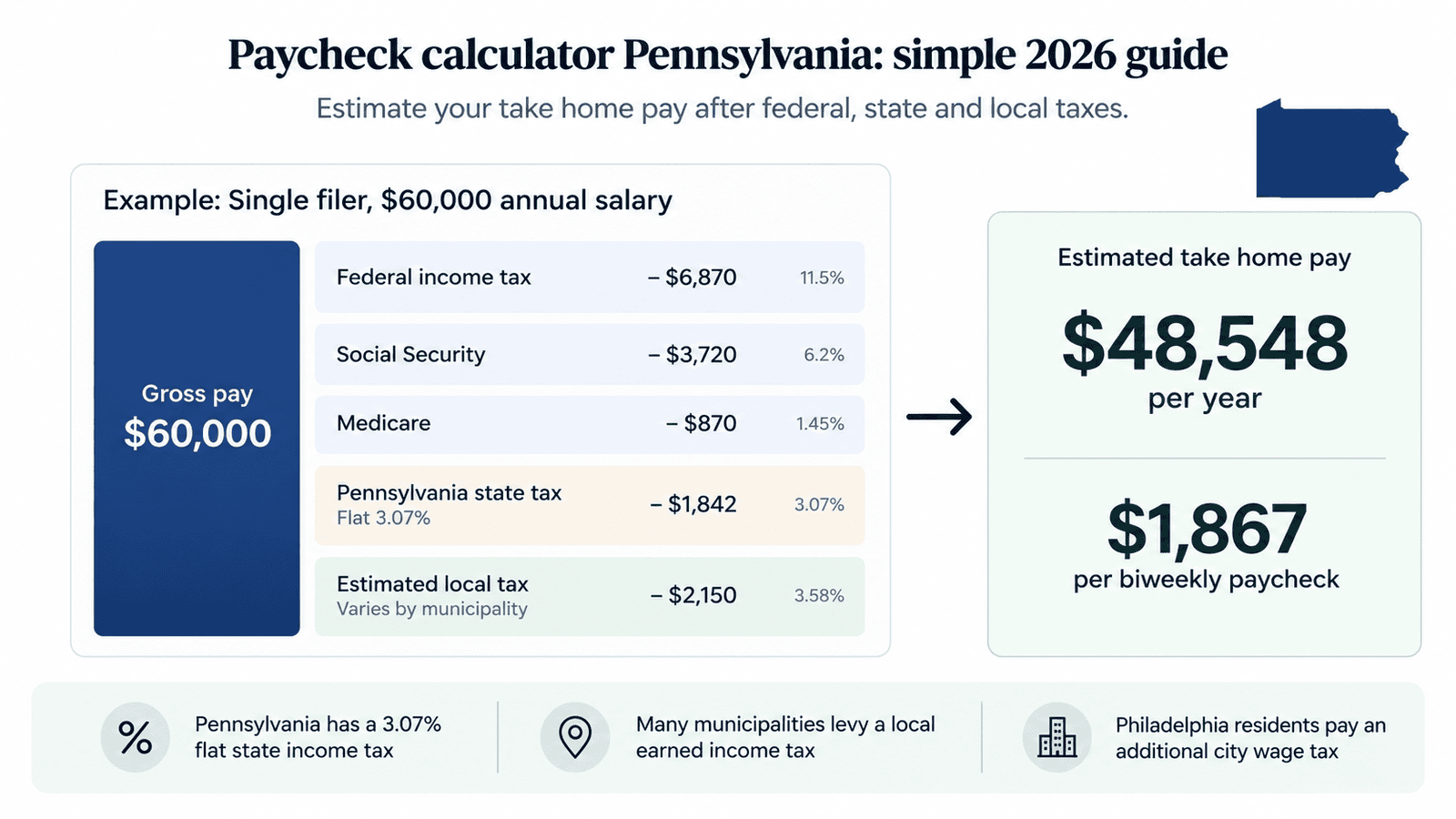
Our paycheck calculator pennsylvania helps you estimate 2026 take home pay after federal income tax, Social Security, Medicare, and Pennsylvania's flat 3.07% state income tax. Pennsylvania does have a state income tax, and many municipalities also levy a local earned income tax, while Philadelphia residents pay an additional city wage tax. A single filer earning $60,000 with no pre-tax deductions takes home about $48,548 per year, or roughly $1,867 per biweekly paycheck.
Paycheck calculator pennsylvania: Pennsylvania paycheck calculator
Enter your annual gross salary to estimate your 2026 take home pay after federal, Pennsylvania state, and FICA taxes. You can also use our full salary after tax calculator for additional options.
How the paycheck calculator works
The calculator estimates your net paycheck using a few standard inputs: gross salary or hourly wage, pay frequency (weekly, biweekly, semimonthly, or monthly), federal filing status, and any pre tax deductions such as traditional 401(k) contributions or eligible health insurance premiums. It then applies the following steps in order.
- Start with gross pay for the period.
- Subtract eligible pre tax deductions from federal taxable wages.
- Calculate federal income tax withholding using the 2026 bracket schedule.
- Calculate Social Security tax (6.2% up to the wage base) and Medicare tax (1.45% on all wages).
- Apply Pennsylvania’s flat 3.07% state income tax on gross compensation.
- Subtract any applicable local or city payroll taxes.
- The remainder is your estimated take home pay.
Actual withholding may vary based on your employer’s payroll system, your Form W 4 elections, and local tax rules in your municipality.
2026 federal taxes on your paycheck
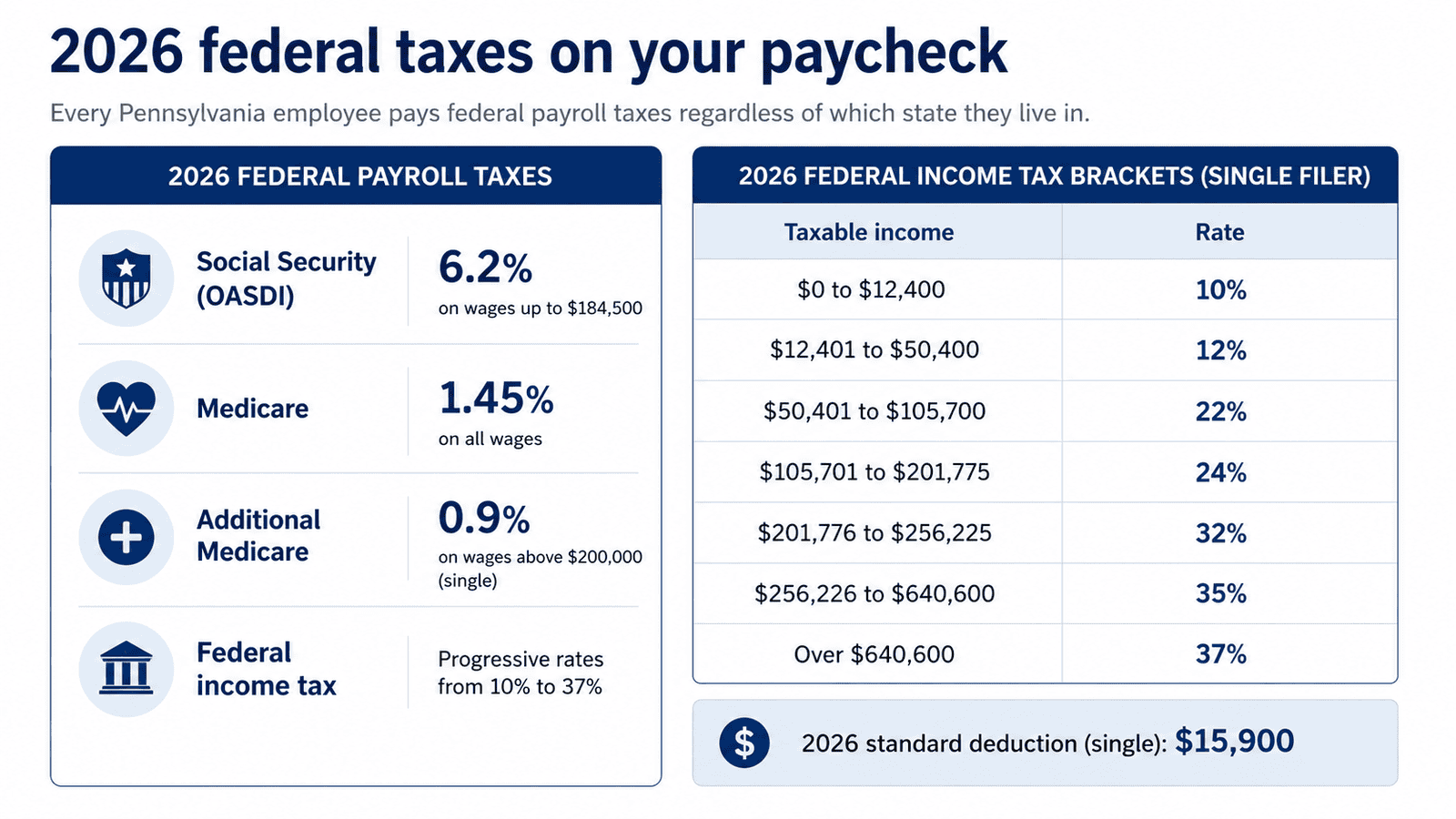
Every Pennsylvania employee pays federal payroll taxes regardless of which state they live in. For 2026, the key federal rates are listed below.
| Tax | 2026 rate |
|---|---|
| Social Security (OASDI) | 6.2% on wages up to $184,500 |
| Medicare | 1.45% on all wages |
| Additional Medicare | 0.9% on wages above $200,000 (single) |
| Federal income tax | Progressive rates from 10% to 37% |
The 2026 federal income tax brackets for a single filer, per IRS Rev. Proc. 2025-32, are shown below.
| Taxable income | Rate |
|---|---|
| $0 to $12,400 | 10% |
| $12,401 to $50,400 | 12% |
| $50,401 to $105,700 | 22% |
| $105,701 to $201,775 | 24% |
| $201,776 to $256,225 | 32% |
| $256,226 to $640,600 | 35% |
| Over $640,600 | 37% |
The 2026 standard deduction is $16,100 for single filers, $32,200 for married filing jointly, and $24,150 for head of household. Your taxable income equals gross wages minus the standard deduction (or itemized deductions if higher), and federal income tax is calculated on that amount using the progressive brackets above.
Source: IRS, tax inflation adjustments for tax year 2026, Rev. Proc. 2025-32. Social Security wage base per SSA 2026 announcement.
Pennsylvania state income tax explained
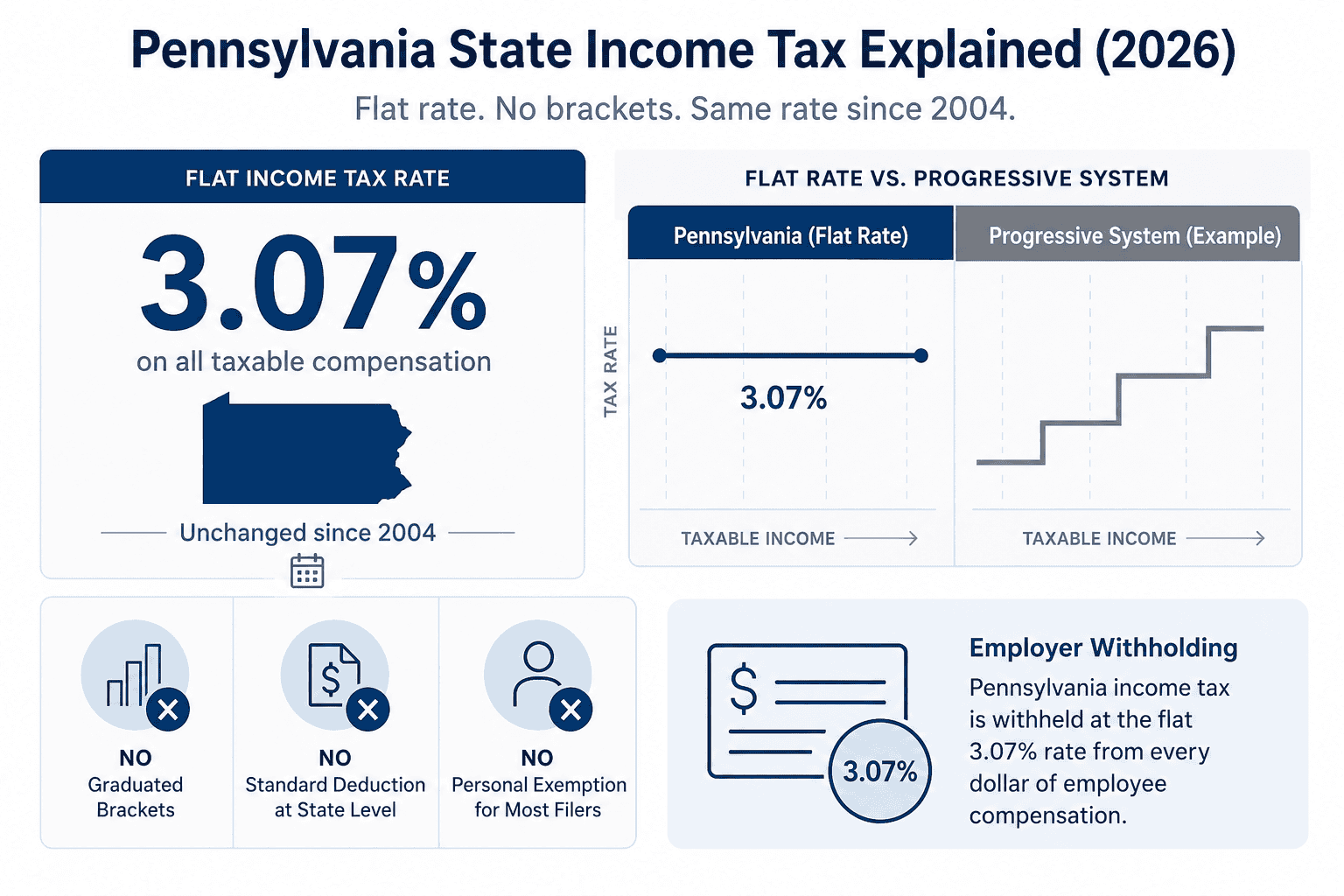
Pennsylvania is one of the few states that applies a flat income tax rather than a progressive bracket system. For 2026, the personal income tax rate is 3.07% on all taxable compensation. This rate has remained unchanged since 2004. There are no graduated brackets, no standard deduction at the state level, and no personal exemption for most filers. Employers withhold Pennsylvania income tax at the flat 3.07% rate from every dollar of employee compensation.
Source: Pennsylvania Department of Revenue, Tax Rates (2026).
Local payroll taxes in Pennsylvania
Although the state rate is flat and relatively low, many municipalities impose additional payroll taxes that can significantly affect take home pay. Common local taxes include the local Earned Income Tax (EIT), which most suburban communities set at around 1%, the Philadelphia Wage Tax at 3.75% for residents (approximately 3.44% for nonresidents working in the city) for 2026, and the Local Services Tax levied by many municipalities. Pittsburgh residents pay a local earned income tax of approximately 3%. These local taxes vary by where you live and work, so your actual paycheck may differ from estimates that exclude them.
Pennsylvania’s flat 3.07% state rate is among the lowest flat rates in the country, but local earned income taxes can add 1% to 3.75% on top of it depending on your municipality. Always check your specific local rate.
Worked examples: biweekly take home pay
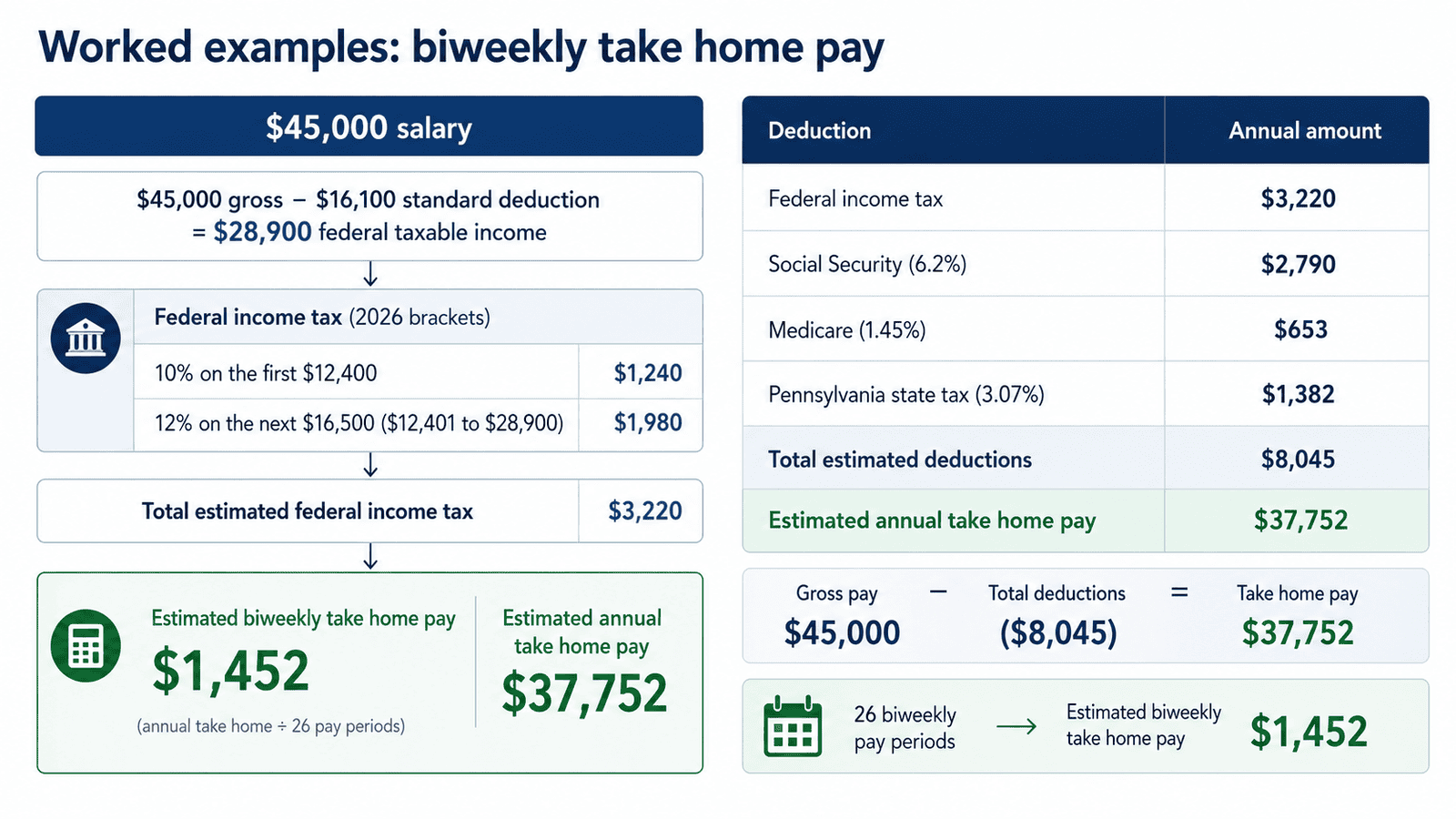
The following examples assume a single filer taking the 2026 federal standard deduction of $16,100, with no pre tax deductions, no overtime, no local payroll taxes, and 26 biweekly pay periods per year. All figures are estimates for educational purposes.
$45,000 salary
Federal income tax:
- 10% on the first $12,400 = $1,240
- 12% on the next $16,500 ($12,401 to $28,900) = $1,980
| Deduction | Annual amount |
|---|---|
| Federal income tax | $3,220 |
| Social Security (6.2%) | $2,790 |
| Medicare (1.45%) | $653 |
| Pennsylvania state tax (3.07%) | $1,382 |
| Estimated annual take home | $36,955 |
| Estimated biweekly paycheck | $1,421 |
$60,000 salary
Federal income tax:
- 10% on the first $12,400 = $1,240
- 12% on the next $31,500 ($12,401 to $43,900) = $3,780
| Deduction | Annual amount |
|---|---|
| Federal income tax | $5,020 |
| Social Security (6.2%) | $3,720 |
| Medicare (1.45%) | $870 |
| Pennsylvania state tax (3.07%) | $1,842 |
| Estimated annual take home | $48,548 |
| Estimated biweekly paycheck | $1,867 |
$85,000 salary
Federal income tax:
- 10% on the first $12,400 = $1,240
- 12% on the next $38,000 ($12,401 to $50,400) = $4,560
- 22% on the next $18,500 ($50,401 to $68,900) = $4,070
| Deduction | Annual amount |
|---|---|
| Federal income tax | $9,870 |
| Social Security (6.2%) | $5,270 |
| Medicare (1.45%) | $1,233 |
| Pennsylvania state tax (3.07%) | $2,610 |
| Estimated annual take home | $66,017 |
| Estimated biweekly paycheck | $2,539 |
All three examples exclude local earned income taxes, retirement contributions, and employer provided benefits. Adding a 1% local EIT would reduce each annual take home figure by the corresponding percentage of gross pay.
Hourly wages in Pennsylvania
The table below converts common hourly rates to estimated annual and biweekly take home pay, assuming 40 hours per week, 52 weeks per year, a single filer with the standard deduction, Pennsylvania’s 3.07% flat tax, and no local taxes or pre tax deductions.
| Hourly wage | Annual gross pay | Estimated annual take home | Estimated biweekly take home |
|---|---|---|---|
| $20 | $41,600 | $34,329 | $1,320 |
| $25 | $52,000 | $42,366 | $1,630 |
| $30 | $62,400 | $50,402 | $1,939 |
If you earn $25 per hour, see our detailed breakdown at $25 an hour: what does that pay look like?
How bonuses are taxed in Pennsylvania
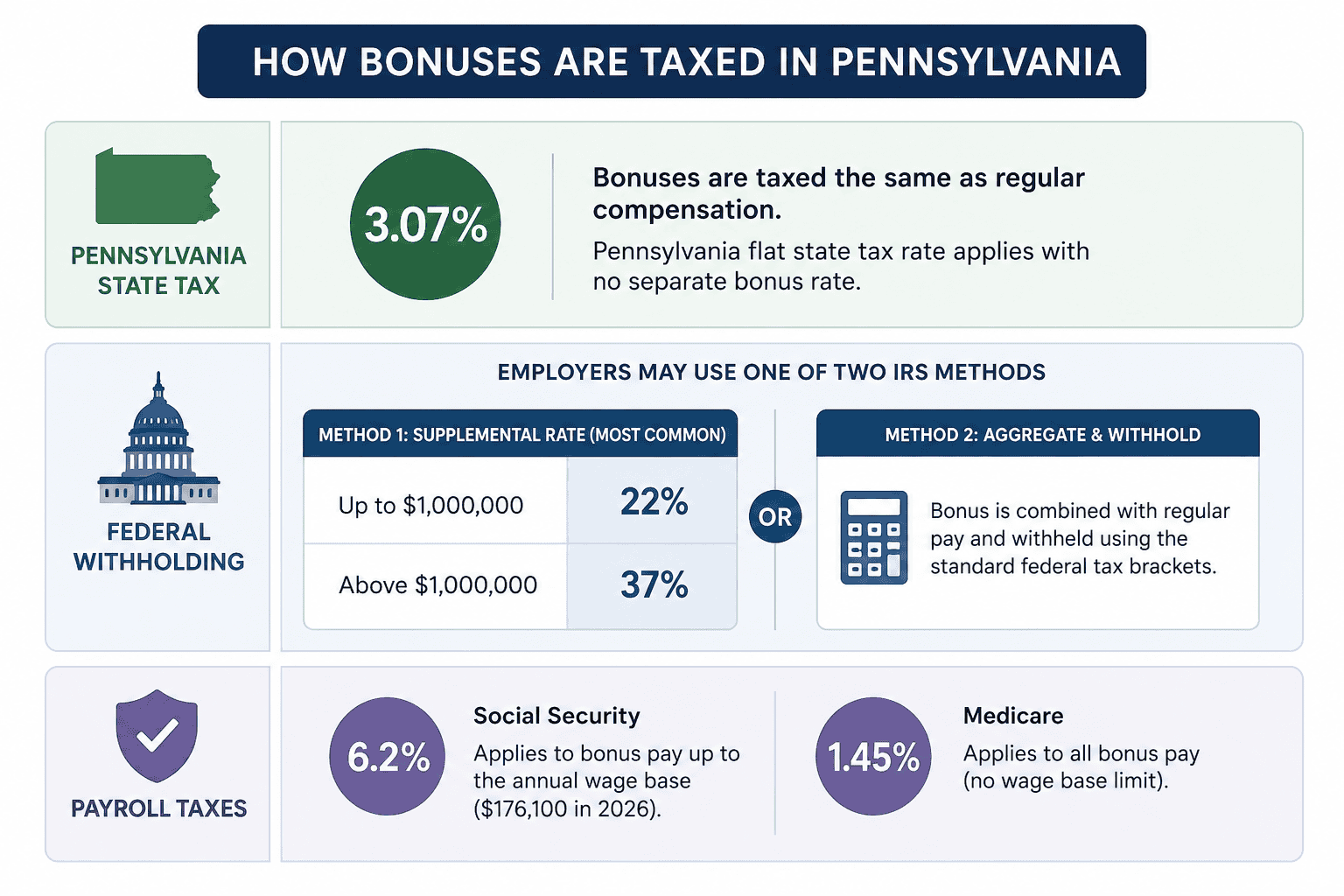
Pennsylvania treats bonus income the same as regular compensation for state tax purposes. The flat 3.07% rate applies to bonuses with no separate bonus rate at the state level.
For federal withholding, employers may use one of two IRS methods for supplemental wages such as bonuses. The most common approach is the flat 22% federal supplemental withholding rate on bonuses up to $1,000,000 in a calendar year. Amounts above $1,000,000 are withheld at 37%. Alternatively, employers may aggregate the bonus with your regular pay and withhold using the standard bracket method. Social Security and Medicare taxes also apply to bonus pay as long as the annual Social Security wage base ($184,500 for 2026) has not been reached.
A large bonus can temporarily increase your per paycheck withholding, but your final federal tax liability depends on your total annual taxable income. Any overwithholding is reconciled when you file your tax return.
Source: IRS Topic No. 751, Social Security and Medicare withholding rates; Pennsylvania Department of Revenue, Personal Income Tax (2026).
Effect of 401(k) and health insurance premiums
Contributing to a traditional 401(k) plan generally reduces your federal taxable wages, which lowers federal income tax withholding and increases take home pay on the federal side. However, 401(k) contributions do not reduce Social Security or Medicare taxes because FICA is calculated on gross compensation before elective deferrals.
Do not assume your 401(k) contribution lowers your Pennsylvania state tax. Pennsylvania generally does not exclude elective 401(k) salary deferrals from state taxable compensation. You will still owe the 3.07% state tax on those deferred dollars. This is one of the few states with this rule.
Eligible employer sponsored health insurance premiums paid through a Section 125 cafeteria plan typically reduce federal taxable income, Social Security wages, and Medicare wages. Treatment under Pennsylvania law depends on the specific benefit arrangement, but many cafeteria plan health premiums are also excluded from Pennsylvania taxable compensation.
For example, a $60,000 earner contributing $5,000 per year to a traditional 401(k) would reduce their federal taxable income to $38,900 ($60,000 minus $16,100 standard deduction minus $5,000 deferral), lowering estimated federal income tax from $5,020 to roughly $4,420. Pennsylvania state tax would remain at $1,842 because the state still taxes the full $60,000 of compensation.
Source: Pennsylvania Department of Revenue, Personal Income Tax (2026). Check the paycheck calculator pennsylvania before accepting a new job offer or negotiating your salary.
How Pennsylvania compares with neighboring states
Pennsylvania’s flat 3.07% rate is relatively straightforward compared to many of its neighbors, which use progressive income tax brackets and, in some cases, additional local income taxes.
| State | State income tax structure (2026) |
|---|---|
| Pennsylvania | Flat 3.07% |
| New York | Progressive, 4% to 10.9% |
| New Jersey | Progressive, 1.4% to 10.75% |
| Ohio | Progressive with local municipal income taxes |
| Maryland | Progressive with local county income taxes |
For workers earning between $45,000 and $85,000, Pennsylvania’s flat rate often results in a lower state income tax bill than New York or New Jersey, though Pennsylvania’s local earned income taxes can narrow the gap depending on municipality. Detailed breakdowns for each neighboring state are available in our paycheck calculator guides: A paycheck calculator pennsylvania can help estimate the impact of 401(k) contributions on take home pay.
- New York paycheck calculator
- New Jersey paycheck calculator
- Ohio paycheck calculator
- Maryland paycheck calculator
Frequently asked questions
How much is taken out of my paycheck in Pennsylvania?
Most Pennsylvania employees have federal income tax, Social Security (6.2%), Medicare (1.45%), and Pennsylvania’s flat 3.07% state income tax withheld from each paycheck. Many workers also pay a local earned income tax, typically around 1% in suburban areas and up to 3.75% for Philadelphia residents. The exact total depends on your gross pay, filing status, and municipality.
What is the Pennsylvania income tax rate in 2026?
Pennsylvania’s personal income tax rate is 3.07% for 2026. It is a flat statewide rate that applies to all taxable compensation regardless of income level. There are no progressive brackets. This rate has been in effect since 2004. Source: Pennsylvania Department of Revenue, Tax Rates.
How much is $60,000 a year after taxes in Pennsylvania?
For a single filer taking the 2026 federal standard deduction with no pre tax deductions and no local taxes, estimated take home pay on a $60,000 salary is approximately $48,548 per year, or about $1,867 per biweekly paycheck. This accounts for $5,020 in federal income tax, $3,720 in Social Security, $870 in Medicare, and $1,842 in Pennsylvania state income tax. Individual results will vary based on filing status, deductions, and local taxes.
How are bonuses taxed in Pennsylvania?
Pennsylvania taxes bonuses at the same flat 3.07% rate as regular wages. There is no separate state bonus tax rate. For federal purposes, employers commonly withhold at the 22% supplemental wage rate on bonuses up to $1,000,000. Social Security and Medicare taxes also apply to bonus pay.
How do 401(k) contributions change take home pay in Pennsylvania?
Traditional 401(k) contributions reduce your federal taxable income, which lowers federal income tax withholding and increases federal take home pay. However, Pennsylvania generally does not exclude elective 401(k) deferrals from state taxable compensation, so your Pennsylvania state tax remains the same. FICA taxes (Social Security and Medicare) are also calculated on gross wages before 401(k) deferrals. The paycheck calculator pennsylvania shows how state and federal taxes affect every paycheck.
Methodology
The estimates on this page and in the calculator above are based on the following sources and assumptions.
- 2026 federal income tax brackets, standard deductions, and FICA rates from IRS Rev. Proc. 2025-32 (published October 2025).
- 2026 Social Security wage base of $184,500 from the Social Security Administration (October 2025 announcement).
- Pennsylvania flat personal income tax rate of 3.07% from the Pennsylvania Department of Revenue (2026).
- Salary examples assume a single filer, the standard federal deduction, no pre tax deductions, no overtime, and no local payroll taxes.
- Biweekly figures use 26 pay periods per year (annual take home divided by 26).
- Hourly conversions use 40 hours per week and 52 weeks per year.
Actual paychecks can differ because of local earned income taxes, retirement contributions, health insurance premiums, payroll schedules, Form W 4 withholding elections, and employer payroll system settings. This page provides estimates only and does not replace a payroll calculation from your employer or a consultation with a tax professional.
This content is for educational purposes only and does not constitute personalized financial advice. Consult a qualified financial advisor for guidance specific to your situation.
By Nathan Whitmore for MoneyFN Use the paycheck calculator pennsylvania to compare take home pay for salary and hourly jobs.

Nathan Whitmore is a US based personal finance writer at MoneyFN covering salary, paycheck, and tax math for American workers. He works from primary sources only: IRS revenue procedures, Bureau of Labor Statistics wage data, and Federal Reserve statistics. Every figure he publishes is dated and traceable to a public source.