

Our paycheck calculator wisconsin helps you estimate your 2026 take home pay after federal income tax, Wisconsin state income tax, and FICA withholding. Wisconsin uses a progressive income tax system with four brackets ranging from 3.50% to 7.65%. A single filer earning $60,000 typically takes home about $47,890 per year, or roughly $1,842 per biweekly paycheck, and there are no local or city payroll taxes anywhere in the state.
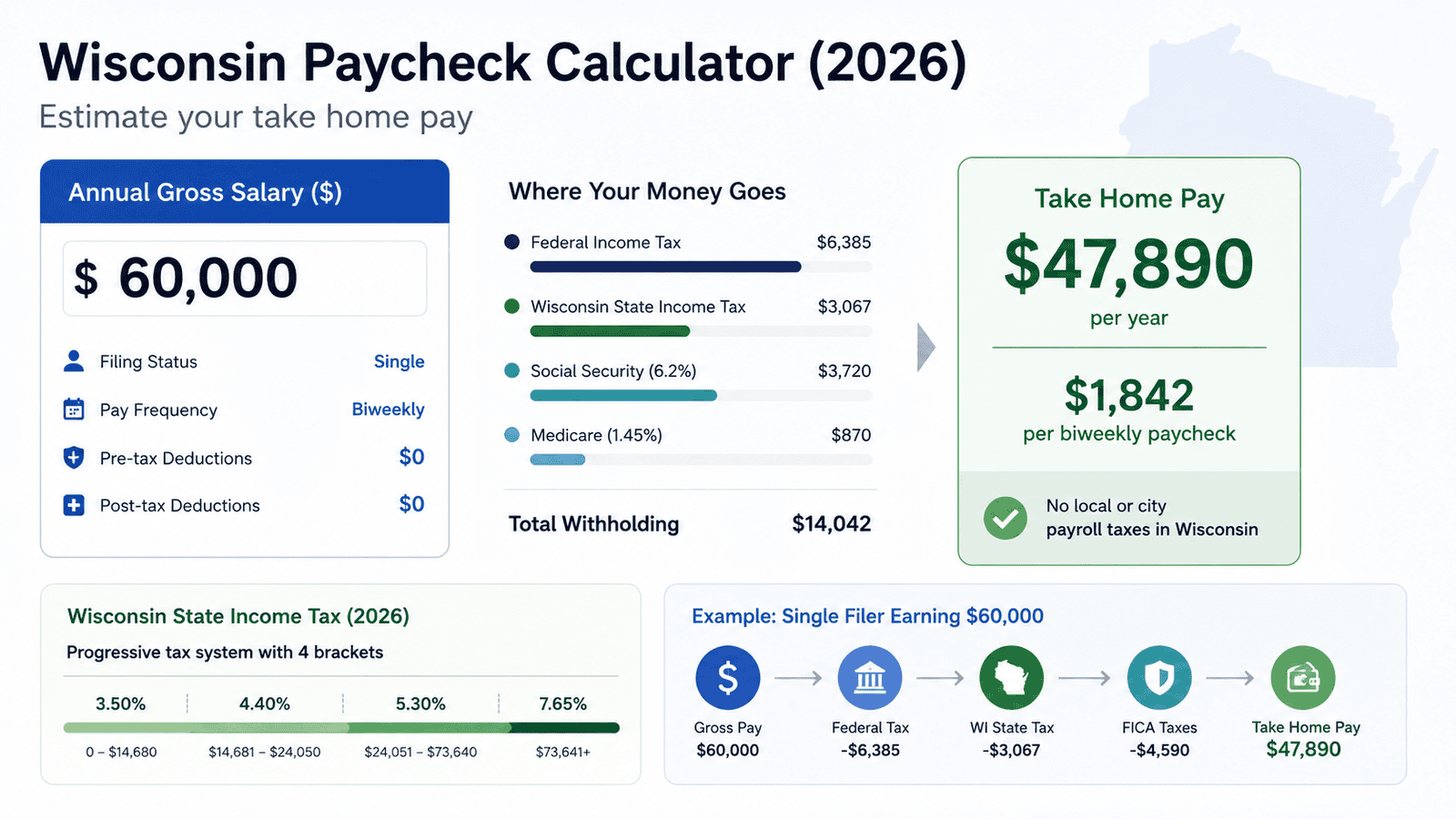
Paycheck calculator wisconsin: Wisconsin paycheck calculator
Use the calculator above for a quick estimate, or try the full MoneyFN salary after tax calculator for additional filing statuses and deduction options. The sections below explain every line item that reduces your Wisconsin paycheck.
How the paycheck calculator works
A paycheck calculator estimates your net (take home) pay by subtracting all mandatory taxes and any voluntary pre-tax deductions from your gross earnings. To produce an accurate estimate, you need four key inputs.
Gross pay is the total amount your employer pays you before any deductions. This can be entered as an annual salary or an hourly rate. If you enter an hourly rate, the calculator multiplies it by your expected weekly hours and then by the number of pay periods in the year.
Pay frequency determines how often you receive a paycheck and affects how your annual taxes are distributed across each pay period. The most common frequencies are weekly (52 paychecks per year), biweekly (26 paychecks), semimonthly (24 paychecks), and monthly (12 paychecks).
Filing status controls which set of federal and Wisconsin state tax brackets apply to your income and determines the size of your standard deduction. Single, married filing jointly, married filing separately, and head of household are the standard options.
Pre-tax deductions include contributions to a 401(k), 403(b), traditional IRA, health savings account (HSA), and employer sponsored health insurance premiums. These reduce your taxable income before federal and state income taxes are calculated, which lowers your tax bill and increases your take home pay.
2026 federal taxes on your paycheck
Every wage earner in the United States pays federal income tax and FICA payroll taxes, regardless of state. For tax year 2026, the IRS maintained seven marginal tax brackets at the same rates established under the Tax Cuts and Jobs Act, now made permanent by the One Big Beautiful Bill Act. The 2026 inflation adjustments were published in IRS Revenue Procedure 2025-32.
2026 federal income tax brackets for single filers
| Taxable income | Rate |
|---|---|
| $0 to $12,400 | 10% |
| $12,401 to $50,400 | 12% |
| $50,401 to $105,700 | 22% |
| $105,701 to $201,775 | 24% |
| $201,776 to $256,225 | 32% |
| $256,226 to $640,600 | 35% |
| Over $640,600 | 37% |
Source: IRS Revenue Procedure 2025-32, effective for tax year 2026.
2026 federal income tax brackets for married filing jointly
| Taxable income | Rate |
|---|---|
| $0 to $24,800 | 10% |
| $24,801 to $100,800 | 12% |
| $100,801 to $211,400 | 22% |
| $211,401 to $403,550 | 24% |
| $403,551 to $512,450 | 32% |
| $512,451 to $768,700 | 35% |
| Over $768,700 | 37% |
Source: IRS Revenue Procedure 2025-32.
The 2026 federal standard deduction is $16,100 for single filers and $32,200 for married filing jointly (IRS Rev. Proc. 2025-32). Your standard deduction is subtracted from gross income before the bracket rates are applied.
FICA payroll taxes in 2026
FICA taxes fund Social Security and Medicare. For 2026, the employee share is 6.2% for Social Security on wages up to the $184,500 wage base, plus 1.45% for Medicare on all wages with no cap (IRS Publication 926, 2026 edition). Workers earning above $200,000 (single) also pay an additional 0.9% Medicare tax on wages exceeding that threshold. Your employer pays a matching amount on top of what is deducted from your paycheck.
Wisconsin state income tax explained
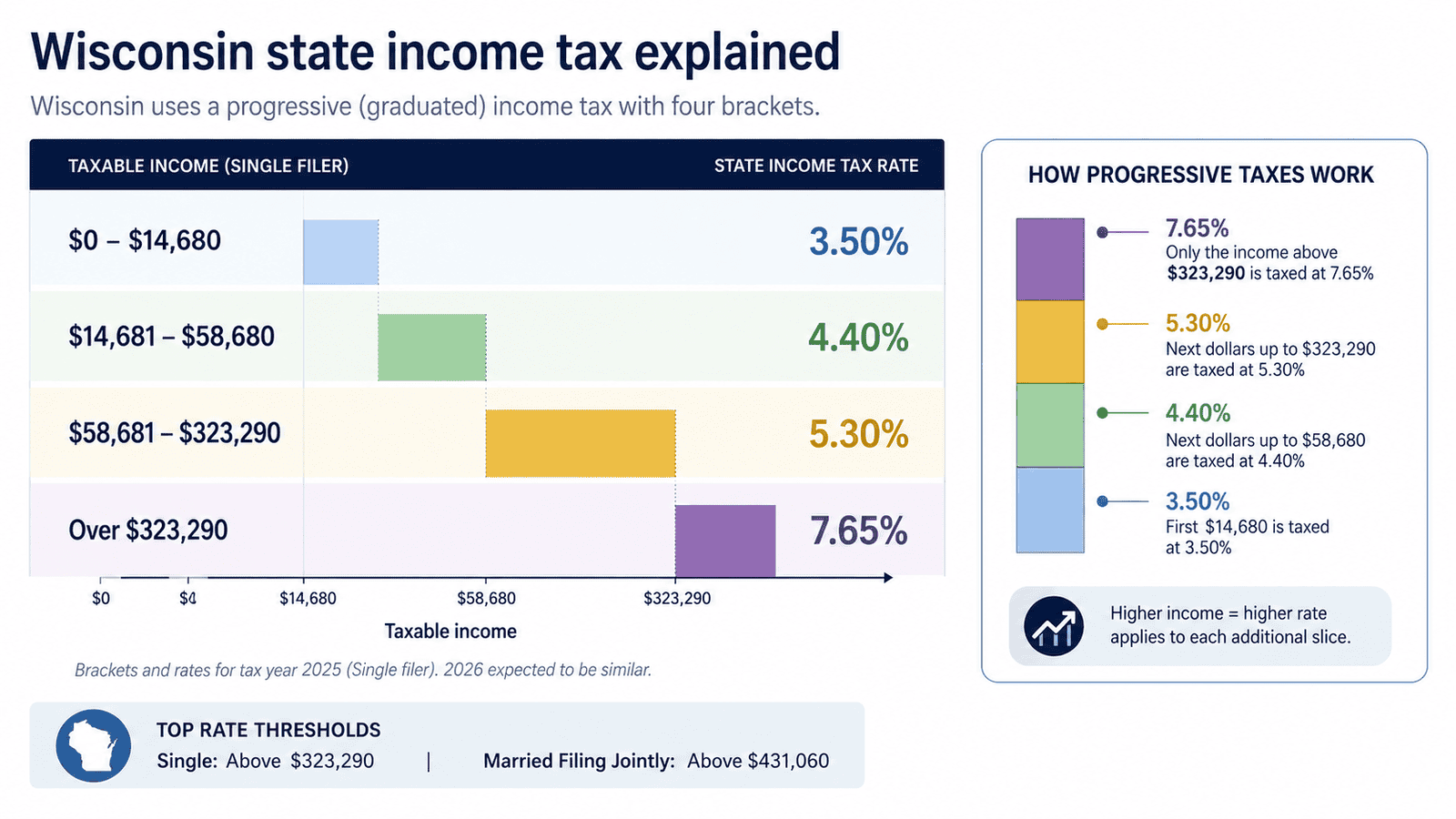
Wisconsin levies a progressive (graduated) state income tax with four brackets. Unlike flat tax states such as neighboring Michigan, Wisconsin taxes higher slices of income at higher rates. The four rates are 3.50%, 4.40%, 5.30%, and 7.65%, with the top rate applying only to income above $323,290 for single filers or $431,060 for married filing jointly (Wisconsin Department of Revenue, published January 16, 2026, for tax year 2025; 2026 brackets are expected to be similar with minor inflation adjustments and had not been separately published by the DOR at the time of writing).
Wisconsin income tax brackets for single filers
| Taxable income | Rate |
|---|---|
| $0 to $14,680 | 3.50% |
| $14,681 to $50,480 | 4.40% |
| $50,481 to $323,290 | 5.30% |
| Over $323,290 | 7.65% |
Wisconsin income tax brackets for married filing jointly
| Taxable income | Rate |
|---|---|
| $0 to $19,580 | 3.50% |
| $19,581 to $67,300 | 4.40% |
| $67,301 to $431,060 | 5.30% |
| Over $431,060 | 7.65% |
Source: Wisconsin Department of Revenue, Tax Rates page (revenue.wi.gov), updated January 16, 2026.
Wisconsin has its own standard deduction, separate from the federal amount. For 2026, the maximum Wisconsin standard deduction is approximately $12,760 for single filers and $23,620 for married filing jointly. However, Wisconsin uses a sliding scale that phases out the standard deduction as income increases. For single filers, the phase out begins at roughly $18,950 of income. By the time a single filer earns $50,000 or more, the Wisconsin standard deduction is substantially reduced. This phase out effectively makes the Wisconsin income tax more progressive than the brackets alone suggest.
Wisconsin does not impose any local or city income taxes on wages. There is no payroll tax at the county or municipal level, so the only state level deduction from your paycheck is the Wisconsin state income tax.
Worked examples: biweekly take home pay in Wisconsin
The examples below show estimated biweekly take home pay for three common salary levels. All examples assume a single filer with no dependents, no pre-tax deductions such as 401(k) or health insurance, and paid biweekly (26 pay periods per year). Wisconsin state tax figures are approximate because the sliding scale standard deduction varies by income level.
$45,000 annual salary
The first $12,400 is taxed at 10% ($1,240) and the remaining $16,500 is taxed at 12% ($1,980), totaling $3,220 in federal income tax. The Wisconsin state income tax of approximately $1,700 reflects the partially phased out state standard deduction and the 3.50% and 4.40% bracket rates on the resulting state taxable income.
| Item | Annual | Biweekly |
|---|---|---|
| Gross pay | $45,000 | $1,730.77 |
| Federal income tax | $3,220 | $123.85 |
| Social Security (6.2%) | $2,790 | $107.31 |
| Medicare (1.45%) | $652 | $25.08 |
| Wisconsin state income tax | $1,700 | $65.38 |
| Total deductions | $8,362 | $321.62 |
| Estimated take home pay | $36,638 | $1,409.15 |
$60,000 annual salary
The first $12,400 is taxed at 10% ($1,240) and the remaining $31,500 is taxed at 12% ($3,780), for a total of $5,020. The Wisconsin state tax of approximately $2,500 reflects the heavily phased out state standard deduction at this income level and rates in the 3.50% and 4.40% brackets.
| Item | Annual | Biweekly |
|---|---|---|
| Gross pay | $60,000 | $2,307.69 |
| Federal income tax | $5,020 | $193.08 |
| Social Security (6.2%) | $3,720 | $143.08 |
| Medicare (1.45%) | $870 | $33.46 |
| Wisconsin state income tax | $2,500 | $96.15 |
| Total deductions | $12,110 | $465.77 |
| Estimated take home pay | $47,890 | $1,841.92 |
$60,000 a year after taxes in Wisconsin is approximately $47,890 for a single filer with no pre-tax deductions, which works out to about $1,842 per biweekly paycheck.
$85,000 annual salary
The tax is calculated as 10% on the first $12,400 ($1,240), plus 12% on the next $38,000 ($4,560), plus 22% on the remaining $18,500 ($4,070), totaling $9,870. The Wisconsin state tax of approximately $3,800 reflects rates in the 3.50%, 4.40%, and 5.30% brackets, with the state standard deduction nearly eliminated by the phase out at this income level.
| Item | Annual | Biweekly |
|---|---|---|
| Gross pay | $85,000 | $3,269.23 |
| Federal income tax | $9,870 | $379.62 |
| Social Security (6.2%) | $5,270 | $202.69 |
| Medicare (1.45%) | $1,233 | $47.42 |
| Wisconsin state income tax | $3,800 | $146.15 |
| Total deductions | $20,173 | $775.88 |
| Estimated take home pay | $64,827 | $2,493.35 |
Hourly wages in Wisconsin: what $20, $25, and $30 an hour take home
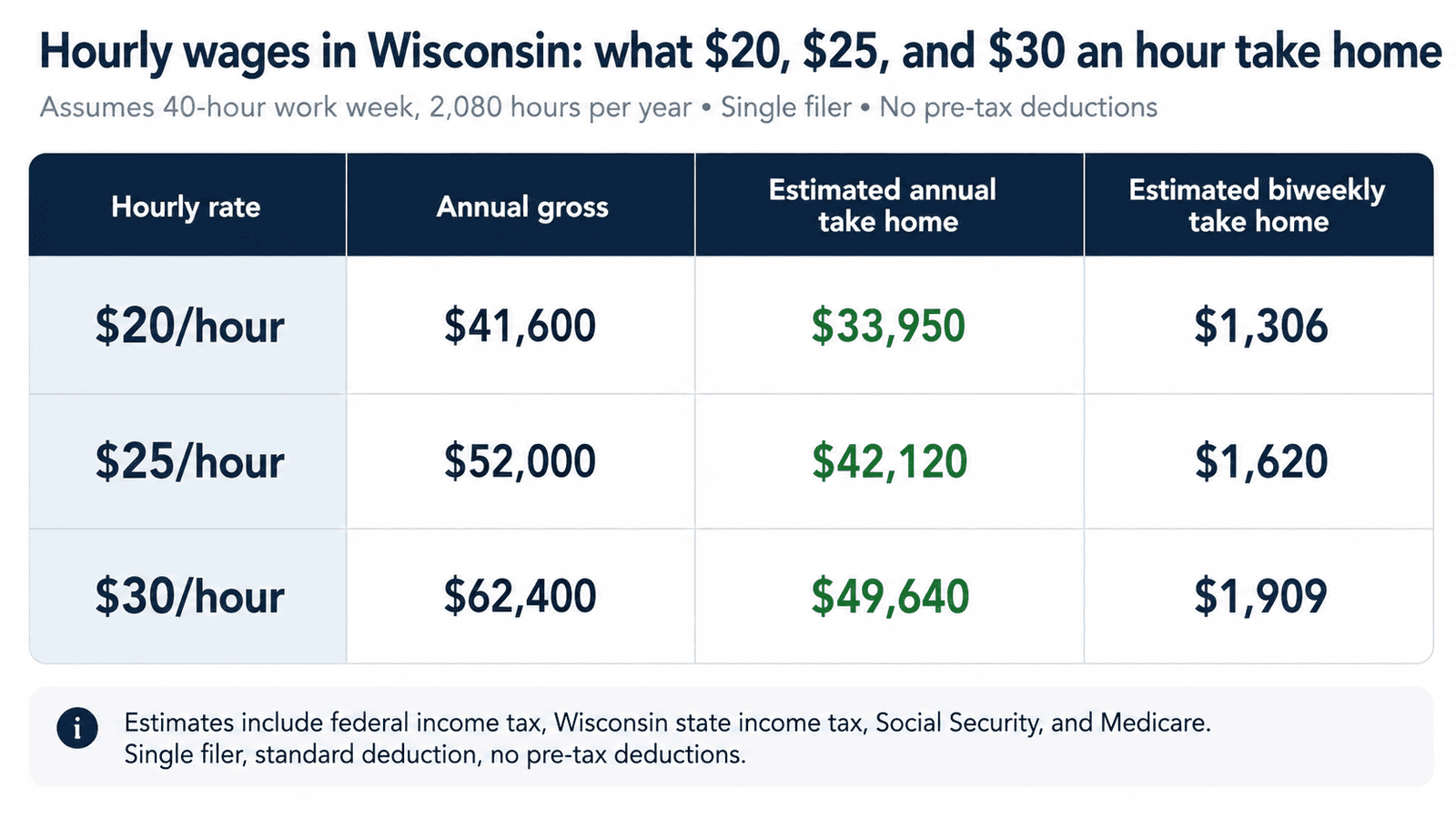
If you are paid hourly in Wisconsin, your annual gross pay depends on how many hours you work each week. The estimates below assume a standard 40 hour work week and 2,080 hours per year, with a single filing status and no pre-tax deductions.
| Hourly rate | Annual gross | Estimated annual take home | Estimated biweekly take home |
|---|---|---|---|
| $20/hour | $41,600 | $33,950 | $1,306 |
| $25/hour | $52,000 | $42,120 | $1,620 |
| $30/hour | $62,400 | $49,640 | $1,909 |
Estimates include federal income tax, Wisconsin state income tax, Social Security, and Medicare. Single filer, standard deduction, no pre-tax deductions.
Workers earning $25 an hour take home roughly $1,620 per biweekly paycheck in Wisconsin after all taxes. Overtime pay, if applicable, is taxed at the same rates but may push more of your income into a higher bracket for that pay period.
How bonuses are taxed in Wisconsin
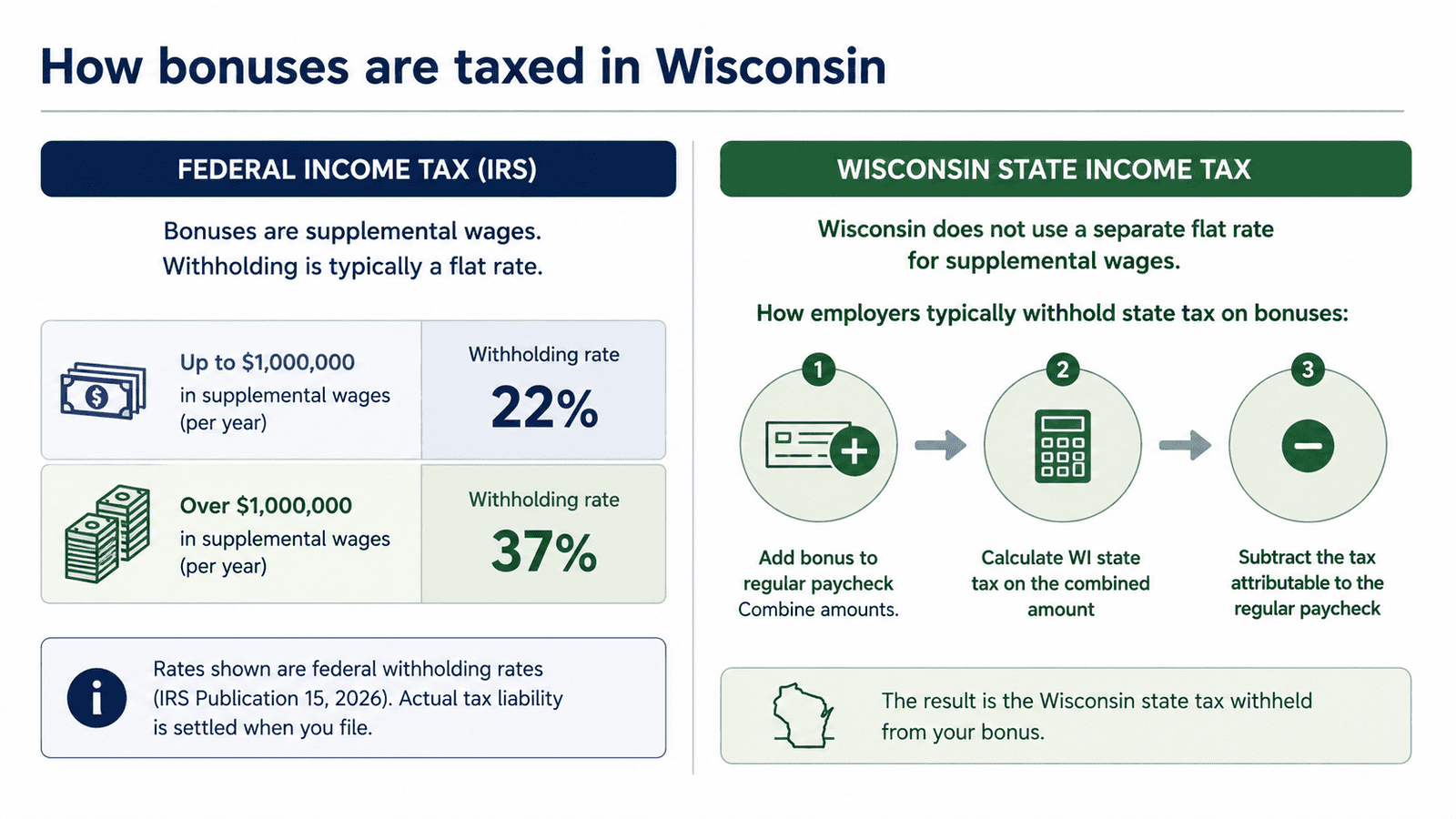
Bonuses are considered supplemental wages by the IRS. When your employer pays a bonus separately from your regular paycheck, federal income tax is typically withheld at a flat 22% rate (IRS Publication 15, 2026). If your total supplemental wages for the year exceed $1,000,000, the federal withholding rate on the excess is 37%.
Wisconsin also withholds state income tax on bonuses. The state does not have a separate flat withholding rate for supplemental wages the way the federal system does. Instead, Wisconsin employers may withhold state tax on bonuses by adding the bonus to a regular paycheck and calculating the tax on the combined amount, then subtracting the tax already withheld on the regular pay alone. This aggregate method can result in higher withholding on the bonus portion because the combined amount may push income into a higher state bracket for that pay period.
It is important to understand that bonus withholding is not the same as the actual tax owed. When you file your Wisconsin and federal tax returns, your bonus income is combined with all other income and taxed at your actual marginal rates. If too much was withheld from your bonus, you will receive the difference back as a refund. If too little was withheld, you will owe the balance.
For a quick estimate, a $5,000 bonus for a single filer in Wisconsin might see roughly $1,100 withheld for federal tax (22%), $265 withheld for Wisconsin state tax (approximately 5.3% marginal rate for middle income earners), $310 for Social Security (6.2%), and $72.50 for Medicare (1.45%). That leaves approximately $3,253 in hand from a $5,000 bonus, though the final amount depends on your total annual income and filing status.
Effect of 401(k) and health insurance premiums on take home pay
Contributing to a traditional 401(k) or paying for employer sponsored health insurance premiums reduces your taxable income before federal and Wisconsin state income taxes are calculated. This is one of the most effective ways to increase your take home pay per dollar spent, because each dollar you contribute avoids both federal and state income tax.
FICA taxes (Social Security and Medicare) are still calculated on your gross pay before 401(k) deductions for most employer plans, so your 401(k) contributions do not reduce your FICA obligation. Health insurance premiums paid through a Section 125 cafeteria plan, on the other hand, are typically excluded from both income tax and FICA.
Here is how a 6% traditional 401(k) contribution affects take home pay for a $60,000 single filer in Wisconsin:
| Item | Without 401(k) | With 6% 401(k) |
|---|---|---|
| Gross pay | $60,000 | $60,000 |
| 401(k) contribution | $0 | $3,600 |
| Federal taxable income | $43,900 | $40,300 |
| Federal income tax | $5,020 | $4,588 |
| Wisconsin state income tax | $2,500 | $2,310 |
| FICA (SS + Medicare) | $4,590 | $4,590 |
| Total deductions (taxes + 401k) | $12,110 | $15,088 |
| Take home pay (cash in hand) | $47,890 | $44,912 |
| Total compensation (take home + retirement) | $47,890 | $48,512 |
In this example, the $3,600 annual 401(k) contribution reduces take home cash by about $2,978, because $622 of the contribution is offset by tax savings ($432 in federal savings and approximately $190 in Wisconsin state tax savings). Put another way, each dollar contributed to the 401(k) only reduces take home pay by about $0.83, while the full dollar goes into your retirement account. The savings are even larger for workers in higher tax brackets. Check the paycheck calculator wisconsin before accepting a new job offer to estimate your expected paycheck.
How Wisconsin compares with neighboring states
Wisconsin shares borders with Illinois, Minnesota, Michigan, and Iowa. Each state handles income tax differently, which affects the size of your paycheck.
| State | Income tax structure | Top marginal rate | Local payroll taxes |
|---|---|---|---|
| Wisconsin | Progressive (4 brackets) | 7.65% | None |
| Illinois | Flat rate | 4.95% | None statewide |
| Minnesota | Progressive (4 brackets) | 9.85% | None |
| Michigan | Flat rate | 4.25% | Some city taxes |
| Iowa | Progressive (4 brackets) | 5.70% | None |
Wisconsin’s top rate of 7.65% is higher than the flat rates in Illinois (4.95%) and Michigan (4.25%), and also higher than Iowa’s top rate of 5.70%. However, Wisconsin’s top rate only applies to taxable income above $323,290 for single filers. For most middle income earners, the effective Wisconsin state rate falls in the 4% to 5% range, which is more comparable to its neighbors. Minnesota is the only bordering state with a higher top rate at 9.85%.
Michigan is notable because several cities, including Detroit and Grand Rapids, levy their own local income taxes on top of the state rate. Wisconsin has no such local income taxes, which simplifies paycheck calculations for workers across the state. Our paycheck calculator wisconsin also helps you see how hourly wages translate into annual take home pay.
Frequently asked questions
How much is taken out of my paycheck in Wisconsin?
Your Wisconsin paycheck is reduced by federal income tax (10% to 37% marginal rates), Wisconsin state income tax (3.50% to 7.65%), Social Security tax (6.2% on wages up to $184,500 in 2026), and Medicare tax (1.45% on all wages). For a single filer earning $60,000 with no pre-tax deductions, total deductions are approximately $12,110, or about 20.2% of gross pay. Your actual percentage depends on your filing status, income, and any pre-tax deductions you make.
What is the Wisconsin income tax rate in 2026?
Wisconsin uses a progressive income tax with four brackets: 3.50%, 4.40%, 5.30%, and 7.65%. The rates are the same for all filing statuses, but the income thresholds for each bracket differ depending on whether you file as single, married filing jointly, or married filing separately. These rates are published by the Wisconsin Department of Revenue. The 2026 bracket thresholds may be slightly adjusted for inflation from the 2025 figures, but the rates themselves have remained stable.
How much is $60,000 a year after taxes in Wisconsin?
A single filer earning $60,000 in Wisconsin with no pre-tax deductions can expect approximately $47,890 in annual take home pay after federal income tax, Wisconsin state income tax, Social Security, and Medicare. That works out to roughly $1,842 per biweekly paycheck or $3,991 per month.
How are bonuses taxed in Wisconsin?
At the federal level, bonuses are withheld at a flat 22% when paid separately from regular wages (IRS Publication 15). Wisconsin does not have a separate flat withholding rate for bonuses. Instead, employers typically use the aggregate method, combining the bonus with regular pay to calculate withholding. Regardless of how taxes are withheld during the year, your actual tax liability on the bonus is determined when you file your annual federal and state returns based on your total income and applicable tax brackets.
Does Wisconsin have local or city income taxes?
No. Wisconsin does not impose any local or city income taxes on wages. The only state level tax deducted from your paycheck is the Wisconsin state income tax. This is different from neighboring Michigan, where some cities levy their own income taxes on residents and nonresidents who work within city limits.
Is the Wisconsin standard deduction the same as the federal standard deduction?
No. Wisconsin has its own standard deduction that is separate from the federal amount. For 2026, the maximum Wisconsin standard deduction is approximately $12,760 for single filers and $23,620 for married filing jointly. However, Wisconsin uses a sliding scale that reduces the standard deduction as income rises, starting at approximately $18,950 for single filers. At higher incomes, the Wisconsin standard deduction may be reduced to near zero. The federal standard deduction for 2026 is $16,100 for single filers and $32,200 for married filing jointly, with no similar phase out for most taxpayers. The paycheck calculator wisconsin estimates your net pay after federal, state, and FICA payroll taxes.
Methodology
The estimates in this article are based on 2026 federal income tax brackets and standard deductions from IRS Revenue Procedure 2025-32, FICA rates and the Social Security wage base from IRS Publication 926 (2026 edition), and Wisconsin state income tax brackets and rates from the Wisconsin Department of Revenue (revenue.wi.gov, updated January 16, 2026). Wisconsin state tax estimates are approximate due to the sliding scale standard deduction, which varies by income level and filing status. All examples assume single filing status, one job, no dependents, no itemized deductions, and no tax credits. Actual take home pay will vary based on your W-4 elections, pre-tax deductions, additional income sources, and applicable tax credits.
For a personalized estimate, use the MoneyFN salary after tax calculator.
This content is for educational purposes only and does not constitute personalized financial advice. Consult a qualified financial advisor for guidance specific to your situation.
By Nathan Whitmore for MoneyFN Use the paycheck calculator wisconsin to compare take home pay across different salaries and pay frequencies.

Nathan Whitmore is a US based personal finance writer at MoneyFN covering salary, paycheck, and tax math for American workers. He works from primary sources only: IRS revenue procedures, Bureau of Labor Statistics wage data, and Federal Reserve statistics. Every figure he publishes is dated and traceable to a public source.