

18 dollars an hour is how much a year? At $18 per hour, you earn $37,440 per year before taxes if you work 40 hours a week for all 52 weeks. A single filer claiming the 2026 standard deduction can expect an estimated take-home pay of about $32,263 per year, though your actual paycheck will vary based on state taxes, filing status, pre-tax deductions, overtime, and hours worked.
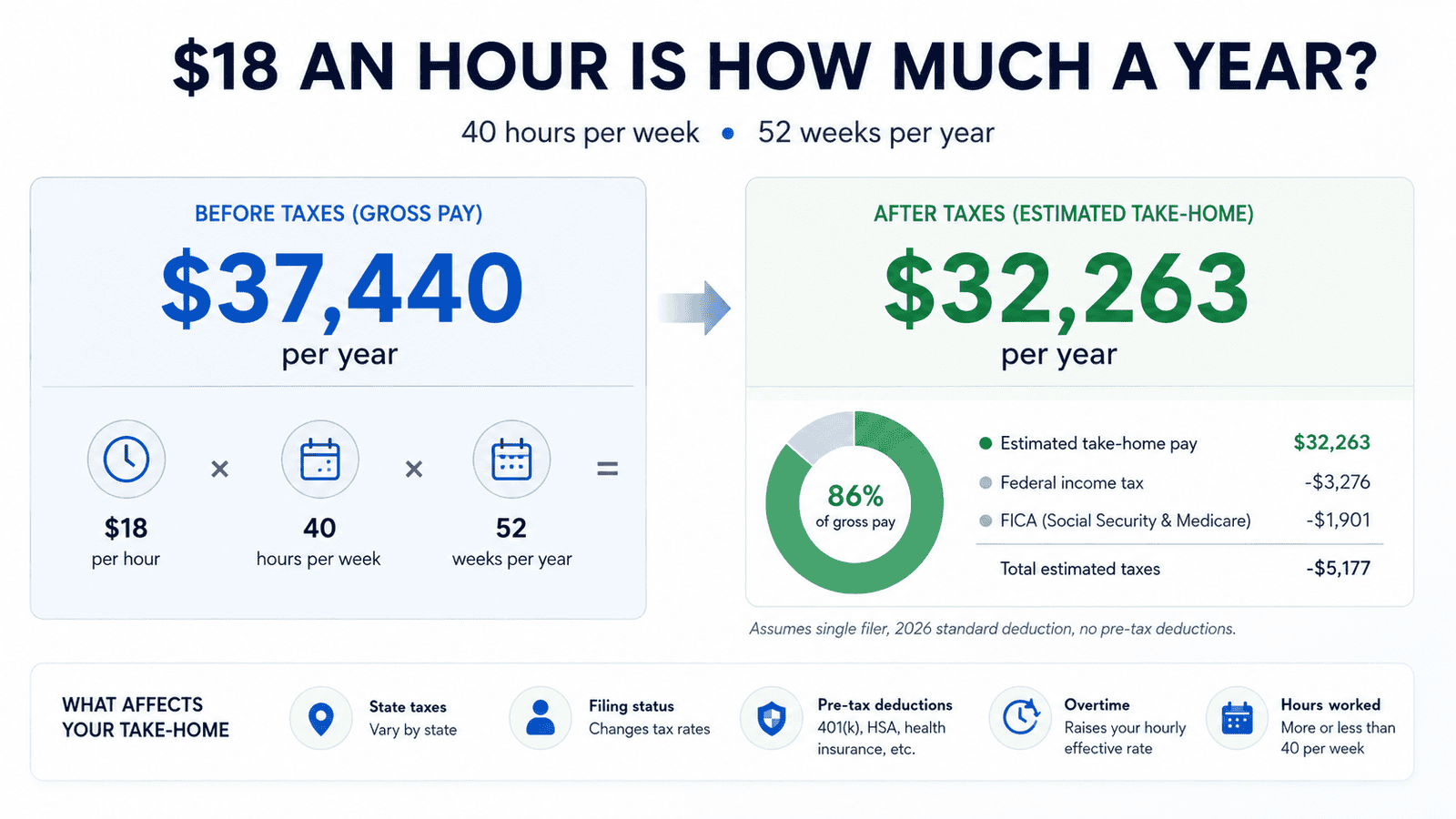
18 dollars an hour is how much a year: $18 an hour salary calculator
The math behind $18 an hour to yearly salary
Converting an hourly wage to an annual salary requires two numbers: the hours you work each week and the number of weeks you work each year. The standard calculation used by the Bureau of Labor Statistics and most employers is 40 hours per week multiplied by 52 weeks per year, which equals 2,080 paid hours annually.
The 2,080 hour figure is the benchmark for a full time salaried position in the United States. It assumes no unpaid time off. If your employer offers paid vacation and paid holidays, your annual gross pay remains $37,440 because you are compensated for those hours even when you are not working. If you take unpaid time off, your actual earnings will be lower.
$18 an hour broken down by pay period
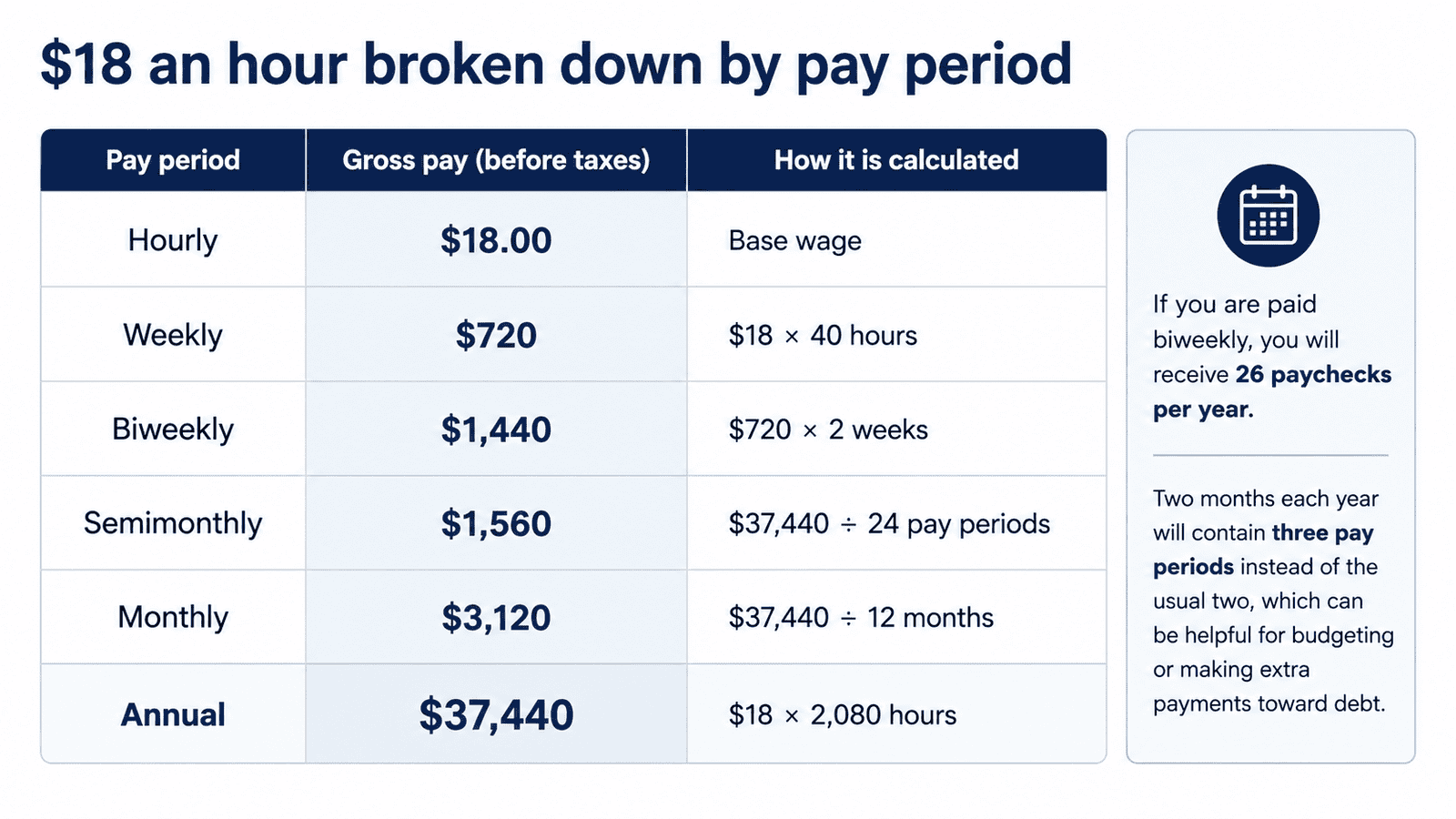
The table below shows what 18 dollars an hour is how much a year, per month, biweekly, and weekly before any taxes are withheld.
| Pay period | Gross pay (before taxes) | How it is calculated |
|---|---|---|
| Hourly | $18.00 | Base wage |
| Weekly | $720 | $18 × 40 hours |
| Biweekly | $1,440 | $720 × 2 weeks |
| Semimonthly | $1,560 | $37,440 ÷ 24 pay periods |
| Monthly | $3,120 | $37,440 ÷ 12 months |
| Annual | $37,440 | $18 × 2,080 hours |
If you are paid biweekly, you will receive 26 paychecks per year. Two months each year will contain three pay periods instead of the usual two, which can be helpful for budgeting or making extra payments toward debt.
You can also use our hourly to salary calculator to run these conversions with your own numbers.
What $18 an hour looks like after federal taxes in 2026
The gross annual figure of $37,440 is only part of the picture. Federal income tax and FICA payroll taxes reduce your take home pay significantly. The estimate below assumes a single filer with no dependents, taking the standard deduction, and with no other income or pretax deductions.
2026 standard deduction
For the 2026 tax year, the standard deduction for a single filer is $16,100 (IRS Revenue Procedure 2025‑32, published October 2025). This amount is subtracted from gross income before tax brackets are applied.
2026 federal income tax brackets (single filer)
The seven federal income tax rates remain 10%, 12%, 22%, 24%, 32%, 35%, and 37% for the 2026 tax year (IRS Revenue Procedure 2025‑32). For a single filer, the first two brackets apply to a taxable income of $21,340.
FICA taxes in 2026
FICA consists of two components withheld from every paycheck (IRS Topic No. 751, updated for 2026).
Social Security tax: 6.2% of gross wages up to the 2026 wage base of $184,500. On $37,440 of earnings, this equals $2,321.
Medicare tax: 1.45% of all gross wages with no cap. On $37,440, this equals $543.
Estimated total federal tax burden
| Tax type | Estimated annual amount |
|---|---|
| Federal income tax | $2,313 |
| Social Security (6.2%) | $2,321 |
| Medicare (1.45%) | $543 |
| Total federal taxes | $5,177 |
| After tax annual income | $32,263 |
| After tax monthly income | $2,689 |
This estimate does not include state income tax, local taxes, or any pretax deductions like health insurance premiums or retirement contributions. Figures are rounded to the nearest dollar.
For a full state by state walkthrough, see our companion article on $18 an hour after taxes. If you live in Texas, which has no state income tax, you can estimate your paycheck using our Texas paycheck calculator.
$18 an hour working part time
Not everyone works a full 40 hour week. Below is what $18 an hour looks like at two common part time schedules.
30 hours per week
Monthly gross pay at this schedule is approximately $2,340.
35 hours per week
Monthly gross pay at this schedule is approximately $2,730.
Working 30 hours instead of 40 reduces your annual income by $9,360, a 25% reduction. If you are considering part time work, factor in whether your employer offers benefits like health insurance at reduced hours, since losing those benefits may cost more than the wage difference suggests.
How overtime changes $18 an hour
Under the Fair Labor Standards Act, non exempt employees must receive overtime pay at 1.5 times their regular rate for any hours worked beyond 40 in a single workweek. At $18 an hour, your overtime rate is $27 per hour.
If you consistently work 45 hours per week (40 regular hours plus 5 overtime hours), your weekly pay increases from $720 to $855.
That is $7,020 more per year than the standard 40 hour schedule. Even a few hours of weekly overtime can meaningfully increase your annual income at this wage level.
Is $18 an hour a good wage in 2026?
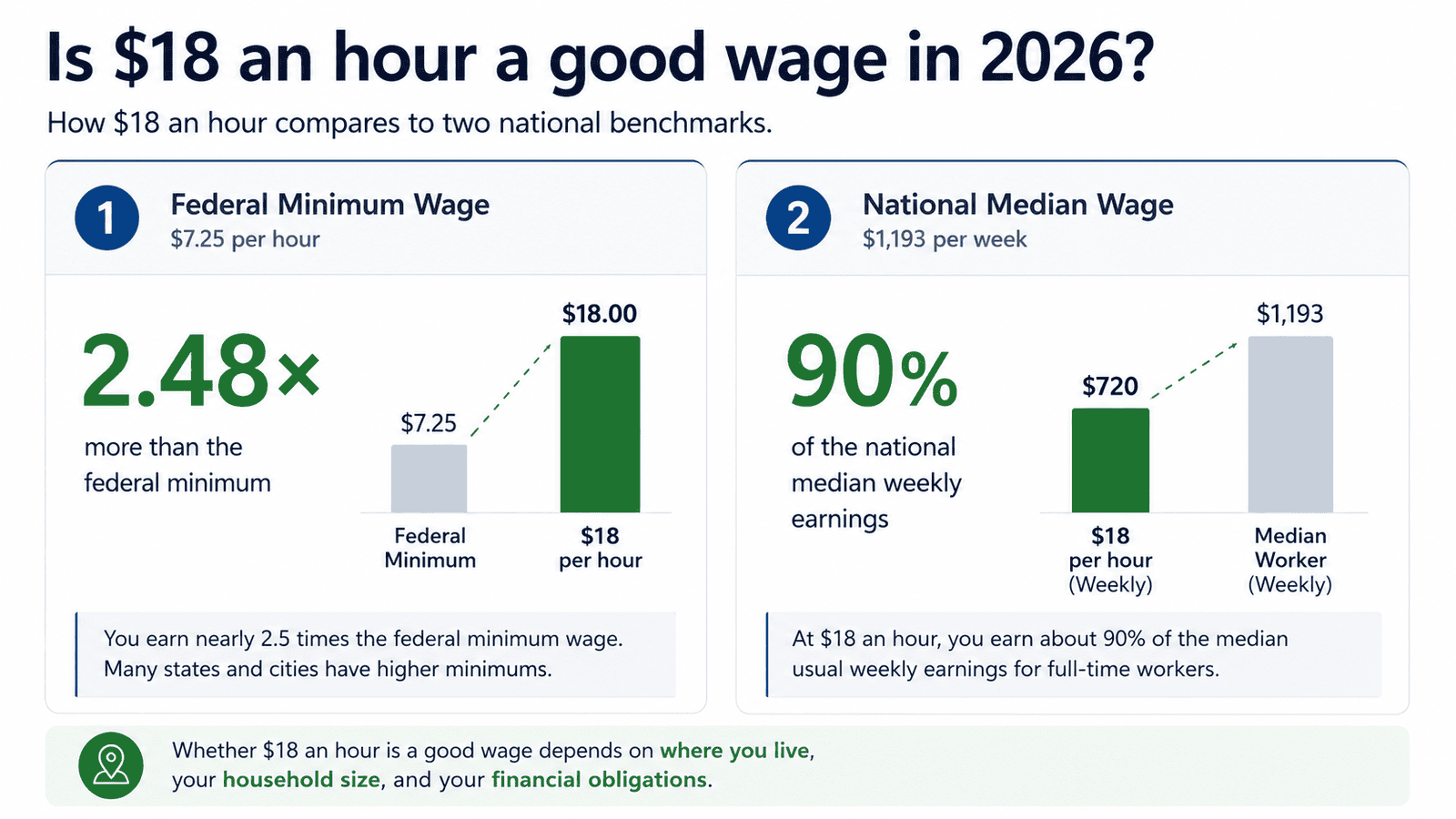
Whether $18 an hour is a good wage depends on where you live, your household size, and your financial obligations. Here is how it compares to two national benchmarks.
Comparison with the federal minimum wage
The federal minimum wage has been $7.25 per hour since July 2009 (U.S. Department of Labor, Wage and Hour Division). At $18 an hour, you earn nearly 2.5 times the federal minimum. Many states and cities have enacted higher minimum wages, so the gap between $18 and the local floor may be smaller depending on your location.
Comparison with the national median wage
According to the Bureau of Labor Statistics, the median usual weekly earnings for full time wage and salary workers were $1,233 in the first quarter of 2026 (Usual Weekly Earnings report, April 2026). Dividing $1,233 by 40 hours gives an approximate median hourly wage of $30.83.
At $18 an hour, your earnings fall below the national median. Your weekly gross of $720 is about 58% of the median worker’s weekly earnings. This does not mean $18 an hour is unlivable, but it does mean budgeting carefully is important, especially in higher cost areas.
Sample monthly budget on $18 an hour
Using the 50/30/20 budgeting framework on an estimated after tax monthly income of $2,689, here is one way to structure your spending. The 50/30/20 rule allocates 50% to needs, 30% to wants, and 20% to savings and debt repayment.
| Category | Percentage | Monthly amount | Examples |
|---|---|---|---|
| Needs | 50% | $1,345 | Rent or mortgage, utilities, groceries, insurance, minimum debt payments, transportation |
| Wants | 30% | $807 | Dining out, entertainment, subscriptions, hobbies, non essential shopping |
| Savings and debt repayment | 20% | $538 | Emergency fund, retirement contributions, extra debt payments |
A housing payment at or below $900 per month (roughly one third of after tax income) will give you the most flexibility in the needs category. In many parts of the country, this is achievable with a roommate or in lower cost metro areas and rural communities.
For context on nearby wage levels and how small increases affect your budget, see our breakdowns for $15 an hour, $16 an hour, $17 an hour, and $19 an hour.
Frequently asked questions
How much is $18 an hour per year?
$18 an hour is $37,440 per year before taxes, based on working 40 hours per week for 52 weeks. After estimated federal taxes for a single filer in 2026, take home pay is approximately $32,263 per year or about $2,689 per month.
How much is $18 an hour per month after taxes?
After federal income tax and FICA withholding (assuming a single filer with the standard deduction and no state tax), $18 an hour works out to roughly $2,689 per month. State and local taxes will reduce this further in most states. See our full breakdown at $18 an hour after taxes.
Can you live on $18 an hour in 2026?
It depends heavily on your location and household expenses. In lower cost areas of the South and Midwest, $18 an hour can cover basic living expenses for a single person, especially with disciplined budgeting. In high cost cities like New York, San Francisco, or Boston, $18 an hour will likely require a roommate or supplemental income to cover rent and essentials.
Is $18 an hour above minimum wage?
Yes. The federal minimum wage is $7.25 per hour (unchanged since 2009, per the U.S. Department of Labor). At $18 an hour you earn $10.75 more per hour than the federal floor. However, many states set higher minimums, so the gap between $18 and the applicable minimum in your area may be narrower.
How much is $18 an hour for 30 hours a week?
At 30 hours per week, $18 an hour equals $540 per week and $28,080 per year before taxes. That is $9,360 less annually compared to a 40 hour week at the same rate.
What is $18 an hour on overtime?
Under federal law, overtime is paid at 1.5 times your regular rate. At $18 an hour, your overtime rate is $27 per hour. Five overtime hours per week for a full year would add $7,020 to your annual gross income, bringing the total to $44,460. Understanding 18 dollars an hour is how much a year makes it easier to compare hourly jobs with salaried positions and plan your budget.
Methodology
All calculations on this page use a 40 hour workweek and a 52 week work year (2,080 annual hours) unless otherwise noted. Federal income tax estimates use the 2026 tax brackets and standard deduction for a single filer as published by the IRS in Revenue Procedure 2025‑32. FICA calculations use a Social Security tax rate of 6.2% up to the 2026 wage base of $184,500 and a Medicare tax rate of 1.45% on all earnings, per IRS Topic No. 751. The median weekly earnings figure comes from the Bureau of Labor Statistics Usual Weekly Earnings report for Q1 2026.
The federal minimum wage of $7.25 per hour is sourced from the U.S. Department of Labor, Wage and Hour Division. All tax estimates are rounded to the nearest dollar and are for educational illustration only. State taxes, local taxes, pretax deductions, tax credits, and individual circumstances are not reflected in these figures.
This content is for educational purposes only and does not constitute personalized financial advice. Consult a qualified financial advisor for guidance specific to your situation.
By Nathan Whitmore for MoneyFN If you are wondering 18 dollars an hour is how much a year, your annual income depends on your weekly hours and weeks worked.

Nathan Whitmore is a US based personal finance writer at MoneyFN covering salary, paycheck, and tax math for American workers. He works from primary sources only: IRS revenue procedures, Bureau of Labor Statistics wage data, and Federal Reserve statistics. Every figure he publishes is dated and traceable to a public source.