

Our paycheck calculator Minnesota helps estimate your 2026 take home pay after federal income tax, Minnesota state income tax, Social Security, Medicare, and pre-tax deductions. Minnesota has a progressive state income tax with rates from 5.35% to 9.85% and does not tax wages at the local city or county level. A single filer earning $60,000 can expect to take home roughly $47,830 per year, or about $1,840 per biweekly paycheck, before retirement or insurance deductions.
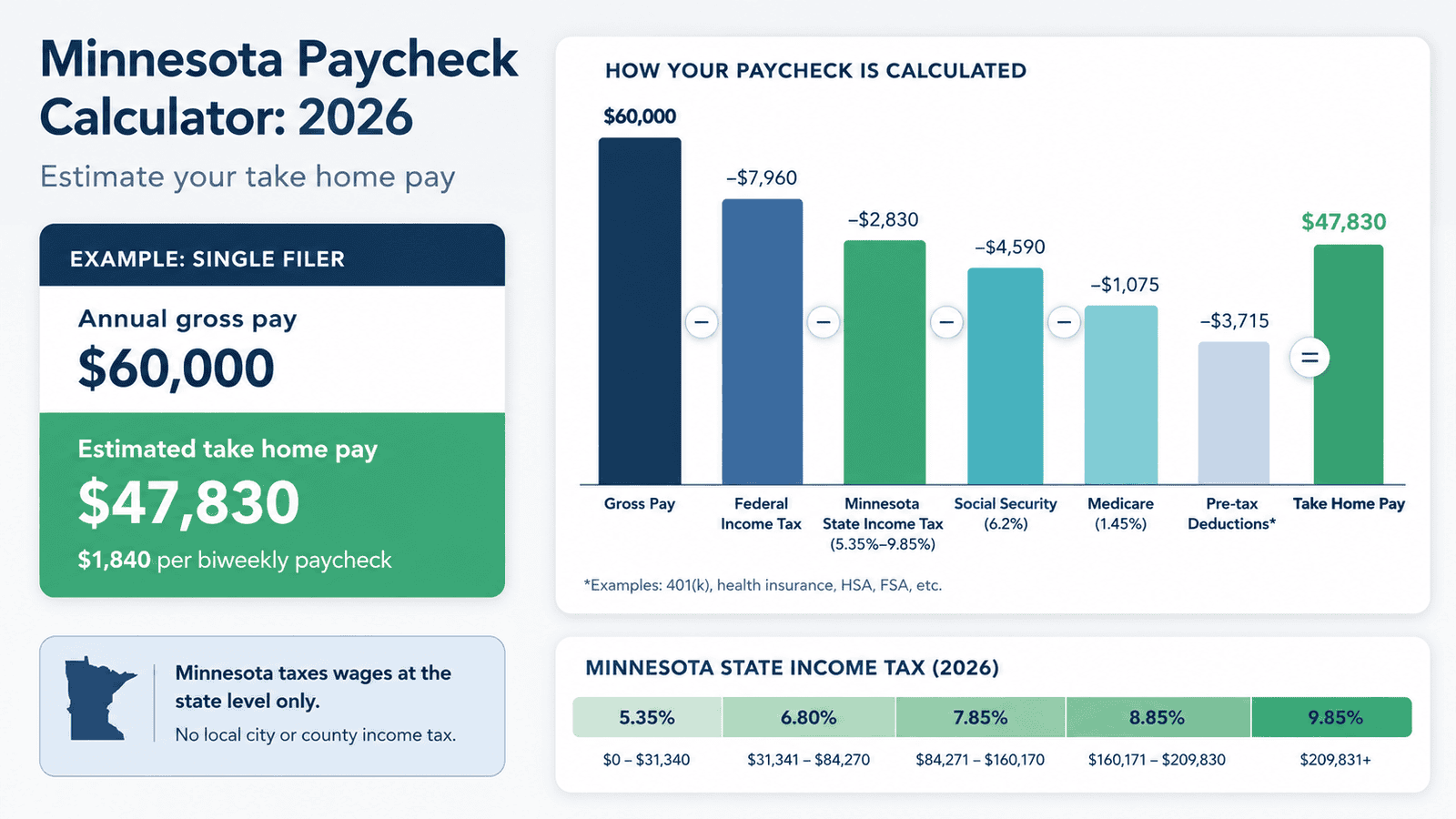
Minnesota paycheck calculator
This calculator needs JavaScript. The worked examples below cover the same math.
How the paycheck calculator works
Use our salary after tax calculator to estimate your Minnesota take home pay after federal taxes, state income tax, FICA payroll taxes, and common pre tax deductions. The calculator starts with your gross earnings and subtracts each applicable tax and deduction to arrive at your estimated net pay.
Inputs
You will typically enter the following information:
- Annual salary or hourly wage and hours worked
- Pay frequency (weekly, biweekly, semimonthly, or monthly)
- Federal and Minnesota filing status
- Pre tax deductions such as traditional 401(k) contributions, health insurance premiums, Health Savings Account (HSA) contributions, and Flexible Spending Account (FSA) contributions
Formula
Gross pay
Minus pre tax deductions
= Taxable wages
Minus federal income tax
Minus Minnesota state income tax
Minus Social Security tax (6.2%)
Minus Medicare tax (1.45%)
= Estimated take home pay
The calculator provides an estimate for educational purposes and is not a substitute for your employer’s payroll calculations.
2026 federal taxes on your paycheck
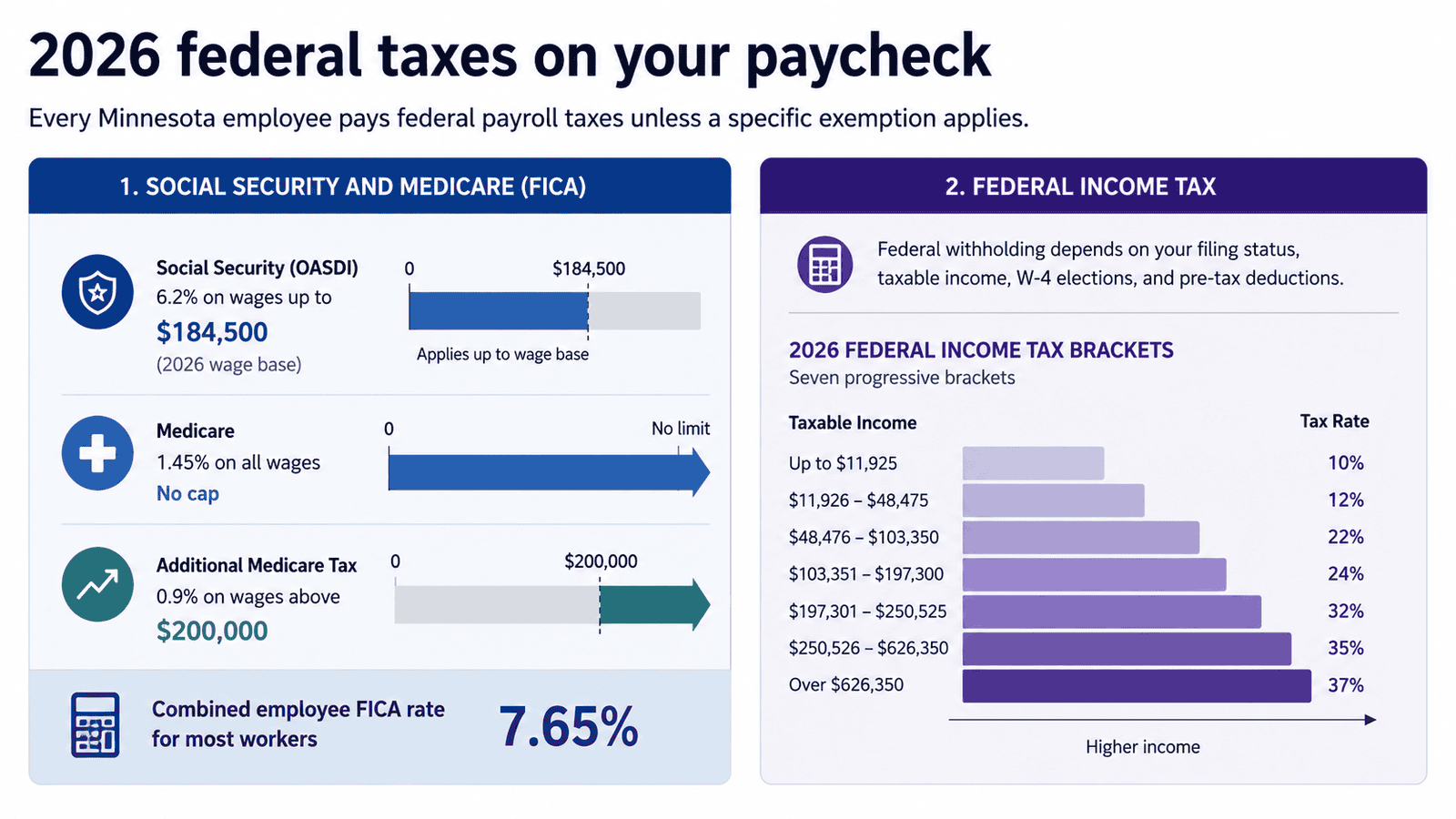
Every Minnesota employee pays federal payroll taxes unless a specific exemption applies.
Social Security and Medicare (FICA)
The employee portion of Social Security tax is 6.2% on wages up to the 2026 wage base of $184,500 (IRS Topic 751, 2026; SSA, 2026). The employee portion of Medicare tax is 1.45% on all wages with no cap. An additional 0.9% Medicare tax applies to individual wages above $200,000. The combined employee FICA rate for most workers is 7.65%.
Federal income tax
Federal withholding depends on your filing status, taxable income, W-4 elections, and pre tax deductions. The federal income tax system uses seven progressive brackets with rates of 10%, 12%, 22%, 24%, 32%, 35%, and 37% for tax year 2026 (IRS Revenue Procedure 2025-32).
The 2026 federal standard deduction is $16,100 for single filers and $32,200 for married filing jointly.
| Tax rate | Single filer taxable income | Married filing jointly taxable income |
|---|---|---|
| 10% | $0 to $12,400 | $0 to $24,800 |
| 12% | $12,401 to $50,400 | $24,801 to $100,800 |
| 22% | $50,401 to $105,700 | $100,801 to $211,400 |
| 24% | $105,701 to $201,775 | $211,401 to $403,550 |
| 32% | $201,776 to $256,225 | $403,551 to $512,450 |
| 35% | $256,226 to $640,600 | $512,451 to $768,700 |
| 37% | $640,601 or more | $768,701 or more |
Source: IRS Revenue Procedure 2025-32.
Minnesota state income tax explained
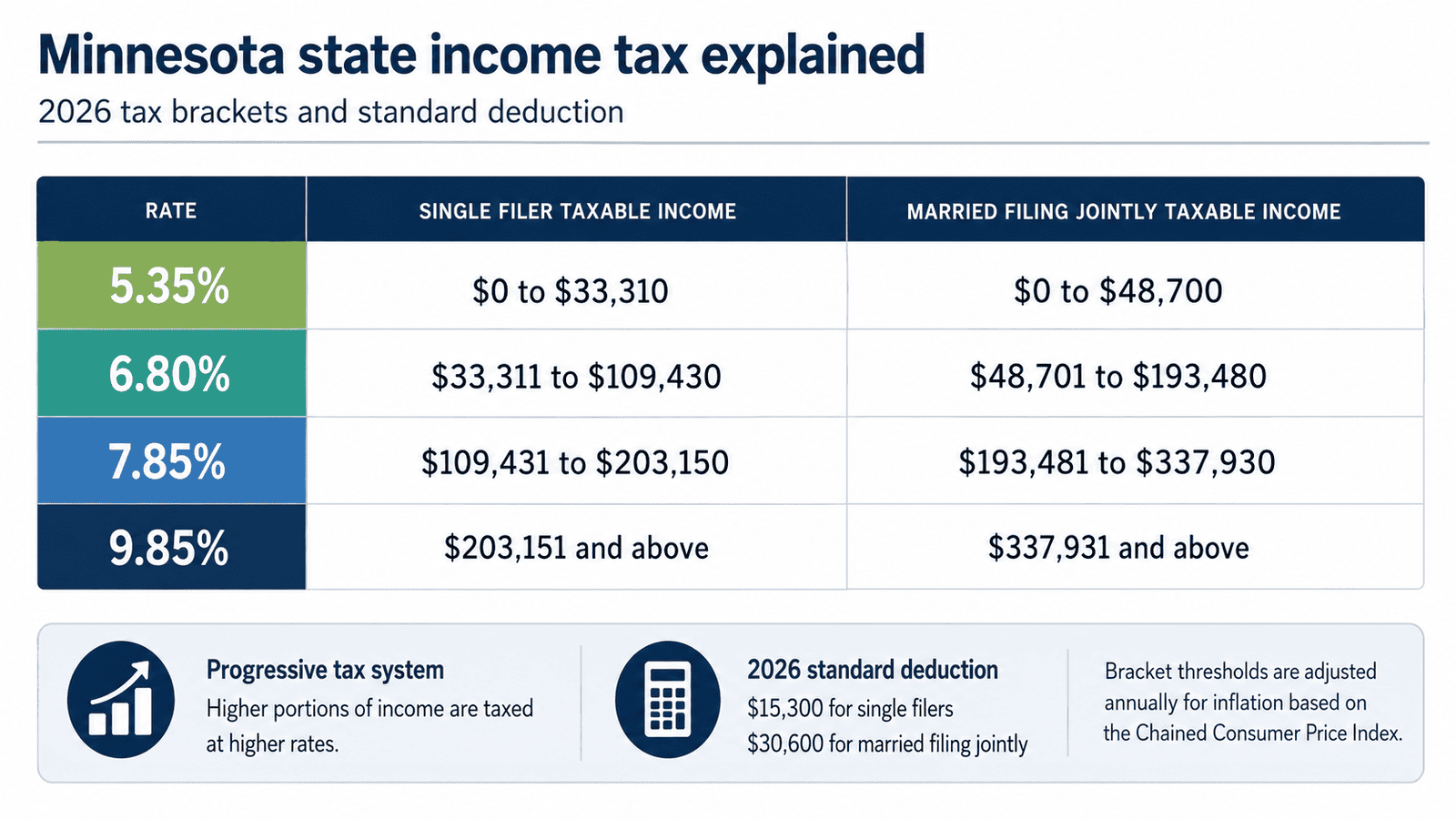
Minnesota has one of the more progressive state income tax systems in the Midwest. For tax year 2026, the state uses four brackets with rates of 5.35%, 6.80%, 7.85%, and 9.85%. Bracket thresholds are adjusted annually for inflation based on the Chained Consumer Price Index.
The 2026 Minnesota standard deduction is $15,300 for single filers and $30,600 for married filing jointly (Minnesota Department of Revenue, December 2025).
| Rate | Single filer taxable income | Married filing jointly taxable income |
|---|---|---|
| 5.35% | $0 to $33,310 | $0 to $48,700 |
| 6.80% | $33,311 to $109,430 | $48,701 to $193,480 |
| 7.85% | $109,431 to $203,150 | $193,481 to $337,930 |
| 9.85% | $203,151 and above | $337,931 and above |
Source: Minnesota Department of Revenue, tax year 2026.
Is Minnesota a flat tax state?
No. Minnesota uses a progressive income tax, meaning higher portions of income are taxed at higher rates. The lowest rate is 5.35% and the highest rate is 9.85%.
Are there local payroll taxes?
No. Minnesota does not levy separate city or county income taxes on employee wages. Your state level paycheck deduction covers the full Minnesota income tax obligation.
Worked examples
The following examples assume a single filer, the 2026 federal standard deduction ($16,100), the 2026 Minnesota standard deduction ($15,300), no retirement contributions, no health insurance deductions, and 26 biweekly pay periods per year. All figures are rounded estimates. Actual withholding varies by payroll settings.
Example 1: $45,000 salary
| Item | Amount |
|---|---|
| Annual gross salary | $45,000 |
| Federal taxable income ($45,000 minus $16,100) | $28,900 |
| Federal income tax (10% on $12,400 + 12% on $16,500) | $3,220 |
| Social Security ($45,000 x 6.2%) | $2,790 |
| Medicare ($45,000 x 1.45%) | $653 |
| MN taxable income ($45,000 minus $15,300) | $29,700 |
| Minnesota income tax (5.35% on $29,700) | $1,589 |
| Total deductions | $8,252 |
| Estimated annual take home | $36,748 |
| Biweekly take home | $1,413 |
Example 2: $60,000 salary
| Item | Amount |
|---|---|
| Annual gross salary | $60,000 |
| Federal taxable income ($60,000 minus $16,100) | $43,900 |
| Federal income tax (10% on $12,400 + 12% on $31,500) | $5,020 |
| Social Security ($60,000 x 6.2%) | $3,720 |
| Medicare ($60,000 x 1.45%) | $870 |
| MN taxable income ($60,000 minus $15,300) | $44,700 |
| Minnesota income tax (5.35% on $33,310 + 6.80% on $11,390) | $2,557 |
| Total deductions | $12,167 |
| Estimated annual take home | $47,833 |
| Biweekly take home | $1,840 |
Example 3: $85,000 salary
| Item | Amount |
|---|---|
| Annual gross salary | $85,000 |
| Federal taxable income ($85,000 minus $16,100) | $68,900 |
| Federal income tax (10% on $12,400 + 12% on $38,000 + 22% on $18,500) | $9,870 |
| Social Security ($85,000 x 6.2%) | $5,270 |
| Medicare ($85,000 x 1.45%) | $1,233 |
| MN taxable income ($85,000 minus $15,300) | $69,700 |
| Minnesota income tax (5.35% on $33,310 + 6.80% on $36,390) | $4,257 |
| Total deductions | $20,630 |
| Estimated annual take home | $64,370 |
| Biweekly take home | $2,476 |
Hourly wages in Minnesota
The estimates below assume 40 hours per week and 52 weeks per year, with the same single filer and standard deduction assumptions used in the worked examples above.
| Hourly wage | Annual gross pay | Estimated annual take home | Estimated biweekly take home |
|---|---|---|---|
| $20 | $41,600 | $34,200 | $1,315 |
| $25 | $52,000 | $41,950 | $1,613 |
| $30 | $62,400 | $49,600 | $1,908 |
If you earn $30 per hour, see our complete guide: $30 an hour salary guide.
How bonuses are taxed in Minnesota
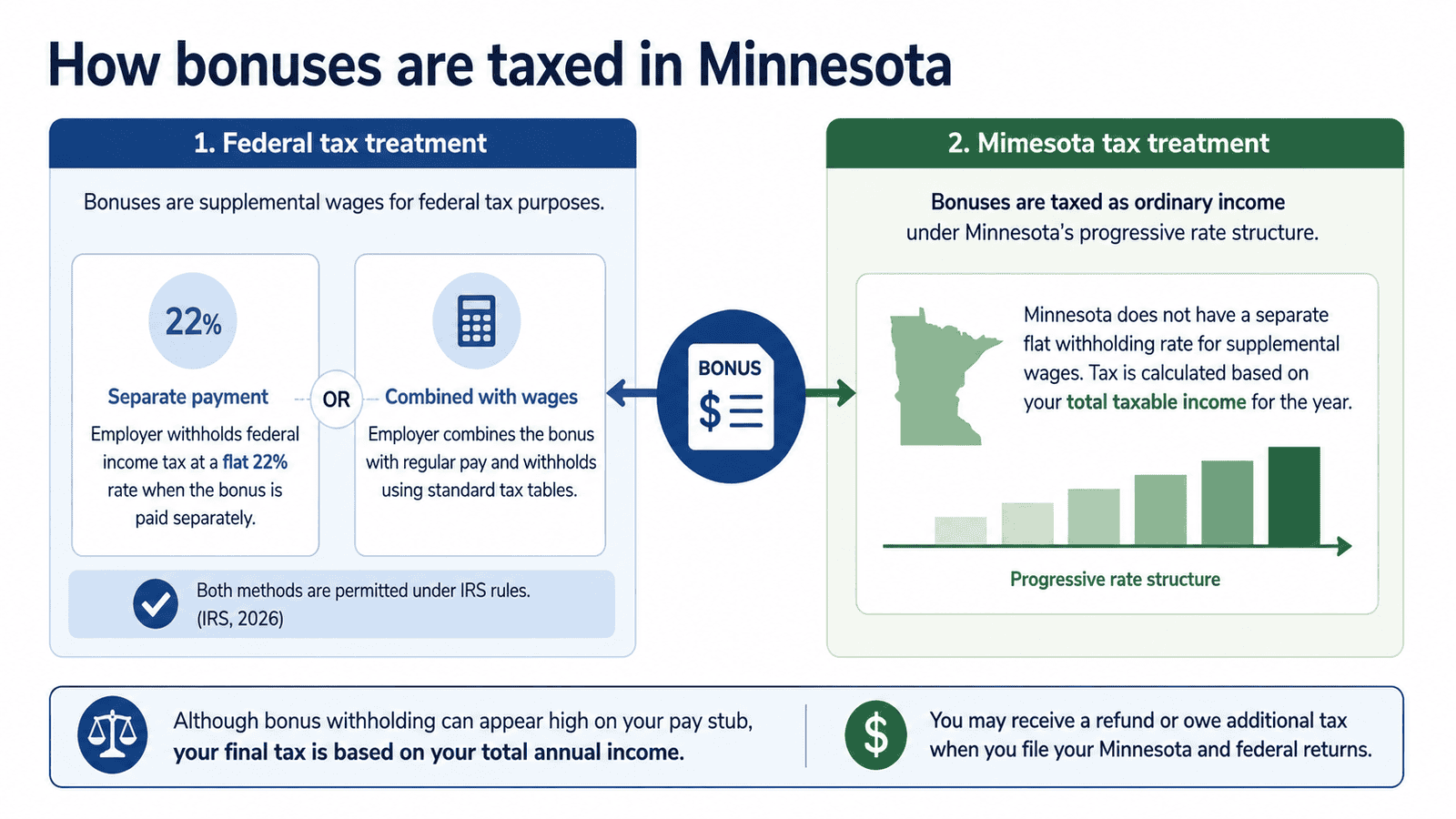
Bonuses are classified as supplemental wages for federal tax purposes. Employers typically withhold federal income tax on bonuses at a flat 22% rate when the bonus is paid separately from regular wages, or they may combine the bonus with your regular pay and withhold using standard tax tables. Both methods are permitted under IRS rules (IRS, 2026).
Minnesota also taxes bonuses as ordinary income under its progressive rate structure. The state does not have a separate flat withholding rate for supplemental wages, so the tax is calculated based on your total taxable income for the year.
Although bonus withholding can appear high on your pay stub, your final tax liability is determined when you file your annual tax return. If too much was withheld during the year, you may receive a refund.
Effect of 401(k) and health insurance premiums
Traditional 401(k) contributions reduce both federal and Minnesota taxable income because they are deducted from your gross pay before income taxes are calculated. This generally lowers your income tax withholding, though FICA taxes (Social Security and Medicare) are still assessed on the full gross pay amount in most cases.
Health insurance premiums paid through an employer sponsored cafeteria plan (Section 125) typically reduce both taxable income and FICA wages, providing an additional payroll tax benefit.
Example: $60,000 salary with $6,000 traditional 401(k) contribution
| Item | Without 401(k) | With $6,000 401(k) |
|---|---|---|
| Federal taxable income | $43,900 | $37,900 |
| Federal income tax | $5,020 | $4,300 |
| MN taxable income | $44,700 | $38,700 |
| Minnesota income tax | $2,557 | $2,149 |
| Social Security + Medicare | $4,590 | $4,590 |
| 401(k) withheld | $0 | $6,000 |
| Take home pay | $47,833 | $42,961 |
| Combined tax savings from 401(k) | $1,128 |
In this scenario, contributing $6,000 to a traditional 401(k) costs $4,872 in reduced take home pay rather than the full $6,000, because the contribution lowers income tax by approximately $1,128. Many financial planners suggest using pre tax retirement contributions as one approach to reduce current taxable income while building long term savings. Check the paycheck calculator Minnesota after updating your 401(k) contributions to see how take-home pay changes.
How Minnesota compares with neighboring states
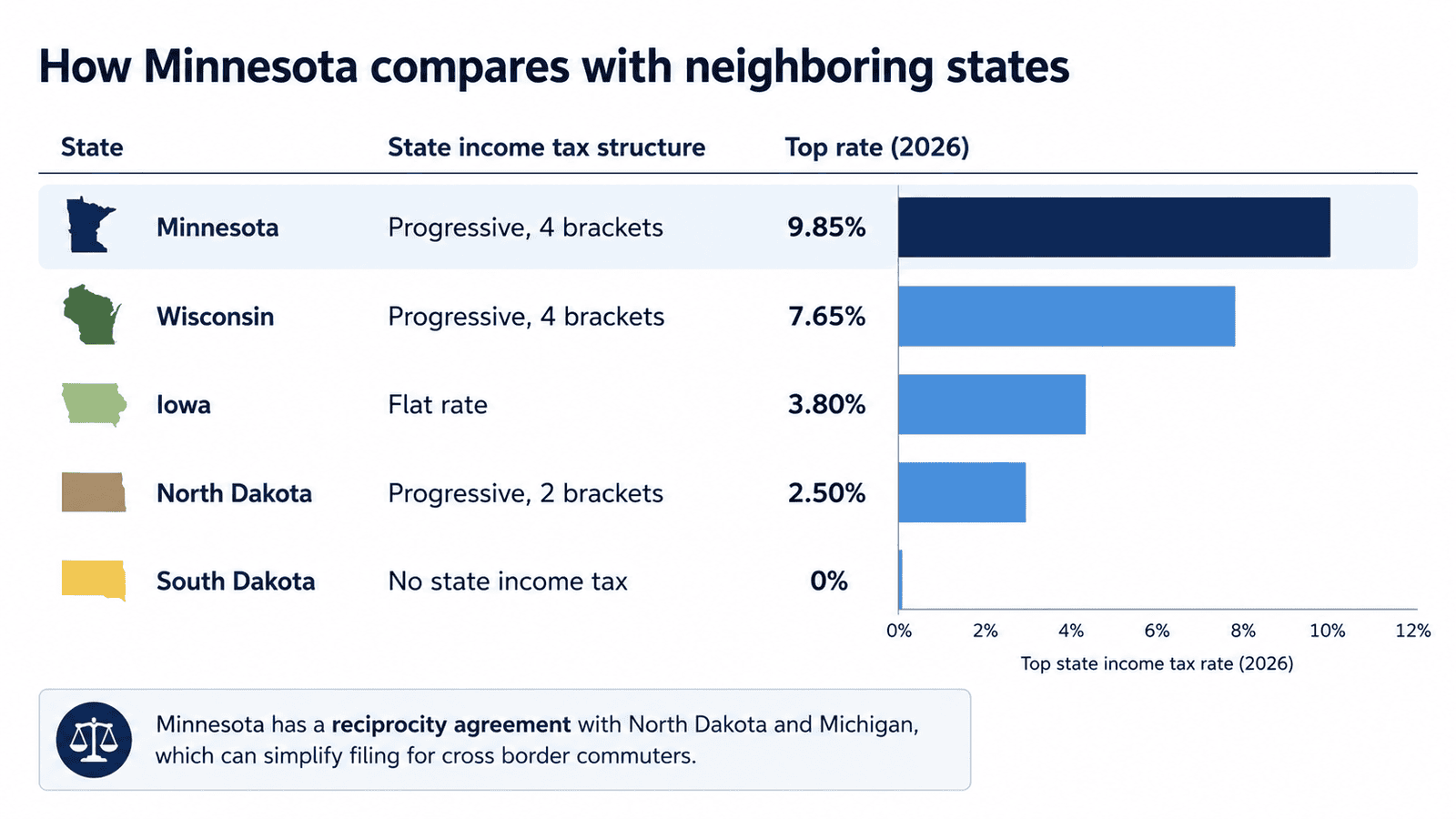
| State | State income tax structure | Top rate (2026) |
|---|---|---|
| Minnesota | Progressive, 4 brackets | 9.85% |
| Wisconsin | Progressive, 4 brackets | 7.65% |
| Iowa | Flat rate | 3.80% |
| North Dakota | Progressive, 2 brackets | 2.50% |
| South Dakota | No state income tax | 0% |
Employees moving across state lines may see noticeable differences in take home pay because of these varying state income tax structures. South Dakota charges no state income tax at all, while Minnesota’s top rate of 9.85% is among the highest in the nation. Minnesota does have a reciprocity agreement with North Dakota and Michigan, which can simplify filing for cross border commuters. Our paycheck calculator Minnesota includes federal, state, and payroll taxes for a clearer estimate.
Frequently asked questions
How much is taken out of my paycheck in Minnesota?
Most Minnesota paychecks include withholding for federal income tax, Social Security (6.2%), Medicare (1.45%), and Minnesota state income tax (5.35% to 9.85%). The exact amount depends on your gross income, filing status, W-4 elections, and any pre tax deductions you have chosen. There are no additional local or city payroll taxes in Minnesota.
What is the Minnesota income tax rate in 2026?
Minnesota has a progressive income tax with four brackets for tax year 2026. The rates are 5.35%, 6.80%, 7.85%, and 9.85%. A single filer pays 5.35% on the first $33,310 of taxable income and progressively higher rates on income above that amount, up to 9.85% on taxable income over $203,150 (Minnesota Department of Revenue, 2026).
How much is $60,000 a year after taxes in Minnesota?
A single filer earning $60,000 with the standard deduction and no pre tax deductions can expect to take home approximately $47,833 per year, or about $1,840 per biweekly paycheck. This accounts for federal income tax, FICA, and Minnesota state income tax. See the full breakdown in the worked examples section.
How are bonuses taxed in Minnesota?
Bonuses are taxed as ordinary income for Minnesota state income tax purposes. On the federal side, employers typically withhold at a flat 22% supplemental wage rate or use the aggregate method. Although bonus withholding can seem high, your actual tax liability is reconciled when you file your annual return.
How do 401(k) contributions change take home pay in Minnesota?
Traditional 401(k) contributions reduce both federal and Minnesota taxable income. For example, a $6,000 contribution on a $60,000 salary saves roughly $1,128 in combined federal and state income taxes, meaning every dollar contributed costs about $0.81 in reduced take home pay. FICA taxes are generally still assessed on the full gross amount. The paycheck calculator Minnesota lets you compare different pay frequencies and withholding choices.
Methodology
All estimates in this article are calculated using the following sourced data:
- 2026 federal income tax brackets, standard deductions, and withholding rules from IRS Revenue Procedure 2025-32.
- Employee FICA rates of 6.2% for Social Security (wage base $184,500) and 1.45% for Medicare, per IRS Topic 751 (2026) and the Social Security Administration (2026).
- Minnesota state income tax brackets, standard deductions, and filing rules from the Minnesota Department of Revenue, tax year 2026.
All worked examples assume a single filer claiming the federal standard deduction ($16,100) and the Minnesota standard deduction ($15,300) with no additional pre tax deductions unless otherwise stated. Actual payroll withholding may differ depending on your employer’s payroll system, W-4 elections, retirement contributions, health benefits, and other deductions. This article was last reviewed in July 2026.
This content is for educational purposes only and does not constitute personalized financial advice. Consult a qualified financial advisor for guidance specific to your situation.
By Nathan Whitmore for MoneyFN Use the paycheck calculator Minnesota to estimate your net pay before accepting a new job offer.

Nathan Whitmore is a US based personal finance writer at MoneyFN covering salary, paycheck, and tax math for American workers. He works from primary sources only: IRS revenue procedures, Bureau of Labor Statistics wage data, and Federal Reserve statistics. Every figure he publishes is dated and traceable to a public source.