

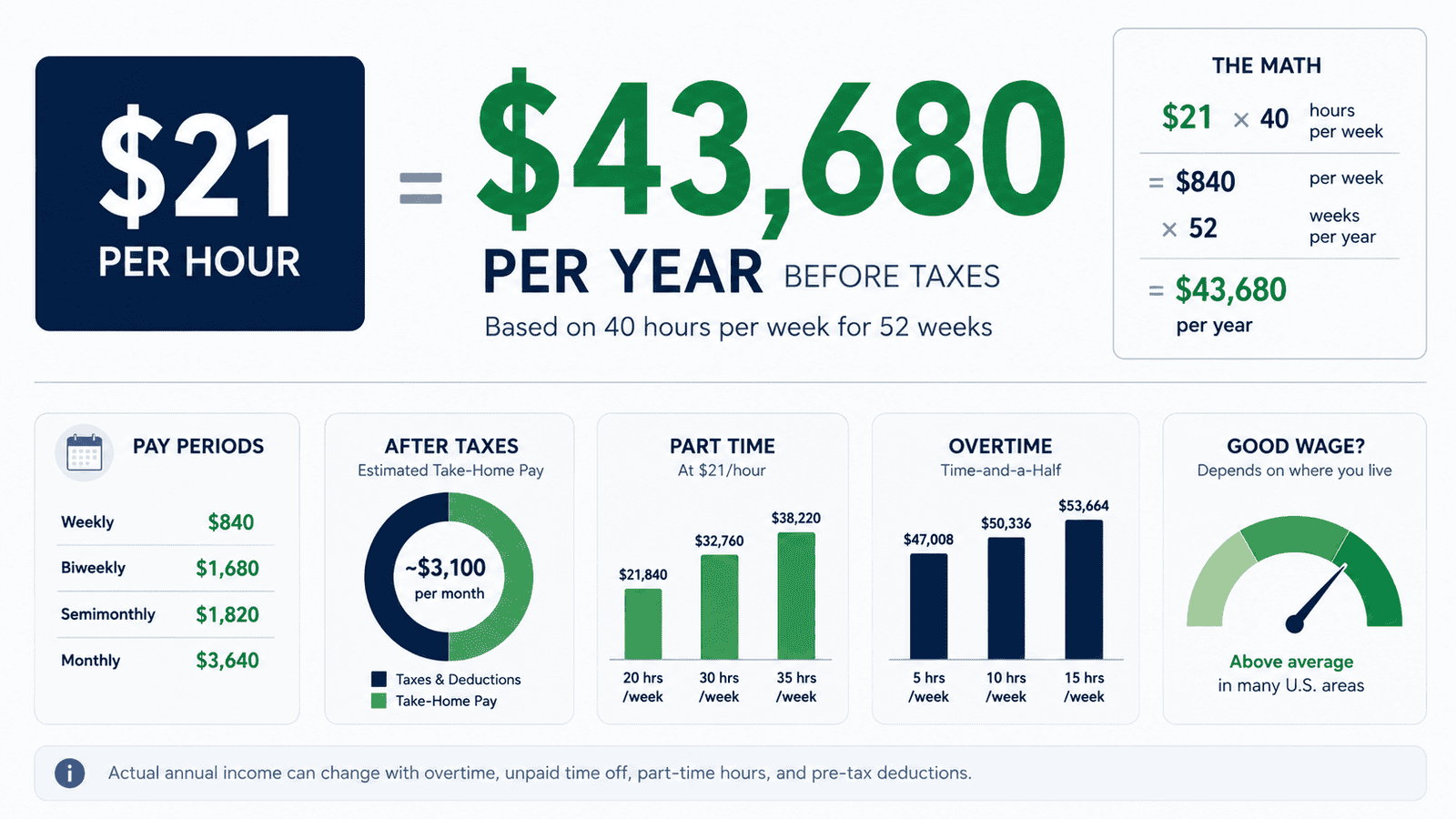
21 dollars an hour is how much a year? At $21 per hour, you earn about $43,680 per year before taxes if you work 40 hours a week for 52 weeks. Your actual annual income can change with overtime, unpaid time off, part-time hours, and pre-tax deductions.
21 dollars an hour is how much a year: $21 an hour salary calculator
The math behind $21 an hour to yearly salary
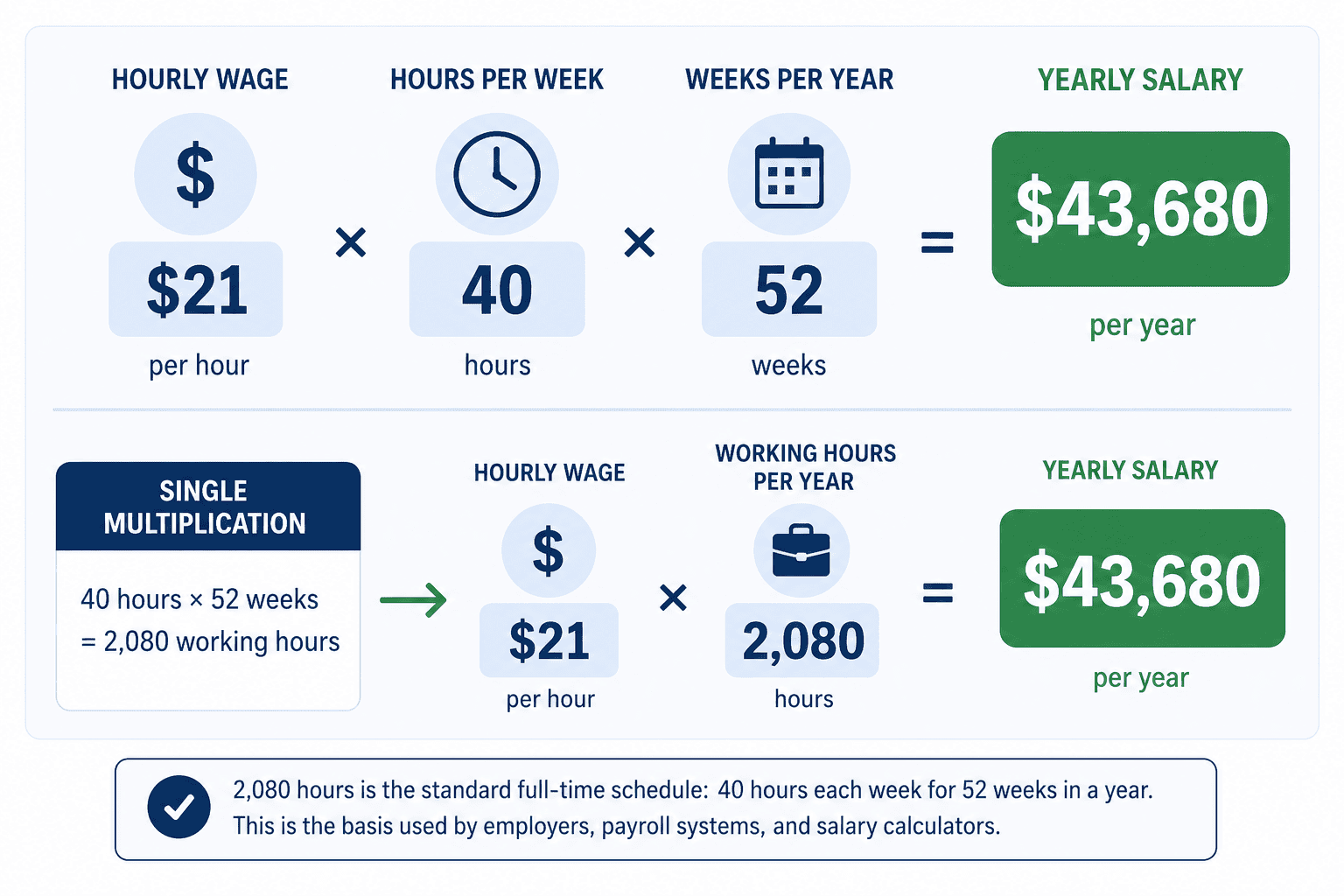
The standard calculation for a full time employee uses three numbers: the hourly wage, hours worked each week, and weeks in a year.
You can also express it as a single multiplication. Because 40 hours multiplied by 52 weeks equals 2,080 working hours, the formula becomes:
The 2,080 hour figure is widely used by employers, payroll systems, and salary calculators because it represents a standard full time schedule of 40 hours each week for a full calendar year. If you need to convert a different hourly wage, try the hourly to salary calculator.
$21 an hour per week, biweekly, monthly, and yearly
The table below breaks $43,680 into common pay periods, all before taxes.
| Time period | Gross pay |
|---|---|
| Hourly | $21.00 |
| Daily (8 hours) | $168.00 |
| Weekly (40 hours) | $840.00 |
| Biweekly | $1,680.00 |
| Monthly (average) | $3,640.00 |
| Yearly | $43,680.00 |
Monthly pay is calculated as $43,680 divided by 12. Biweekly pay is $840 multiplied by 2.
What $21 an hour looks like after taxes
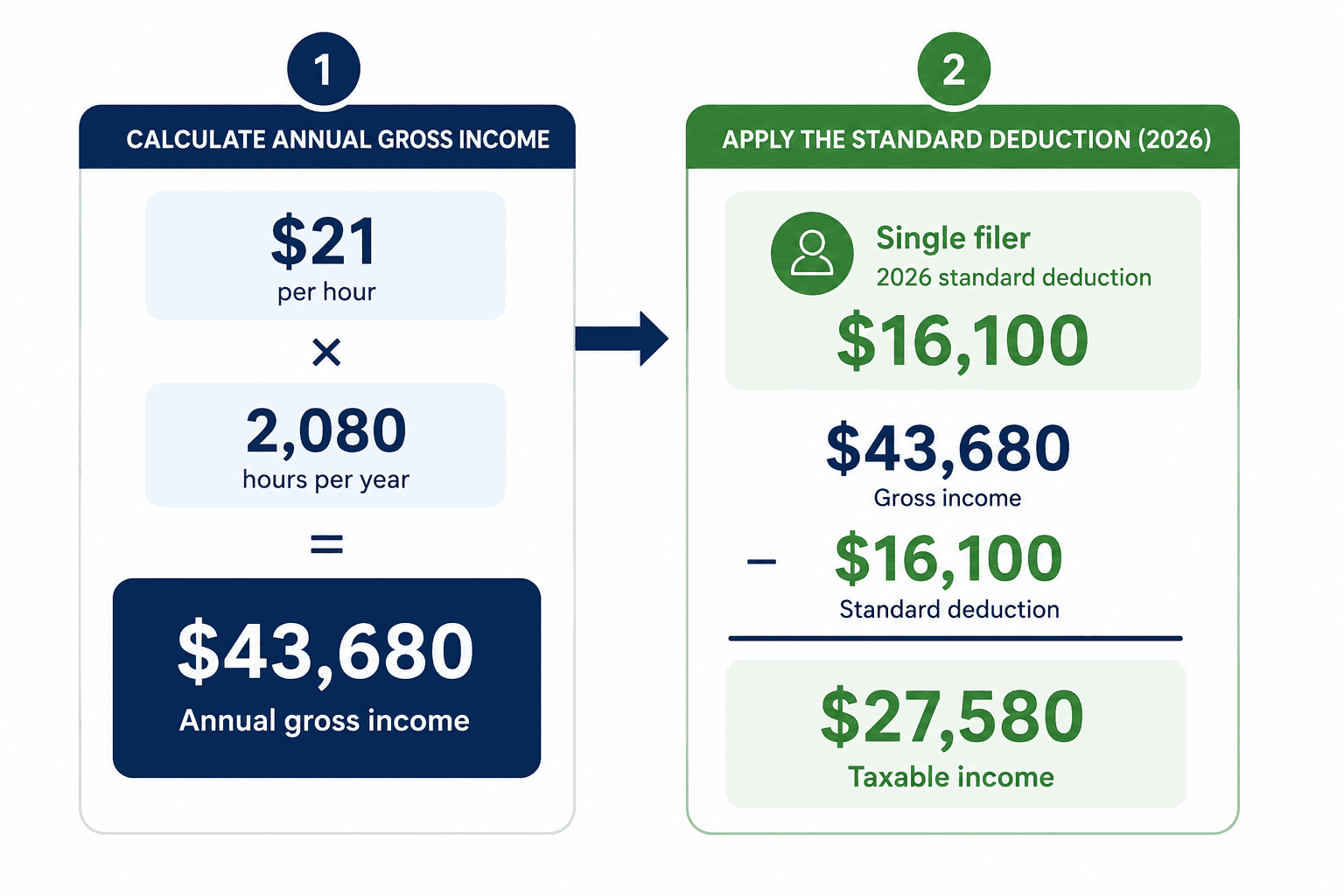
Actual take home pay depends on your filing status, state of residence, retirement contributions, health insurance deductions, and other payroll adjustments. The example below uses a single filer taking the 2026 standard deduction with no pre tax deductions and no state income tax.
For other filing statuses, use the salary after tax calculator. For a state specific example, see the Texas paycheck calculator.
Step 1. Calculate annual gross income
Step 2. Apply the standard deduction
The 2026 standard deduction for a single filer is $16,100, per IRS Rev. Proc. 2025-32 (published October 2025).
Step 3. Estimate federal income tax
Using the 2026 federal income tax brackets for a single filer:
| Bracket | Rate | Tax |
|---|---|---|
| First $12,400 | 10% | $1,240.00 |
| Remaining $15,180 | 12% | $1,821.60 |
| Total | $3,061.60 |
2026 tax brackets from IRS Rev. Proc. 2025-32.
Step 4. Calculate FICA taxes
FICA consists of Social Security and Medicare taxes, both withheld from every paycheck.
Social Security is 6.2% of wages up to the 2026 wage base of $184,500:
Medicare is 1.45% of all wages with no cap:
FICA rates per IRS Publication 15 (Circular E), 2026 edition.
Step 5. Estimate annual take home pay
| Item | Amount |
|---|---|
| Gross income | $43,680.00 |
| Federal income tax | $3,061.60 |
| Social Security | $2,708.16 |
| Medicare | $633.36 |
| Estimated annual take home pay | $37,276.88 |
| Estimated monthly take home pay | $3,106 |
This estimate is for a single filer with no state income tax, no local taxes, and no pre tax deductions. State taxes, retirement contributions, health insurance premiums, and tax credits can significantly change your actual paycheck.
Part time variants at $21 an hour
Not everyone works a 40 hour week. The table below shows how annual earnings change at two common part time schedules.
| Hours per week | Annual pay |
|---|---|
| 30 | $32,760 |
| 35 | $38,220 |
| 40 (full time) | $43,680 |
Dropping from 40 to 30 hours per week reduces annual income by $10,920.
How overtime changes it
Under the Fair Labor Standards Act, many hourly workers earn overtime pay at 1.5 times their regular rate after 40 hours in a workweek, although exemptions apply.
At $21 per hour the overtime rate is:
For example, working 45 hours every week for a full year:
| Component | Weekly | Annual (52 weeks) |
|---|---|---|
| Regular pay (40 hours × $21) | $840.00 | $43,680.00 |
| Overtime pay (5 hours × $31.50) | $157.50 | $8,190.00 |
| Total | $997.50 | $51,870.00 |
Consistent overtime can increase annual earnings substantially. In this example, five overtime hours each week add $8,190 to the yearly total. Actual eligibility depends on your job classification and employer.
Is $21 an hour a good wage in 2026?
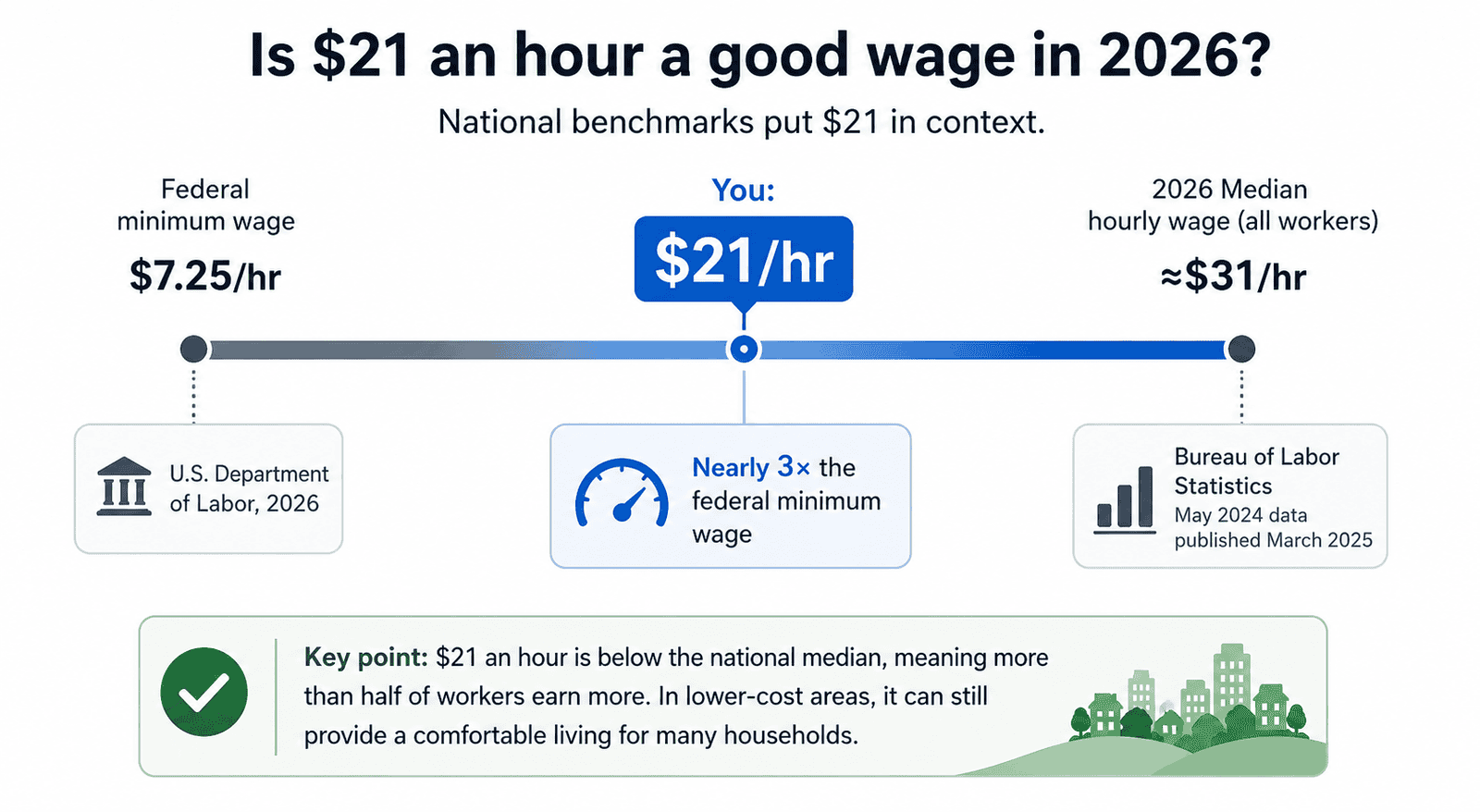
Whether $21 an hour is considered a good wage depends on your location, household size, and cost of living. Two national benchmarks provide useful context.
| Benchmark | Amount | Source |
|---|---|---|
| Federal minimum wage | $7.25 per hour | U.S. Department of Labor, 2026 |
| Median hourly wage (all workers) | Approximately $31 per hour | Bureau of Labor Statistics, May 2024 data published March 2025 |
At $21 an hour, you earn nearly three times the federal minimum wage. However, this rate falls below the national median hourly wage reported by the BLS, which means more than half of all workers earn a higher hourly rate.
In lower cost areas, $21 per hour may comfortably cover essential expenses for a single person. In higher cost cities, housing and transportation can consume a much larger share of income. Comparing your wage to local area data from the BLS gives a more accurate picture than national averages alone.
For a closer look at nearby wage levels, see the breakdowns for $18 an hour, $19 an hour, $20 an hour, and $22 an hour.
Sample monthly budget on $21 an hour
The 50/30/20 rule is a common budgeting framework. Using the estimated monthly take home pay of $3,106, the split looks like this:
| Category | Percentage | Monthly amount |
|---|---|---|
| Needs (housing, food, utilities, insurance) | 50% | $1,553 |
| Wants (dining out, entertainment, hobbies) | 30% | $932 |
| Savings and debt repayment | 20% | $621 |
Many financial planners suggest treating these percentages as flexible guidelines rather than strict rules. If your housing costs exceed 50% of take home pay, you may want to consider adjusting the other categories to stay on track with savings goals.
Frequently asked questions
Is $21 an hour working full time equal to $43,680 a year?
Yes. Working 40 hours each week for all 52 weeks in a year equals 2,080 hours. Multiplying 2,080 hours by $21 gives $43,680 before taxes.
How much is $21 an hour per month?
Average gross monthly income at $21 an hour is $3,640 before taxes. This is calculated by dividing the $43,680 annual total by 12 months.
How much is $21 an hour every two weeks?
A full time employee earning $21 an hour receives approximately $1,680 gross pay each biweekly pay period. That is $840 per week multiplied by two.
Is $21 an hour above the federal minimum wage?
Yes. The federal minimum wage is $7.25 per hour as of 2026, per the U.S. Department of Labor. At $21 an hour you earn nearly three times that amount.
How much is $21 an hour after taxes?
A single filer with no pre tax deductions and no state income tax would take home approximately $37,277 per year, or about $3,106 per month, based on 2026 federal tax rates and the standard deduction. Your actual amount may differ depending on filing status, state taxes, and deductions. Understanding 21 dollars an hour is how much a year helps you compare job offers and estimate your annual income.
Methodology
This guide assumes an hourly rate of $21, a 40 hour workweek, 52 working weeks per year, and 2,080 total annual work hours. The after tax example uses a single filer claiming the 2026 standard deduction of $16,100 with no retirement contributions, no other pre tax deductions, and no state or local income taxes.
Federal income tax calculations use the 2026 IRS tax brackets and standard deduction published in IRS Rev. Proc. 2025-32 (October 2025). Social Security tax is calculated at 6.2% of wages up to the 2026 wage base of $184,500. Medicare tax is calculated at 1.45% of all wages, per IRS Publication 15 (Circular E). Wage comparisons reference Bureau of Labor Statistics Occupational Employment and Wage Statistics (May 2024 data, published March 2025). The federal minimum wage of $7.25 per hour is set by the Fair Labor Standards Act and has not changed since July 2009.
This content is for educational purposes only and does not constitute personalized financial advice. Consult a qualified financial advisor for guidance specific to your situation.
By Nathan Whitmore for MoneyFN If you are asking 21 dollars an hour is how much a year, this guide breaks down every common pay period.

Nathan Whitmore is a US based personal finance writer at MoneyFN covering salary, paycheck, and tax math for American workers. He works from primary sources only: IRS revenue procedures, Bureau of Labor Statistics wage data, and Federal Reserve statistics. Every figure he publishes is dated and traceable to a public source.