

Our paycheck calculator Tennessee helps you estimate your 2026 take-home pay after federal income tax and FICA withholding. Tennessee has no state income tax on wages, so only federal taxes and Social Security and Medicare reduce your paycheck. A single filer earning $60,000 with the standard deduction takes home about $50,390 per year, or roughly $1,938 per biweekly paycheck.
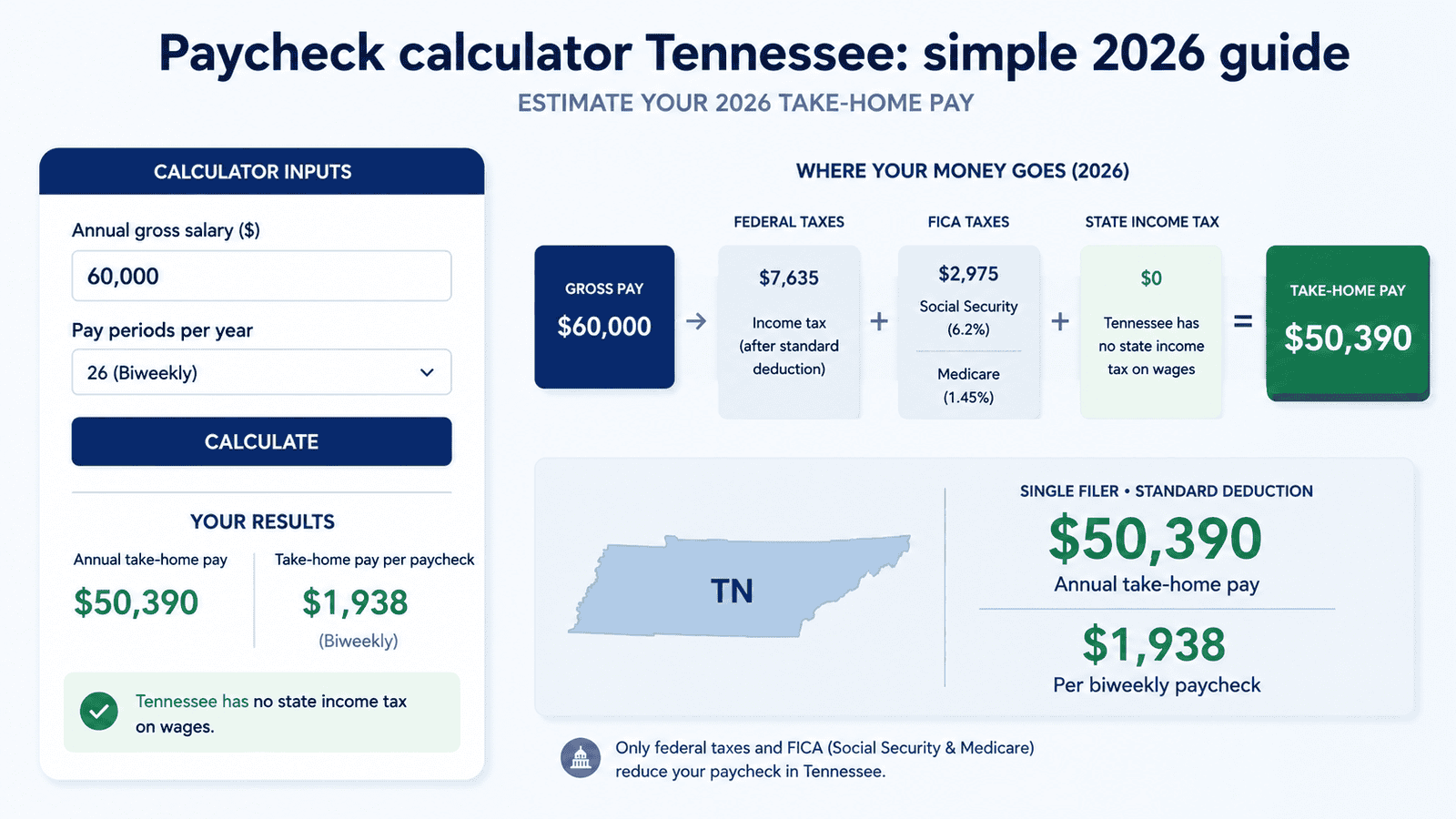
Paycheck calculator tennessee: Tennessee paycheck calculator
How the paycheck calculator works
A paycheck calculator for Tennessee estimates your net (take home) pay by subtracting mandatory tax withholdings from your gross pay. Because Tennessee charges zero state income tax on wages, the calculator only needs to account for federal deductions. Here are the inputs you will typically provide.
Gross pay. This is your total earnings before any deductions. You can enter an annual salary or an hourly wage. If you enter an hourly rate, the calculator multiplies it by your scheduled hours per pay period to find gross pay for that period.
Pay frequency. Common options include weekly (52 pay periods per year), biweekly (26), semimonthly (24), and monthly (12). Your pay frequency determines how your annual salary is divided into individual paychecks.
Filing status. Your federal filing status (single, married filing jointly, married filing separately, or head of household) affects your standard deduction and the income thresholds for each tax bracket. For example, the 2026 standard deduction is $16,100 for single filers and $32,200 for married couples filing jointly (IRS Revenue Procedure 2025-32).
Pre tax deductions. Contributions to employer sponsored retirement plans like a 401(k) or 403(b), health insurance premiums paid through your employer, and health savings account (HSA) contributions are subtracted from gross pay before federal income tax is calculated. These reduce your taxable income and therefore your tax bill. FICA taxes, however, still apply to most of these amounts (with the exception of certain cafeteria plan deductions under IRC Section 125).
Once these inputs are entered, the calculator applies the 2026 federal income tax brackets and FICA rates to determine what comes out of your check and what you actually receive.
2026 federal taxes on your paycheck
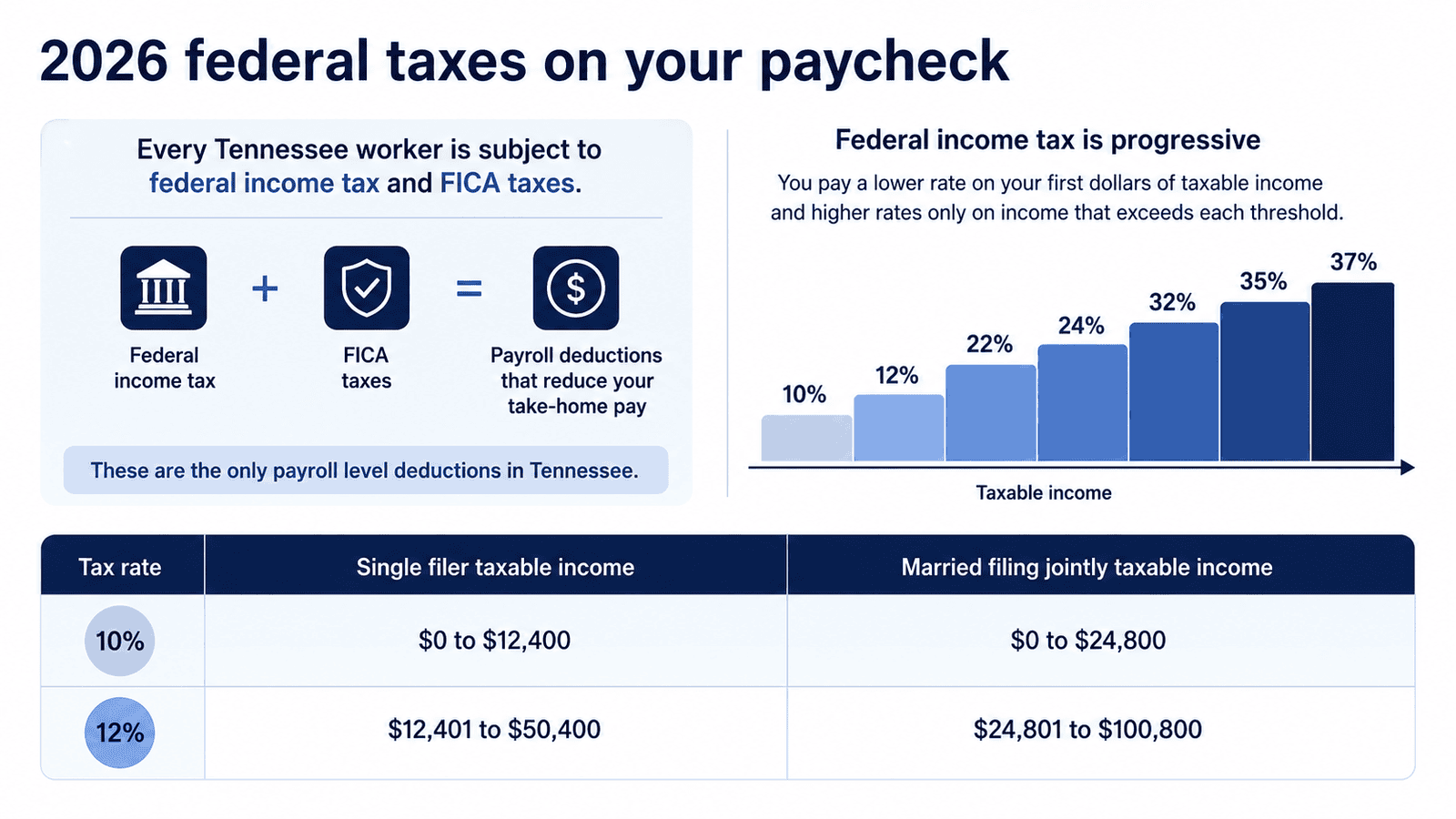
Every Tennessee worker is subject to federal income tax and FICA taxes. These are the only payroll level deductions that reduce your take home pay in the state.
Federal income tax brackets for 2026
The federal income tax uses a progressive, marginal bracket system. You pay a lower rate on your first dollars of taxable income and higher rates only on income that exceeds each threshold. For 2026, the IRS has set seven brackets at rates of 10%, 12%, 22%, 24%, 32%, 35%, and 37% (IRS Revenue Procedure 2025-32).
| Tax rate | Single filer taxable income | Married filing jointly taxable income |
|---|---|---|
| 10% | $0 to $12,400 | $0 to $24,800 |
| 12% | $12,401 to $50,400 | $24,801 to $100,800 |
| 22% | $50,401 to $105,700 | $100,801 to $211,400 |
| 24% | $105,701 to $201,775 | $211,401 to $403,550 |
| 32% | $201,776 to $256,225 | $403,551 to $512,450 |
| 35% | $256,226 to $640,600 | $512,451 to $768,700 |
| 37% | Above $640,600 | Above $768,700 |
Source: IRS Revenue Procedure 2025-32, published October 2025.
Your taxable income is your gross pay minus the standard deduction (or itemized deductions if higher) and any pre tax adjustments. The 2026 standard deduction is $16,100 for single filers, $32,200 for joint filers, and $24,150 for heads of household.
FICA taxes (Social Security and Medicare)
FICA taxes fund Social Security and Medicare and are withheld from every paycheck regardless of your income level or filing status.
The Social Security tax rate for 2026 is 6.2% on wages up to the annual wage base of $184,500 (Social Security Administration, October 2025 announcement). Once your year to date earnings exceed $184,500, no further Social Security tax is withheld for the rest of the calendar year. At the full wage base, the maximum employee Social Security tax is $11,439.
The Medicare tax rate for 2026 is 1.45% on all wages with no cap. An additional 0.9% Medicare surtax applies to wages exceeding $200,000 for single filers or $250,000 for married couples filing jointly (IRS Publication 15, 2026 edition).
Combined, most employees pay 7.65% of gross wages in FICA taxes on earnings below the Social Security wage base. In Tennessee, FICA and federal income tax are the only payroll taxes you will see on your pay stub.
Tennessee state income tax explained
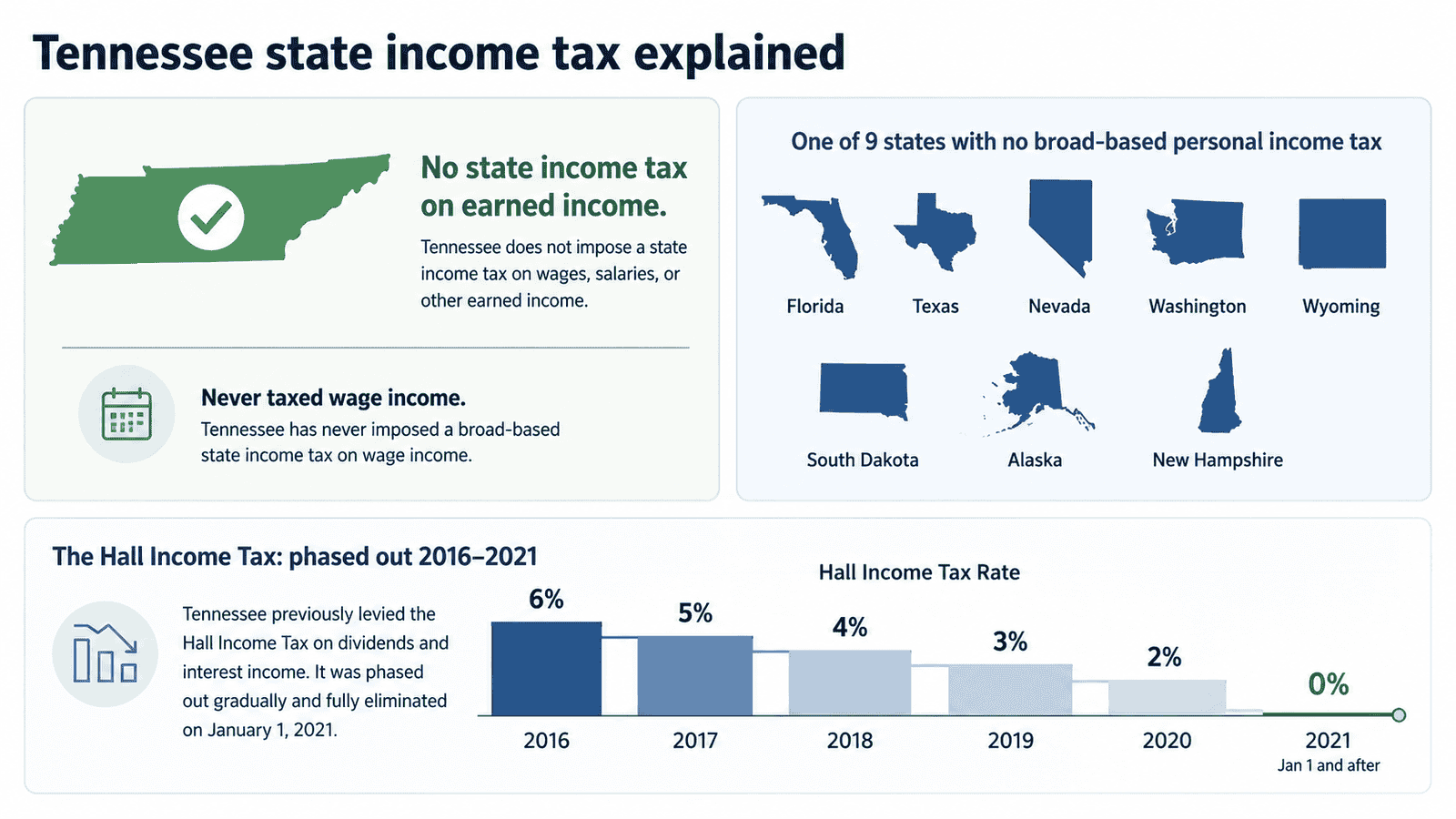
Tennessee does not impose a state income tax on wages, salaries, or earned income. It has never taxed wage income at any point in its history. Tennessee is one of nine states with no broad based personal income tax, alongside Florida, Texas, Nevada, Washington, Wyoming, South Dakota, Alaska, and New Hampshire.
The state did previously levy the Hall Income Tax, a narrow tax on dividends and interest income named after the state senator who introduced it in 1929. The Hall Tax was gradually phased out starting in 2016, with the rate dropping by one percentage point each year from 6% down to 0%. It was fully eliminated effective January 1, 2021 (Tennessee Department of Revenue). As a result, Tennessee residents now pay zero state tax on any form of personal income, including investment income.
Because there is no state income tax, no state withholding line appears on a Tennessee worker’s pay stub. This is a meaningful advantage. In neighboring states like Georgia (top marginal rate of 5.39% in 2026) or Virginia (top rate of 5.75%), a portion of each paycheck goes to the state before the worker sees it. Tennessee workers keep that portion entirely.
Tennessee funds its government primarily through sales taxes. The state sales tax rate is 7.00%, and combined state and local rates average approximately 9.61%, among the highest in the nation (Tax Foundation, 2026 Tennessee data). This is the trade off that residents accept in exchange for zero income tax.
Worked examples: biweekly take home pay in Tennessee
The following examples show step by step how much a single filer in Tennessee takes home on a biweekly pay schedule (26 pay periods per year) using the 2026 standard deduction of $16,100 and no pre tax deductions. All figures are rounded to the nearest dollar.
Example 1: $45,000 annual salary
Step 1: Find taxable income. $45,000 gross minus $16,100 standard deduction equals $28,900 in taxable income.
Step 2: Calculate federal income tax. The first $12,400 is taxed at 10%, producing $1,240. The remaining $16,500 (from $12,401 to $28,900) is taxed at 12%, producing $1,980. Total annual federal income tax: $3,220.
Step 3: Calculate FICA. Social Security at 6.2% of $45,000 equals $2,790. Medicare at 1.45% of $45,000 equals $653. Total annual FICA: $3,443.
Divided by 26 pay periods, that is approximately $1,474 per biweekly paycheck. The effective total tax rate is about 14.8%.
Example 2: $60,000 annual salary
Step 1: Find taxable income. $60,000 minus $16,100 equals $43,900.
Step 2: Calculate federal income tax. The first $12,400 at 10% produces $1,240. The next $31,500 (from $12,401 to $43,900) at 12% produces $3,780. Total federal income tax: $5,020.
Step 3: Calculate FICA. Social Security: $3,720. Medicare: $870. Total FICA: $4,590.
That works out to approximately $1,938 per biweekly paycheck. The effective total tax rate is about 16.0%.
Example 3: $85,000 annual salary
Step 1: Find taxable income. $85,000 minus $16,100 equals $68,900.
Step 2: Calculate federal income tax. The first $12,400 at 10% produces $1,240. The next $38,000 (from $12,401 to $50,400) at 12% produces $4,560. The remaining $18,500 (from $50,401 to $68,900) at 22% produces $4,070. Total federal income tax: $9,870.
Step 3: Calculate FICA. Social Security: $5,270. Medicare: $1,233. Total FICA: $6,503.
That is approximately $2,640 per biweekly paycheck. The effective total tax rate is about 19.3%.
| Annual salary | Federal income tax | FICA | Annual take home | Biweekly take home | Effective rate |
|---|---|---|---|---|---|
| $45,000 | $3,220 | $3,443 | $38,337 | $1,474 | 14.8% |
| $60,000 | $5,020 | $4,590 | $50,390 | $1,938 | 16.0% |
| $85,000 | $9,870 | $6,503 | $68,627 | $2,640 | 19.3% |
All examples assume single filing status, 2026 standard deduction of $16,100, no pre tax deductions, and 26 biweekly pay periods. Tennessee state income tax: $0.
Hourly wages in Tennessee: what $20, $25, and $30 an hour take home
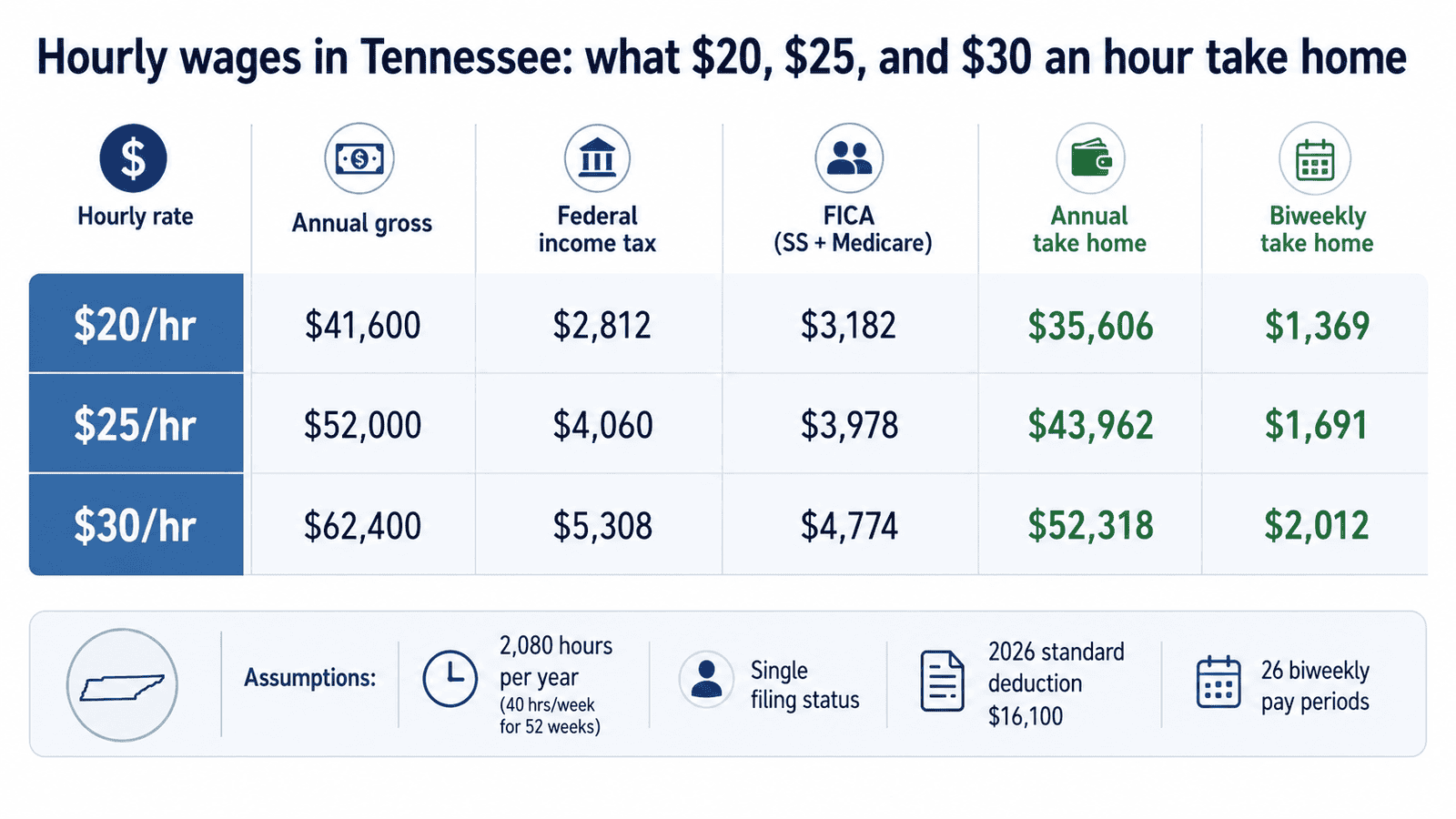
Many Tennessee workers are paid hourly rather than on salary. The following estimates assume a full time schedule of 2,080 hours per year (40 hours per week for 52 weeks), single filing status, the 2026 standard deduction of $16,100, and 26 biweekly pay periods. For a deeper look at one of these rates, see our guide to what $25 an hour looks like in take home pay.
| Hourly rate | Annual gross | Federal income tax | FICA (SS + Medicare) | Annual take home | Biweekly take home |
|---|---|---|---|---|---|
| $20/hr | $41,600 | $2,812 | $3,182 | $35,606 | $1,369 |
| $25/hr | $52,000 | $4,060 | $3,978 | $43,962 | $1,691 |
| $30/hr | $62,400 | $5,308 | $4,774 | $52,318 | $2,012 |
At $20 per hour, a Tennessee worker keeps about 85.6% of gross pay. At $30 per hour, that percentage drops slightly to about 83.8% because more income falls into the 12% federal bracket. In all three cases, zero dollars go to state income tax.
How bonuses are taxed in Tennessee
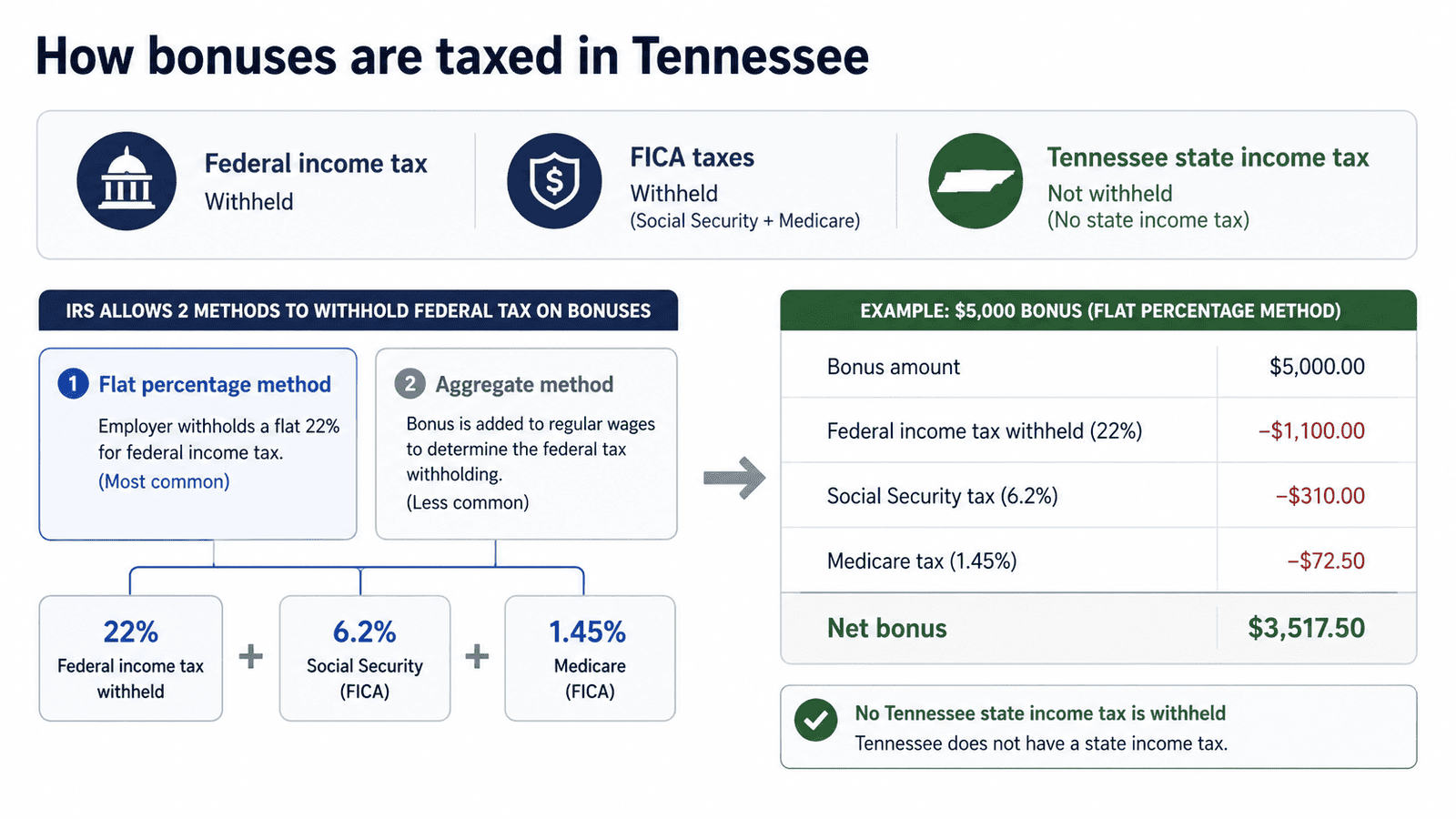
Bonuses and other supplemental wages in Tennessee are subject to federal income tax and FICA, but not state income tax. The IRS allows employers to withhold federal tax on bonuses using one of two methods (IRS Publication 15, Employer’s Tax Guide, 2026).
Flat percentage method. The employer withholds a flat 22% for federal income tax on the bonus amount. This is the most common approach because it is simple. If you receive a $5,000 bonus, $1,100 is withheld for federal income tax at the flat rate. FICA taxes are also withheld: $310 for Social Security (6.2%) and $73 for Medicare (1.45%). Your net bonus would be approximately $3,517. For supplemental wages exceeding $1 million in a calendar year, the flat withholding rate increases to 37%.
Aggregate method. The employer adds the bonus to your regular paycheck for that pay period and calculates withholding on the combined total as though it were a single payment. This can result in higher withholding in that period because the combined amount may push your income into a higher bracket for withholding purposes. However, any overwithholding is reconciled when you file your annual tax return.
Regardless of the withholding method used, your actual tax liability on bonus income is determined by your total annual income and your marginal tax bracket. If too much was withheld during the year, you receive a refund when you file. If too little was withheld, you owe the difference.
Effect of 401(k) and health insurance premiums on take home pay
Pre tax deductions like 401(k) contributions and employer sponsored health insurance premiums reduce your taxable income before federal income tax is calculated. In Tennessee, where there is no state tax to reduce, these deductions still provide a meaningful federal tax benefit.
401(k) contributions
The 2026 employee contribution limit for a 401(k) plan is $23,500, with a catch up contribution of $7,500 for workers aged 50 and older (IRS, 2026 retirement plan limits). A special enhanced catch up of $11,250 is available for participants aged 60 through 63 under the SECURE 2.0 Act.
Consider the $60,000 salary example from above. If that worker contributes 6% of gross pay ($3,600 per year) to a traditional 401(k), the taxable income drops from $43,900 to $40,300. Federal income tax falls from $5,020 to $4,588, a savings of $432. FICA taxes remain unchanged at $4,590 because traditional 401(k) contributions are not exempt from Social Security or Medicare tax. The net result is that the worker’s annual take home pay decreases from $50,390 to $47,222 (after subtracting the $3,600 contribution), but $432 of that reduction is offset by lower taxes.
In the 12% federal bracket, each dollar contributed to a traditional 401(k) reduces take home pay by only about $0.88 instead of the full dollar. The remaining $0.12 comes from the federal tax savings.
Health insurance premiums
Employer sponsored health insurance premiums paid through a Section 125 cafeteria plan are typically exempt from both federal income tax and FICA taxes. If you pay $200 per biweekly paycheck ($5,200 per year) toward your health insurance premium through such a plan, that $5,200 is excluded from your gross pay for both income tax and FICA purposes. For a worker in the 12% bracket, that saves $624 in federal income tax and an additional $398 in FICA, for a total tax reduction of about $1,022 per year compared to paying the same premium with after tax dollars. Try the paycheck calculator Tennessee after updating your W-4 to preview your estimated paycheck.
How Tennessee compares with neighboring states
Tennessee’s zero income tax policy gives its workers a clear paycheck advantage over most surrounding states. The table below compares the estimated 2026 take home pay on a $60,000 salary for a single filer using the standard deduction in Tennessee and four neighboring states. State tax rates are based on 2026 data from each state’s department of revenue and the Tax Foundation.
| State | State income tax on $60,000 | Estimated annual take home | Difference vs. Tennessee |
|---|---|---|---|
| Tennessee | $0 | $50,390 | Baseline |
| Georgia | ~$2,420 | ~$47,970 | About $2,420 less |
| Kentucky | ~$1,756 | ~$48,634 | About $1,756 less |
| Virginia | ~$2,318 | ~$48,072 | About $2,318 less |
| Alabama | ~$2,110 | ~$48,280 | About $2,110 less |
Estimates assume single filing status, 2026 standard deductions, no pre tax deductions. State tax figures are approximate and may vary based on individual circumstances.
A Tennessee worker earning $60,000 takes home roughly $1,750 to $2,420 more per year than a worker earning the same salary in a neighboring state with an income tax. Over a decade, that gap compounds significantly. However, Tennessee’s higher sales tax rates (averaging around 9.6% combined) offset some of this advantage depending on how much you spend on taxable goods and services. Compare different salaries with the paycheck calculator Tennessee to see how your net pay changes.
Frequently asked questions
How much is taken out of my paycheck in Tennessee?
In Tennessee, the only mandatory payroll deductions are federal income tax and FICA taxes (6.2% for Social Security and 1.45% for Medicare). Tennessee has no state income tax on wages. A single filer earning $60,000 with the standard deduction sees about $9,610 withheld annually in combined federal income tax and FICA, keeping roughly $50,390 of gross pay. Your employer may also withhold voluntary deductions like 401(k) contributions or health insurance premiums, but these are not taxes.
What is the Tennessee income tax rate in 2026?
Tennessee’s income tax rate on wages and salaries is 0%. The state has never imposed an income tax on earned income. The Hall Income Tax, which applied only to dividends and interest, was fully repealed effective January 1, 2021 (Tennessee Department of Revenue). In 2026, no Tennessee resident pays any state income tax on any type of personal income.
How much is $60,000 a year after taxes in Tennessee?
A single filer earning $60,000 per year in Tennessee with no pre tax deductions and the 2026 standard deduction of $16,100 pays approximately $5,020 in federal income tax and $4,590 in FICA taxes. That leaves about $50,390 in annual take home pay, or roughly $1,938 per biweekly paycheck. If filing as married filing jointly with a non working spouse, the larger standard deduction of $32,200 would reduce federal income tax and increase take home pay by roughly $1,400 to $1,700.
How are bonuses taxed in Tennessee?
Bonuses in Tennessee are subject to federal income tax and FICA, but not state income tax. Most employers use the IRS flat withholding rate of 22% on supplemental wages. FICA taxes (7.65%) are also withheld. On a $5,000 bonus, you can expect roughly $3,517 in net pay using the flat method. Your actual tax rate on the bonus depends on your marginal bracket, and any difference between what was withheld and what you owe is settled when you file your federal return.
How do 401(k) contributions change take home pay in Tennessee?
Traditional 401(k) contributions reduce your taxable income for federal income tax purposes. In the 12% bracket, every $1,000 you contribute saves $120 in federal tax, meaning your take home pay decreases by only $880 rather than the full $1,000. However, 401(k) contributions do not reduce your FICA tax liability. In Tennessee, this federal tax benefit is the only tax relief available because there is no state income tax to reduce.
Does Tennessee have any local income taxes?
No. Unlike some states where cities or counties impose local income or payroll taxes (such as certain cities in Kentucky or Ohio), Tennessee does not allow local jurisdictions to levy income taxes. The only local taxes you will encounter in Tennessee are property taxes and local option sales taxes. The paycheck calculator Tennessee estimates federal tax and FICA because Tennessee does not tax wage income.
Methodology
All calculations in this article use 2026 federal income tax brackets, standard deduction amounts, and FICA rates as published by the IRS in Revenue Procedure 2025-32. The Social Security wage base of $184,500 for 2026 was announced by the Social Security Administration in October 2025. Tennessee’s zero percent state income tax rate is sourced from the Tennessee Department of Revenue and confirmed by Tax Foundation 2026 state tax data. Worked examples assume single filing status, no dependents, no itemized deductions, no pre tax contributions, and 26 biweekly pay periods per year unless otherwise stated. Estimates in the state comparison table use approximate effective state tax calculations and may vary based on individual circumstances.
Federal withholding in practice may differ from annual tax liability due to the structure of IRS withholding tables.
This content is for educational purposes only and does not constitute personalized financial advice. Consult a qualified financial advisor for guidance specific to your situation.
By Nathan Whitmore for MoneyFN Use the paycheck calculator Tennessee tool to estimate your take-home pay before your next payday.

Nathan Whitmore is a US based personal finance writer at MoneyFN covering salary, paycheck, and tax math for American workers. He works from primary sources only: IRS revenue procedures, Bureau of Labor Statistics wage data, and Federal Reserve statistics. Every figure he publishes is dated and traceable to a public source.