

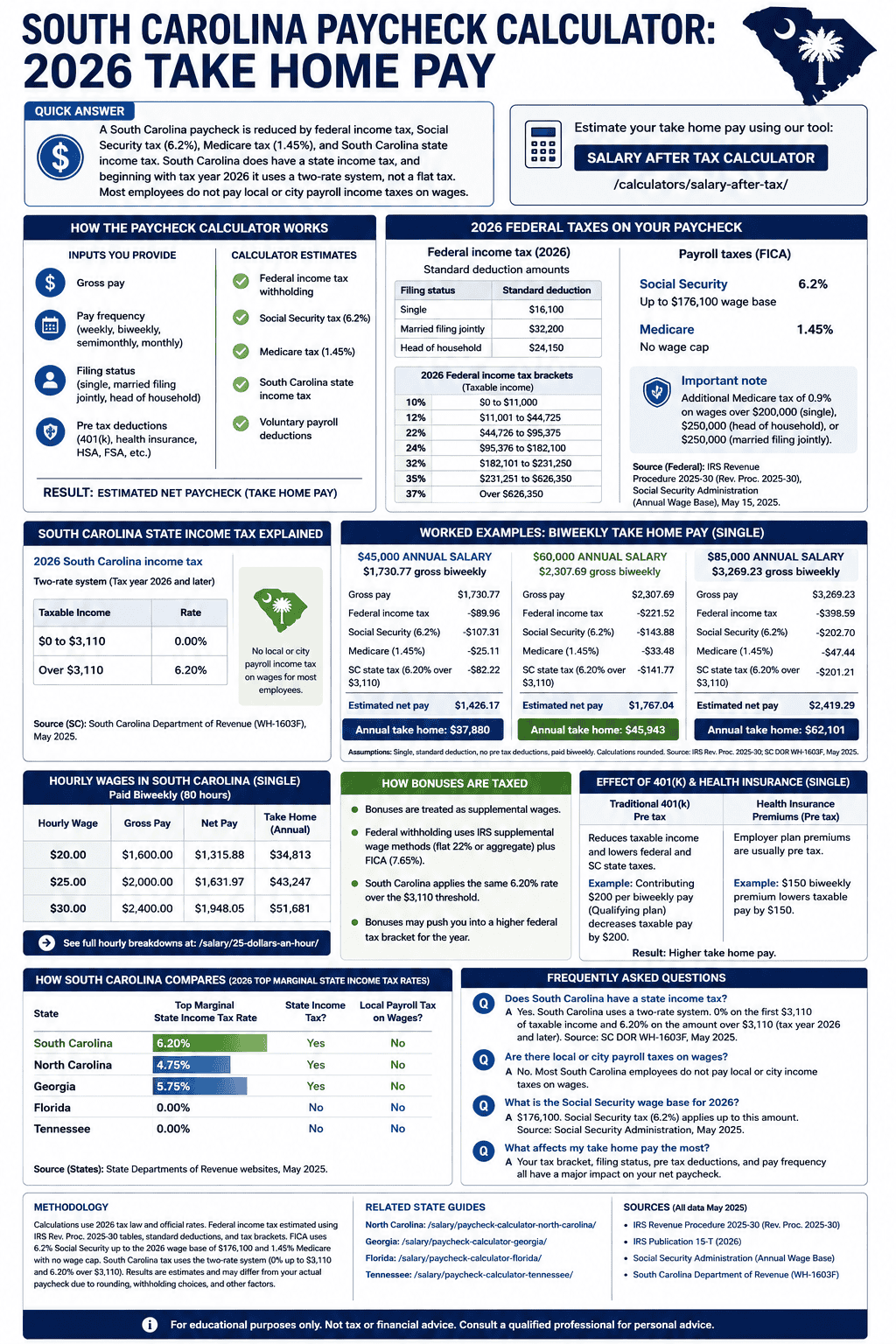
Our paycheck calculator south carolina guide helps you estimate 2026 take home pay after federal, FICA, and South Carolina taxes. South Carolina does have a state income tax and, beginning with tax year 2026, uses a 1.99% rate on the first $30,000 of taxable income and 5.21% above that threshold. The state does not impose local or city payroll taxes on wages.

Paycheck calculator south carolina: South Carolina paycheck calculator
A South Carolina paycheck calculator estimates how much of your gross pay you actually keep after required taxes and payroll deductions. Enter your salary or hourly wage, pay frequency, filing status, and any pre-tax deductions to see your estimated net paycheck. You can also use the salary after tax calculator for a customized estimate.
How the paycheck calculator works
A paycheck calculator estimates your take home pay using four main inputs:
- Gross pay (annual salary or hourly rate multiplied by hours)
- Pay frequency such as weekly, biweekly, semimonthly, or monthly
- Federal filing status (single, married filing jointly, or head of household)
- Pre-tax deductions such as traditional 401(k) contributions or employer health insurance premiums
The calculator then applies federal income tax withholding, Social Security tax, Medicare tax, and South Carolina state income tax to your gross pay. Any voluntary pre-tax deductions are subtracted before taxes are computed on the reduced amount. The final result is your estimated net paycheck, also called take home pay.
2026 federal taxes on your paycheck
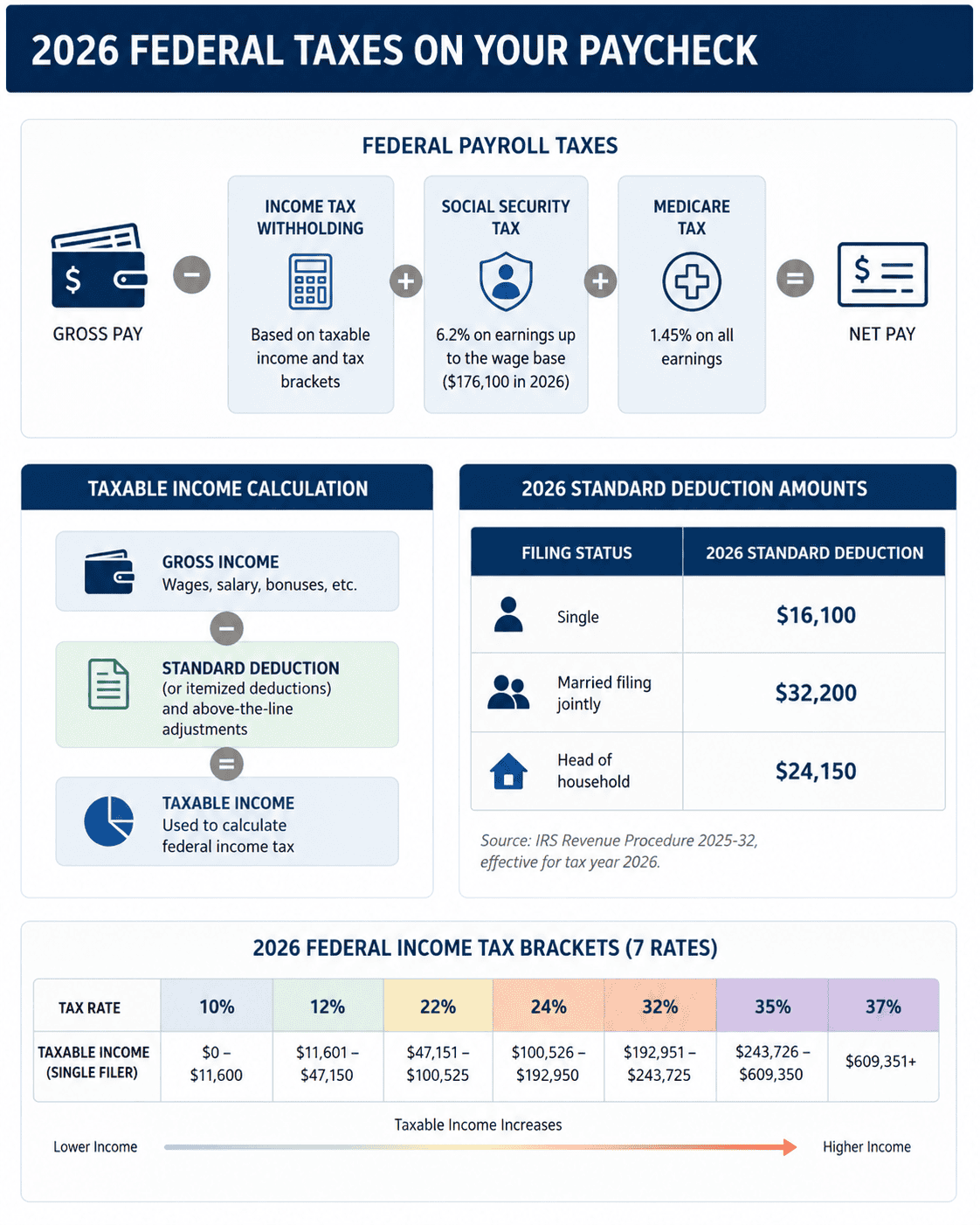
Every South Carolina employee pays federal payroll taxes unless a specific exemption applies. Federal deductions include income tax withholding, Social Security tax, and Medicare tax.
Federal income tax brackets
Federal income tax is calculated on your taxable income, which equals gross income minus your standard deduction (or itemized deductions) and any above the line adjustments. For tax year 2026, the IRS standard deduction amounts are:
| Filing status | 2026 standard deduction |
|---|---|
| Single | $16,100 |
| Married filing jointly | $32,200 |
| Head of household | $24,150 |
Source: IRS Revenue Procedure 2025-32, effective for tax year 2026.
The seven federal income tax rates for 2026 are 10%, 12%, 22%, 24%, 32%, 35%, and 37%. These rates apply progressively, meaning each rate only applies to the portion of income within that bracket.
| Tax rate | Single filer taxable income | Married filing jointly taxable income |
|---|---|---|
| 10% | $0 to $12,400 | $0 to $24,800 |
| 12% | $12,401 to $50,400 | $24,801 to $100,800 |
| 22% | $50,401 to $105,700 | $100,801 to $211,400 |
| 24% | $105,701 to $201,775 | $211,401 to $403,550 |
| 32% | $201,776 to $256,225 | $403,551 to $512,450 |
| 35% | $256,226 to $640,600 | $512,451 to $768,700 |
| 37% | $640,601 or more | $768,701 or more |
Source: IRS Revenue Procedure 2025-32.
Social Security tax
Employees pay 6.2% of wages up to the 2026 Social Security wage base of $184,500. Wages above that limit are not subject to Social Security tax. The maximum employee Social Security tax for 2026 is $11,439. Source: IRS Topic 751 and the Social Security Administration 2026 COLA fact sheet.
Medicare tax
Employees pay 1.45% on all wages with no cap. An additional 0.9% Medicare surtax applies to wages above $200,000 for single filers ($250,000 for married filing jointly). Source: IRS Topic 751.
South Carolina state income tax explained
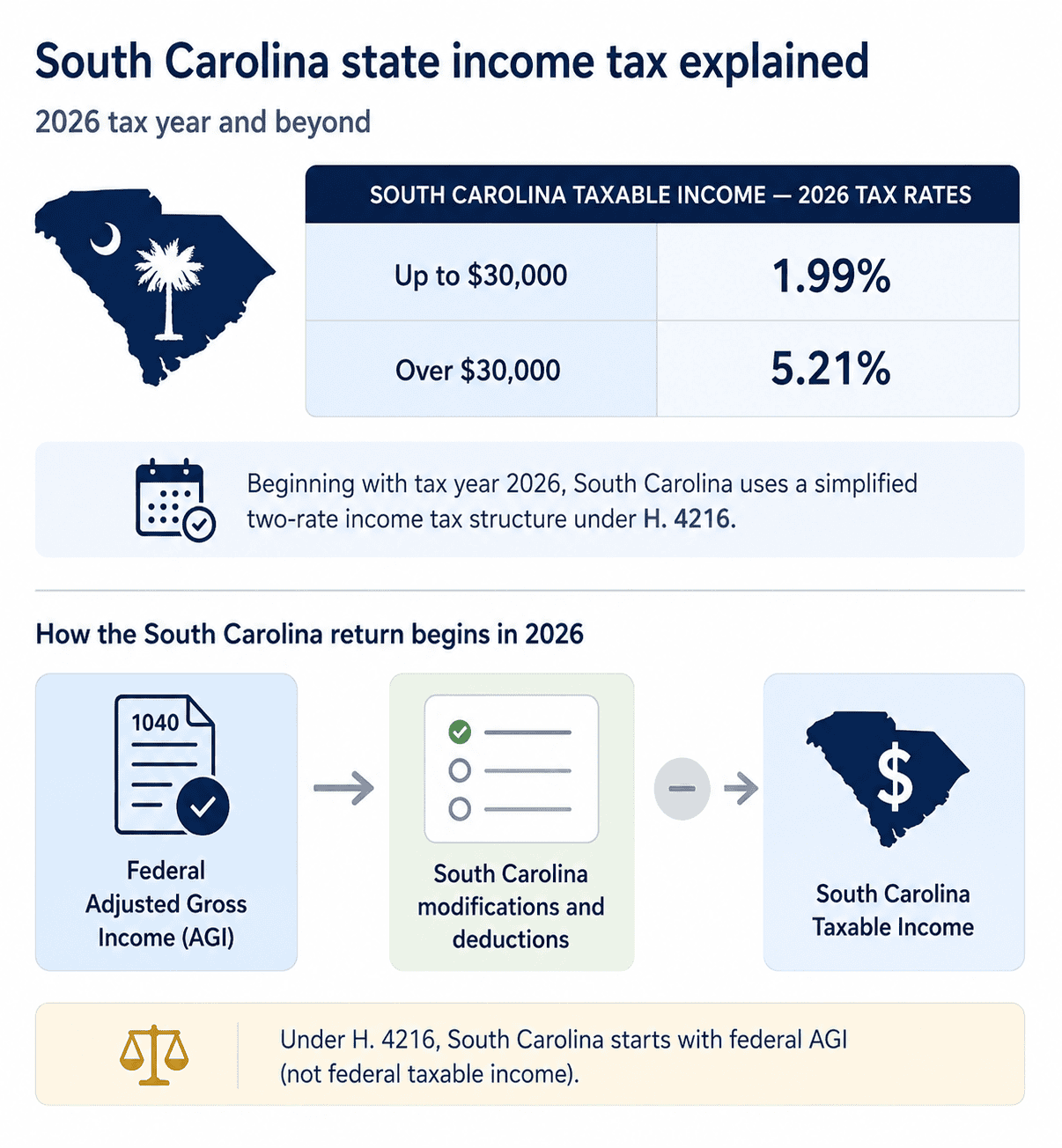
South Carolina taxes wage income earned by residents and certain nonresidents. Beginning with tax year 2026, South Carolina moved to a simplified two rate income tax structure under H. 4216, signed into law on March 30, 2026 by Governor Henry McMaster. This replaced the state’s previous multi-bracket system.
| South Carolina taxable income | 2026 tax rate |
|---|---|
| Up to $30,000 | 1.99% |
| Over $30,000 | 5.21% |
Source: South Carolina Department of Revenue, Information about H. 4216, effective for tax year 2026.
Under H. 4216, the South Carolina return now begins with federal adjusted gross income (AGI) rather than federal taxable income. The law also creates a new South Carolina Income Adjusted Deduction (SCIAD) in place of the federal standard and itemized deductions. Employers use the official withholding formulas published by the South Carolina Department of Revenue to calculate state tax withholding each pay period.
The legislation also establishes revenue triggered rate reductions beginning in 2027. If individual income tax revenue grows by at least 5%, the 5.21% rate will decrease incrementally until it merges with the 1.99% rate.
Does South Carolina have local payroll taxes?
No. South Carolina does not impose local or city income taxes on employee wages. Your state level tax obligation is limited to the two rate structure described above.
Worked examples: biweekly take home pay
The following examples assume a single filer taking the 2026 federal standard deduction ($16,100), no pre-tax deductions, and no additional withholding. South Carolina state tax is computed using the simplified two rate formula applied to gross wages. Actual withholding may differ based on your W-4 elections, SCIAD amount, and payroll settings.
$45,000 annual salary
Step 1: Federal income tax
10% on the first $12,400 = $1,240. Then 12% on the remaining $16,500 = $1,980.
Step 2: FICA taxes
Step 3: South Carolina state income tax
Step 4: Take home pay
$60,000 annual salary
Step 1: Federal income tax
10% on $12,400 = $1,240. Then 12% on $31,500 = $3,780.
Step 2: FICA taxes
Step 3: South Carolina state income tax
Step 4: Take home pay
$85,000 annual salary
Step 1: Federal income tax
10% on $12,400 = $1,240. Then 12% on $38,000 = $4,560. Then 22% on $18,500 = $4,070.
Step 2: FICA taxes
Step 3: South Carolina state income tax
Step 4: Take home pay
| Annual salary | Federal tax | FICA | SC state tax | Annual take home | Biweekly take home |
|---|---|---|---|---|---|
| $45,000 | $3,220 | $3,443 | $1,379 | $36,958 | $1,422 |
| $60,000 | $5,020 | $4,590 | $2,160 | $48,230 | $1,855 |
| $85,000 | $9,870 | $6,503 | $3,463 | $65,164 | $2,506 |
Estimates for a single filer with the 2026 federal standard deduction and no pre-tax deductions. SC state tax uses the simplified two rate formula on gross wages. Actual withholding depends on W-4 elections, the SCIAD, and employer payroll settings.
Hourly wages in South Carolina
Using the standard assumption of 40 hours per week and 52 weeks per year, here is what common hourly rates look like before and after estimated taxes in South Carolina for a single filer.
| Hourly wage | Annual gross pay | Estimated annual take home | Estimated monthly take home |
|---|---|---|---|
| $20 | $41,600 | $34,405 | $2,867 |
| $25 | $52,000 | $42,219 | $3,518 |
| $30 | $62,400 | $49,858 | $4,155 |
Assumes 40 hours per week, 52 weeks per year, single filer, 2026 federal standard deduction, no pre-tax deductions. SC state tax uses the two rate formula on gross wages.
See the detailed guide on $25 an hour for a complete breakdown of that wage level.
How bonuses are taxed in South Carolina
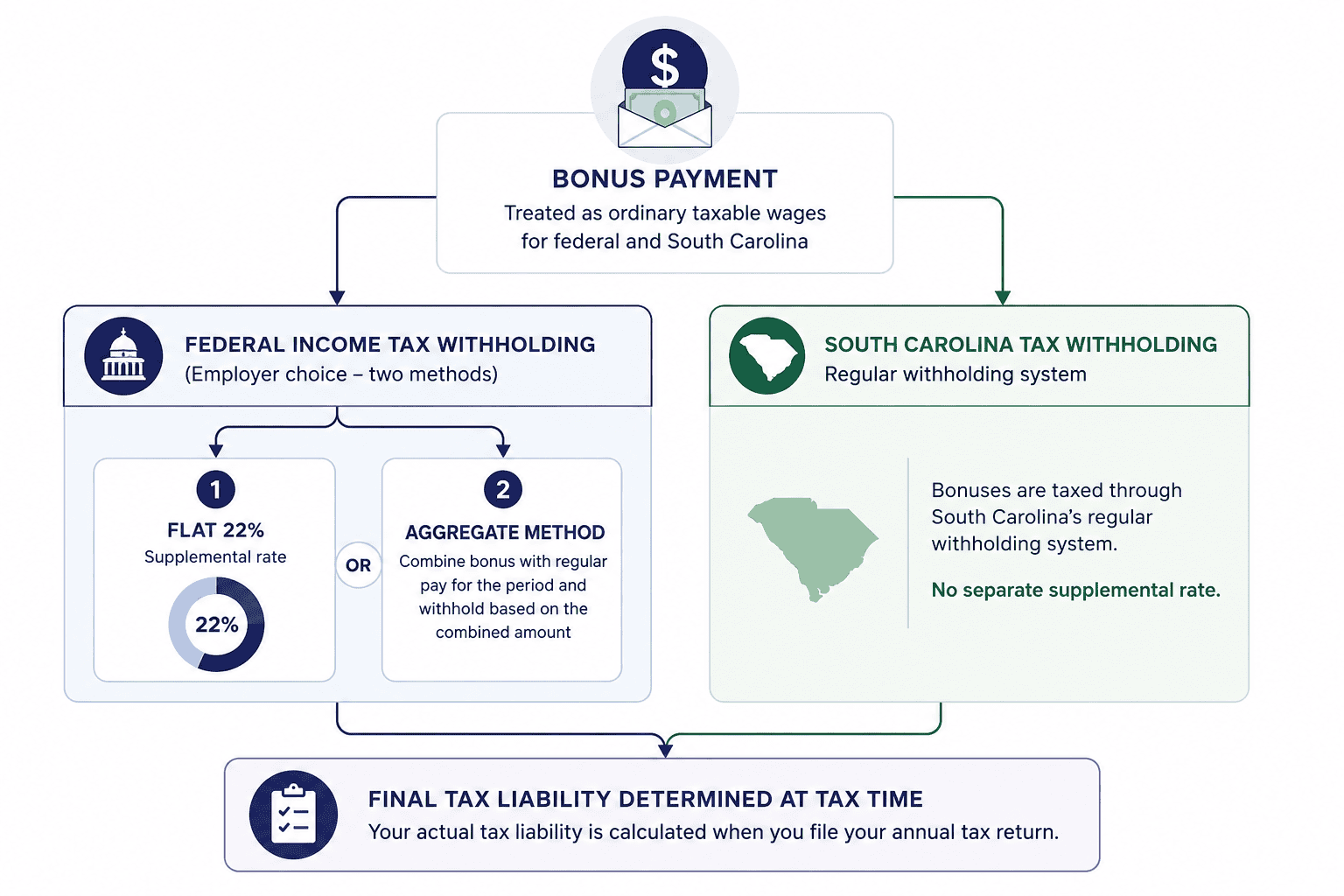
Bonuses are treated as ordinary taxable wages for both federal and South Carolina purposes. The IRS allows employers to withhold federal income tax on supplemental wages (including bonuses) using one of two methods: a flat 22% supplemental rate, or the aggregate method that combines the bonus with your regular pay for that period and withholds based on the combined amount. Source: IRS Publication 15 (Circular E).
South Carolina also taxes bonus income through its regular withholding system. The state does not apply a separate supplemental rate. Regardless of how your employer withholds, your final tax liability is determined when you file your annual federal and state returns.
A bonus may appear to be taxed at a higher rate because of the withholding method your employer uses. When you file your return, the bonus is simply added to your other income and taxed at your actual marginal rate.
Effect of 401(k) and health insurance premiums
Traditional 401(k) contributions reduce your federal taxable wages and generally reduce your South Carolina taxable income as well. Under H. 4216, South Carolina begins its tax calculation from federal adjusted gross income, which already reflects pre-tax retirement contributions. This means a traditional 401(k) contribution lowers both your federal and South Carolina income tax withholding.
However, traditional 401(k) contributions do not reduce Social Security or Medicare wages. FICA taxes still apply to the full gross amount.
Employer sponsored health insurance premiums deducted before taxes under a qualifying Section 125 cafeteria plan typically reduce federal income tax, South Carolina income tax, and FICA taxes. This makes health insurance premiums one of the most tax efficient payroll deductions available.
For example, a worker earning $60,000 who contributes $5,000 to a traditional 401(k) would have a federal taxable income of $38,900 ($60,000 minus $16,100 standard deduction minus $5,000 contribution) instead of $43,900. That reduces the federal tax bill and the SC state tax bill, increasing take home pay compared with making the same contribution on an after tax basis. The paycheck calculator south carolina guide explains how state and federal taxes affect your take-home pay.
How South Carolina compares with neighboring states
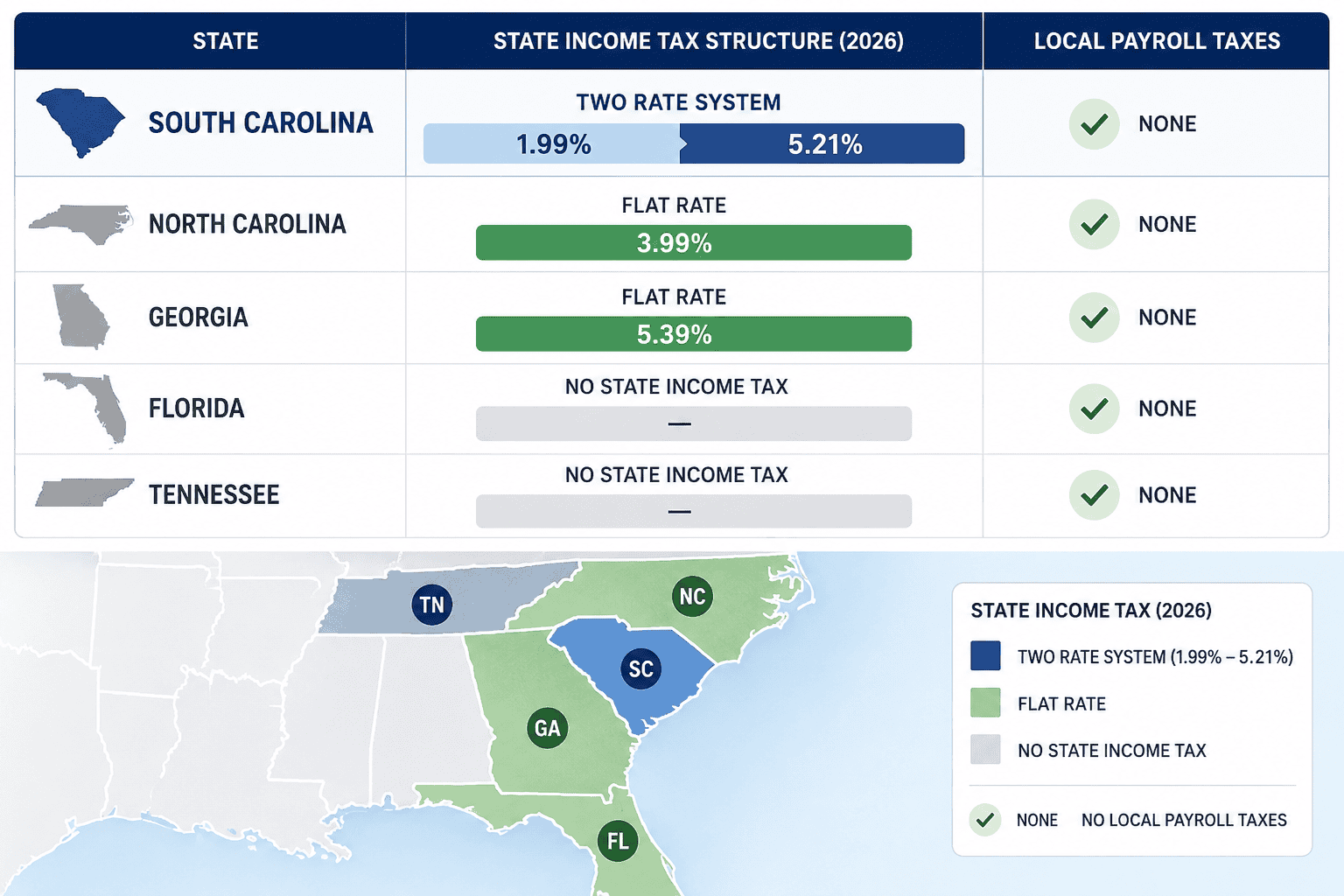
| State | State income tax structure (2026) | Local payroll taxes |
|---|---|---|
| South Carolina | Two rate system (1.99% and 5.21%) | None |
| North Carolina | Flat rate (3.99%) | None |
| Georgia | Flat rate (5.39%) | None |
| Florida | No state income tax | None |
| Tennessee | No state income tax | None |
Rates are for tax year 2026. Employees considering a move between neighboring states may want to compare both state income tax rates and overall cost of living before making a decision.
Florida and Tennessee do not tax wage income at the state level, so workers in those states keep more per paycheck when all other factors are equal. North Carolina’s flat 3.99% rate is lower than South Carolina’s top rate of 5.21%, though South Carolina’s lower first bracket (1.99% on the first $30,000) benefits workers with modest incomes. A paycheck calculator south carolina result changes if you adjust 401(k) contributions or filing status.
Frequently asked questions
How much is taken out of my paycheck in South Carolina?
Most workers have four types of deductions: federal income tax, Social Security tax (6.2% up to $184,500), Medicare tax (1.45%), and South Carolina state income tax (1.99% on the first $30,000 and 5.21% above that). The exact amount depends on your earnings, filing status, W-4 elections, and any pre-tax deductions you have elected.
What is the South Carolina income tax rate in 2026?
Beginning with tax year 2026 under H. 4216, South Carolina uses a two rate system: 1.99% on the first $30,000 of taxable income and 5.21% on taxable income above $30,000. This replaced the state’s previous multi-bracket system. Source: South Carolina Department of Revenue.
How much is $60,000 a year after taxes in South Carolina?
A single filer earning $60,000 with no pre-tax deductions may take home approximately $48,230 per year, or about $1,855 per biweekly paycheck. This estimate includes federal income tax, FICA, and South Carolina state income tax. Actual results vary depending on your withholding elections and deductions.
How are bonuses taxed in South Carolina?
Bonuses are treated as ordinary taxable wage income. For federal purposes, your employer may withhold at a flat 22% supplemental rate or use the aggregate method. South Carolina taxes bonus income through its regular withholding system. Your final tax liability is reconciled when you file your annual return.
How do 401(k) contributions change take home pay in South Carolina?
Traditional 401(k) contributions reduce both federal and South Carolina taxable income because the state starts its calculation from federal adjusted gross income. This means pre-tax retirement contributions lower your income tax withholding at both levels, increasing your net paycheck. However, 401(k) contributions do not reduce Social Security or Medicare taxes. Use the paycheck calculator south carolina tool before accepting a new job offer or pay increase.
Methodology
The estimates in this guide use the following 2026 tax parameters:
- Federal income tax brackets and standard deductions from IRS Revenue Procedure 2025-32
- Employee FICA rates of 6.2% for Social Security (on wages up to the $184,500 wage base) and 1.45% for Medicare, per IRS Topic 751 and the SSA 2026 COLA fact sheet
- South Carolina 2026 two rate income tax structure (1.99% and 5.21%) from SC Department of Revenue, H. 4216 guidance
- Standard assumption of 40 hours per week and 52 weeks per year for hourly wage conversions
All worked examples assume a single filer taking the federal standard deduction with no pre-tax deductions. South Carolina state tax in the simplified examples is applied to gross wages using the two rate formula. Actual withholding follows the official SCDOR withholding tables and the SCIAD, which may produce slightly different results. These estimates are for educational comparison only and should not be used as a substitute for your actual payroll calculations.
This content is for educational purposes only and does not constitute personalized financial advice. Consult a qualified financial advisor for guidance specific to your situation.
By Nathan Whitmore for MoneyFN A paycheck calculator south carolina estimate helps you compare different salary and withholding scenarios.

Nathan Whitmore is a US based personal finance writer at MoneyFN covering salary, paycheck, and tax math for American workers. He works from primary sources only: IRS revenue procedures, Bureau of Labor Statistics wage data, and Federal Reserve statistics. Every figure he publishes is dated and traceable to a public source.