

27 dollars an hour is how much a year? If you earn $27 per hour and work 40 hours a week for 52 weeks, your gross annual pay is $56,160 before taxes. After estimated 2026 federal income tax and FICA for a single filer, take-home pay is roughly $47,305 per year, or about $3,942 per month, though your actual pay depends on overtime, filing status, and state taxes.
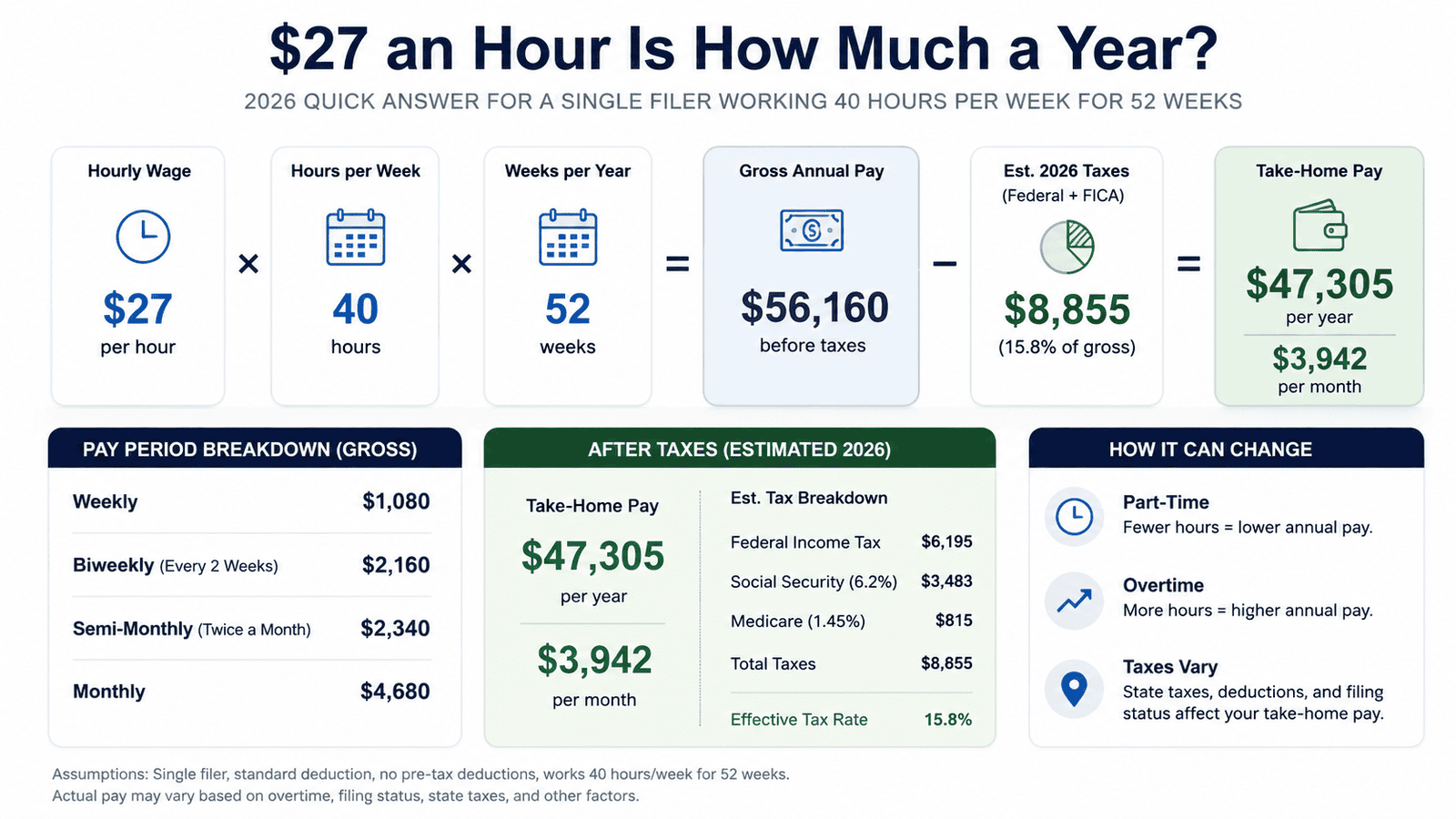
27 dollars an hour is how much a year: $27 an hour salary calculator
The math: how to convert $27 an hour to a yearly salary
The standard formula for converting an hourly wage into an annual salary is straightforward.
The number 2,080 (40 hours times 52 weeks) is the figure the U.S. Office of Personnel Management and the Bureau of Labor Statistics use as the benchmark for a full time work year. It does not subtract holidays, vacation days, or sick leave because those are considered paid time off for most salaried and many hourly positions. If your employer does not offer paid time off and you take two weeks unpaid, your working year drops to 50 weeks and your annual gross falls to $54,000.
You can run your own numbers with our hourly to salary calculator.
$27 an hour broken down by pay period
| Pay period | Calculation | Gross pay |
|---|---|---|
| Hourly | Base rate | $27.00 |
| Daily (8 hours) | $27 × 8 | $216.00 |
| Weekly (40 hours) | $27 × 40 | $1,080.00 |
| Biweekly (80 hours) | $27 × 80 | $2,160.00 |
| Semimonthly | $56,160 ÷ 24 | $2,340.00 |
| Monthly | $56,160 ÷ 12 | $4,680.00 |
| Annual (52 weeks) | $27 × 2,080 | $56,160.00 |
If you are paid biweekly, you will receive 26 paychecks per year. Two months each year will contain three paydays instead of two, which can help with budgeting or building savings if you plan for it.
What $27 an hour looks like after federal taxes in 2026
Below is a full step by step federal tax estimate for a single filer with no dependents taking the standard deduction. For married filing jointly, head of household, or other filing statuses, use our salary after tax calculator.
Step 1: determine gross annual income
Step 2: subtract the 2026 standard deduction
The standard deduction for a single filer in tax year 2026 is $16,100 (IRS Revenue Procedure 2025‑32, published 2025).
Step 3: apply the 2026 federal income tax brackets
The seven federal income tax rates for 2026 remain at 10%, 12%, 22%, 24%, 32%, 35%, and 37% (IRS Revenue Procedure 2025‑32). For a single filer with $40,060 in taxable income, only the first two brackets apply.
| Bracket | Rate | Taxable amount | Tax owed |
|---|---|---|---|
| $0 to $12,400 | 10% | $12,400 | $1,240.00 |
| $12,401 to $40,060 | 12% | $27,660 | $3,319.20 |
| Total federal income tax | $4,559.20 |
That works out to an effective federal income tax rate of about 8.1% on gross income.
Step 4: calculate FICA taxes
FICA stands for the Federal Insurance Contributions Act. It funds Social Security and Medicare and is calculated on your full gross wages, not your taxable income after the standard deduction (IRS Topic No. 751, updated 2026).
- Social Security tax: 6.2% of $56,160 = $3,481.92 (the 2026 wage base cap is $184,500, so the full amount is subject to this tax)
- Medicare tax: 1.45% of $56,160 = $814.32
- Total FICA: $4,296.24
Step 5: estimated take home pay
| Tax type | Annual amount |
|---|---|
| Federal income tax | $4,559.20 |
| Social Security (6.2%) | $3,481.92 |
| Medicare (1.45%) | $814.32 |
| Total federal taxes | $8,855.44 |
| Estimated annual take home (federal only) | $47,305 |
| Estimated monthly take home (federal only) | $3,942 |
This estimate does not include state income tax, local income tax, or pretax deductions such as 401(k) contributions and health insurance premiums. All of those would change your take home figure.
In a state with no income tax, such as Texas, your take home would remain close to the figure above. See our Texas paycheck calculator for a state specific breakdown.
$27 an hour working part time
Not everyone works a 40 hour week. Here is what $27 an hour looks like at two common part time schedules.
Working 30 hours per week at $27 an hour would cut your annual gross by $14,040 compared to the full time figure. That is a meaningful difference for budgeting and retirement savings, although you may qualify for a lower effective tax rate on less income.
How overtime changes the picture
Under the Fair Labor Standards Act, most hourly employees must be paid at least 1.5 times their regular rate for every hour worked beyond 40 in a single workweek. At $27 an hour, your overtime rate would be $40.50 per hour.
Added to the $56,160 base, five hours of weekly overtime would bring your total gross to $66,690. That bump would push part of your taxable income into the 22% federal bracket for a single filer in 2026, so your effective tax rate would rise slightly as well.
Is $27 an hour a good wage in 2026?
Whether $27 an hour feels comfortable depends on where you live, your household size, and your financial goals. Here is how it stacks up against two national benchmarks.
Federal minimum wage. The federal minimum wage has been $7.25 per hour since July 2009 (U.S. Department of Labor, Wage and Hour Division). At $27 an hour you are earning roughly 3.7 times the federal floor. Many states and cities set their own minimums well above $7.25, but on a national level $27 an hour is solidly above the legal minimum.
National median wage. The Bureau of Labor Statistics reported that median weekly earnings for full time wage and salary workers were $1,233 in the first quarter of 2026 (BLS, Usual Weekly Earnings, Q1 2026 release). That translates to roughly $30.83 per hour for a 40 hour week, or about $64,116 per year. At $27 an hour you would be earning about 12% less than the national median.
That said, cost of living varies dramatically across the country. In many midwestern and southern metro areas, $56,160 goes further than $64,000 does in higher cost regions. If you live in a lower cost area, $27 an hour can cover a comfortable single person budget and still leave room for saving and investing.
Sample monthly budget on $27 an hour
Using the 50/30/20 budgeting framework on the estimated federal only monthly take home of $3,942, a simple spending plan could look like this.
| Category | Percentage | Monthly amount | What it covers |
|---|---|---|---|
| Needs | 50% | $1,971 | Rent or mortgage, utilities, groceries, insurance, minimum debt payments, transportation |
| Wants | 30% | $1,183 | Dining out, entertainment, subscriptions, hobbies, travel |
| Savings and debt payoff | 20% | $788 | Emergency fund, retirement contributions, extra debt payments |
If you live in a state that also taxes income, your monthly take home will be lower and you will need to adjust these dollar amounts accordingly. The 50/30/20 percentages stay the same; only the base number changes.
For a look at how nearby hourly rates compare, see our guides for $24 an hour, $25 an hour, $26 an hour, and $28 an hour.
Frequently asked questions
How much is $27 an hour per week?
At 40 hours per week, $27 an hour comes to $1,080 before taxes. If you work fewer hours, multiply $27 by the number of hours you typically work to find your weekly gross.
How much is $27 an hour biweekly?
A biweekly paycheck at $27 an hour and 40 hours per week is $2,160 before taxes. Over the course of a year you will receive 26 biweekly paychecks.
How much is $27 an hour per month?
Monthly gross pay at $27 an hour is $4,680 ($56,160 divided by 12). After estimated federal taxes for a single filer, the monthly take home is approximately $3,942.
Is $27 an hour enough to live on?
In many parts of the United States, $27 an hour provides enough income for a single person to cover essential expenses and save modestly. In high cost cities such as San Francisco or New York, $56,160 before taxes may feel tight. Your answer depends heavily on local housing costs, whether you have dependents, and how much debt you carry.
How much more would I earn going from $26 to $27 an hour?
One extra dollar per hour across a full time schedule adds $2,080 per year before taxes. Going from $26 to $27 an hour raises your annual gross from $54,080 to $56,160. See the full breakdown on our $26 an hour page. Knowing 27 dollars an hour is how much a year helps you compare hourly jobs with annual salary offers and plan your budget more accurately.
Methodology
All calculations on this page use a full time schedule of 40 hours per week and 52 weeks per year (2,080 working hours), which is the standard used by the Bureau of Labor Statistics and the U.S. Office of Personnel Management. Federal income tax estimates are based on the 2026 marginal tax brackets and standard deduction amounts published by the IRS in Revenue Procedure 2025‑32. FICA rates (6.2% Social Security up to the $184,500 wage base and 1.45% Medicare with no cap) are sourced from IRS Topic No. 751, updated for the 2026 tax year. The median wage comparison uses the BLS Usual Weekly Earnings release for the first quarter of 2026, published April 2026.
All tax estimates assume a single filer with one job, no dependents, no itemized deductions, and no pretax contributions. This page does not account for state or local income taxes.
This content is for educational purposes only and does not constitute personalized financial advice. Consult a qualified financial advisor for guidance specific to your situation.
By Nathan Whitmore for MoneyFN If you are wondering 27 dollars an hour is how much a year, the standard full-time calculation comes to $56,160 before taxes.

Nathan Whitmore is a US based personal finance writer at MoneyFN covering salary, paycheck, and tax math for American workers. He works from primary sources only: IRS revenue procedures, Bureau of Labor Statistics wage data, and Federal Reserve statistics. Every figure he publishes is dated and traceable to a public source.