

Our paycheck calculator Kentucky guide helps you estimate your 2026 take home pay after federal income tax, Social Security, Medicare, and Kentucky's 3.5% flat state income tax. Kentucky does not impose a statewide local income tax, although many cities and counties withhold occupational license taxes based on where you work. A single filer earning $60,000 in 2026 can expect to take home roughly $48,400 per year before any applicable local taxes.
A paycheck calculator Kentucky tool estimates how much of your gross pay you actually receive after all required payroll deductions. It combines federal withholding rules, FICA taxes, Kentucky state income tax, and any pre-tax deductions to calculate your net pay. You can also estimate your take home pay using our salary after tax calculator.
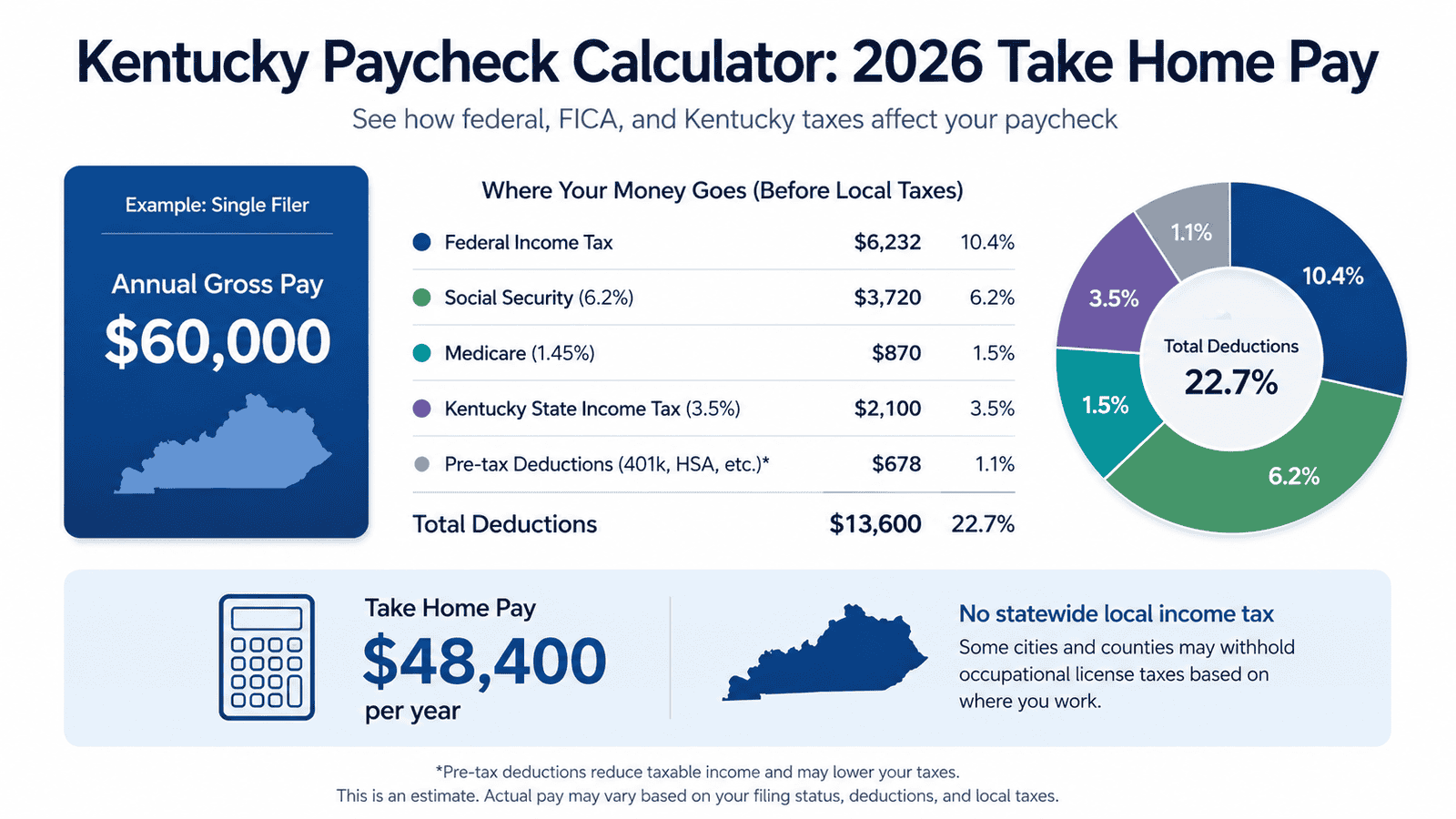
Kentucky paycheck calculator
How the paycheck calculator works
A Kentucky paycheck calculator uses the following inputs to estimate your net pay:
- Gross salary or hourly wage and the number of hours worked per pay period
- Pay frequency such as weekly, biweekly, semimonthly, or monthly
- Filing status (single, married filing jointly, or head of household)
- Pre-tax deductions such as traditional 401(k) contributions or employer sponsored health insurance premiums
From those inputs the calculator estimates federal income tax withholding, Social Security tax, Medicare tax, Kentucky state income tax, and your remaining take home pay. The exact amount withheld on each paycheck may differ slightly because employers apply IRS and Kentucky withholding formulas on a per period basis rather than simply dividing annual tax liability by the number of pay periods.
2026 federal taxes on your paycheck
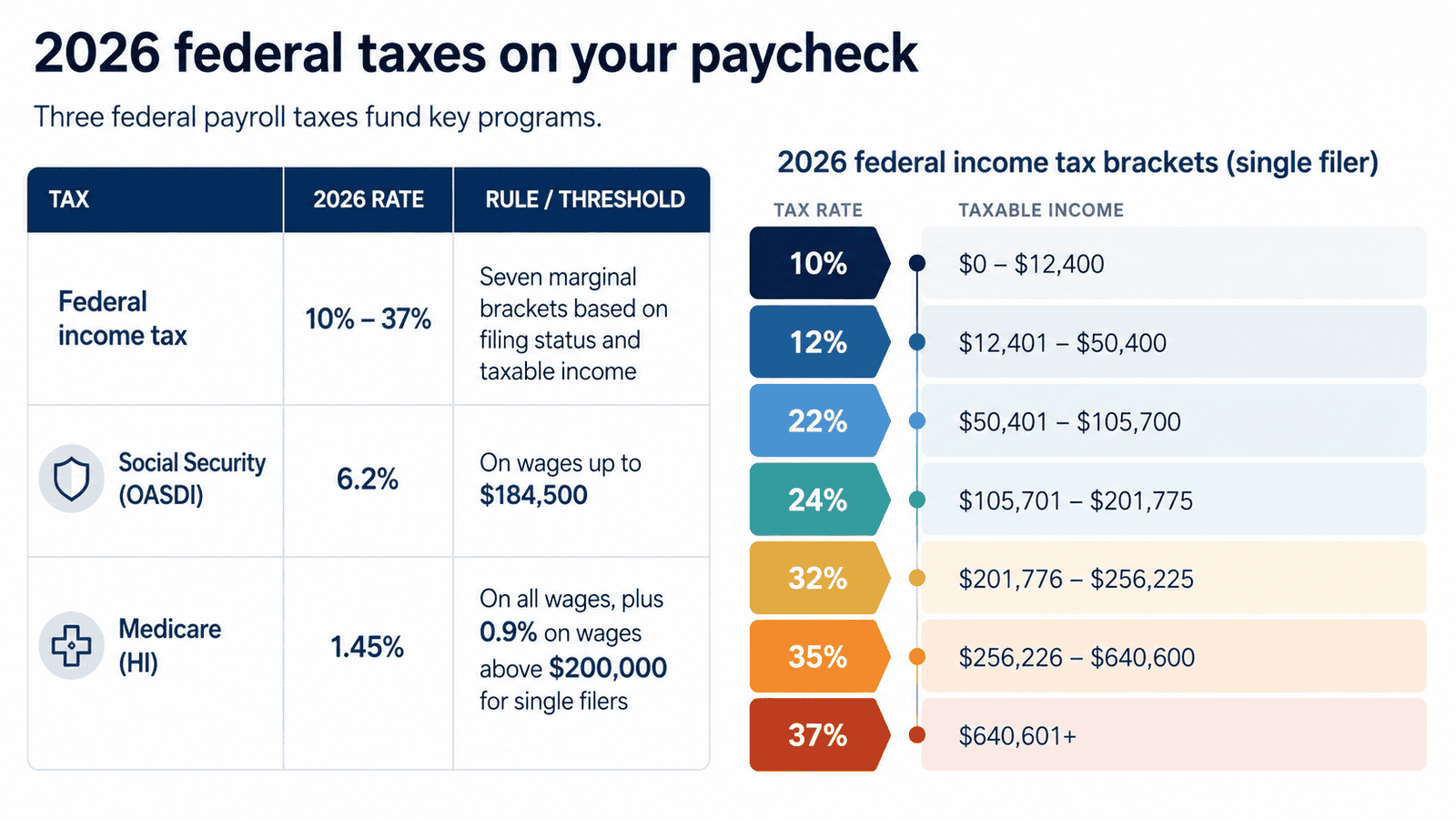
Every Kentucky employee generally pays three federal payroll taxes. The rates and thresholds below apply to tax year 2026 per IRS Revenue Procedure 2025-32.
| Tax | 2026 rate and rule |
|---|---|
| Federal income tax | Seven marginal brackets from 10% to 37%, based on filing status and taxable income |
| Social Security (OASDI) | 6.2% on wages up to $184,500 |
| Medicare (HI) | 1.45% on all wages, plus 0.9% on wages above $200,000 for single filers |
The 2026 federal income tax brackets for a single filer are 10% on the first roughly $12,400 of taxable income, 12% up to about $50,400, 22% up to about $105,700, and 24% up to about $201,775, with higher brackets applying above that. These thresholds were adjusted for inflation and reflect the permanent rate structure under the One Big Beautiful Bill Act signed in July 2025.
The 2026 standard deduction is:
- Single: $16,100
- Married filing jointly: $32,200
- Head of household: $24,150
Source: IRS tax year 2026 inflation adjustments. Social Security wage base confirmed at $184,500 by the Social Security Administration.
Kentucky state income tax explained
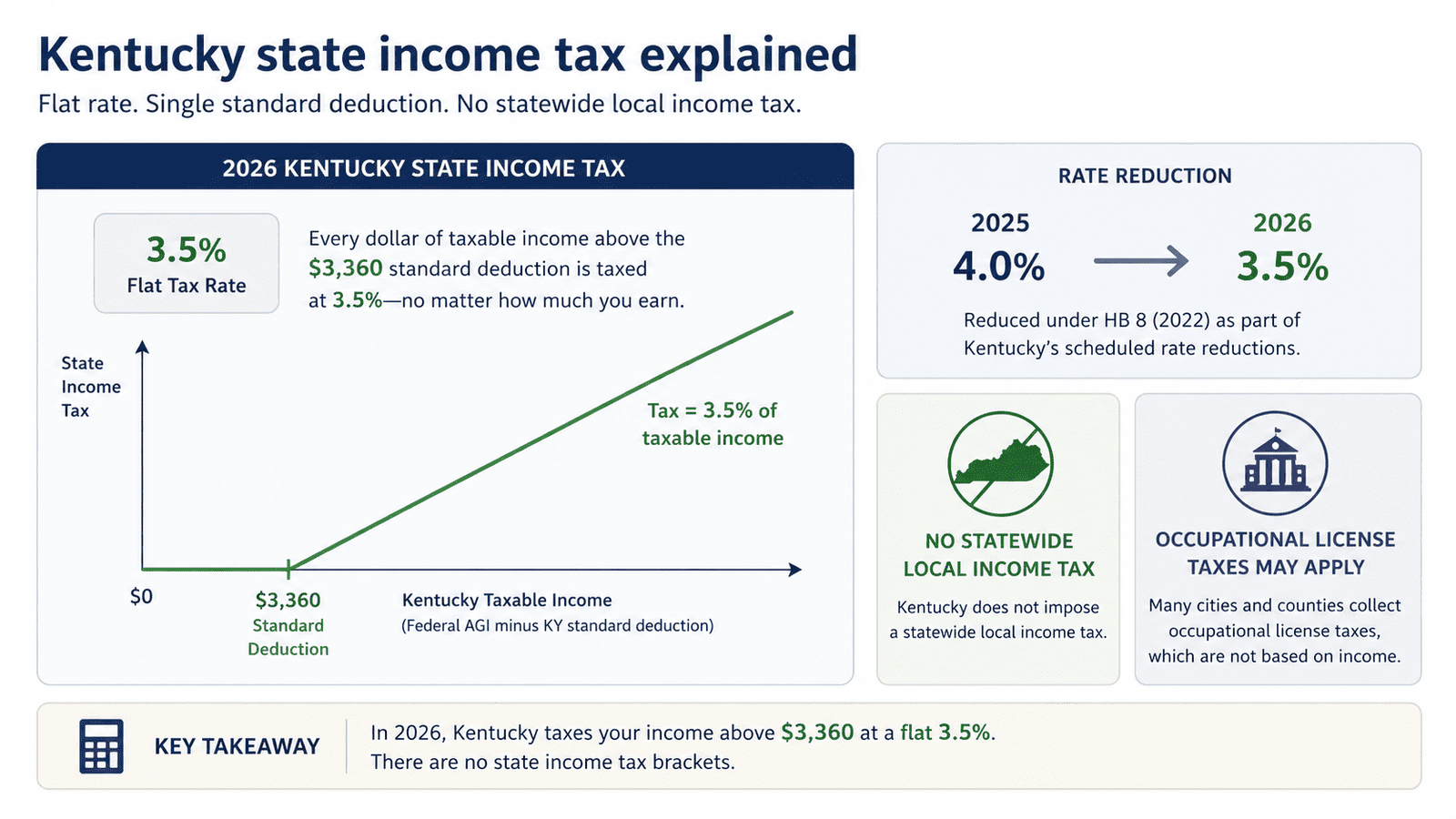
Kentucky uses a flat income tax. For tax year 2026, the rate is 3.5% of Kentucky taxable income. This is a reduction from the 4.0% rate that applied in 2025, continuing the state’s scheduled rate reductions under HB 8 (2022). The Kentucky standard deduction used in the withholding formula is $3,360 for 2026.
Kentucky does not impose a statewide local income tax. However, many cities and counties collect occupational license taxes or payroll taxes that employers withhold separately. For example, Louisville levies approximately 2.2% and Lexington levies approximately 2.25%. These local taxes depend on where you work and are not reflected in the examples below.
Source: Kentucky Department of Revenue, 2026 withholding tax formula (Form 42A003).
Worked examples
The following examples assume a single filer taking the federal standard deduction ($16,100) and the Kentucky standard deduction ($3,360), with no retirement contributions, no health insurance deductions, no local occupational taxes, and 26 biweekly pay periods per year. These are educational estimates.
Example 1: $45,000 annual salary
Federal taxable income = $45,000 − $16,100 = $28,900
| Deduction | Calculation | Annual amount |
|---|---|---|
| Social Security | 6.2% × $45,000 | $2,790 |
| Medicare | 1.45% × $45,000 | $653 |
| Kentucky income tax | 3.5% × ($45,000 − $3,360) | $1,457 |
| Federal income tax (estimated) | 10% and 12% brackets on $28,900 | $3,220 |
| Estimated annual take home | $36,880 |
Estimated biweekly paycheck = $36,880 ÷ 26 ≈ $1,418
Example 2: $60,000 annual salary
Federal taxable income = $60,000 − $16,100 = $43,900
| Deduction | Calculation | Annual amount |
|---|---|---|
| Social Security | 6.2% × $60,000 | $3,720 |
| Medicare | 1.45% × $60,000 | $870 |
| Kentucky income tax | 3.5% × ($60,000 − $3,360) | $1,982 |
| Federal income tax (estimated) | 10% and 12% brackets on $43,900 | $5,020 |
| Estimated annual take home | $48,408 |
Estimated biweekly paycheck = $48,408 ÷ 26 ≈ $1,862
Example 3: $85,000 annual salary
Federal taxable income = $85,000 − $16,100 = $68,900
| Deduction | Calculation | Annual amount |
|---|---|---|
| Social Security | 6.2% × $85,000 | $5,270 |
| Medicare | 1.45% × $85,000 | $1,233 |
| Kentucky income tax | 3.5% × ($85,000 − $3,360) | $2,857 |
| Federal income tax (estimated) | 10%, 12%, and 22% brackets on $68,900 | $9,870 |
| Estimated annual take home | $65,770 |
Estimated biweekly paycheck = $65,770 ÷ 26 ≈ $2,530
Hourly wages in Kentucky
The table below shows estimated take home pay for common hourly rates, assuming 40 hours per week, 52 weeks per year, a single filer with the standard deduction, and no pre-tax deductions or local taxes.
| Hourly wage | Annual gross pay | Estimated annual take home | Estimated biweekly pay |
|---|---|---|---|
| $20 | $41,600 | $34,270 | $1,318 |
| $25 | $52,000 | $42,260 | $1,625 |
| $30 | $62,400 | $50,250 | $1,933 |
For a closer look at what a common hourly rate looks like after taxes, see our guide on $22 an hour take home pay.
How bonuses are taxed in Kentucky
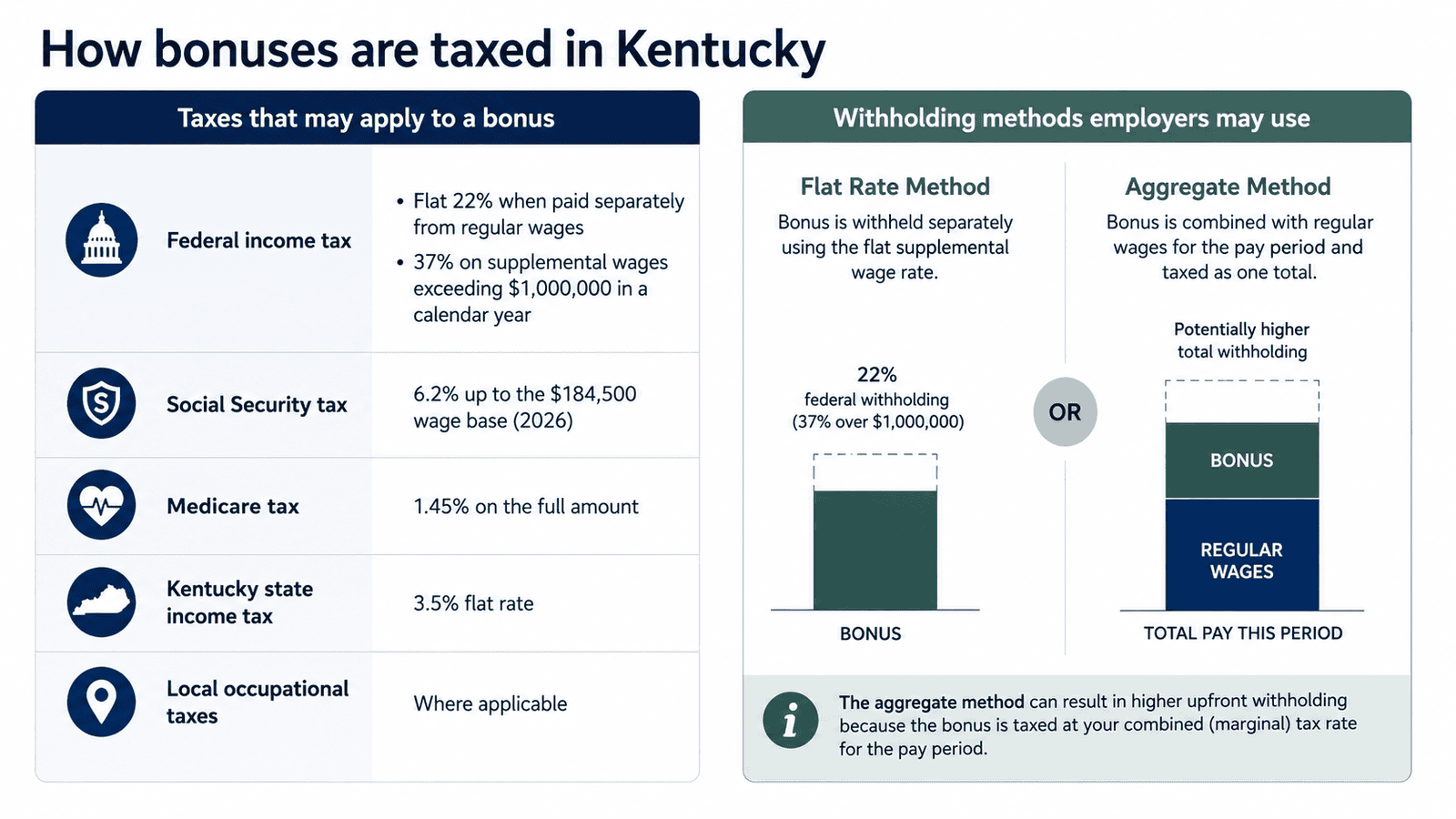
Bonuses and other supplemental wages in Kentucky are subject to:
- Federal income tax withholding at a flat 22% rate when paid separately from regular wages (or 37% on supplemental wages exceeding $1,000,000 in a calendar year), per IRS supplemental wage rules
- Social Security tax at 6.2% up to the $184,500 wage base
- Medicare tax at 1.45% on the full amount
- Kentucky state income tax at the flat 3.5% rate
- Local occupational taxes where applicable
Some employers use the aggregate method instead of the flat 22% rate, combining the bonus with regular wages for a single pay period and calculating withholding on the total. This can result in higher upfront withholding, but any overpayment is reconciled when you file your annual tax return.
Example: A $5,000 bonus in Kentucky paid separately from regular wages would have approximately $1,100 withheld for federal tax (22%), $310 for Social Security, $73 for Medicare, and $175 for Kentucky state tax, leaving roughly $3,342 before any local taxes.
Effect of 401(k) and health insurance premiums
Traditional 401(k) contributions reduce both your federal and Kentucky taxable income, which lowers your income tax withholding on each paycheck. However, 401(k) contributions generally do not reduce wages subject to Social Security or Medicare taxes.
Employer sponsored health insurance premiums paid through a Section 125 cafeteria plan typically reduce federal taxable wages, Kentucky taxable wages, and in most cases FICA wages as well.
Example: A single filer earning $60,000 who contributes $5,000 per year to a traditional 401(k) reduces their federal taxable income from $43,900 to $38,900 and their Kentucky taxable income from $56,640 to $51,640. This saves roughly $775 in combined federal and state income taxes annually, increasing take home pay by about $30 per biweekly paycheck. The paycheck calculator Kentucky helps compare salary and hourly earnings under the same tax rules.
How Kentucky compares with neighboring states
| State | State income tax structure (2026) | Guide |
|---|---|---|
| Kentucky | Flat 3.5% | This page |
| Tennessee | No state income tax on wages | Tennessee paycheck calculator |
| Indiana | Flat state income tax (plus county taxes) | Indiana paycheck calculator |
| Ohio | Progressive income tax with multiple brackets | Ohio paycheck calculator |
| Virginia | Progressive income tax with multiple brackets | Virginia paycheck calculator |
Among its neighbors, Kentucky sits in the middle of the pack. Tennessee does not tax wage income at all, making take home pay higher for equivalent salaries. Indiana also uses a flat tax but adds mandatory county income taxes. Ohio and Virginia use progressive rate structures where higher earners pay higher marginal rates. Check the paycheck calculator Kentucky after updating your W-4 or pre-tax deductions for a more accurate estimate.
Frequently asked questions
How much is taken out of my paycheck in Kentucky?
A typical Kentucky paycheck includes deductions for federal income tax (based on your bracket and filing status), Social Security tax (6.2% up to $184,500), Medicare tax (1.45%), and Kentucky’s flat 3.5% state income tax. Some workers also have local occupational taxes withheld depending on their work location. A single filer earning $60,000 loses roughly $11,592 per year to these combined taxes before any local levies.
What is the Kentucky income tax rate in 2026?
Kentucky imposes a flat 3.5% individual income tax for tax year 2026, reduced from 4.0% in 2025. The state withholding formula uses a $3,360 standard deduction before applying the flat rate. Source: Kentucky Department of Revenue, 2026 withholding formula.
How much is $60,000 a year after taxes in Kentucky?
A single filer earning $60,000 with the standard deduction and no pre-tax deductions can expect to take home approximately $48,408 per year, or about $1,862 every two weeks. This estimate includes federal income tax, Social Security, Medicare, and Kentucky’s 3.5% state tax but excludes any local occupational taxes.
How are bonuses taxed in Kentucky?
Bonuses are subject to federal income tax withholding (typically at a flat 22% when paid separately), Social Security and Medicare taxes, Kentucky’s 3.5% flat income tax, and any applicable local occupational taxes. The total withholding on a bonus often exceeds what you owe at filing time, so any overpayment is returned as a refund when you file your annual return.
How do 401(k) contributions change take home pay in Kentucky?
Traditional 401(k) contributions reduce both your federal and Kentucky taxable income, which lowers the income tax withheld from each paycheck. For example, a $5,000 annual contribution for someone in the 12% federal bracket and the 3.5% Kentucky bracket saves roughly $775 per year in income taxes. Social Security and Medicare taxes still apply to the full gross wage. The paycheck calculator Kentucky estimates federal, state, and payroll taxes using the information you enter.
Methodology
The estimates in this guide use the following 2026 tax parameters:
- IRS 2026 federal income tax brackets (seven rates from 10% to 37%) per Revenue Procedure 2025-32
- Federal standard deduction of $16,100 for single filers per the same IRS guidance
- Employee FICA rates of 6.2% Social Security (up to the $184,500 wage base per SSA) and 1.45% Medicare per IRS Topic 751
- Kentucky flat income tax rate of 3.5% with a $3,360 standard deduction per the Kentucky Department of Revenue 2026 withholding formula
All worked examples assume a single filer taking the standard deduction with no additional adjustments, credits, retirement contributions, or local payroll taxes. Actual payroll withholding will vary based on employer systems, W-4 elections, and individual circumstances.
This content is for educational purposes only and does not constitute personalized financial advice. Consult a qualified financial advisor for guidance specific to your situation.
By Nathan Whitmore for MoneyFN Use the paycheck calculator Kentucky tool before accepting a new job offer to estimate your expected take home pay.

Nathan Whitmore is a US based personal finance writer at MoneyFN covering salary, paycheck, and tax math for American workers. He works from primary sources only: IRS revenue procedures, Bureau of Labor Statistics wage data, and Federal Reserve statistics. Every figure he publishes is dated and traceable to a public source.