

New Jersey paycheck calculator
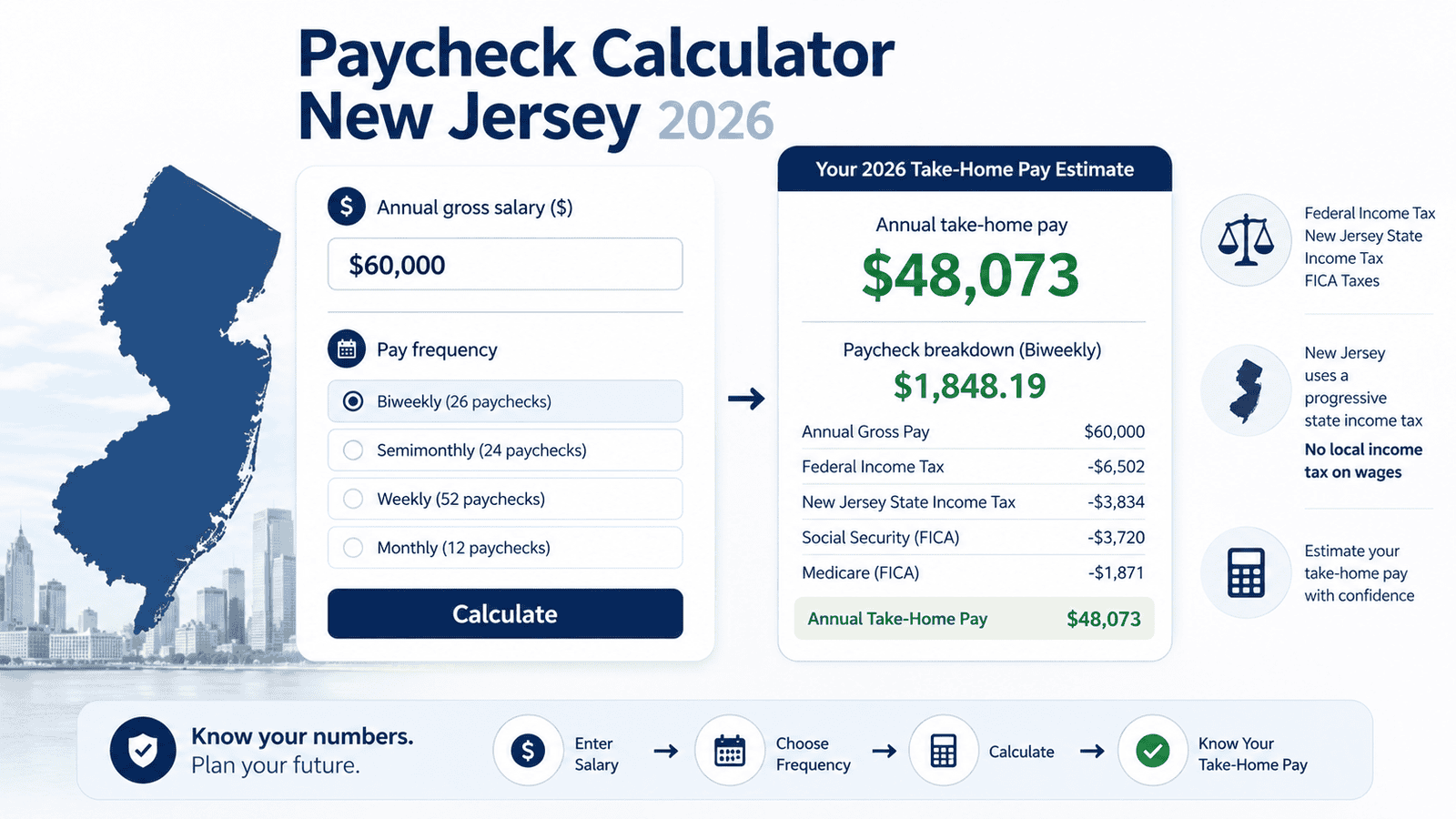
Our paycheck calculator new jersey helps you estimate your 2026 take home pay after federal income tax, New Jersey state income tax, and FICA deductions. New Jersey uses a progressive state income tax but does not levy local income taxes on wages. A single filer earning $60,000 takes home roughly $48,073 per year after mandatory taxes.
Paycheck Calculator New Jersey: Table of contents
- How the paycheck calculator works
- 2026 federal taxes on your paycheck
- New Jersey state income tax explained
- Worked examples: biweekly take home pay
- Hourly wages in New Jersey
- How bonuses are taxed in New Jersey
- Effect of 401(k) and health insurance premiums
- How New Jersey compares with neighboring states
- Frequently asked questions
- Methodology
How the paycheck calculator works
The salary after tax calculator estimates your New Jersey take home pay by applying federal, state, and payroll tax rules to your gross earnings. You provide four inputs, and the tool runs the math against the current 2026 tax schedules.
Gross pay is your total earnings before any deductions. Enter either your annual salary or your per pay period amount.
Pay frequency tells the calculator how often you receive a paycheck. Options include weekly (52 paychecks per year), biweekly (26), semimonthly (24), and monthly (12).
Filing status determines which federal and state tax brackets apply. Single filers face narrower brackets than married couples filing jointly, and head of household filers fall in between.
Pre tax deductions include contributions to employer sponsored retirement plans such as a 401(k) or 403(b), health insurance premiums, and flexible spending accounts. These reduce your taxable income before federal and state taxes are calculated, which lowers your overall tax bill.
After you enter those inputs, the calculator subtracts the 2026 standard deduction, applies the correct federal and New Jersey state tax brackets, adds FICA taxes (Social Security and Medicare), and factors in New Jersey’s mandatory employee payroll contributions for unemployment insurance, disability insurance, family leave insurance, and workforce development. The result is your estimated net pay per paycheck.
2026 federal taxes on your paycheck
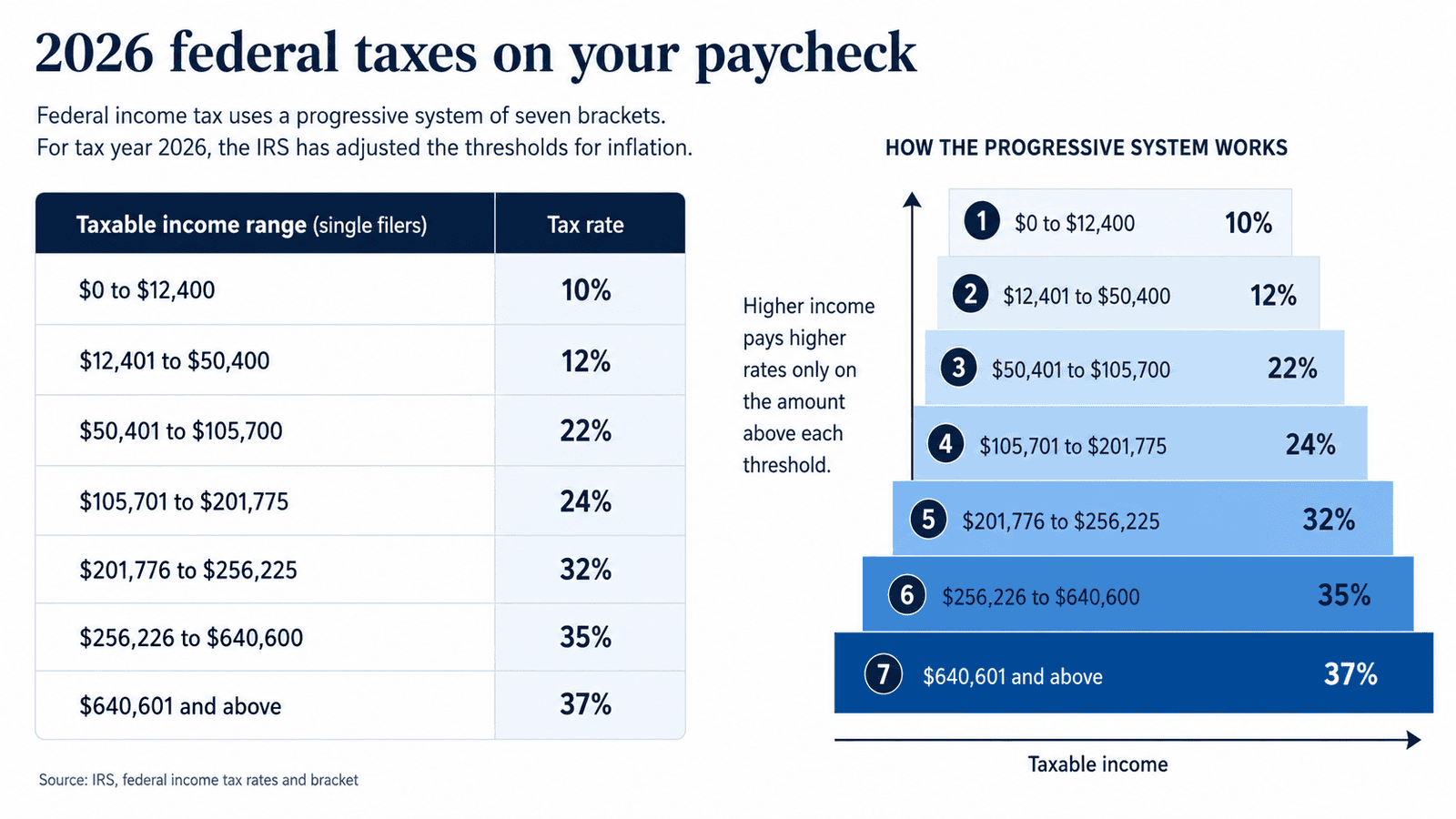
Every New Jersey paycheck is subject to federal income tax, which uses a progressive system of seven brackets. The IRS adjusts these thresholds annually for inflation. For tax year 2026, the brackets were set by Revenue Procedure 2025-32, reflecting adjustments made permanent under the One Big Beautiful Bill Act signed in July 2025 (IRS, 2026 inflation adjustments).
2026 federal income tax brackets for single filers
| Taxable income range | Tax rate |
|---|---|
| $0 to $12,400 | 10% |
| $12,401 to $50,400 | 12% |
| $50,401 to $105,700 | 22% |
| $105,701 to $201,775 | 24% |
| $201,776 to $256,225 | 32% |
| $256,226 to $640,600 | 35% |
| $640,601 and above | 37% |
Source: IRS, federal income tax rates and brackets, Revenue Procedure 2025-32, effective for tax year 2026.
The 2026 standard deduction is $16,100 for single filers and $32,200 for married couples filing jointly. This amount is subtracted from your gross income before the bracket rates apply.
FICA: Social Security and Medicare
In addition to income tax, your paycheck is subject to FICA taxes that fund Social Security and Medicare. For 2026, the employee share breaks down as follows:
Social Security: 6.2% on the first $184,500 of wages, for a maximum employee contribution of $11,439 per year.
Medicare: 1.45% on all wages, with no cap. Employees earning more than $200,000 pay an additional 0.9% Medicare surtax on wages above that threshold.
Combined, FICA takes 7.65% of your gross wages up to the Social Security wage base. Source: IRS Topic No. 751, 2026 rates.
New Jersey state income tax explained
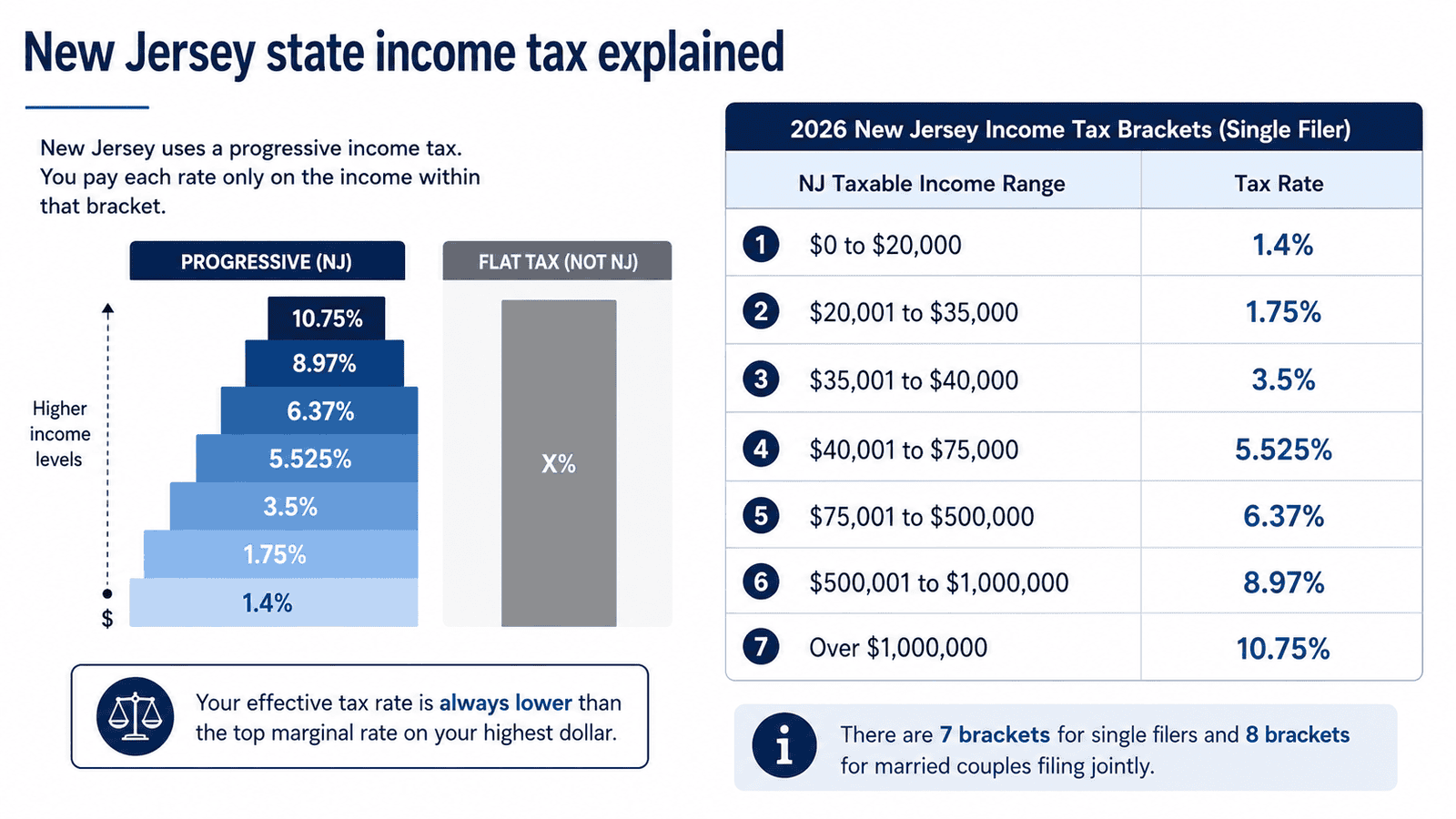
New Jersey imposes a progressive state income tax with seven brackets for single filers and eight brackets for married couples filing jointly. Rates range from 1.4% on the first $20,000 of taxable income up to 10.75% on income exceeding $1,000,000. This is not a flat tax. You pay each rate only on the income within that bracket, so the effective rate is always lower than the top marginal rate that applies to your highest dollar earned.
2026 New Jersey income tax brackets (single filer)
| NJ taxable income range | Tax rate |
|---|---|
| $0 to $20,000 | 1.4% |
| $20,001 to $35,000 | 1.75% |
| $35,001 to $40,000 | 3.5% |
| $40,001 to $75,000 | 5.525% |
| $75,001 to $500,000 | 6.37% |
| $500,001 to $1,000,000 | 8.97% |
| Over $1,000,000 | 10.75% |
Source: New Jersey Division of Taxation, NJ income tax rates, rate schedule effective 2020 and after (last updated March 2026).
New Jersey has no local or city income taxes on wages. Unlike New York, where residents may owe separate city taxes, every New Jersey wage earner pays the same state schedule regardless of which municipality they live or work in.
New Jersey employee payroll taxes
Beyond the state income tax, New Jersey employees also pay mandatory contributions to four state insurance programs. For calendar year 2026, these rates are:
| Program | Employee rate | 2026 wage base |
|---|---|---|
| Unemployment insurance (UI) | 0.425% | $44,800 |
| Workforce development (WF/SWF) | 0.1175% | $44,800 |
| Temporary disability insurance (TDI) | 0.19% | $171,100 |
| Family leave insurance (FLI) | 0.23% | $171,100 |
Source: NJ Department of Labor, rate information, calendar year 2026.
These amounts are relatively small per paycheck but do reduce your take home pay. On a $60,000 salary, the combined NJ payroll contributions total roughly $495 per year.
Worked examples: biweekly take home pay
The following step by step calculations assume a single filer claiming the standard deduction, with no pre tax deductions, paid biweekly (26 pay periods per year). All figures use the 2026 federal and New Jersey rates sourced above.
$45,000 annual salary
Step 1: Federal income tax. Subtract the $16,100 standard deduction from $45,000 to get $28,900 in taxable income. Apply the brackets: 10% on the first $12,400 equals $1,240, and 12% on the remaining $16,500 equals $1,980. Total federal income tax: $3,220.
Step 2: FICA. Social Security at 6.2% of $45,000 equals $2,790. Medicare at 1.45% of $45,000 equals $652.50. Total FICA: $3,442.50.
Step 3: New Jersey state income tax. Apply the NJ brackets to $45,000: 1.4% on $20,000 ($280) plus 1.75% on $15,000 ($262.50) plus 3.5% on $5,000 ($175) plus 5.525% on $5,000 ($276.25). Total NJ income tax: $993.75.
Step 4: NJ employee payroll. UI: $190.40, WF: $52.64, TDI: $85.50, FLI: $103.50. Total: $432.04.
$45,000 gross pay
minus $3,220 federal income tax
minus $3,442.50 FICA
minus $993.75 NJ state income tax
minus $432.04 NJ payroll
= $36,911.71 annual take home pay
= $1,419.68 per biweekly paycheck
$60,000 annual salary
Step 1: Federal income tax. Taxable income: $60,000 minus $16,100 equals $43,900. Apply the brackets: 10% on $12,400 ($1,240) plus 12% on $31,500 ($3,780). Total federal income tax: $5,020.
Step 2: FICA. Social Security: $3,720. Medicare: $870. Total: $4,590.
Step 3: New Jersey state income tax. Apply the NJ brackets to $60,000: 1.4% on $20,000 ($280) plus 1.75% on $15,000 ($262.50) plus 3.5% on $5,000 ($175) plus 5.525% on $20,000 ($1,105). Total NJ income tax: $1,822.50.
Step 4: NJ employee payroll. UI: $190.40, WF: $52.64, TDI: $114, FLI: $138. Total: $495.04.
$60,000 gross pay
minus $5,020 federal income tax
minus $4,590 FICA
minus $1,822.50 NJ state income tax
minus $495.04 NJ payroll
= $48,072.46 annual take home pay
= $1,849.71 per biweekly paycheck
$85,000 annual salary
Step 1: Federal income tax. Taxable income: $85,000 minus $16,100 equals $68,900. Apply the brackets: 10% on $12,400 ($1,240) plus 12% on $38,000 ($4,560) plus 22% on $18,500 ($4,070). Total federal income tax: $9,870.
Step 2: FICA. Social Security: $5,270. Medicare: $1,232.50. Total: $6,502.50.
Step 3: New Jersey state income tax. Apply the NJ brackets to $85,000: 1.4% on $20,000 ($280) plus 1.75% on $15,000 ($262.50) plus 3.5% on $5,000 ($175) plus 5.525% on $35,000 ($1,933.75) plus 6.37% on $10,000 ($637). Total NJ income tax: $3,288.25.
Step 4: NJ employee payroll. UI: $190.40, WF: $52.64, TDI: $161.50, FLI: $195.50. Total: $600.04.
$85,000 gross pay
minus $9,870 federal income tax
minus $6,502.50 FICA
minus $3,288.25 NJ state income tax
minus $600.04 NJ payroll
= $64,739.21 annual take home pay
= $2,489.97 per biweekly paycheck
Biweekly take home summary
| Annual salary | Total annual taxes | Annual take home | Biweekly take home |
|---|---|---|---|
| $45,000 | $8,088 | $36,912 | $1,420 |
| $60,000 | $11,928 | $48,072 | $1,850 |
| $85,000 | $20,261 | $64,739 | $2,490 |
Figures rounded to the nearest dollar. All calculations assume a single filer with the 2026 standard deduction and no additional pre tax deductions.
Hourly wages in New Jersey
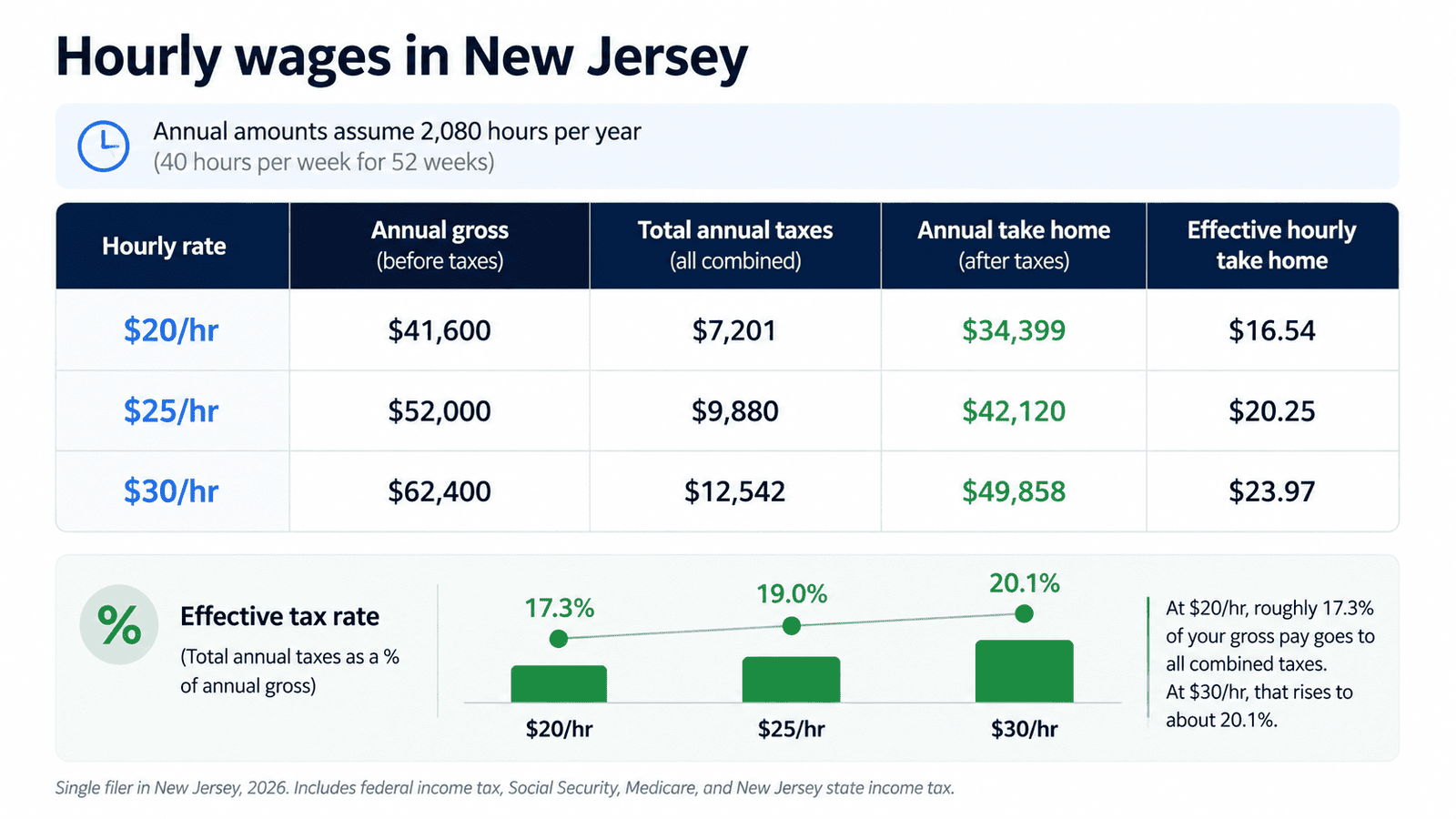
If you are paid hourly, your annual gross income depends on how many hours you work. The standard assumption is 2,080 hours per year (40 hours per week for 52 weeks). Here is what $20, $25, and $30 per hour look like after taxes for a single filer in New Jersey in 2026.
| Hourly rate | Annual gross | Total annual taxes | Annual take home | Effective hourly take home |
|---|---|---|---|---|
| $20/hr | $41,600 | $7,201 | $34,399 | $16.54 |
| $25/hr | $52,000 | $9,880 | $42,120 | $20.25 |
| $30/hr | $62,400 | $12,542 | $49,858 | $23.97 |
At $20 per hour, roughly 17.3% of your gross pay goes to all combined taxes. At $30 per hour, that rises to about 20.1%, primarily because higher earnings push more income into the 12% federal bracket and the 5.525% New Jersey bracket.
How bonuses are taxed in New Jersey
Bonuses in New Jersey are subject to the same taxes as regular wages, but the withholding method usually differs. Most employers use the IRS flat rate method, which for 2026 withholds federal income tax at 22% on supplemental wages up to $1,000,000. Supplemental wages exceeding $1,000,000 in a calendar year are withheld at 37%.
New Jersey treats bonuses as regular wages for state income tax purposes. Your employer withholds NJ state tax based on the applicable withholding table rate, just as it would for any paycheck. FICA taxes also apply to bonus payments at the standard 6.2% Social Security and 1.45% Medicare rates.
For example, a $5,000 bonus paid to a single filer in New Jersey would face approximately:
$5,000 bonus
minus $1,100 federal withholding (22% flat rate)
minus $310 Social Security (6.2%)
minus $72.50 Medicare (1.45%)
minus approximately $276 NJ state withholding (5.525% marginal rate)
= roughly $3,241 net bonus received
The 22% flat withholding rate on bonuses is not a separate tax rate. It is a withholding convenience. When you file your annual return, bonus income is combined with your regular wages and taxed at your actual marginal rate. If your employer overwithheld, you may receive a refund.
Effect of 401(k) and health insurance premiums
Pre tax contributions to a 401(k) or employer sponsored health insurance plan reduce your taxable income for both federal and New Jersey state income tax purposes. This lowers the amount of tax withheld from each paycheck and increases your take home pay relative to what the taxes alone would suggest.
Consider a single filer earning $60,000 who contributes 6% of their salary ($3,600) to a traditional 401(k). Their adjusted federal taxable income drops from $43,900 to $40,300, and their NJ taxable income drops from $60,000 to $56,400. The resulting tax savings are:
Federal savings: $3,600 at the 12% marginal rate equals $432 less in federal income tax per year.
NJ state savings: $3,600 at the 5.525% marginal rate equals roughly $199 less in state income tax per year.
Total annual tax savings: approximately $631, which translates to about $24.27 more per biweekly paycheck.
FICA taxes, however, are not reduced by 401(k) contributions. Social Security and Medicare are calculated on your gross wages before any retirement plan deductions.
Health insurance premiums paid through an employer cafeteria plan (Section 125) work similarly. They reduce both your federal and state taxable income. If you pay $200 per month ($2,400 per year) in pre tax health premiums, you may save an additional $420 or more in combined taxes annually, depending on your bracket. Check the paycheck calculator new jersey before accepting a new salary or hourly wage offer.
How New Jersey compares with neighboring states
Where you live significantly affects your take home pay. Here is how New Jersey stacks up against its four neighboring states for a single filer earning $60,000 in 2026.
| State | Income tax structure | Approximate state income tax on $60,000 | Local income tax |
|---|---|---|---|
| New Jersey | Progressive: 1.4% to 10.75% | $1,823 | None |
| New York | Progressive: 4% to 10.9% | ~$2,510 | NYC residents pay additional 3.078% to 3.876% |
| Pennsylvania | Flat: 3.07% | $1,842 | Yes, local earned income taxes of 1% to 3.75% |
| Delaware | Progressive: 2.2% to 6.6% | ~$2,323 | Wilmington wage tax of 1.25% |
| Connecticut | Progressive: 2% to 6.99% | ~$2,400 | None |
At the $60,000 income level, New Jersey’s state income tax is the lowest among these neighboring states. However, New Jersey has the highest average property tax rate in the nation at roughly 2.47% of assessed home value (source: Tax Foundation, 2026), which is an important consideration for total cost of living even though it does not directly reduce your paycheck. Our paycheck calculator new jersey includes federal, state, and FICA payroll taxes in every estimate.
Frequently asked questions
How much is taken out of my paycheck in New Jersey?
A New Jersey paycheck is subject to federal income tax (10% to 37% depending on your bracket), FICA payroll taxes (7.65%), New Jersey state income tax (1.4% to 10.75%), and small NJ employee contributions for unemployment, disability, family leave, and workforce development insurance. For a single filer earning $60,000, total deductions are approximately $11,928 per year, leaving about $48,072 in annual take home pay.
What is the New Jersey income tax rate in 2026?
New Jersey uses a progressive income tax with seven brackets for single filers. Rates start at 1.4% on taxable income up to $20,000 and rise to 10.75% on income over $1,000,000. The rates for the 2026 tax year are unchanged from the schedule in effect since 2020, as published by the NJ Division of Taxation. Most middle income earners in New Jersey fall into the 5.525% or 6.37% bracket.
How much is $60,000 a year after taxes in New Jersey?
A single filer earning $60,000 in New Jersey in 2026 takes home approximately $48,072 per year after federal income tax ($5,020), FICA ($4,590), NJ state income tax ($1,823), and NJ employee payroll contributions ($495). That works out to about $1,850 per biweekly paycheck or $4,006 per month. These figures assume the standard deduction and no additional pre tax deductions.
How are bonuses taxed in New Jersey?
Bonuses are treated as supplemental wages. For federal withholding purposes, most employers use the flat 22% rate on bonuses up to $1,000,000. New Jersey withholds state income tax on bonuses using the same graduated rate tables as regular wages. FICA applies at the standard 7.65% rate. The final tax owed on your bonus is reconciled when you file your annual return, meaning you may receive a refund if too much was withheld.
How do 401(k) contributions change take home pay in New Jersey?
Traditional 401(k) contributions are made before federal and New Jersey state income taxes are calculated, which reduces your taxable income and the amount of tax withheld. A $60,000 earner contributing 6% ($3,600) to a traditional 401(k) may save roughly $631 per year in combined federal and NJ state taxes. However, FICA taxes still apply to the full gross pay. The contribution effectively means you keep more cash per paycheck while building retirement savings. The paycheck calculator new jersey lets you estimate how pre-tax deductions affect your net pay.
Methodology
All calculations in this article use the following 2026 tax parameters:
Federal income tax brackets and the $16,100 single filer standard deduction come from IRS Revenue Procedure 2025-32, effective for tax year 2026. FICA rates of 6.2% (Social Security, on wages up to $184,500) and 1.45% (Medicare, no wage cap) come from IRS Topic No. 751, 2026 figures. New Jersey state income tax brackets come from the NJ Division of Taxation rate schedules (effective 2020 and after, last updated March 2026). New Jersey employee payroll contribution rates for UI, TDI, FLI, and WF/SWF come from the NJ Department of Labor, calendar year 2026.
Worked examples assume a single filer taking the standard deduction with no dependents, no additional pre tax deductions, and no itemized deductions. Actual take home pay may differ based on your filing status, withholding elections, local tax obligations (if you work in another state), and employer benefit elections. Hourly calculations assume 2,080 working hours per year (40 hours per week, 52 weeks). This article is educational and is not a substitute for professional tax advice.
This content is for educational purposes only and does not constitute personalized financial advice. Consult a qualified financial advisor for guidance specific to your situation.
By Nathan Whitmore for MoneyFN Use the paycheck calculator new jersey to compare take home pay across different salary levels.

Nathan Whitmore is a US based personal finance writer at MoneyFN covering salary, paycheck, and tax math for American workers. He works from primary sources only: IRS revenue procedures, Bureau of Labor Statistics wage data, and Federal Reserve statistics. Every figure he publishes is dated and traceable to a public source.